Flashcards APHG-Full Unit 3 Flash-Cards
 Call Kai
 Learn
 Practice Test
 Spaced Repetition
 Match
 Flashcards
 Knowt Play
1/63

There's no tags or description
Looks like no tags are added yet.
64 Terms
Acculturation
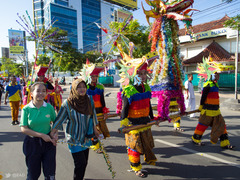
The adoption of cultural traits, such as language, by one group under the influence of another (willingly borrowing traits while keeping original identity, e.g., a foreigner to the U.S. learns English).

Assimilation
When a minority group loses distinct cultural traits, such as dress, food, or speech, and adopts the customs of the dominant culture (can happen voluntarily or by force).

Cultural Diffusion
The spread of cultural beliefs, ideas, and social activities from one group to another; increases globalization (two main types are expansion and relocation diffusion).

Expansion Diffusion
The spread of cultural traits outward from a hearth without relocation or migration (includes stimulus, contagious, and hierarchical diffusion).

Hierarchical Diffusion
The spread of an idea, feature, or trend from one key person or node of authority or power to other persons or places based on a hierarchy of connectedness (e.g., fashion spreading from NYC/Paris/London to medium and smaller cities).

Contagious Diffusion
The rapid, widespread diffusion of ideas or cultural traits outward from a hearth through direct contact or exchange of information (e.g., diseases, viral YouTube videos).

Stimulus Diffusion
The spread of an underlying principle, even though a specific characteristic is modified to fit the local culture (e.g., McDonald's menu adaptations in India, or different companies making voice assistants like Siri and Alexa).

Relocation Diffusion
The spread of an idea or innovation from its hearth through the physical movement of people migrating and taking the idea with them.

Centrifugal Forces
Negative forces within a country that pull states and people apart (e.g., racism, segregation, slavery, conflicting ideologies).

Centripetal Forces
Positive forces within a country that pull states and people together (e.g., nationalism).

Cultural Landscape
Cultural properties that represent the combined works of nature and of humans; a natural landscape that has been modified by human activity (e.g., Carl Sauer, terrace farming).

Material Culture
The tangible, physical items produced and used by members of a specific culture group that reflect their traditions, lifestyles, and technologies (things you can touch).

Non-Material Culture
Cultural aspects of a group that cannot be physically touched, such as beliefs, values, religious ideas, or language traits (e.g., Buddhist philosophy).

Cultural Trait
A single, distinguishing feature of regular occurrence within a culture (e.g., using chopsticks, observing a caste system, or how you greet someone).

Custom
The frequent repetition of an act to the extent that it becomes characteristic of the group of people performing it (e.g., the Haka in Maori culture or bowing in Japanese culture).

Taboo
A restriction on behavior imposed by a social custom (e.g., Amish restrictions on tattoos, or Muslim and Hindu dietary taboos against pork and beef).

Local Culture
Culture traditionally practiced by a small, homogeneous, rural group living in relative isolation from other groups (e.g., the Amish in the U.S. or the Maori in New Zealand).
Global Culture
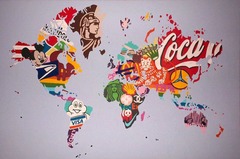
Culture found in large, heterogeneous societies that share certain habits despite differences in personal characteristics; spreads rapidly through technology and increases globalization.
Cultural Relativism
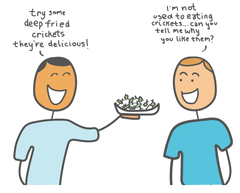
The view that a culture should be judged based on its own standards, not based on the standards of another culture.

Ethnocentrism
Judging other cultures based on the rules and standards of your own culture.

Cultural Convergence
When cultures interact and come into contact with each other, becoming increasingly alike through trade, technology, and communication (could lead to assimilation, acculturation, [Columbian Exchange]).

Cultural Divergence
When cultural groups dissociate from each other to protect or preserve their own culture (e.g., physical barriers, the fall of Yugoslavia).

Cultural Barriers
Prevailing cultural attitudes that render certain innovations, ideas, or practices unacceptable or unadoptable in a particular culture (e.g., language barriers when migrating).

Multiculturalism
When various ethnic groups coexist with one another within a society without having to sacrifice their particular identities.

Syncretism
The blending or combining of elements of two or more cultural traits or belief systems into a new, distinct form.

Syncretic Religion
A religion that combines elements of two or more belief systems (e.g., Shintoism combining Buddhism and Animism, or Voodoo combining Christianity and Indigenous religion).

Hearth
The region or place from which innovative ideas, cultural traits, languages, or religions originate.

Globalization
Actions or processes that involve the entire world and result in making something worldwide in scope, increasing cultural interaction and interconnectedness.

Urbanization
An increase in the percentage and number of people living in urban settlements (cities).

Sequent Occupance
The notion that successive societies leave their cultural imprints on a place, each contributing to the cumulative cultural landscape, toponyms, language, and beliefs (e.g., Chinatown in New York).

Placemaking
Reimagining and reinventing public spaces as the heart or center of a community.

Toponyms
The name of a place, often reflecting that place's history, geography, and culture.

Imperialism
The policy of extending a country's influence through political or military force to areas already developed by indigenous (native) people.

Colonialism
The attempt by one country to establish settlements and impose its political, economic, and cultural principles in another territory.

Indigenous
People native to a specific part or region of the world (e.g., Aztecs, Taínos, Mayans).

Ethnicity
Identity with a group of people who share the cultural traditions of a particular homeland or hearth.

Ethnic Neighborhoods
A voluntary community or area within a city where people of the same ethnicity or culture cluster together to preserve their culture, language, and traditions.

Ethnic Cleansing
The forced removal, elimination, or extermination of an ethnic or racial group from a territory.

Nationalism
Loyalty and devotion to a nationality; a strong sense of national identity that acts as a centripetal force uniting a country.

Diaspora
The forced or voluntary dispersal of a people from their homeland to new places (e.g., the dispersal of Jews from Jerusalem and from Germany following WWII).

Postmodern Architecture
A late-20th-century architectural style that rejects the uniformity of modernism and incorporates diverse historical styles, cultural context, ornamentation, and human-scaled design.

Language Family
A collection of languages related to each other through a common ancestor long before recorded history; the trunk of the language tree (e.g., Indo-European, Sino-Tibetan).

Indo-European Languages
The largest language family, including English and most languages in the Western Hemisphere (includes Germanic, Indo-Iranian, Balto-Slavic, and Romance branches).

Dialects
A regional variation of a language distinguished by vocabulary, spelling, and pronunciation, particular to a specific region or social group.

Lingua Franca
A language mutually understood and commonly used in trade by people who have different native languages (currently English worldwide).

Pidgin
A form of speech that adopts a simplified grammar and limited vocabulary of a lingua franca, used for communication among speakers of two different languages.

Creole
A language that results from the mixing of a colonizer's language with the indigenous language of the people being dominated, developing out of an earlier pidgin stage (e.g., Haitian Creole).

Creolization
The process in which two or more languages or cultures converge and blend to form a new, distinct language or culture.

Endangered Language
A language at risk of falling out of use as its speakers die out or shift to another language (can be revived, like Hebrew, to prevent extinction).

Extinct Language
A language that no longer has any speakers or is no longer in current use.

Universalizing Religions
Religions that seek to convert adherents to their beliefs and appeal to people globally (e.g., Christianity, Islam, Buddhism, Sikhism).

Ethnic Religions
A religion that is particular to one, culturally distinct group of people, is primarily found in one region, and does not actively seek converts (e.g., Hinduism, Judaism, Shintoism).

Monotheism
A belief system in which only one supreme being is revered as creator (e.g., Christianity, Islam, Judaism).

Polytheism
Belief in multiple gods (e.g., Hinduism, Shintoism, Animism).

Hinduism
One of the oldest religions in the modern world, originating in the Indus River Valley; a polytheistic/ethnic religion based on reincarnation and karma with no single founder.

Judaism
A monotheistic/ethnic religion with roots in the teachings of Abraham (from Ur), credited with uniting his people to worship only one God; an example of a religious diaspora.

Buddhism
A universalizing religion founded in the 6th century BCE teaching that enlightenment (Nirvana) comes through self-knowledge, eliminating greed and desire, and non-harm.

Christianity
The world's largest universalizing religion, based on the teachings of Jesus, whom Christians believe is the Son of God placed on Earth to teach how to live according to God's plan.

Protestant
One of the three major branches of Christianity, led by Martin Luther after questioning Catholic Church practices and sparking the Protestant Reformation in 1517.

Denomination
A division or subgroup that diverts away from a larger religious branch (e.g., Anglican, Lutheran, and Presbyterian within Protestantism).

IslamA
The youngest of the major world religions and fastest-growing universalizing religion, based on the teachings of Muhammad (born in Mecca in 571 CE).

Sikhism
A universalizing religion founded by Guru Nanak in Punjab, India during the 15th century, with its sacred site at the Golden Temple.

Shintoism
A polytheistic/syncretic ethnic religion with its hearth in Japan, centered on belief in Kami and ancestor/spirit worship.

Secularism
The indifference to or rejection of formal religion in public and political life.