W9 Contact Materials and Prescribing
 Call Kai
 Learn
 Practice Test
 Spaced Repetition
 Match
 Flashcards
 Knowt Play
1/14

There's no tags or description
Looks like no tags are added yet.
15 Terms
What are options for refractive correction?
Spectacles
Refractive surgery
Contact lenses- soft, RGP, ortho-k
Intra-ocular lenses
Corneal implants
What are the 3 modes of wear?
Conventional wear- wear until worn out
Planned or frequent replacement
Disposables
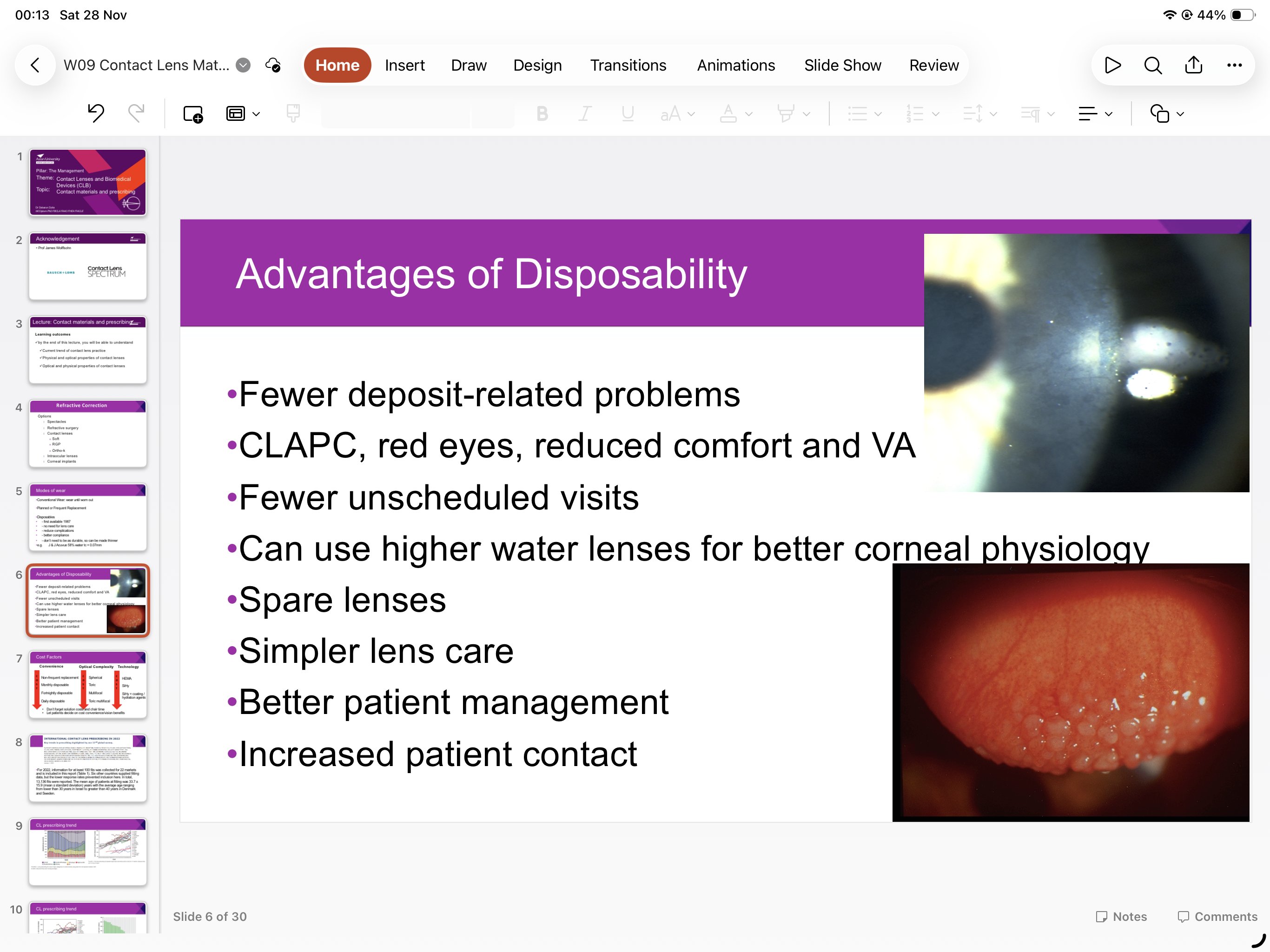
What are advantages of disposable lenses?
Fewer deposit related problems
Simpler lens care
No need to be durable so can be made thinner
Which modes of wear are the most convenient?
Non-frequent replacement
Monthly disposables
Fortnightly disposable
Daily disposable (most costly)
Which mode of wear has the most optical complexity?
Spherical
Toric
Multifocal
Toric multifocal (costly)
Which mode of wear is the most technologically advanced?
HEMA
SiHy
SiHy + coating + hydrating agents
What is the size of the contact lens wear market?
Estimated 4.75 million people in the UK wear CL- largest market in Europe worth over £700 million
Why do 20-50% of contact lens wearers drop out?
Discomfort (50%)
Inconvenience
Cost
Clinical complications
How do you calculate oxygen permeability?
P=Dk where D is the diffusion coefficient (cm2/s) and k is the solubility coefficient of oxygen in a given material
What are limitations of contact lenses?
Fewer degrees of freedom in lens design
Narrow range of refractive indices
Flexible lens shape determined by conformance to corneal shape
What are average refractive indices?
Tears- 1.336
Cornea- 1.376
Keratometry- 1.3375
What is accommodative demand in Hyperopes?
Accommodative demand when wearing CL is less than when wearing spectacles
What is accommodative demand in myopes?
Accommodative demand wearing CL is greater than when wearing spectacles
Who is prioritised when switching to CL?
Myopes- Hyperopes may be postponed
How do aberrations occur?
Higher spectacle rx and larger the lens, greater the oblique astigmatism, distortion, TCA and curvature of field
Pin cushion for Hyperopes, barrel distortion for myopes