Money demand and supply
 Call Kai
 Learn
 Practice Test
 Spaced Repetition
 Match
 Flashcards
1/15

There's no tags or description
Looks like no tags are added yet.
Name | Mastery | Learn | Test | Matching | Spaced | Call with Kai | Chat |
|---|
No analytics yet
Send a link to your students to track their progress
16 Terms
Money demand
The desire to hold liquid assets for transactions, savings, and precautionary purposes, influenced by interest rates and income.
Money supply
The total amount of money available in an economy at a specific time, including cash, coins, and balances held in bank accounts.
Transaction demand for money
The need for money to facilitate everyday transactions, such as buying goods and services, which varies with income levels and price changes.
Asset demand for money
The demand for money held as a store of value, influenced by interest rates and expectations about future income, rather than immediate transactions.
Money demand and supply curves
Understand the relationships present. What happens if the money supply is increased/decreased?

Shifters of money demand: Increase in the price level
People will need more money for transactions due to an increase in the general price of goods/services.
Shifters of money demand: Increase in consumer incomes
As consumer incomes rise, individuals tend to increase their spending, leading to a higher demand for money for transactions.
Shifters of money demand: Increase in technology
Can either increase or decrease money demand. ATMs reduced transaction costs and increased money demand, debit cards have reduced the need for cash on hand and reduced money demand.
If interest rates are above equilibrium….
people will save more and want less money on hand. (the opportunity cost of holding money will increase)
If interest rates are below equilibrium…
people will save less, borrow more, and hold more cash on hand.
If the price level is above equilibrium…
people will demand less money because the purchasing power of cash is reduced.
If the price level is below equilibrium…
people will want to hold less money on hand because purchasing power of existing cash on hand has increased.
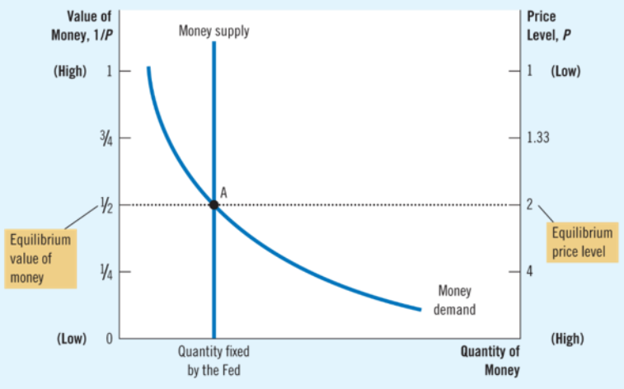
Value of money and price level
1/P is the inverse of the price level, representing the purchasing power of money.
Value of money and price level graph
Understand what happens to both the value of money and the price level when the money supply increases/decreases.
Quantity Equation
MV=PY, where M is the money supply, V is the velocity of money, P is the price level, and Y is the real output.
If there was an increase in the money supply and the price level and velocity of money remain constant….
Y (or GDP) would have to increase.