Nursing Foundations - Test 3
 Call Kai
 Learn
 Practice Test
 Spaced Repetition
 Match
 Flashcards
 Knowt Play
1/71

There's no tags or description
Looks like no tags are added yet.
72 Terms
Why is understanding culture essential to being a nurse?
You will be working with people from various cultures.
Learning helps with teaching, supervising, and role modeling culturally competent care.
What are barriers to culturally competent care?
Bias, discrimination, racism, sexism, language barrier, lack of knowledge.
T or F: Certain cultures have their own health related issues due to genetics, SES, lifestyle, and nutrition.
T — educating yourself on this can help you educate your clients for disease prevention and wellness and identify early signs/symptoms of a disease.
What is cultural competency in nursing care?
Enabling of nurses to deliver services that are respectful of and responsive to the health beliefs, practices, and cultural/linguistic needs of diverse patients.
Why is valuing a patient’s unique needs important?
It improves overall safety and quality of care, helps to eliminate healthcare disparities.
To provide better culturally competent care, it is important to understand non-verbal behaviors that differ between culture, such as…
Tone of voice, touch, eye contact, use of space.
What devices can we use to speak to a client with a different language?
Interpreter/translator
MUST BE FACILITY-APPROVED.
Internet and computer translation software.
To perform culturally competent care, remember BALI.
Be aware of your biases.
Appreciate client’s culture.
Learn about culture.
Incorporate culture into care.
(short version): Be aware, Appreciate, Learn, Incorporate.
Q: The most important concept about vulnerable subcultures guiding nursing care is that persons belonging to these groups…
Often have limited access to healthcare.
Q: The student nurse is assigned an undocumented immigrant injured while crossing the boarder into the U.S. The student tells you, “I do not know what to put for race and he probably can’t tell me.” What is your best response?
Let’s discuss approaches to obtaining data on race from patients.
Helps student find approaches / helps them develop culturally competent care.
What is the best way to provide culturally competent care when it comes to language services?
A professional medical interpreter or translator.

What are the 6 links of the chain of infection?
Infectious agent.
Reservoir.
Portal of exit.
Mode of transmission.
Portal of entry.
Susceptible host.
T or F: All 6 links of the chain must be present for the infection to be transmitted between individuals.
T.
What is the first link? What is an example of it?
Infectious agent.
Ex. pathogen.
What is an infection?
The invasion and multiplication in the body by a pathogen.
Types of flora mentioned? (think of microbiology).
Transient flora: microbes picked up via contact w/ objects and people; removed by handwashing.
Resident flora: live deep in skin layers, live and multiply harmlessly.
Permanent inhabitants, not dangerous unless they enter deep tissues.
What 4 factors determine whether a person develops an infection once a pathogen enters the host?
1. Virulence of the organism (power to cause disease).
2. Number of organisms (more = more likely to cause disease).
3. Host environment (ability of organism to thrive).
4. Host defense (ability to prevent infection).
What is the reservoir chain?
A source of infection / place where pathogens survive and multiply.
Usually the human body; can also include animals, insects, environmental surfaces, food, etc.
What environments do pathogens thrive in?
Warm, moist, dark environments.
Explains why the human body is such a common reservoir.
Relating to reservoir, what is a carrier?
An asymptomatic person who is able to defend themselves from the disease, but still harbors the pathogen and passes it on to others.
What is the portal of exit link?
How a pathogen exits the body and passes onto others.
Body naturally wants to get rid of pathogen → coughing, sneezing, diarrhea.
Can also exit via wounds, bites, drainage tubes, and puncture sites.
What is the most frequent portal of exit in human and animal reservoirs?
Body fluids.
For an infection to spread it must exit the _____.
Reservoir.
What is the mode of transmission link?
How the pathogen travels into a new host.
Ex. direct contact, indirect contact (fomite), droplet transmission, airborne transmission, vector.
On the previous flashcard, the word “fomite” was mentioned as a way of indirect contact. What is a fomite?
An object that transfers a pathogen.
Ex. keyboard, stethoscope, eyeglasses, phones, shoes.
What is a vector?
An organism that carries a pathogen to a susceptible host.
Ex. mosquito, ticks, and fleas.
What is a portal of entry (5th link)?
Openings pathogens are able to use to enter a new host.
Normal body openings.
Abnormal body openings.
What is a susceptible host (6th link)?
A person who is at risk for infection because of inadequate defense against invading pathogen.
Specific factors increase susceptibility.
Age.
Compromised immune system,
Immune deficiency condition.
Classifications of infections: local vs. systemic.
Local: limited to one region of the body.
Systemic: pathogens invade blood/lymph and spread throughout the body.
Classifications of infections: Primary vs Secondary infections.
Primary: first infection.
Secondary: infection that occurs during or after the primary infection, while the immune system is recovering.
Classifications of infections: Health-related infections, what are exogenous and endogenous infections?
Exogenous: acquired from the healthcare environment.
Endogenous: pathogen arises from the patient’s normal flora.
Surgical site infections, [chemotherapy, antibiotics] → multiplication of harmless microbes which can cause infection.
What type of techniques help reduce exogenous and endogenous infection risks in healthcare?
Aseptic techniques, techniques with the purpose of eliminating/reducing pathogens and their transfer.
Handwashing, sterile equipment, disinfecting, etc.
What is another name for healthcare-related infections?
Nosocomial infections.
Classifications of infections: Compare acute, chronic, and latent infections.
Acute: Rapid onset of short duration (e.g. common cold).
Chronic: Slow development, long duration (e.g. osteomyelitis).
Latent: Infection present with no discernible symptoms (e.g. HIV/AIDS).
Name all of the classification of infections we went over.
Local.
Systemic.
Primary.
Secondary.
Exogenous.
Endogenous
Acute.
Chronic.
Latent.
Q: A client living with AIDS develops oral hairy leukoplakia, an infection caused by the Epstein=Barr virus. The leukoplakia is considered a:
Secondary infection.
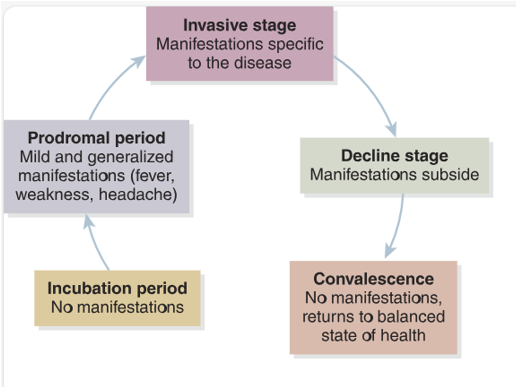
What are the stages of infection?
Incubation.
Prodromal.
Invasive.
Decline.
Convalescence.
What occurs during the incubation stage of infection?
The person shows no symptoms but is capable of infecting others, lasts a few days.
What occurs during the prodromal stage of infection?
An infected person may experience minor symptoms; not all diseases have this stage.
What happens during the invasive stage of infection?
Signs and symptoms are present, if a person is immunocompromised this stage can end in death.
What happens during the decline stage of infection?
Immune defenses/medical therapies reduce the number of pathogens, which causes signs and symptoms to fade.
What occurs during the convalescence stage of infection?
Tissue repair with return to health, remaining number of pathogens approaches zero.
The body has 3 lines of defense against infectious diseases. What are they?
Primary defense: anatomical features.
Secondary defense: protective biochemical processes that fight pathogens that enter.
Tertiary defense: presence of pathogens activates immune response against specific, recognized invaders.
Care is highly specialized and usually extended over a long period of time.
What are some examples of the body’s primary defenses?
Normal flora.
Skin.
Mouth.
Eyes.
Respiratory tract.
Gastrointestinal tract.
Genitourinary tract.
What are some examples of the body’s secondary defenses?
Processes activated in response to cell/tissue breakdown.
Phagocytosis.
Complement Cascade (blood proteins triggering release of chemical that attack pathogens).
Inflammation.
Fever.
What are some examples of tertiary defense?
Active immunity (antibodies made by body).
Passive immunity (antibodies from other source).
Specific immunity (recognition from past encounter).
Tertiary defenses: what are humoral and cell-mediated immune responses?
Humoral immune response (antibody-mediated): protects the body by circulating antibodies to fight pathogens; producing WBC’s.
Cellular (cell-mediated): acts directly to destory infection-causing pathogens w/o using antibodies by activating phagocytes and T cells.
What are the four different types of T cells that play a role in fighting infections?
Cytotoxic (killer) T cells.
Helper T cells.
Memory T cells.
Suppressor T cells.
Why are children more susceptible to hosting pathogens?
Immature immune systems and limited exposure to pathogens.
What are some examples of factors that increase host susceptibility?
Age.
Break in body structures.
Illness.
Chronic disease.
Smoking.
Substance abuse.
Multiple sex partners.
Medications that inhibit/decrease immune response.
NSAID’s.
What is medical asepsis?
Procedures that decrease the potential for the spread of infections.
e.g. hand hygiene, environmental cleanliness, precautions, protective isolation.
Patient safety is heavily depended on medical asepsis.
What medical asepsis technique is the most important for preventing infection?
Hand hygiene.
How long should you wash your hands for?
at least 15 seconds in nonsurgical settings; 2-6 mins in surgical settings.
Hand-washing is very important and emphasized by the slides. Remember these:
Handwashing helps remove spores, unlike alcohol-based solutions.
Remove jewelry.
Wash beneath fingernails.
Use warm water, not hot.
Apply soap to wet hands.
Use friction.
Rinse Soap.
Towel or hand dry.

Q: Which of the following actions violates a principle that is key to proper handwashing at bedside?
B. Shaking your hands dry over the sink.
Explanation: will not completely remove moisture, allowing for the reacquisition of bacteria.
What are the 5 critical principles of “building a safer health system” given by the Institute of Medicine (IOM)?
Provide leadership.
Recognize human limits in process design.
Promote effective team functioning.
Anticipate the unexpected.
Create a learning environment.
What are some safety hazards at home?
Poisoning (#1 cause of accidental death).
Carbon monoxide.
Fire.
Guns.
Burns.
Suffocation.
Take-home toxins.
Falls.
To maximize safety, nurses must prevent…
access or exposure to potential hazards.
What are some factors that increase the risk of falls at home?
Environmental factors:
Slippery floors.
Lack of grab bars.
Low toilet seats.
High beds.
People age 65+ most at risk.
What are some health issues that increase fall risk?
Poor vision.
Hypotension.
History.
Dizziness, pain.
Alcohol use.
Cognitive impairment.
Polypharmacy.
Arthritis.
Gait or balance deficits.
What can help prevent falls at home?
Nonskid shoes.
Proper lighting.
Grab bars.
No scatter rugs.
Tidy clothes.
What are some safety hazards present in communities?
Pollution.
Weather hazards.
Pathogens.
MVA’s.
What is alarm fatigue? How does it increase the risk of injury in healthcare facilities?
A state of sensory overload and desensitization, nurses begin ignoring alarms or do not hear them (a lot of them are unnecessary) leads to accidents.
What are safety hazards that can contribute to risk in healthcare?
Falls.
Alarm fatigue.
Fire and electrical hazards.
Restraints.
Physical or chemical.
Chemical exposure.
Biological hazards (infectious).
What are sentinel events?
Healthcare-acquired unexpected complications that can cause serious injury or death.
How can a root cause analysis (RCA) help with future sentinel events?
Analyze errors with 3 simple questions:
What happened?
Why did it happen?
What can be done to prevent it from happening again?
Helps reduce future risk.
What are some elements that promote a culture of safety within a nursing environment?
Team empowerment.
Every individual feels heard, important, and is valued as a team member for their contributions offered.
Communication.
Open and honest communication between team members.
Transparency.
Team members united in their efforts to eliminate rumors and operate with facts.
Accountability
Staff claim ownership for error, willing to disclose.
What are the different types of unexpected events that occur in a healthcare setting?
Near miss: potential error/event that could cause harm but was caught and avoided.
Client safety event: unexpected event that occurred w/o injury to the client but could have caused harm.
Sentinel event: Serious unexpected event that causes severe physical or psychological harm to a client (e.g. death, dismemberment, or permanent injury).
What are some factors that cause risks for healthcare workers?
Back injury (from bending/twisting/lifting).
Needlestick injury (risk for infectious diseases including aids).
Radiation injury (from CT/PET scans, exposed to small doses).
Violence (patient/visitor/staff abuse resulting from anger and stress).
What can help promote safety in healthcare facilities?
Fall assessment and prevention programs.
Comprehensive alarm management programs.
Chair/bed alarms.
Programs to heighten awareness and prevent violence.
Proper storage of hazardous substances.

Q: How would you, as the nurse, support a culture of safety? Select all that apply.
A. Completing incident reports when appropriate.
B. Completing incident reports for a near miss.
C. Communicating product concerns to an immediate supervisor.
D. Identifying the person responsible for an incident.
Done
Done