Bio, unit 4, PART 2

0.0(0)
Studied by 0 people
call kaiCall Kai
learnLearn
examPractice Test
spaced repetitionSpaced Repetition
heart puzzleMatch
flashcardsFlashcards
GameKnowt Play
Card Sorting

1/81

encourage image

There's no tags or description

Looks like no tags are added yet.

82 Terms

1
New cards

What do transcription and translation look like in prokaryotes?

Transcription and translation occur simultaneously, in the same place too(no nuclear envelope)

Multiple polypeptides encoded by one mRNA (polycistronic)

Emphasis on speed and energy conservation

2
New cards

What are polycistronic transcripts?

Prokaryotes are in a hurry; efficient

Polycistronic transcripts -1 mRNA can encode multiple polypeptides multiple proteins

This always helps them to adapt to their environment quickly

3
New cards
4
New cards

What do transcription and translation look like in eukaryotes?

Where does transcription occur, and where does translation occur?

Focus on regulation in eukaryotes

Transcription in nucleus

Translation in cytoplasm

Limited to one polypeptide per mRNA (monocistronic)

Emphasis on regulation in time and space

5
New cards

what are operons?

Operons contain multiple genes that are all a part of a similar biochemical process 

  • Same common regulatory mechanism 

A single promoter that controls multiple gene transcripts.

An operon is a way bacteria can organize genes that are involved in a similar biochemical process to maximize efficiency and establish a common regulatory mechanism.

An operon in how bacteria can regulate multiple related genes simultaneously.

<p><span style="background-color: transparent;"><strong>Operons</strong> contain multiple genes that are all a part of a similar biochemical process&nbsp;</span></p><ul><li><p><span style="background-color: transparent;">Same common regulatory mechanism&nbsp;</span></p></li></ul><p><span style="background-color: transparent;">A single promoter that controls multiple gene transcripts.</span></p><p><span style="background-color: transparent;">An <strong>operon</strong> is a way bacteria can organize genes that are involved in a similar biochemical process to maximize efficiency and establish a common regulatory mechanism.</span></p><p><span style="background-color: transparent;">An operon in how bacteria can regulate multiple related genes simultaneously.</span></p>
6
New cards

why do bacteria need operons?

Bacteria especially need to respond quickly to changes in the environment and cellular needs.

Bacteria live in a highly competitive world.

An operon is a way bacteria can organize genes that are involved in a similar biochemical process to maximize efficiency and establish a common regulatory mechanism.

7
New cards

what does polycistronic mean?

Often a single transcript (mRNA) will have multiple translation start sites for multiple genes. 

This is called polycistronic.

8
New cards

Operon structure: What is the promoter? what is the operator?

Promoter – RNA polymerase binds (-10, -35, σ Factor, etc.).

Operator – where a repressor protein binds to prevent transcription.

9
New cards

Operon structure: what is an enchancer or silencer?

Enhancer or Silencer – upstream or downstream DNA sequences that can increase or decrease transcription.

10
New cards

what is the order of the operon structure?

Note the Sequence elements – promoter, operator, enhancer, silencer- and the proteins: repressors, activators 

11
New cards

What is negative vs. positive transcription regulation?

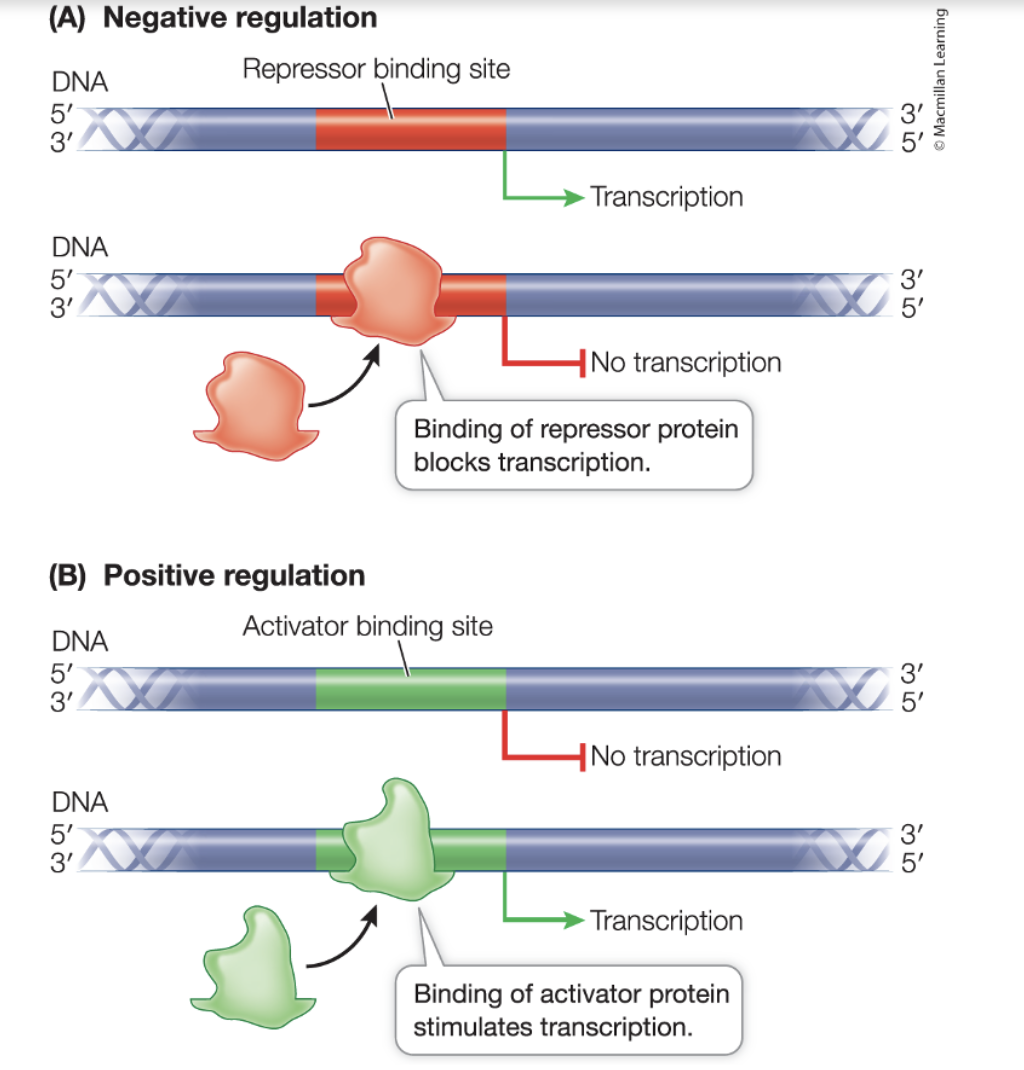
1: negative-negative regulations(protein binds to repressor sequence and stops the RNA polymerase from access the sequence) 

2: positive– proteins bind to activating sites, makes it easier for RNA polymerase to bind 

Proteins that bind to DNA can either promote or prevent transcription by positive or negative regulation
<p><span style="background-color: transparent;">1: <strong>negative</strong>-negative regulations(protein binds to repressor sequence and stops the RNA polymerase from access the sequence)&nbsp;</span></p><p><span style="background-color: transparent;">2: <strong>positive</strong>– proteins bind to activating sites, makes it easier for RNA polymerase to bind&nbsp;</span></p><p><span style="background-color: transparent;">Proteins that bind to DNA can either promote or prevent transcription by positive or negative regulation</span></p>
12
New cards

what is allosteric vs. transcriptional regulation?

Allosteric regulation: regulation of enzyme activity(end product inhibits the enzyme that started the pathway) 

Transcription regulation: inhibiting the DNA that encodes these enzymes 

  • The end product inhibits all the genes that encode for the enzymes 


<p><span style="background-color: transparent;"><strong>Allosteric regulation: </strong>regulation of enzyme activity(end product inhibits the enzyme that started the pathway)&nbsp;</span></p><p><span style="background-color: transparent;"><strong>Transcription regulation:</strong> inhibiting the DNA that encodes these enzymes&nbsp;</span></p><ul><li><p><span style="background-color: transparent;">The end product inhibits all the genes that encode for the enzymes&nbsp;</span></p></li></ul><p></p>
13
New cards

what is the trp operon?

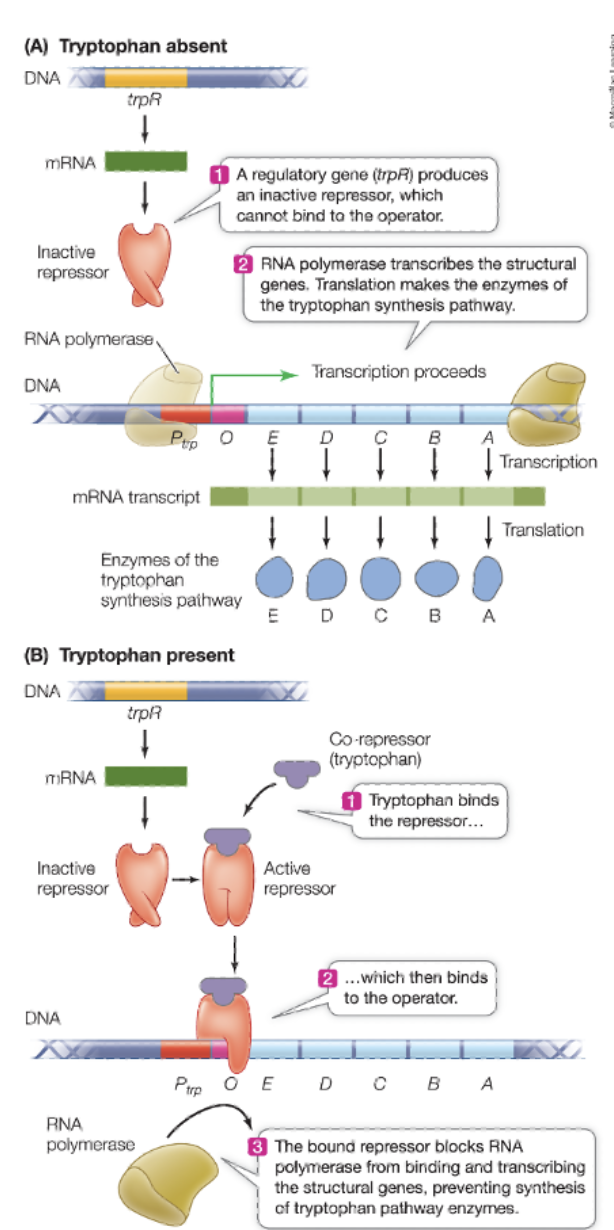
Tryptophan is an essential(all organisms need it) amino acid that is required to make protein

  • In this example, a lack of tryptophan can stimulate the genes required to make it (anabolic reaction), while excess tryptophan will turn the operon off.  

They will need to produce it if they are running low but also, don't make it if you don't need it)
<p><span style="background-color: transparent;">Tryptophan is an essential(all organisms need it) amino acid that is required to make protein</span></p><ul><li><p><span style="background-color: transparent;">In this example, a lack of tryptophan can stimulate the genes required to make it (anabolic reaction), while excess tryptophan will turn the operon off.&nbsp;&nbsp;</span></p></li></ul><p><span style="background-color: transparent;">They will need to produce it if they are running low but also, don't make it if you don't need it)</span></p>
14
New cards

What is the lac operon?

—The lac operon regulates lactose metabolism(catabolic) 

—While lactose is a sugar and a good source of energy for bacteria, it is not the preferred source.  

—Sugars like glucose are better than lactose because they are easier to metabolize.

—To make sure lactose transport and metabolism is secondary to glucose, bacteria have clever regulatory mechanisms

<p><span style="background-color: transparent;">—The lac operon regulates lactose metabolism(catabolic)&nbsp;</span></p><p><span style="background-color: transparent;">—While lactose is a sugar and a good source of energy for bacteria, it is not the preferred source.&nbsp;&nbsp;</span></p><p><span style="background-color: transparent;">—Sugars like glucose are better than lactose because they are easier to metabolize.</span></p><p><span style="background-color: transparent;">—To make sure lactose transport and metabolism is secondary to glucose, bacteria have clever regulatory mechanisms</span></p>
15
New cards

why is the lac operon different from the trp operon

The lac operon is different from the Trp operon because it is a catabolic process to break down lactose when needed

Three genes are needed for the transport and metabolism of lactose. 

16
New cards

What happens in the lac operon if lactose is absent?

You would not metabolize lactose if there were none 

In this case, the bacteria do not want to waste energy, so the repressor blocks transcription

<p><span style="background-color: transparent;">You would not metabolize lactose if there were none&nbsp;</span></p><p><span style="background-color: transparent;">In this case, the bacteria do not want to waste energy, so the repressor blocks transcription</span></p>
17
New cards

What happens in the lac operon if lactose is present?

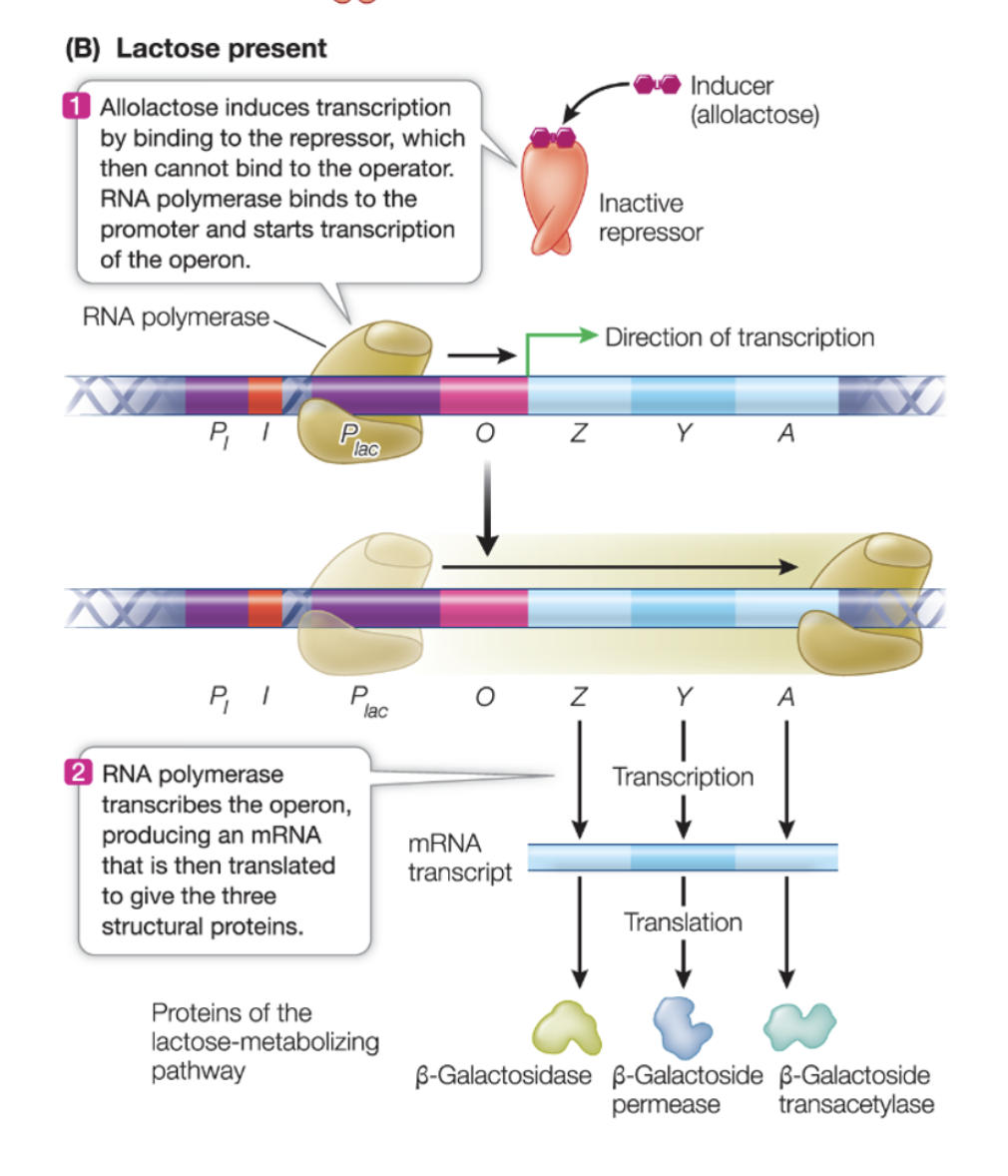
Let's break it down; transcription should go forward 

When bound to the small molecules, it falls off, and allows transcription 
<p><span style="background-color: transparent;">Let's break it down; transcription should go forward&nbsp;</span></p><p><span style="background-color: transparent;">When bound to the small molecules, it falls off, and allows transcription&nbsp;</span></p>
18
New cards

what is the lac reproessor on the lac operon?

The lac repressor is encoded upstream of the lac operon by the gene called lac I.

  • A repressor will bind to and negatively regulate the lac operon unless lactose is present; then the repressor will fall off and transcription will occur.  In this case, lactose is acting as an inducer (induces gene expression by removing the repressor) 


19
New cards

lac operon: low glucose and high lactose:

Low glucose and low lactose: bacteria are hungry and see lactose, so they eat it. They allow transcription; this is when transcription is highest 

<p><span style="background-color: transparent;">Low glucose and low lactose: bacteria are hungry and see lactose, so they eat it. They allow transcription; <strong>this is when transcription is highest&nbsp;</strong></span></p>
20
New cards

Lac operon: high glucose and no lactose

High glucose, no lactose– not hungry and no points in transcription; the activator protein has not been activated; the repressor is bound  

<p><span style="background-color: transparent;">High glucose, no lactose– not hungry and no points in transcription; the activator protein has not been activated; the repressor is bound&nbsp;&nbsp;</span></p>
21
New cards

Lac operon: low glucose and no lactose

Low glucose, no lactose, hungry bacteria; the activator protein is bound. But when RNA polymerase gets there, the repressor is blocking it. The repressor wins 

<p><span style="background-color: transparent;">Low glucose, no lactose, hungry bacteria; the activator protein is bound. But when RNA polymerase gets there, the repressor is blocking it. The repressor wins&nbsp;</span></p>
22
New cards

lac operon: high gluocse and high lactose

High glucose, high lactose–the bacteria are not hungry but not turning their noses to lactose. Low levels of transcription 

<p><span style="background-color: transparent;">High glucose, high lactose–the bacteria are not hungry but not turning their noses to lactose. Low levels of transcription&nbsp;</span></p>
23
New cards

What is a riboswitch?

it is used for post-transcriptional regulation (before translation)

Bacteria can also regulate gene expression post-transcriptionally.

mRNA not only contains information about protein synthesis, but it can also act as a structural molecule.  RNA can base pair with itself and form a 3D shape.

The 3D shape of RNA may help with its own translation, or block ribosomes and prevent its own translation.  

This regulation can also be done with the help of a small molecule such as a negative or positive feedback molecule. 

  • Such RNA structures are called Riboswitches.


24
New cards

What does a riboswitch structure that causes termination before transcription is complete look like?

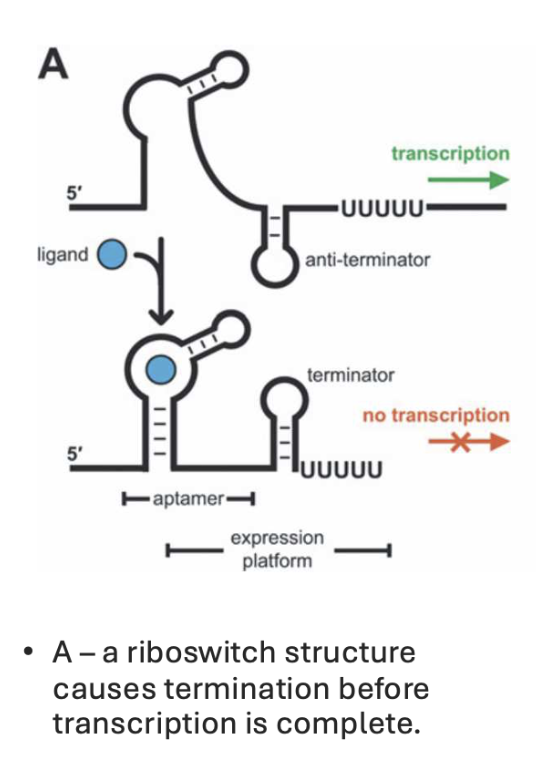
A – a riboswitch structure causes termination before transcription is complete.

  • Anti-terminator loop→ going forward with transcript 

  • If a small ligand binds to RNA, it creates a different loop

  • This new loop eliminates the anti-terminator; it is not a real terminator 

  • Expression STOPS

negative feedback

<p><span style="background-color: transparent;">A – a riboswitch structure causes termination before transcription is complete.</span></p><ul><li><p><span style="background-color: transparent;">Anti-terminator loop→ going forward with transcript&nbsp;</span></p></li><li><p><span style="background-color: transparent;">If a small ligand binds to RNA, it creates a different loop</span></p></li><li><p><span style="background-color: transparent;">This new loop eliminates the anti-terminator; it is not a real terminator&nbsp;</span></p></li><li><p><span style="background-color: transparent;">Expression STOPS</span></p></li></ul><p>negative feedback </p>
25
New cards

What does a riboswitch structure that prevents ribosome binding look like?

B – a riboswitch prevents ribosome binding.

  • When a ligand binds, it forms a new structure in the RNA 

  • Does not allow the ribosome to bind to the ribosome binding site 

negative feedback

<p><span style="background-color: transparent;">B – a riboswitch prevents ribosome binding.</span></p><ul><li><p><span style="background-color: transparent;">When a ligand binds, it forms a new structure in the RNA&nbsp;</span></p></li><li><p><span style="background-color: transparent;">Does not allow the ribosome to bind to the ribosome binding site&nbsp;</span></p></li></ul><p>negative feedback </p>
26
New cards

How do bacteriophages infect bacteria and have timed expression?

Set up their genes to have timed expression 

  • The early genes hijack the RNA polymerase inside the bacteria

  • The early genes can bind to the later genes and activate them 

  • Transcription and translation of the earlier genes must come before the later genes  


<p><span style="background-color: transparent;">Set up their genes to have timed expression&nbsp;</span></p><ul><li><p><span style="background-color: transparent;">The early genes hijack the RNA polymerase inside the bacteria</span></p></li><li><p><span style="background-color: transparent;">The early genes can bind to the later genes and activate them&nbsp;</span></p></li><li><p><span style="background-color: transparent;">Transcription and translation of the earlier genes must come before the later genes&nbsp;&nbsp;</span></p></li></ul><p></p>
27
New cards

What are the lytic vs. lysogenic bacteriophage cycles?

In the lytic cycle, viruses destroy the host cells and only make more viruses

  • In the lysogenic cycle, the phage DNA is integrated into the host cell genome, and the cell can divide and may also eventually enter the lytic cycle.  

  • Lytic cycle–breaking open

Integrate their genome into the genome of the host; the bacteria can then divide and grow

Then switches over to lytic

<p><span style="background-color: transparent;">In the lytic cycle, viruses destroy the host cells and only make more viruses</span></p><ul><li><p><span style="background-color: transparent;">In the lysogenic cycle, the phage DNA is integrated into the host cell genome, and the cell can divide and may also eventually enter the lytic cycle.&nbsp;&nbsp;</span></p></li></ul><ul><li><p><span style="background-color: transparent;">Lytic cycle–breaking open</span></p></li></ul><p>Integrate <span style="background-color: transparent;">their genome into the genome of the host; the bacteria can then divide and grow</span></p><p><span style="background-color: transparent;">Then switches over to lytic</span></p>
28
New cards

How is gene expression determined by compaction of chromatin? modifiying enzymes

If the chromatin is dense and compact, it prevents gene expression 

Loose and open up→it can occur 

  • There are chromatin-modifying enzymes that can either open the structure up or make it more compact 

  • Many of these enzymes do it some by modifying histones, the histone tail, to be exact 

  • But also modify DNA directly


29
New cards

what are chromatine modifiying enzymes?

Chromatin-modifying enzymes provide initial control of gene expression by making a region of DNA either more or less able to bind the transcription machinery

  • Histone tails (acetylation and de-acetylation)

  • DNA nucleotide in the double helix DNA (methylation and de-methylation)


30
New cards

What is epigenetic inheritance?

Chromatin modifications do not alter DNA sequence(not even protein sequences) 

DNA modifications are passed on to future generations of cells (long-term, not temporary) 

The inheritance of traits transmitted by mechanisms not directly involving the nucleotide sequence is called epigenetic inheritance

Epigenetic refers to altering gene expression without altering the DNA.  It roughly translates to ‘above or on top of the genes.’  Some of these can be reversible, while others can be so permanent they are passed on from one generation to the next. 

31
New cards

how are histones modified? (histone acetylation)

The easiest epigenetic alteration to understand is that of histone acetylation.  DNA has a negative charge, and histones have a positive charge due to basic amino acids like lysine (+)

  • This + and – interaction means DNA is tightly bound to histones

  • If lysine amino acids are acetylated (chemically modified) that + charge is neutralized and now the DNA and histones have a much weaker interaction

  • A weaker interaction means less compact chromatin and more access to transcription factors – so more gene expression

  • Less acetylation means more compact chromatin and less transcription.  


<p><span style="background-color: transparent;">The easiest epigenetic alteration to understand is that of histone acetylation.&nbsp; DNA has a negative charge, and histones have a positive charge due to basic amino acids like lysine (+)</span></p><ul><li><p><span style="background-color: transparent;">This + and – interaction means DNA is tightly bound to histones</span></p></li><li><p><span style="background-color: transparent;">If lysine amino acids are acetylated (chemically modified) that + charge is neutralized and now the DNA and histones have a much weaker interaction</span></p></li><li><p><span style="background-color: transparent;">A weaker interaction means less compact chromatin and more access to transcription factors – so more gene expression</span></p></li><li><p><span style="background-color: transparent;">Less acetylation means more compact chromatin and less transcription.&nbsp;&nbsp;</span></p></li></ul><p></p>
32
New cards

what is heterochromatin vs euchromatin?

  • Compact DNA is called Heterochromatin and is transcriptionally inactive.

    • Heterochromatin is darker in electron microscopy because it is denser and cannot be accessed by transcription factors. Compact 

  • Less compact DNA is called Euchromatin and is transcriptionally active.

    • The euchromatin is lighter in color because it is less dense and can be accessed by transcription factors.  Useful! It is useful bc it can be transcribed


<ul><li><p><span style="background-color: transparent;">Compact DNA is called Heterochromatin and is transcriptionally inactive.</span></p><ul><li><p><span style="background-color: transparent;"><strong>Heterochromatin</strong> is darker in electron microscopy because it is denser and cannot be accessed by transcription factors. Compact&nbsp;</span></p></li></ul></li><li><p><span style="background-color: transparent;">Less compact DNA is called Euchromatin and is transcriptionally active.</span></p><ul><li><p><span style="background-color: transparent;">The <strong>euchromatin</strong> is lighter in color because it is less dense and can be accessed by transcription factors.&nbsp; Useful! It is useful bc it can be transcribed</span></p></li></ul></li></ul><p></p>
33
New cards

what is DNA methylation?

Direct methylation of DNA

DNA itself can be directly modified by methylation at CpG islands

  •  Methylation makes DNA transcriptionally inactive

  • These types of modifications can persist through multiple generations of people, as seen in descendants of people who experienced starvation conditions.  


<p><span style="background-color: transparent;">Direct methylation of DNA</span></p><p><span style="background-color: transparent;">DNA itself can be directly modified by methylation at CpG islands</span></p><ul><li><p><span style="background-color: transparent;">&nbsp;Methylation makes DNA transcriptionally inactive</span></p></li><li><p><span style="background-color: transparent;">These types of modifications can persist through multiple generations of people, as seen in descendants of people who experienced starvation conditions.&nbsp;&nbsp;</span></p></li></ul><p></p>
34
New cards

how does DNA methylation effect bees?

Methylation levels in bees can determine if they will become queen bees or worker bees. 

Regular bee: normal DNA methylation 

If we take a bee larva and inhibit DNA methylation, we end up with a larger bee 

<p><span style="background-color: transparent;">Methylation levels in bees can determine if they will become queen bees or worker bees.&nbsp;</span></p><p><span style="background-color: transparent;">Regular bee: normal DNA methylation&nbsp;</span></p><p><span style="background-color: transparent;">If we take a bee larva and inhibit DNA methylation, we end up with a larger bee&nbsp;</span></p>
35
New cards

What are general transcription factors? (transcription regulation in eukaryotes)

General transcription factors are needed for all promoters

  • Sometimes called ‘basal transcription factors’ which are the first level of factors

  • If you want the basic amount, you need the general factors 


<p><span style="background-color: transparent;"><strong>General transcription factors </strong>are needed for all promoters</span></p><ul><li><p><span style="background-color: transparent;">Sometimes called ‘basal transcription factors’ which are the first level of factors</span></p></li><li><p><span style="background-color: transparent;">If you want the basic amount, you need the general factors&nbsp;</span></p></li></ul><p></p>
36
New cards

What is TFIID? (transcription regulation in eukaryotes)

TFIID binds first (kinda like sigma factor in bacteria)

At transcription initiation, the protein that binds first is TFIID 

  • Parallel to the sigma factor, it recognizes DNA sequence

  • Other proteins bind following TFIID


<p><span style="background-color: transparent;"><strong>TFIID</strong> binds first (kinda like sigma factor in bacteria)</span></p><p><span style="background-color: transparent;">At transcription initiation, the protein that binds first is TFIID&nbsp;</span></p><ul><li><p><span style="background-color: transparent;">Parallel to the sigma factor, it recognizes DNA sequence</span></p></li><li><p><span style="background-color: transparent;">Other proteins bind following TFIID</span></p></li></ul><p></p>
37
New cards

What is the difference between speciific transcirpion facotrs and mediators (transcription regulation in eukaryotes)

More control can come from specific transcription factors that are only needed for certain genes.

  • They are specific to a type of gene, or type of gene 

Mediators (co-activators) can bring distant activator proteins closer to the promoter sequence and general transcription factors.

  • Mediators mediate the interaction between general and specific factors 


<p><span style="background-color: transparent;">More control can come from <strong>specific transcription factors </strong>that are only needed for certain genes.</span></p><ul><li><p><span style="background-color: transparent;">They are specific to a type of gene, or type of gene&nbsp;</span></p></li></ul><p><span style="background-color: transparent;"><strong>Mediators</strong> (co-activators) can bring distant activator proteins closer to the promoter sequence and general transcription factors.</span></p><ul><li><p><span style="background-color: transparent;">Mediators mediate the interaction between general and specific factors&nbsp;</span></p></li></ul><p></p>
38
New cards

What is the significance of where activators or specific transcription factors bind? (transcription regulation in eukaryotes)

The enhancer regions bind to active proteins 

  • Far away from the promoter, so we need some way to communicate 

  • The DNA bends to allow transcription factors to interact with the mediator 

Activators or specific transcription factors bind away from the core promoter region.  Sometimes nearby, but sometimes far away.  They bind to enhancer sequences.  Note the differences between protein factors involved in transcription and DNA sequence factors.  

<p><span style="background-color: transparent;">The enhancer regions bind to active proteins&nbsp;</span></p><ul><li><p><span style="background-color: transparent;">Far away from the promoter, so we need some way to communicate&nbsp;</span></p></li><li><p><span style="background-color: transparent;">The DNA bends to allow transcription factors to interact with the mediator&nbsp;</span></p></li></ul><p><span style="background-color: transparent;">Activators or specific transcription factors bind away from the core promoter region.&nbsp; Sometimes nearby, but sometimes far away.&nbsp; They bind to enhancer sequences.&nbsp; Note the differences between protein factors involved in transcription and DNA sequence factors.&nbsp;&nbsp;</span></p>
39
New cards

What is differential gene expression in eukaryotes?

This states that different genes at expressed at different levels in different places at different times

Based on when and where they are needed  

The term ‘differential gene expression’ simply means that different genes are expressed at different levels in different cell/tissues/organs at different times.

40
New cards

What is coordinated transcription?

Coordinated Transcription: 

One transcription factor can activate multiple subsequent genes.

All at the same time; normally, the genes are related  

This is needed in eukaryotes bc we don't have operons  

41
New cards

how is the stress response an example of coordinated control of transcription?

Example: Stress response 

  • Stress response genes are scattered throughout the genome, but they all have a stress response element (SRE) near the promoter

  • So when the cell is stressed, a stress-specific transcription factor can activate all of those genes.  

Process: 1) a stressor activates transcription of a gene that encodes a transcription factor

2) binding of the transcription factor to the stress response element stimulates transcription of genes A, B, and C…

3)…which produces different proteins participating in the stress response

<p><span style="background-color: transparent;">Example: Stress response&nbsp;</span></p><ul><li><p><span style="background-color: transparent;">Stress response genes are scattered throughout the genome, but they all have a stress response element (SRE) near the promoter</span></p></li><li><p><span style="background-color: transparent;">So when the cell is stressed, a stress-specific transcription factor can activate all of those genes.&nbsp;&nbsp;</span></p></li></ul><p><span style="background-color: transparent;">Process: 1) a stressor activates transcription of a gene that encodes a transcription factor </span></p><p><span style="background-color: transparent;">2) binding of the transcription factor to the stress response element stimulates transcription of genes A, B, and C…</span></p><p><span style="background-color: transparent;">3)…which produces different proteins participating in the stress response </span></p>
42
New cards

What is combinatorial control?

Combinatorial control–an enhancer can have 10 control elements(places where proteins can bind), and this creates a large number of possibilities at control regions 

  • The right amount and combination of proteins is what determines if transcription occurs 

An enhancer can have 10 control elements (enhancer sequences), each of which binds 1 or 2 potential activator proteins.  

To generate diverse transcriptional cues, the combination of activators and enhancers is key.

Think of your room key.  Most keys look the same at first glance.  But the order and number of hills and valleys on the key determine whether it will open a door.  

43
New cards

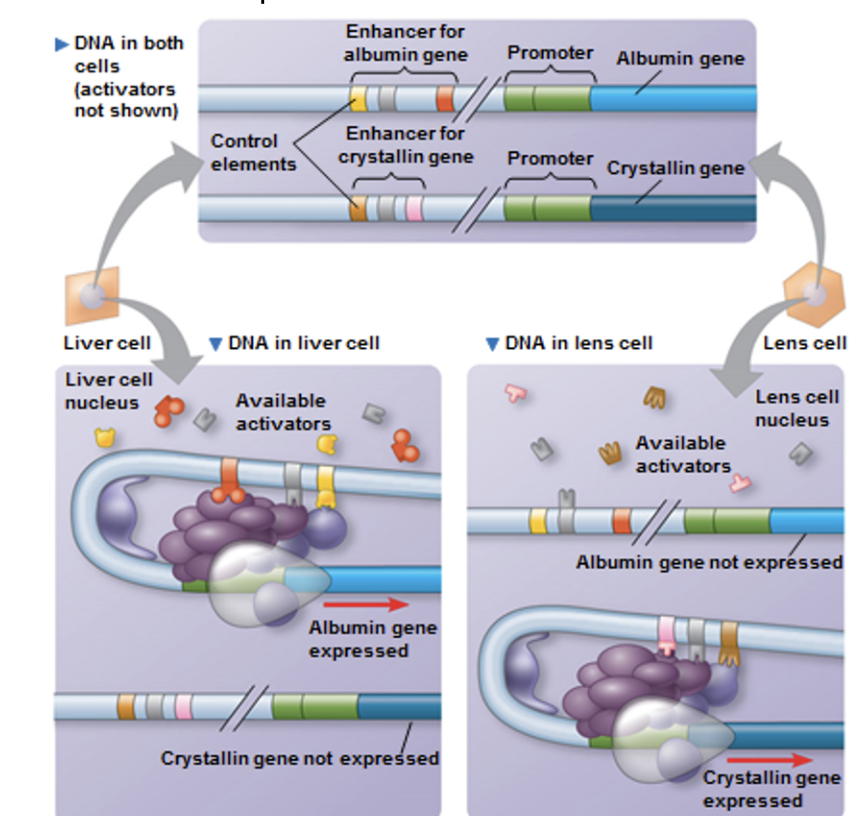
How is the albumin and crystallin genes examples of cominatorial control

Example of combinatorial control 

  • Albumin(liver) and Crystallin (eyes)

  • Enhancer regions for albumin and crystallin share some regions, But they have some differences 

  • The liver cells will bind to all the control elements of albumin 

  • But crystallin does not have the correct combination of activator proteins  of 3, so it does not bind 

Both genes have a gray enhancer sequence that binds to a gray activator protein.  In the liver, you need yellow, gray, and red activator sequences for gene expression, while in the eye you need brown, gray, and pink

In this example, two enhancer regions share one sequence element (gray) but also have two unique sequence elements (yellow & red for albumin and orange & pink for crystallin) in the enhancer regions.  A cell must have all three for efficient transcription.  If the levels of activator proteins in each respective cell line were incorrect, blindness and metabolic problems would result.  
<p><span style="background-color: transparent;">Example of combinatorial control&nbsp;</span></p><ul><li><p><span style="background-color: transparent;">Albumin(liver) and Crystallin (eyes)</span></p></li><li><p><span style="background-color: transparent;">Enhancer regions for albumin and crystallin share some regions, But they have some differences&nbsp;</span></p></li><li><p><span style="background-color: transparent;">The liver cells will bind to all the control elements of albumin&nbsp;</span></p></li><li><p><span style="background-color: transparent;">But crystallin does not have the correct combination of activator proteins&nbsp; of 3, so it does not bind&nbsp;</span></p></li></ul><p><span style="background-color: transparent;">Both genes have a gray enhancer sequence that binds to a gray activator protein.&nbsp; In the liver, you need yellow, gray, and red activator sequences for gene expression, while in the eye you need brown, gray, and pink</span></p><p><span style="background-color: transparent;">In this example, two enhancer regions share one sequence element (gray) but also have two unique sequence elements (yellow &amp; red for albumin and orange &amp; pink for crystallin) in the enhancer regions.&nbsp; A cell must have all three for efficient transcription.&nbsp; If the levels of activator proteins in each respective cell line were incorrect, blindness and metabolic problems would result.&nbsp;&nbsp;</span></p>
44
New cards

What is alternative RNA splicing, and what are its implications?

In alternative RNA splicing, different mRNA molecules are produced from the same primary transcript

Alternative RNA splicing can significantly expand the repertoire of a eukaryotic genome(Multiple different functions 

It is a proposed explanation for the surprisingly low number of genes in the human genome

45
New cards

What are microRNAs?

MicroRNAs (miRNAs) are small, single-stranded RNA molecules that can bind complementary sequences in mRNA—Very specific lengths(20/21 base pairs long)

The miRNAs and associated proteins cause degradation of the target mRNA or sometimes block its translation—When they bind, translation is blocked 

Biologists estimate that expression of at least one-half of human genes may be regulated by miRNAs 

46
New cards

How can microRNA and siRNA(small interfering RNA) regulate gene expression in mRNA transcripts?

mRNA transcription (miRNA) and mRNA stability (siRNA) can be regulated by small RNA molecules that interfere, in one way or another, with the transcripts

Single-stranded miRNA or siRNA combines with protiens to form an RNA-induced silencying complex

this inhibits translation of several mRNAs(miRNA) or degrades a specific mRNA(siRNA)

<p><span style="background-color: transparent;">mRNA transcription (miRNA) and mRNA stability (siRNA) can be regulated by small RNA molecules that interfere, in one way or another, with the transcripts</span></p><p><span style="background-color: transparent;">Single-stranded miRNA or siRNA combines with protiens to form an RNA-induced silencying complex </span></p><p>this inhibits translation of several mRNAs(miRNA) or degrades a specific mRNA(siRNA) </p>
47
New cards

Since women have XX and men only have XY, do women have more gene expression?

X Inactivation makes sure women do not have so much more gene expression 

  • In each cell, one of the two X chromosomes (at random) is transcriptionally inactivated.

  • This is partially accomplished by a long noncoding RNA called Xist blocking access to the chromosome. 


48
New cards

how does Xist cause X-inactivation?

The Xist RNA (also called long noncoding RNA or lncRNA) surrounds one of the two X chromosomes and blocks transcription

This means that each cell in a biological female is (randomly) turned off, so each cell might be slightly different depending on what alleles are found on the expressed chromosome

So, all females are ‘mosaic’  or have individual cells that have slightly different gene expression.  

<p><span style="background-color: transparent;">The Xist RNA (also called long noncoding RNA or lncRNA) surrounds one of the two X chromosomes and blocks transcription</span></p><p><span style="background-color: transparent;">This means that each cell in a biological female is (randomly) turned off, so each cell might be slightly different depending on what alleles are found on the expressed chromosome</span></p><p><span style="background-color: transparent;">So, all females are ‘mosaic’&nbsp; or have individual cells that have slightly different gene expression.&nbsp;&nbsp;</span></p>
49
New cards

What is the Xist gene?

Two different alleles on the X chromosome; only one will be activated in the cell 

  • Female cells are kinda hemizygous 

The Xist gene is transcribed into RNA that binds to the inactivated X chromosome

A calico cat is an example of X-inactivation-mediated mosaicism

  • Different fur colors result from different X chromosomes being inactivated in different parts of the skin. 


<p><span style="background-color: transparent;">Two different alleles on the X chromosome; only one will be activated in the cell&nbsp;</span></p><ul><li><p><span style="background-color: transparent;">Female cells are kinda hemizygous&nbsp;</span></p></li></ul><p><span style="background-color: transparent;">The Xist gene is transcribed into RNA that binds to the inactivated X chromosome</span></p><p><span style="background-color: transparent;">A calico cat is an example of X-inactivation-mediated mosaicism</span></p><ul><li><p><span style="background-color: transparent;">Different fur colors result from different X chromosomes being inactivated in different parts of the skin.&nbsp;</span></p></li></ul><p></p>
50
New cards

what does the proteasome do?

If the half-life of the protein is coming to an end, the cell will add ubiquitin to an amino acid side chain 

  • It is sent to the proteasome 

  • It is a tunnel, and if a protein has a ubiquitin on it, it will go through the tunnel 

  • As it goes through, the bonds get broken, and when it comes out the other side, it is all broken up

The tunnel-shaped proteasome breaks the covalent bonds (peptide bonds) and destroys the protein.

Ubiquitin is used to label proteins for destruction. 

<p><span style="background-color: transparent;">If the half-life of the protein is coming to an end, the cell will add ubiquitin to an amino acid side chain&nbsp;</span></p><ul><li><p><span style="background-color: transparent;">It is sent to the proteasome&nbsp;</span></p></li><li><p><span style="background-color: transparent;">It is a tunnel, and if a protein has a ubiquitin on it, it will go through the tunnel&nbsp;</span></p></li><li><p><span style="background-color: transparent;">As it goes through, the bonds get broken, and when it comes out the other side, it is all broken up</span></p></li></ul><p><span style="background-color: transparent;">The tunnel-shaped proteasome breaks the covalent bonds (peptide bonds) and destroys the protein.</span></p><p><span style="background-color: transparent;">Ubiquitin is used to label proteins for destruction.&nbsp;</span></p>
51
New cards

How do transcription factors relate to purple and white flowers?

Transcription factors can be key regulators of gene expression in eukaryotes.  A transcription factor is why we see complete dominance in some traits such as the purple pea flowers.  If purple was controlled by an enzyme instead, we would see incomplete dominance.

Transcription factors have a major role in animal development because they can be cell-specific and time-specific.  Development needs to be very well regulated both in space and time.

Transcription factors also supersede downstream regulation points (splicing, translation, etc.

52
New cards

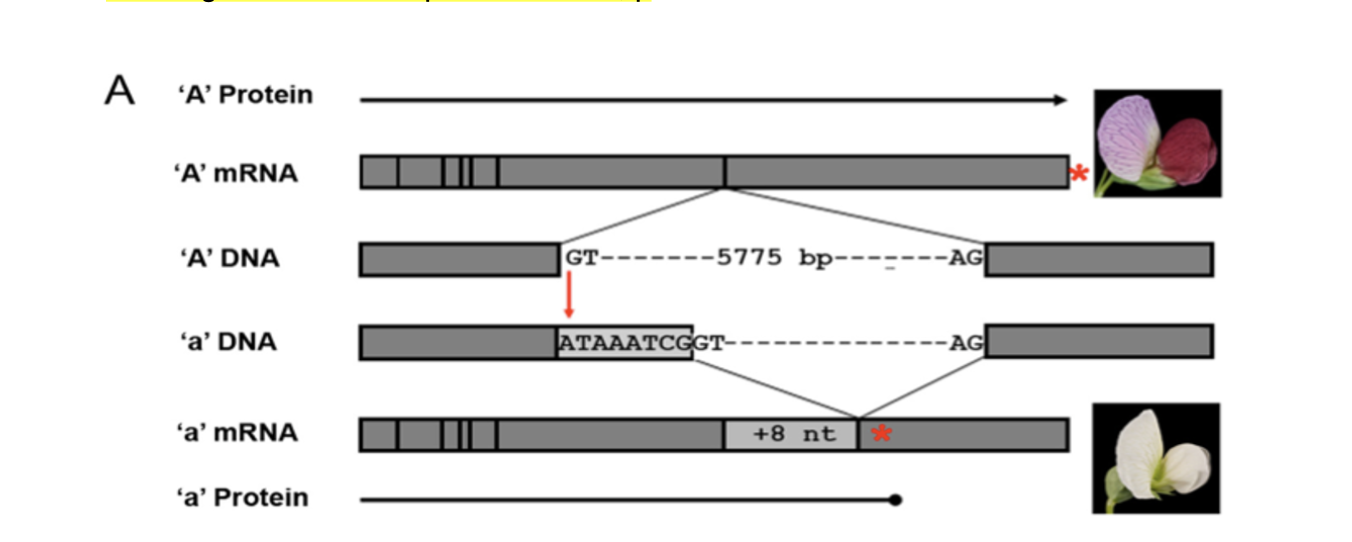
What is the single mutation that causes it to go from purple to white, and where does this happen?

Only one mutation causes flowers to go from purple to white: G→A 

This base occurs at the exon-intron junction 

A Single Base Pair Change in Intron 6 between Exons 6 and 7 in the 
<p><span style="background-color: transparent;">Only one mutation causes flowers to go from purple to white: G→A&nbsp;</span></p><p><span style="background-color: transparent;">This base occurs at the exon-intron junction&nbsp;</span></p><p><span style="background-color: transparent;">A Single Base Pair Change in <strong>Intron</strong> 6 between Exons 6 and 7 in the&nbsp;</span></p>
53
New cards

how does the spliceosome remove the intron?

The Spliceosome RNA is looking for GGUA and will cut between the two G’s

The mutation occurs right at the exon-intron junction where the GU bases determine where the DNA gets cut

  • When that G is mutated to an A, the splice site no longer exists, and the next available GU sequence becomes the new splice site

  • This is 8 bases away and can cause 8 bases to be inserted into the mRNA sequence.  This is a frameshift

Process: small nuclear ribonucleoproteins (snRNPs) bind to the pre-mRNA near both the 5’ donor and branch point consensus sequences

Binding of snRNPs recruits many other proteins (not shown)

A cut is made between the upstream exon and the intron

<p><span style="background-color: transparent;">The Spliceosome RNA is looking for GGUA and will cut between the two G’s</span></p><p><span style="background-color: transparent;">The mutation occurs right at the exon-intron junction where the GU bases determine where the DNA gets cut</span></p><ul><li><p><span style="background-color: transparent;">When that G is mutated to an A, the splice site no longer exists, and the next available GU sequence becomes the new splice site</span></p></li><li><p><span style="background-color: transparent;">This is 8 bases away and can cause 8 bases to be inserted into the mRNA sequence.&nbsp; This is a frameshift</span></p></li></ul><p>Process: small nuclear ribonucleoproteins (snRNPs) bind to the pre-mRNA near both the 5’ donor and branch point consensus sequences </p><p>Binding of snRNPs recruits many other proteins (not shown) </p><p>A cut is made between the upstream exon and the intron</p>
54
New cards

what are frame shift mutations?

Frameshift Mutations – Insertions or deletions not divisible by 3

But if you insert 3 bases, no frameshift, just one new amino acid

55
New cards

Why does the white flower locus have complete dominance, but snapdragon has incomplete dominance?

A small amount of transcription factor can activate both genes and generate a lot of protein

  • So if a mutation is in a transcription factor, having one functional copy is usually good enough for a typical phenotype, which is why we see complete dominance (heterozygote looks like the homozygous dominant)

  • If the mutation is in an enzyme, having half the amount of enzyme only produces half of the phenotype (like color), so this is incomplete dominance


<p><span style="background-color: transparent;">A small amount of transcription factor can activate both genes and generate a lot of protein</span></p><ul><li><p><span style="background-color: transparent;">So if a mutation is in a transcription factor, having one functional copy is usually good enough for a typical phenotype, which is why we see complete dominance (heterozygote looks like the homozygous dominant)</span></p></li><li><p><span style="background-color: transparent;">If the mutation is in an enzyme, having half the amount of enzyme only produces half of the phenotype (like color), so this is incomplete dominance</span></p></li></ul><p></p>
56
New cards

what controls the transcription of transcription factor genes?

The egg has pre-made mRNA, and this controls the master transcription factors 

The mother puts transcription factor proteins and mRNAs in the egg

Transcription Factors in the Cytoplasm of the Egg are crucial for development

<p><span style="background-color: transparent;">The egg has pre-made mRNA, and this controls the master transcription factors&nbsp;</span></p><p><span style="background-color: transparent;">The mother puts transcription factor proteins and mRNAs in the egg</span></p><p><span style="background-color: transparent;">Transcription Factors in the Cytoplasm of the Egg are crucial for development</span></p>
57
New cards

what is determination vs. differentiation of transcription factors?

Determination

  • MyoD does 2 things – 

  • 1)activates muscle-specific proteins

  • 2)turns off the cell cycle indirectly

Differentiation

  • The genes activated by MyoD define the cell as muscle.

  • Differentiation into what the genes are destined to be 

  • You can't go back once you do this 


<p><span style="background-color: transparent;">Determination</span></p><ul><li><p><span style="background-color: transparent;">MyoD does 2 things –&nbsp;</span></p></li><li><p><span style="background-color: transparent;">1)activates muscle-specific proteins</span></p></li><li><p><span style="background-color: transparent;">2)turns off the cell cycle indirectly</span></p></li></ul><p><span style="background-color: transparent;">Differentiation</span></p><ul><li><p><span style="background-color: transparent;">The genes activated by MyoD define the cell as muscle.</span></p></li><li><p><span style="background-color: transparent;">Differentiation into what the genes are destined to be&nbsp;</span></p></li><li><p><span style="background-color: transparent;">You can't go back once you do this&nbsp;</span></p></li></ul><p></p>
58
New cards

What are Hox genes and their significance in the embryo?

Hox genes are found in a cluster on the same chromosome

  • Hox genes are expressed in the order in which they appear on the chromosome across the embryo

  • These transcription factors activate other genes that further define organs and body parts.


<p><span style="background-color: transparent;"><u>Hox genes </u>are found in a cluster on the same chromosome</span></p><ul><li><p><span style="background-color: transparent;">Hox genes are expressed in the order in which they appear on the chromosome across the embryo</span></p></li><li><p><span style="background-color: transparent;">These transcription factors activate other genes that further define organs and body parts.</span></p></li></ul><p></p>
59
New cards

What is cancer?

Cancer – uncontrolled proliferation(division) of cells with the ability to spread throughout the body

  • Uncontrolled cells have lost critical regulatory safety nets 

  • Proliferation or excessive cell division – too many cells(too many cells can be bad, take away resources) 

  • Spreading of cells to vital organs can prevent those systems from functioning for the organism


60
New cards

How does the eukaryotic cell cycle differ between normal and cancerous cells?

In cancer, the restriction points are gone; there is no control system in place for those cells

  • No control over the cell cycle 

We learned that the cell cycle only occurs when needed.  This is to replace older cells or repair damage.  When the cell cycle proceeds when it shouldn’t, too many cells are made.  Restriction points prevent the transition from one phase of the cell cycle to the next.  In cancer, these no longer function as they should.  

61
New cards

What are oncogenes?

Oncogenes – when functioning properly, these genes promote cell growth and proliferation when needed

  • In cancer, they are hyperactive or amplified (too much)

  • They have a gain-of-function effect.


62
New cards

what are tumor suppressors?

Tumor Suppressors – when functioning properly, these genes prevent cancer from happening; they slow down the cell cycle 

  • In cancer, they are deleted, mutated, or fail to function

  • This is a Loss of Function.  


63
New cards

Oncogenes and tumor suppressors: loss or gain of function?

Oncogenes: gain-of-function(Gain of function means a protein is doing something it should not.  This could be a new function or too much of its existing function)

Tumor suppressors: loss of function(Loss of function is when a protein stops doing what it is supposed to do.  If it is deleted, it can’t do its job.  If it is mutated, it also may not be able to do its job)

64
New cards

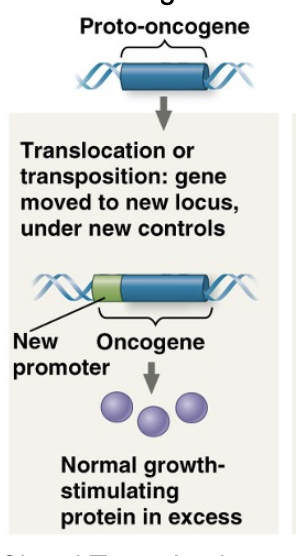
what are proto-oncogenes?

Proto-oncogenes are normal versions 

They create normal growth-stimulating proteins in excess, only when needed and in the right amount 

A proto-oncogene is a normal, healthy gene in the body that helps regulate cell growth, division, and survival. You can think of proto-oncogenes as the "gas pedals" of a cell, giving instructions to make proteins that promote normal development and tissue repair
<p><span style="background-color: transparent;"><mark data-color="#ffffff" style="background-color: rgb(255, 255, 255); color: inherit;">Proto-oncogenes are normal versions&nbsp;</mark></span></p><p><span style="color: inherit;"><mark data-color="#ffffff" style="background-color: rgb(255, 255, 255); color: inherit;">They create normal growth-stimulating </mark></span><span style="background-color: transparent;"><mark data-color="#ffffff" style="background-color: rgb(255, 255, 255); color: inherit;">proteins</mark></span><span style="color: inherit;"><mark data-color="#ffffff" style="background-color: rgb(255, 255, 255); color: inherit;"> in excess, only when needed and in the right amount&nbsp;</mark></span></p><p><span><mark data-color="#ffffff" style="background-color: rgb(255, 255, 255); color: inherit;">A </mark></span><strong><mark data-color="#ffffff" style="background-color: rgb(255, 255, 255); color: inherit;">proto-oncogene</mark></strong><span style="font-size: medium;"><mark data-color="#ffffff" style="background-color: rgb(255, 255, 255); color: inherit;"> is </mark></span><strong><mark data-color="#ffffff" style="background-color: rgb(255, 255, 255); color: inherit;">a normal, healthy gene in the body that helps regulate cell growth, division, and survival</mark></strong><span style="font-size: medium;"><mark data-color="#ffffff" style="background-color: rgb(255, 255, 255); color: inherit;">. You can think of proto-oncogenes as the </mark></span><strong><mark data-color="#ffffff" style="background-color: rgb(255, 255, 255); color: inherit;">"gas pedals"</mark></strong><span style="font-size: medium;"><mark data-color="#ffffff" style="background-color: rgb(255, 255, 255); color: inherit;"> of a cell, giving instructions to make proteins that promote normal development and tissue repair</mark></span></p>
65
New cards

What is gene amplification?

Gene amplification: multiple copies of the gene 

You make too many growth factor receptors and more protein 

66
New cards

What happens when photo-oncogenes become mutated?

Proto-oncogenes  become mutated: hyperactive when the off switch is not working

<p><span style="background-color: transparent;">Proto-oncogenes&nbsp; become mutated: hyperactive when the off switch is not working</span></p>
67
New cards

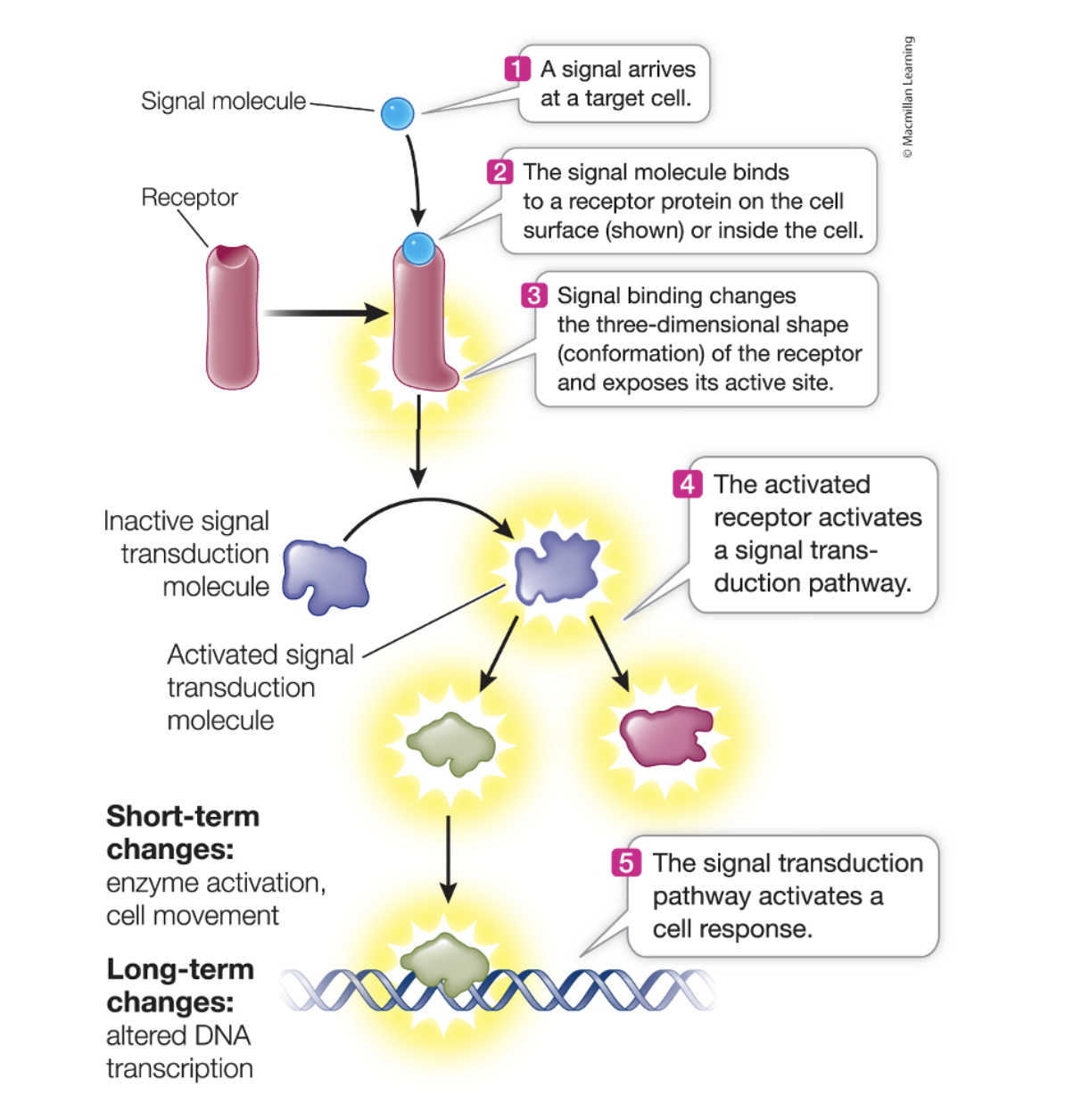
What are the consequences of having oncogenes be important to signal transduction pathways?

Many oncogenes are important to signal transduction pathways:

  • too much signaling molecule

  • receptor that is always ‘on’

  • relay molecules that never turn ‘off’

Any step in this pathway could cause cancer if it becomes hyperactive or overactive. 
<p><span style="background-color: transparent;">Many oncogenes are important to signal transduction pathways:</span></p><ul><li><p><span style="background-color: transparent;">too much signaling molecule</span></p></li><li><p><span style="background-color: transparent;">receptor that is always ‘on’</span></p></li><li><p><span style="background-color: transparent;">relay molecules that never turn ‘off’</span></p></li></ul><p><span style="background-color: transparent;">Any step in this pathway could cause cancer if it becomes hyperactive or overactive.&nbsp;</span></p>
68
New cards

normally, RAS is only activated once…

Normally, RAS is only activated once the RTK is activated

<p><span style="background-color: transparent;">Normally, RAS is only activated once <strong>the RTK is activated</strong></span></p>
69
New cards

What is mutated in ½ of all cancers?

RAS is mutated in half of all cancers, frequently turned on when cancer happens 

70
New cards

How does RAS function normally?

Normal RAS: can bind to GDP or GTP; the active form stimulates cell division 

RAS must lose a P to go from GTP to GDP
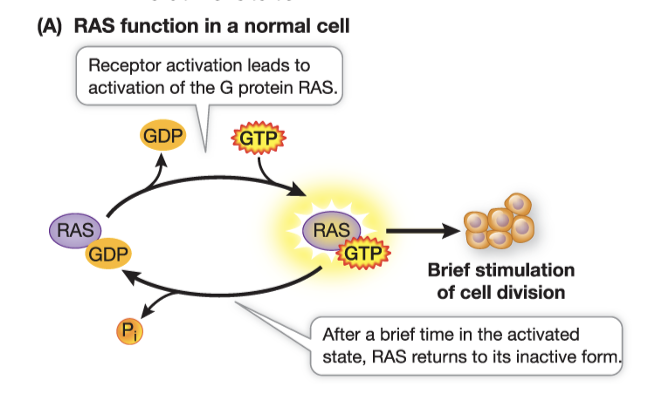
<p><span style="background-color: transparent;">Normal RAS: can bind to GDP or GTP; the active form stimulates cell division&nbsp;</span></p><p><span style="background-color: transparent;">RAS must lose a P to go from GTP to GDP</span></p>
71
New cards

How does cancerous RAS function?

In cancerous RAS: single amino acid difference 

  • The RAS cannot lose GTP, and it is always in the on position

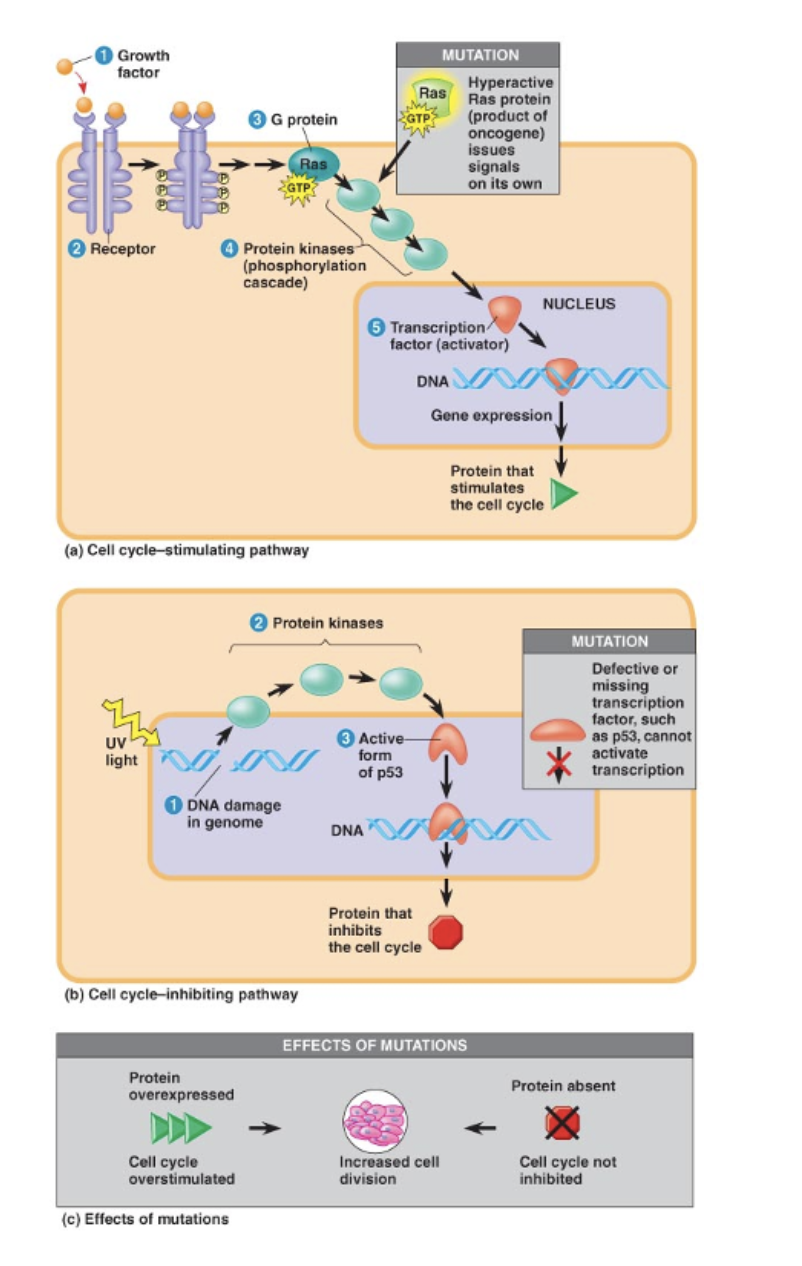
Here, Ras is defective - it is always “on” signaling when it should not be due to a mutation in the gene.

Defective Ras is the product of an Oncogene

The Receptor Tyrosine Kinase is no longer needed for signalling to proceed

In cancer, Ras has a mutation that allows it to bind GTP to establish the active form of the protein, but it cannot release that GTP and exchange it for GDP and reform the inactive state.  

<p><span style="background-color: transparent;">In cancerous RAS: single amino acid difference&nbsp;</span></p><ul><li><p><span style="background-color: transparent;">The RAS cannot lose GTP, and it is always in the on position</span></p></li></ul><p><span style="background-color: transparent;">Here, Ras is defective - it is always “on” signaling when it should not be due to a mutation in the gene.</span></p><p><span style="background-color: transparent;">Defective Ras is the product of an Oncogene</span></p><p><span style="background-color: transparent;">The Receptor Tyrosine Kinase is no longer needed for signalling to proceed</span></p><p><span style="background-color: transparent;">In cancer, Ras has a mutation that allows it to bind GTP to establish the active form of the protein, but it cannot release that GTP and exchange it for GDP and reform the inactive state.&nbsp;&nbsp;</span></p>
72
New cards

How does P53 function normally vs. when there is a mutation in the cell cycle inhibitory pathway?

Normal cell cycle-inhibiting pathway: P53 detects DNA damage and stops the cell cycle.

Mutant cell cycle-inhibiting pathway: P53 does not function as it should, and cells divide with DNA damage and more mutations. (loss of function)

<p><span style="background-color: transparent;">Normal cell cycle-inhibiting pathway: P53 detects DNA damage and stops the cell cycle.</span></p><p><span style="background-color: transparent;">Mutant cell cycle-inhibiting pathway: P53 does not function as it should, and cells divide with DNA damage and more mutations. (loss of function)</span></p>
73
New cards

What is apoptosis a response to?

Another response to DNA damage is apoptosis (programmed cell death)

<p><span style="background-color: transparent;">Another response to <strong>DNA damage</strong> is <u>apoptosis </u>(programmed cell death)</span></p>
74
New cards

What are the two types of failures in cell signaling that cause cancer?

Cancer always results from multiple failures in Cell Signaling

  • Stimulate: Oncogene – hyperactive mutations or duplications enhance cell division

  • (failure to) Stop: Tumor Suppressor – loss-of-function mutations or deletions allow uncontrolled proliferation 

Cancer requires both oncogenes to become active and tumor suppressor genes to fail.  Many things go wrong in a cell for cancer to develop.  
<p><span style="background-color: transparent;">Cancer always results from <u>multiple failures </u>in Cell Signaling</span></p><ul><li><p><span style="background-color: transparent;"><u>Stimulate:</u> Oncogene – hyperactive mutations or duplications enhance cell division</span></p></li><li><p><span style="background-color: transparent;"><u>(failure to) Stop: </u>Tumor Suppressor – loss-of-function mutations or deletions allow uncontrolled proliferation&nbsp;</span></p></li></ul><p><span style="background-color: transparent;">Cancer requires both oncogenes to become active and tumor suppressor genes to fail.&nbsp; Many things go wrong in a cell for cancer to develop.&nbsp;&nbsp;</span></p>
75
New cards

what is metastasis?

Metastasis is the spread of cancer cells from the place where they first formed (the primary tumor) to other parts of the body

76
New cards

in order for full blown cancer to occur…

multiple defects are almost always necessary. Here at least 4 occur, which is typical

<p><span style="background-color: transparent;">multiple defects are almost always necessary. Here at least 4 occur, which is typical</span></p>
77
New cards

what is the bare minumim for cancer to occur?

1 oncogene and 2 tumor suppressor genes are enough to cause cancer 

This is why cancer occurs in adult people; it takes time for these mutations to occur 

<p><span style="background-color: transparent;">1 oncogene and 2 tumor suppressor genes are enough to cause cancer&nbsp;</span></p><p><span style="background-color: transparent;">This is why cancer occurs in adult people; it takes time for these mutations to occur&nbsp;</span></p>
78
New cards

what are the 3 breast cancer oncogenes?

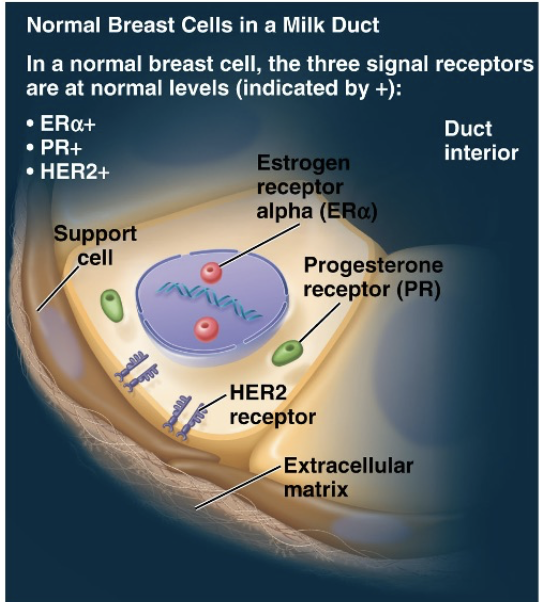
ER – Estrogen Receptor becomes hyperactive 

PR - Progesterone Receptor becomes hyperactive 

HER2 receptor – Receptor Tyrosine Kinase becomes amplified 

<p><span style="background-color: transparent;">ER – Estrogen Receptor becomes hyperactive&nbsp;</span></p><p><span style="background-color: transparent;">PR - Progesterone Receptor becomes hyperactive&nbsp;</span></p><p><span style="background-color: transparent;">HER2 receptor – Receptor Tyrosine Kinase becomes amplified&nbsp;</span></p>
79
New cards

what are the 2 breat cancer tumor suppressors?

BRCA1–responds to and detect DNA damage, so if they don't work, that is bad

BRCA2–responds to and detects DNA damage, so if they don't work, that is bad
<p><span style="background-color: transparent;">BRCA1–responds to and detect DNA damage, so if they don't work, that is bad</span></p><p><span style="background-color: transparent;">BRCA2–responds to and detects DNA damage, so if they don't work, that is bad</span></p>
80
New cards

how do light tools work?

Light tools used to visualize specific proteins

Take a small fluorescent protein from a jellyfish and put it onto a protein and track and watch them 

GFP = Green fluorescent protein

  • Luciferase and luciferin


<p><span style="background-color: transparent;">Light tools used to visualize specific proteins</span></p><p><span style="background-color: transparent;">Take a small fluorescent protein from a jellyfish and put it onto a protein and track and watch them&nbsp;</span></p><p><span style="background-color: transparent;">GFP = Green fluorescent protein</span></p><ul><li><p><span style="background-color: transparent;">Luciferase and luciferin</span></p></li></ul><p></p>
81
New cards
82
New cards