ECOL 417 Module 2
 Call Kai
 Learn
 Practice Test
 Spaced Repetition
 Match
 Flashcards
 Knowt Play
1/189

There's no tags or description
Looks like no tags are added yet.
190 Terms
water exists in the hydrosphere in a … meaning the Earth is …
continuous cycle, not going to run out of water
the quality of water …
varies through space and time
human population growth has resulted in …
greater water use and water contamination
water quality has … because …
increased in importance, water quantity cannot be assessed independently of its quality
efficient management of water resources requires …
the application of knowledge about water quality
what are the water quality measures (or variables)? the first indicators to characterize general water quality?
physical
chemical
biological
physical indicators
total dissolved solids
total suspended solids
conductivity
turbidity
water colour
chemical indicators
pH
biological oxygen demand (BOD)
dissolved oxygen (DO)
hardness
total nitrogen
total phosphorus
heavy metals, pesticides, substances that are toxic at low concentrations
biological indicators
bacteria content: E.coli and coliform bacteria
ephemeroptera
plectoptera
trichoptera
community composition metrics
diversity indices
dominance of pollution tolerant organisms
how is dissolved vs particulate matter defined by
based on their ability to pass through a filter of a specific size
usually 0.45 microns but not always (when comparing studies we should know if they differentiate)
distinction is arbitrary - bc particles range in size along a continuum but it is helpful to study water bodies and have a cutoff
(can also be colloidal and gravitoidal)
what is conductivity
the relative amount of electricity that can be conducted by water
what is conductivity typically driven by
Na+, Ca2+, Mg2+, Cl-, SO4 2-
what is specific conductance
the conductivity measure corrected to 25 deg C to allow for comparison between reported measures of conductivty
conductivity
units are uS/cm
when measuring, 2 probes are 1cm apart to standardize
high temp = ions move faster
conductivity table
distilled water has low conductivity because its low in ions
narrow range in this pic, salt in snow increases it
chloride is a big conductor

what is total dissolved solids (TDS)
the mass of material (inorganic and organic) dissolved in water
“dissolved” is at the 2 um filter threshold

what is total suspended solids
the dry weight of particles trapped on a filter paper
this is what doesn’t pass through the filter paper
reported in mass/volume
what is turbidity
the clarity of a liquid
measured as the light absorption or light scattering of water
can be confused with TSS but its really about light scattering or absorbed
example from high arctic lakes (east and west) on melville island, nunavut
COME BACK TO
both lakes are being impacted by climate change but there has been much more permafrost degradation in the West Lake watershed
what is pH
the concentration of hydrogen ions (acidic vs basic)
pH = -log [H+]
pH cont’d
central for biological activity (lots of hydrogen ions hitting fish gills will kill fish)
most aquatic systems are found near neutrality (pH = 7+-1)
how does acid precipitation majorly impact aquatic systems
by lowering the pH several orders of magnitude
can mobilize metals by increasing solubility at low pH
what is alkalinity
it indicates the capacity to neutralize acids
NOT how basic it is!
usually dictated by surrounding material
what is hardness
the sum of magnesium and calcium ions present, an indicator of the ability of water to precipitate soap, important in domestic water supplies

geology controls water hardness

what is the law of conservation of matter
matter cannot be created or destroyed
matter can only be transformed from one form to another (rearranged)
matter can exist in major states
solid
liquid
gas
dictates why biogeochemical cycles happen
ex. C₆H₁₂O₆ + 6 O₂ → 6 CO₂ + 6 H₂O
what is biogeochemistry
chemistry in an environmental context with an emphasis on the living and non-living (biotic/abiotic) components of an ecosystem
what is biogeochemistry cycle
pathways by which a chemical moves through biotic and abiotic compartments of Earth
ex. nitrogen in plants, we eat those plants (which is how we get amino acids and etc.)
types of elements that are essential for plant growth
macronutrients
micronutrients
macronutrients
need less of them but still necessary
C, H, O, N, P, K, S, Mg, Ca, (Si)
Si is for certain aquatic plants (diatoms)
limiting macronutrients
N, P, K
N and P are limiting for aquatic plants
K is limiting for terrestrial
micronutrients
Fe, Cl, Cu, Mn, Zn, Mo, Bo
what are nutrients
any element required by organisms for growth
C, H, O, N, P, K, S, Mg, Ca, (Si)
nutrients in aquatic ecology
primarily in reference to elements that are limiting to growth (purs brakes on primary productivity)
need to build biomolecules, proteins, nucleic acis, carbohydrates, lipids, etc
what are primary producers
Algae, aquatic plants, cyanobacteria and many bacteria can use inorganic nutrients like nitrate, ammonium, and phosphate
what are heterotrophs
acquire their nutrients in organic form by consuming other organisms or organic matter
sources of nutrients
gas exchange in atmosphere (O2 and CO2)
input from watershed
weathering of rock (increase phosphorus)
biological molecules (ex. algael death = source of nutrients for other organisms)
Sockeye salmon
millions of sockeye salmon return from the ocean to spawn in freshwaters of Bristol Bay watershed
studies have identified the presence of marine-derived nitrogen (MDN) from salmon in freshwaters and terrestrial environments
nutrient requirements vs. availability
using the elemental composition of plants and algae and the availability of nutrients in freshwaters, determine which nutrients are in high demand
in small river N and P had the highest number in average demand/supply (plants and algae / world rivers)
ex. count # of sockeye every spawning season, would throw dead sockeye to the same spot and in that spot the trees had grown bigger because N if often limiting and trees were getting N from the dead sockeye
what is stoichiometry
how the balance of energy and elements influences living systems
stoichiometry of carbon, nitrogen, and phosphorus at balanced growth
106:16:1 = redfield ratio
if the N:P ratio is well above 16…
more N that algae needs relative to P
P is limiting element
C is not limiting so can ignore for a sec
if the N:P ratio is well below 16…
less N that algae needs relative to P
N is limiting element
C is not limiting so can ignore for a sec
Leibig’s Law of the Minimum
the element or resource with the least relative amount will limit growth and production
the rate of a process will be limited by…
the rate of its slowest sub-process
expectation that a single nutrient will limit primary production of a system
how would you experimentally test limiting
dump a bunch of N and P in a lake and see what takes off
in pic, P is the limiting

what is assimilation
the acquisition (obtaining) of nutrients by organisms
what is remineralization
the breakdown of organic matter into biological forms
process leading to remineralization
decomposition
leakage (can be a source of organic matter into water)
heterotrophic organisms
oxygen
major importance to biological processes in freshwaters
amount of O2 is expressed as mg/L or mol/L or percentage saturation
what is dissolved oxygen (DO)
the O2 dissolved in oxygen
what is percentage saturation
the concentration of O2 relative to maximum at equilibrium concentration for that solution
varies with temperature, cold water holds more O2
DO is a function of many factors
temperature
pressure (related to altitude)
salinity
DO temperature changes
solubility decreases as T increases
in pic, 8 mg/L is about 100% saturates at 25 deg C

DO pressure changes
solubility increases as P increases
DO salinity changes
solubility decreases as S increases
increase S = more ions = forces O out because gets tighter
pure water likes to work up = looser
supersaturated
DO concentration is above saturation
will form O2 bubbles and come out of solution
happens during certain times of the day (lots of sunlight on vegetation = supersat)
sub-saturation
Do concentrations below saturation
oxic or aerobic conditions
O2 present in the water
anoxic or anaerobic conditions
no O2 present in the water

O2, altitude, and temp
highest O2 is at low altitude and low temperature
therefore decreasing altitude and temperature will increase O2
oxygen sources
atmosphere
amount depends on diffusion and turbulence
photosynthesis
6 CO2 + 6 H2O → 6(CH2O) + 6 O2
oxygen sinks
diffusion to the atmosphere
respiration
6(CH2O) + 6 O2 → 6 CO2 + 6 H2O
chemical oxidation
using up O2 in chemical reaction
seasonal patter in DO - oligotrophic

seasonal patter in DO - eutrophic

fish winterkill
ice sealing off the atmosphere. winter kills dominate in shallow lakes because water doesn’t have a lot of oxygen
eutrophic lakes also deprive lakes of oxygen
shallow lakes, eutrophic lakes, heavy snow, sensitive fish species
summer kills
warming of the epilimnion, less oxygen in the bottom leads to fish getting squeezed in the water column
shallow lakes, eutrophic lakes, hot spells, little wind

oxygen distribution in streams
higher swings in eutrophic systems, lower swings in something more oligotrophic
photosynthesis increases oxygen concentrations in diurnal basis
in productive rivers, diurnal oscillations in DO concentrations are even more magnified
respiration at night results in repeated oxic-hypoxic cycles

why is carbon important?
its essential to life
currency of energy transfer
carbon is the chemical backbone of organic molecules
proteins, nucleic acids, lipids, carbohydrates
carbon provides a buffering system for lakes to absorb excess acid
exchanges with the atmosphere and global climate regulation
carbon in lakes
lake carbon cycle - how the C moves between these categories

particulate organic carbon (POC)
living algae, bacteria, zooplankton; detritus, fecal pellets, leaf fragments
particulate inorganic carbon (PIC)
CaCO3, other carbonate minerals
dissolved organic carbon
humic substances (tea coloured water); sugars, amino acids, algal exudates
dissolved inorganic carbon
CO2, H2CO3, HCO3-, CO3 2-, (carbonate system)
typical ranking of carbon in lakes
DIC > DOC > POC
forms of carbon
inorganic carbon
organic carbon
inorganic carbon doesn’t provide energy, usually only bonded to oxygen
organic carbon provides energy, has hydrogen in the bond
inorganic carbon (DIC)
when CO2 is dissolved in water, it exists in a variety of forms:
carbon dioxide, carbonic acid, bicarbonate, and carbonate
bicarbonate equilibrium, bicarbonate buffering system

Lake Nyos (Cameroon)
CO2 released from the magma rises through the rock and enters the lake bottom through springs
with no mixing, CO2 arriving at the bottom had no route to the surface and the atmosphere, so it kept building up for years
august 1986 - a massive cloud of CO2 denser than air, poured down the surrounding valleys and suffocated about 1700 ppl and thousands of livestock
organic carbon

particulate organic carbon (POC)
all living and dead organisms, and their parts and feces
dissolved organic carbon (DOC) - humic compounds
large molecular weight compounds that lend a brownish color to water
byproduct of the breakdown of other organic compounds
resistant to microbial use
humic acids, fulvic acids, humin
can attach to other organic substances
can form complexes with metal ions
dissolved organic carbon (DOC) - non-humic compounds
sugars
carbohydrates
amino acids
urea
proteins
pigments
lipids
carbon origins
autochthonous
allochthonous
carbon origin - autochthonous
comes from inside the aquatic system, carbon synthesized through photosynthesis in the lake/stream
carbon origin - allochthonous
comes from outside the aquatic system, carbon synthesized in the drainage and imported in the lake/stream
carbon cycle in lakes
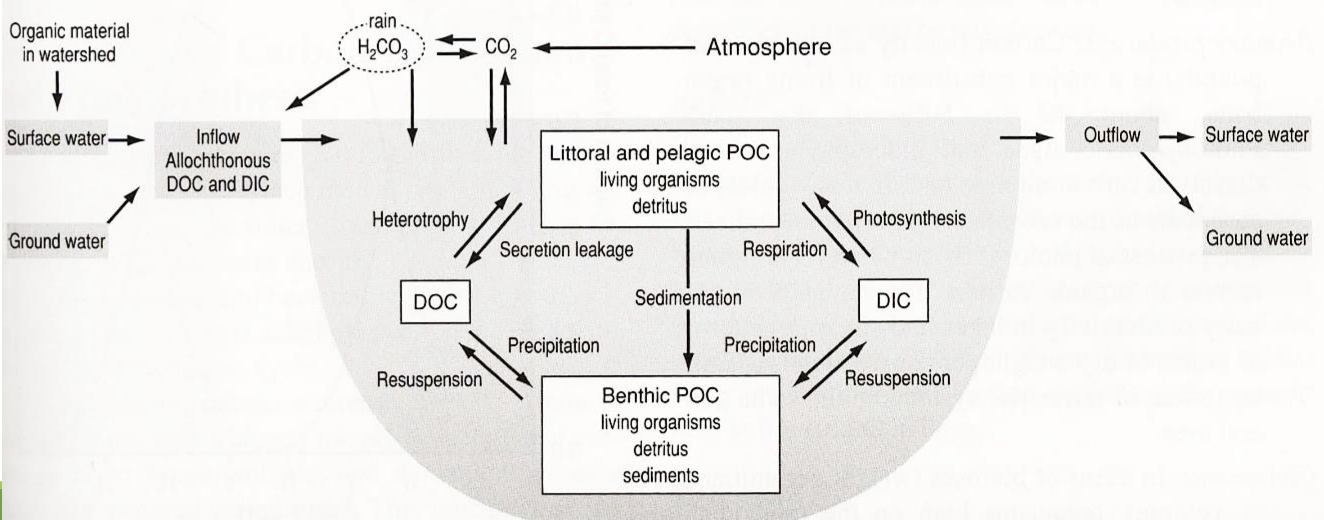
why care about phosphorus in lakes
essential to all organisms
dna, rna, atp, bones, and teeth
often limiting in lakes
high in demand/low in availability
linked to issues such as:
cyanobacteria blooms
eutrophication
natural phosphorus sources
rock weathering (slow)
mostly apatite Ca5(PO4)+
no gas phase
bones
how does phosphorus get into lakes and rivers?
surface runoff (majority)
amplified when it is agricultiral runoff
precipitation (wet or dry)
groundwater (very minor)
streams and rivers (important for lakes)
forms of phosphorus - total phosphorus (TP) ***
often most important
measured on unfiltered water
TP = dissolved P + particulate P
dissolved P = passes through the filter
particulate P = caught on the filter
each part can be organic or inorganic
filter is usually 0.45 um
forms of phosphorus - dissolved inorganic phosphate (DIP)
orthophosphate (PO4 3-)
the form algae use directly
measured in the lab as soluble reactive P (SRP)
aka as phosphate
forms of phosphorus - particulate inorganic phosphate (PIP)
P bound to mineral and soil particles
forms of phosphorus - dissolved organic phosphate (DOP)
dissolved organic compounds released by organisms
forms of phosphorus - particulate organic phosphate (POP)
P inside living cells and dead organic matter
percent forms of phosphorus
most P in aquatic ecosystems is in living organisms
98.5% is POP
1.3% is PIP
0.3% SRP (free P)
a lake has low SRP, but this doesn’t mean the lake is low in P, P might just be in other forms
phosphorus transformations
uptake is rapid
organic P consists of algae + bacteria

external loading

phosphorus in sediments
lake sediments are considered an internal source of phosphorus
internal loading
quantities of P in the sediments greatly exceed those in the overlying waters
decaying organic matter
interstitial waters in sediments contain 0.06 to 10 mg/L P soluble
conditions at the sediment-water interface are key
anoxic sediments release P soluble ____ than oxygenated sediments
1000 times faster