Chapter 16 Regulation of Eukaryotic Gene Expression
 Call Kai
 Learn
 Practice Test
 Spaced Repetition
 Match
 Flashcards
 Knowt Play
1/62

There's no tags or description
Looks like no tags are added yet.
63 Terms
How is gene expression regulated in eukaryotes?
Gene expression is regulated through differential expression, allowing appropriate responses to the environment, embryonic development, and maintenance of adult states.
What is differential gene expression?
Differential gene expression is the process by which not all genes are expressed at all times, allowing cells to respond appropriately to their environment.
What can incorrect gene expression lead to?
Incorrect gene expression can lead to deleterious phenotypes, cancer, or cell death.
At what levels does eukaryotic gene regulation occur?
Eukaryotic gene regulation occurs during transcription initiation, mRNA modifications, stability, and protein synthesis and modification.
What structural features distinguish eukaryotic genes from prokaryotic genes?
Eukaryotic genes are situated on chromosomes occupying distinct locations and are combined with histones and nonhistone proteins to form chromatin.
What is the role of chromatin structure in gene regulation?
Compact chromatin structure inhibits transcription, replication, and DNA repair.

What are chromosome territories?
Chromosome territories are discrete domains occupied by each chromosome in the interphase nucleus, keeping individual chromosomes separate.
How do transcriptionally active genes relate to chromosome territories?
Transcriptionally active genes are located at the edge of chromosome territories, facilitating coordinated expression.
What are interchromatin compartments?
Interchromatin compartments are channels between chromosomes that contain little or no DNA.
What are histone modifications?
Histone modifications involve covalent bonding of functional groups to the N-terminal tails of histone proteins, influencing gene expression.
What is the effect of histone acetylation on gene expression?
Histone acetylation decreases the positive charge of histones, reducing their affinity for DNA and is associated with increased transcription.
What is DNA methylation and its effect on gene expression?
DNA methylation typically occurs on cytosine of CG doublets and can repress transcription by inhibiting transcription factor binding.
What is the relationship between DNA methylation and gene expression?
There is an inverse relationship between the degree of methylation and the level of gene expression.
What are cis-acting sequences?
Cis-acting sequences are specific DNA sequences located on the same chromosome as the gene they regulate, required for accurate transcription.
What are the types of cis-acting sequences?
Types of cis-acting sequences include promoters, enhancers, and silencers.
What is the role of transcription regulatory proteins?
Transcription regulatory proteins bind to cis-acting sequences to influence the transcription of genes.
What is the significance of mRNA modifications in eukaryotic gene expression?
mRNA modifications, such as splicing, capping, and polyadenylation, are crucial for mRNA stability and transport from the nucleus.
How does chromatin remodeling influence gene expression?
Chromatin remodeling involves repositioning or removing nucleosomes, making chromosome regions accessible to transcription regulatory proteins.
What is the role of RNA processing machinery in gene expression?
The RNA processing machinery, housed in interchromatin compartments, facilitates capping, splicing, and poly-A tailing of mRNAs.
What is the effect of histone deacetylation on transcription?
Histone deacetylation is associated with decreased transcription.
What is the importance of proper methylation patterns in development?
Proper methylation patterns are essential for mammalian development and are tissue-specific and heritable.
What is the role of a promoter in transcription?
A region of DNA recognized and bound by the transcription machinery, specifying the transcription start site and DNA template.
What are the two types of promoters?
Core promoters and proximal-promoter elements.
What is a core promoter?
Determines accurate initiation of transcription by RNA polymerase II.
What are focused promoters?
Promoters that specify a single transcription start site, commonly found in lower eukaryotes and associated with highly regulated genes.
What are dispersed promoters?
Promoters that direct transcription initiation from several weak start sites, usually associated with constitutively transcribed genes.
What are some elements found in focused promoters?
Initiator (Inr), TATA box, TFIIB recognition element (BRE), downstream promoter element (DPE), and motif ten element (MTE).

What are proximal promoter elements?
Elements located upstream of TATA and BRE motifs that increase levels of basal transcription.
What is the function of enhancers in transcription?
Enhancers regulate transcription and can be located far from the transcription start site, increasing transcription dramatically.

What is the role of silencers in transcription?
Silencers repress the level of transcription initiation.
How do promoters and enhancers differ in position?
Promoters are immediately adjacent to regulated genes, while enhancers can be located far away.
What is the function of transcription factors?
Regulatory proteins that target cis-acting sites of genes to regulate expression.
What are activators and repressors?
Activators increase transcription initiation, while repressors decrease it.
What is the transcription pre-initiation complex (PIC)?
A complex formed by the assembly of general transcription factors and RNA polymerase II at the core promoter.
What are the two subunits of TFIID?
TBP (TATA box binding protein) and TAFs (TBP associated factors).
What is the role of coactivators in transcription?
Coactivators interact with basal transcriptional machinery and alter chromatin structure to facilitate transcription.
What are Group I coactivators?
Coactivators that interact with components of the basal transcriptional machinery to increase the rate of PIC assembly.
What are Group II coactivators?
Coactivators that act on chromatin to make it more accessible to the transcriptional machinery.
What is RNA processing?
Posttranscriptional regulation that includes removal of introns, splicing exons, adding a 5' cap, and a poly-A tail to the 3' end.
What is alternative splicing of mRNA?
A regulated process during gene expression that allows a single gene to code for multiple proteins.
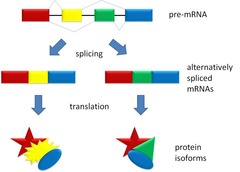
How does alternative splicing increase protein diversity?
It allows for the inclusion or exclusion of specific exons in the final mRNA transcript.
What role do RNA-binding proteins (RBPs) play in alternative splicing?
RBPs bind to specific RNA sequences or structures to regulate tissue-specific alternative splicing.
What is the steady-state level of mRNA?
The amount of mRNA in a cell that is available for translation.
How does mRNA stability vary?
It can range from a few minutes to several days, depending on the cell's needs.
What protects mRNA from degradation?
The 5'-cap and the 3'-poly(A) tail.
What happens when the poly(A) tail is less than ~30 nucleotides?
The mRNA is targeted for degradation.
What initiates the degradation of eukaryotic mRNAs?
Deadenylase enzymes that degrade the poly-A tail.
What is RNA interference (RNAi)?
A mechanism where noncoding RNAs guide the post-transcriptional silencing of mRNAs in a sequence-specific manner.
What are the two main subtypes of small noncoding RNAs involved in RNAi?
Small interfering RNAs (siRNAs) and microRNAs (miRNAs).
How are siRNAs generated?
From longer double-stranded RNAs, often due to virus infection or transposon expression.

What is the role of the enzyme Dicer in RNAi?
Dicer cleaves double-stranded RNA molecules into 22 nucleotide siRNAs.
How are miRNAs processed?
From primary miRNAs that form hairpin structures, which are then cleaved by Drosha and Dicer.
What regulates mRNA localization in cells?
Cis-regulatory sequences on the mRNA and RNA-binding proteins.
What is the function of the zip code in the 3'-UTR of mRNA?
It serves as a binding site for zip code binding protein 1 (ZBP1) to regulate localization.
What is the role of kinases in posttranslational modification?
Kinases catalyze the addition of phosphate groups to amino acid chains.
What do phosphatases do?
They remove phosphate groups from proteins.
How does ubiquitin-mediated protein degradation work?
Proteins are tagged with ubiquitin, which signals for their degradation by the proteasome.

What are the main regulatory steps in ubiquitination?
Ubiquitination by ubiquitin ligase is the major regulatory step before degradation.
What influences gene expression in eukaryotic cells?
Chromatin modifications, transcription initiation regulation, posttranscriptional gene regulation, and translational control.
What is the effect of histone modification on gene expression?
It can influence the accessibility of DNA for transcription.
What is DNA methylation?
A modification that can repress gene expression by adding methyl groups to DNA.
What are activators in gene expression?
Proteins that bind to enhancers and interact with coactivators to promote transcription.
What is the function of repressors in gene expression?
Proteins that inhibit transcription by blocking the action of activators or the transcription machinery.