Gen Chem 2 Chapter 13 Concepts
 Call Kai
 Learn
 Practice Test
 Spaced Repetition
 Match
 Flashcards
 Knowt Play
1/46

There's no tags or description
Looks like no tags are added yet.
47 Terms
Solute-Solvent-Solution Parts
Solutions have a solute component and a solvent component.
The majority component of a solution is called the solvent.
The minority component is called the solute.
The solute is dissolved into the solvent.
Usually we call water “the solvent” even if it is the minority component. Example: 30% water + 70% ethanol - we still call water “a solvent”
Solution Process
Step 1: Separating the solute into its constituents particles
Step 2: Separating the solvent particles from each other to make room for the solute particles.
Step 3: Mixing the solute particles with the solvent particles

Energetics of Solution Formation: Exothermic Dissolution of NaOH

Energetics of Solution Formation: Endothermic Dissolution of NaCl and many other salts, especially NH4NO3


Heats of Solution for Ionic Compounds
This is mainly the equation that matters, enthalpy of solution = enthalpy of hydration - enthalpy of lattice energy (negative is exothermic, positive is endothermic)

Heat of solution from Molar Heat of solution
Enthalpy = number of moles * enthalpy of solution/molar
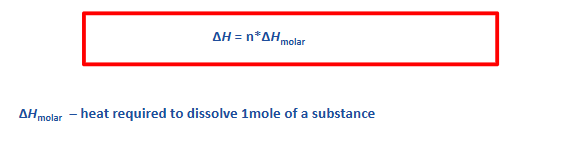
Why is enthalpy of solution is positive for some solutions and negative for others ?
Energy changes in the formation of most solutions involve differences in attractive forces between the particles
Effect of intermolecular forces plays a part
Entropy also matters as well
Energy (formation of bonds between solute and the solvent)
Solutions: Effects of Intermolecular Forces
Energy changes in the formation of most solutions involve differences in attractive forces between the particles
Dipole-Dipole Interactions
Ion-Dipole Interactions
Hydrogen Bonding
London Dispersion Forces
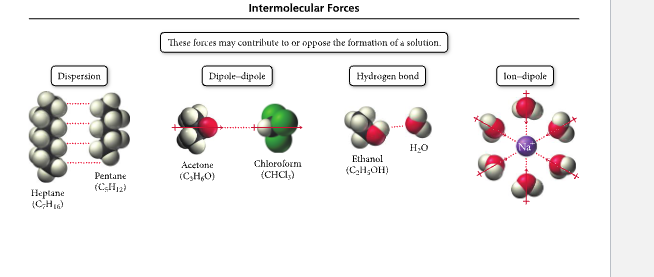
Dipole-Dipole Interactions
Dipole-dipole interactions are attractive forces that act between polar molecules.
The greater the magnitude of the dipole the stronger the attraction between the molecules.
The stronger the intermolecular forces, the higher are the boiling point and melting point of the substance.
Ion-Dipole Interactions
Ion-Dipole Attraction are attractive forces between polar molecules and a ion whether it be a cation (a metal) or a anion (a nonmetal)
Strength of the interaction depends on the charge and the size of an ion.
The higher the charge, the stronger the attraction. The bigger the size of the ion the weaker the attraction, while if smaller the stronger the attraction.
Hydrogen Bonding
Hydrogen Bonding only occurs in molecules that contain H bonded to a small, highly electronegative atom such as N, O, or F
Hydrogen Bonding is a special type of dipole-dipole interaction.
It is the dipole-dipole interaction between H and the other electronegative atom.

London Dispersion Forces
Dispersion forces or London dispersion forces result from Coulombic attractions between instantaneous dipoles of non-polar molecules.
More electrons - the stronger the effect of induced dipoles, stronger London forces.
The larger the atom or molecule - the higher the boiling point.
The effect of Molecular Size on Size of Dispersion Forces
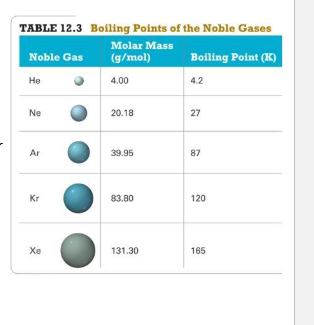
The noble gases are all nonpolar atomic elements
The stronger the attractive forces between the molecules, the higher the boiling point will be.
As the molar mass increases, the number of electrons increase. Therefore, the strength of the dispersion forces increases.
The stronger the attractive forces between the molecules, the higher the oiling point will be.
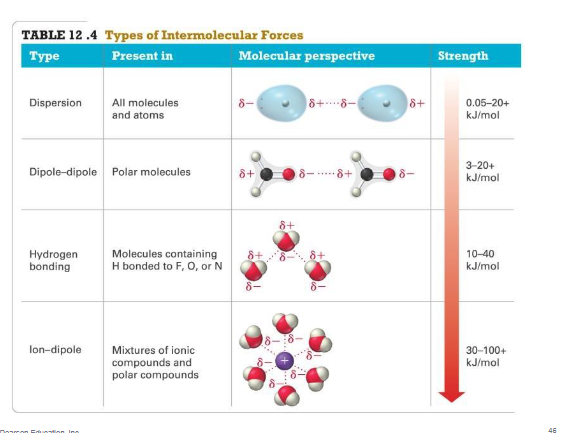
Type of Intermolecular Forces
Strength from weakest to strongest intermolecular forces
Dispersion —> Dipole-Dipole —> Hydrogen Bonding —> Ion-Dipole
Solutions: Effect of Intermolecular Forces
Likes dissolve likes
Polar molecules and ionic compounds are more soluble in polar solvents.
Water + ethanol (H-bonding), water + NaCl (dipole-ion)
Nonpolar molecules are more soluble in nonpolar solvents.
Pentane + Hexane (dispersion)
Other driving forces of dissolution: Energy and entropy
Energy (formation of bonds between solute and a solvent)
Question: Why do some substances dissolve even if the process are endothermic? (almost all salts dissolve endothermically)
Another driving force:
Nature’s Tendency Toward Mixing: Entropy
Entropy: Given a space of two different noble gases with a barrier separating them. Removing the barrier, they will naturally mix because there is a higher probability of the two gases moving around and naturally mixing.
Saturated Solution
When the solution is in the state of dynamic equilibrium - we call it a saturated solution. (Recrystallizing back into the salt and then dissolving again)
Solubility is the maximum amount of substance that can be dissolved in certain amount of liquid.
Solubility equals to the concentration of the saturated solution.
Solubility of Solids in Water
Solubility is maximum amount of substance that can be dissolved in certain amount of liquid.
Solubility is generally given in grams of solute that will dissolve in 100 g of water or it can be given as molar solubility.
Solubility of NaCl in water is 35g/100g H2O
or approximately 6mol/L (per L of solution)
Unsaturated, Saturated, and Supersaturated Solutions
Unsaturated - amount of solute is below solubility; rate of dissolving is higher than rate of recrystallization.
Saturated - amount of solute equals solubility; rate of dissolving equals rate of recrystallization.
Supersaturated - amount of solute is above solubility; metastable solution
Temperature Dependence of Solubility of Solids in Water
For most solids, the solubility of the solid increases as the temperature increases. (This is when dissolution is endothermic)
Enthalpy of Solution > 0
Solubility curves can be used to predict whether a solution with a particular solute dissolved in water is saturated (on the curve), unsaturated (below the curve), or supersaturated (above the curve)

Supersaturated Solution: How Can You Make a Solvent Hold More Solute Than It Is Able To?
Solutions can be made saturated at non-room conditions and then can be allowed to come to room conditions slowly.
Some solutes, instead of coming out of solution when the conditions change, get stuck between the solvent molecules, and the solution becomes supersaturated
Supersaturated solutions are unstable and lose all the solute above saturation when disturbed.
Gas/Liquid Solutions. Solubility of Gases in Liquids
Solubility of gases depends
On the nature of the particular gas and liquid (like polarity or attraction between solute/solvent molecules)
On temperature
On pressure
Gases generally have lower solubility in water than ionic or polar covalent solids because most gases are nonpolar molecules. Usually, gases with high solubility are actually reacting with water.
Solubility, mg/100g H20 at 25C:
HCl - 72,000
NH3 - 25,000
O2 - 5
N2 - 3
He - 1

Temperature and Pressure Dependence of Solubility of Gases in Water
For all gases, the solubility of the gas decreases as the temperature increases.
The enthalpy of solution is exothermic because you do need to over come solute-solute attractions.
The larger the partial pressure of a gas in contact with a liquid, the more soluble the gas is in the liquid.
Cola is bottled under pressure about 5 atm.

Henry’s Law
Pressure greatly influences the solubility of a gas.
Henry’s law states that the solubility of a gas in a liquid is proportional to the pressure of the gas over the solution.
(Formula not in formula sheet, so unsure how important this is, but wasn’t on quiz either so probably 60% not important.)
Solubility of Gas = k(h) * Partial Pressure of gas (P gas)
Each gas has it’s own k(h)
In Henry Law problems we assume that the volume of the pure solvent equals the volume of the solution. BTW

Solution Concentration
How much solute is dissolved in the certain amount of solution?
Concentration is the amount of solute dissolved in the unit quantity of solution or solvent.
[NaCl] means “concentration of NaCl”
Concentration Types
Molarity (M)
Molality (m)
Mole fraction (x)
Mole percent (%)
Parts by mass (%)
Molarity
Molarity (M or mol/L) is defined as the moles of solute per 1 liter of solution.
Molarity slightly depends on temperature because volume increases with increasing temperature.

Molality
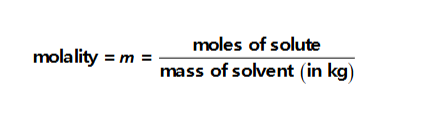
Molality (or molal concentration) m is the number of moles of solute dissolved in 1 kg of solvent.
Units of molality are m (means moles/kg)
Does molality depend on temperature?
Mole Fraction and Mole Percent
Mole Fraction X(a)
Is the ratio of moles of the component A to the total amount of moles in the mixture.
Mole fraction is unitless.
Mole fraction of component A = moles of A/ sum of moles of all components.
Sum of all mole fractions equals 1
1= X(a) + X(b) + X(c) + X(d) in the mixture A+B+C+D
Mole percent is simply mole fraction expressed in a % or percentage
Mass Percent
Mass Percent, %w/w, %mass, or wt%
Percent by mass = mass of solute/mass of solute + mass of solvent * 100%
ppb or ppm is just multiplied by a different percentage of a billion 10^9 or a million 10^6
Converting Concentration Units
Write the given concentration as a ratio
Separate the numerator and denominator
Separate into the solute part and solution part
Convert the solute part into the required unit
Convert the solution part into the required unit
Use the definitions to calculate the new concentration units
Dalton’s Law
For the mixture of non-reacting gases, the total pressure exerted is equal to the sum of the partial pressures of the individual gases.
For the mixture of gases A, B, and C:
P(total) = P(A) + P(B) + P(C)
Partial Pressure of (A) = P(total) * mole fraction of A
Colligative Properties
Colligative properties are properties whose value depends only on the number of solute particles and not on what they are.
Colligative properties are:
Vapor-Pressure Lowering
Boiling Point elevation
Freezing Point Depression
Osmotic Pressure
Van’t Hoff Factor
Colligative properties are properties that depend on the number of solute particles in solution.
Electrolytes undergo dissociation when dissolved in water.
The Van’t Hoff factor (i) account for this effect.
i = actual number of particles in solution after dissociation / number of formulas units initially dissolved in solution.
The Van’t Hoff Factor (i) is usually smaller than predicted due to partial dissociation or to the formation of ion pairs.
Molecular non electrolytes always tend to equal 1 however.

Vapor Pressure Lowering for the “volatile + non-volatile” system
The vapor pressure of a solvent in a solution is always lower than the vapor pressure of the pure solvent.
The vapor pressure of the solution is directly proportional to the amount of the solvent in the solution.
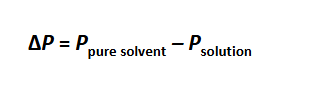
The difference between the vapor pressure of the pure solvent and the vapor pressure of the solvent in the solution is called the vapor pressure lowering.
Change of Pressure = Pressure of Pure Solvent - Pressure of Solution
How to calculate partial pressure of a solvent over a solution: Raoult’s Law
(for nonvolatile + volatile)
Partial pressure of a solvent over a solution is given by the vapor pressure of the pure solvent times the mole fraction of the solvent in the solution.
P1 = X(1)P1(standard)
P1 partial pressure of solvent over solution
P1(standard) is vapor pressure of pure solvent
X(1) is the mole fraction of solvent
To find pressure lowering: Just minus pressure of pure solvent by pressure of solvent in solution
If problem gives you volume of water in mL, convert it immediately to grams because density of water is 1g/1mL

Raoult’s Dumass Law that apparently has Van’t Hoff Factor when calculating mole fraction (for nonvolatile + volatile)
When calculating for the Pressure of the solution, (solvent with solute) it is P(pure solvent) * mole fraction of solvent except,
That the moles of the solute needs to be multiplied by i.

Raoult’s Law - Volatile + Volatile
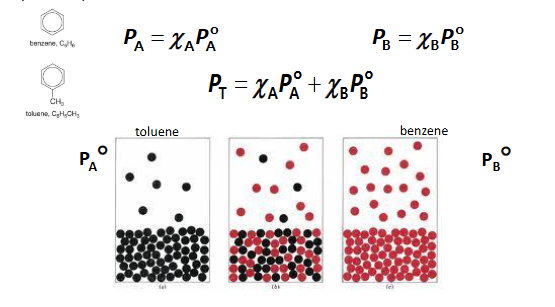
If both components of a solution are volatile, the vapor pressure of the solution is the sum of the individual partial pressures.
P(a) = X(a)Pa(standard)
P(b) = X(b)Pb(standard)
Ptotal = X(a)Pa(standard) + X(b)Pb(standard)
Finding the mole fraction during the gas phase
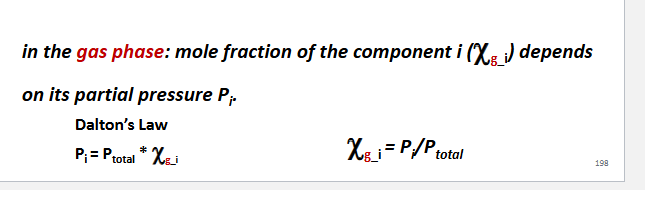
In the gas phase: mole fraction of the component depends on its partial pressure Pa or Pb
More details about distillations of volatile + volatile components and deviations from Raoult’s Law
The gas phase is richer by the more volatile component (which is the benzene in the benzene and toluene solution)
b) When the solute-solvent interactions are stronger than the solute (solute-solute) + (solvent-solvent), the total vapor pressure of the solution will be less than predicted by Raoult’s law because the vapor pressure of the solute and solvent are lower than ideal.
c) When the solute-solvent interactions are weaker than the (solute-solute) + (solvent-solvent), the total vapor pressure of the solution will be more than predicted by Raoult’s law

Boiling Point Elevation
A solution of nonvolatile substance boils at a higher temperature than the pure solvent.
A liquid boils when its vapor pressure equals to the atmospheric pressure.
Vapor pressure of the liquid is lower than the vapor pressure of the pure liquid, because of that solution boils at the higher temperature
△Tb = Tb(final) - Tb(standard)
△T = Kb i m
Where
Kb boiling point elevation constant
m molality of solute
i van’t hoff factor
(Kb is particular for each solvent)
Freezing Point Depression
Solution of nonvolatile substances freezes at a lower temperature than the pure solvent.
Impurities impede formation of crystal lattice.
△Tf = Tf(standard) - Tf(final)
△Tf = Kf i m
Where
Kf freezing point depression constant
m molality of solute
i number of particles (van’t Hoff i factor)
(Kf is particular for each solvent)
The Van’t Hoff Factor (i) for partial dissociation
Strong electrolytes dissociate completely, i = 2
Weak electrolytes dissociate only partially, 1 < i < 2
Two different formulas for this
Will post the image here instead, would be a nightmare to type out.

Osmosis (How does a sprout break through asphalt)?
Osmosis is the selective passage of solvent molecules through a porous membrane from a more dilute solution to a more dilute solution to a more concentrated one.
Semipermeable membrane: a membrane with tiny pores that are big enough to allow solvent molecules to pass through them, but not big enough to allow the passage of large solute molecules or ions.
Osmotic Pressure (π), of a solution is the pressure required to stop osmosis.
π = iMRT
where π is osmotic pressure in atm
M is molarity (moles/L)
R gas constant (0.08206 L*atm/mol*K)
T absolute temperature (Kelvin)
i number of particles (van’t Hoff factor)

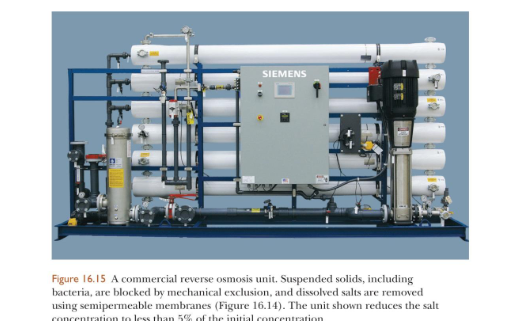
Reverse Osmosis
Reverse Osmosis is the process of applying pressure to “push water out of solution
It’s possible to make seawater into pure water, just fucking impossible is all.
Osmosis in biological systems, Crenation of blood cells in the hypertonic solution
Hypertonic - solution of higher concentration (shriveled blood cells)
Isotonic - solution of equal concentration (normal blood cells)
Hypotonic - solution of lower concentration (swollen blood cells)

How to distinguish real solution from heterogeneous mixtures: and the in-between Colloids
Real solutions: salt water, air, alloys
Heterogeneous mixtures: sand + water, blood, smog (air + ash particles), air + dust, salt +sugar
Colloid: a solution in which the solute particle diameter is between 1nm and 1000nm
In true solutions, the maximum diameter of the a solute particle is about 1nm.
Colloid particles have very large surface area, which accounts for these two characteristics of colloidal systems:
They form stable dispersions; that is, they do not settle out
They scatter light, and therefore, appear turbid, cloudy, or milky
Tyndall (tingel) effect
A characteristic of colloids in which light passing through the colloid scatters
e.g., smoke, serum, fog
