Chem 1210 Unit 1
 Call Kai
 Learn
Learn Practice Test
 Spaced Repetition
 Match
Match Flashcards
 Knowt Play
1/25

Earn XP
Description and Tags
Name | Mastery | Learn | Test | Matching | Spaced | Call with Kai | Chat |
|---|
No analytics yet
Send a link to your students to track their progress
26 Terms
what is chemical equilibrium?
a state in a reversible chemical reaction where the forward and reverse reaction rates are equal
no net change in the concentrations of reactants and product
when does a reaction reach equilibrium?
Depends on the equilibrium constant (K)
How long does it take to reach equilibrium?
Depends on the reaction rates
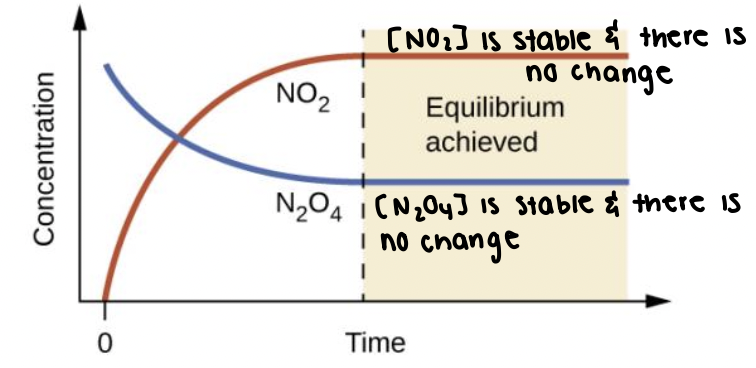
on a concentration time graph of a reactant and product, when is equilibrium reached?
equilibrium is reached when both reactant and product concentrations are stable, and do not change.
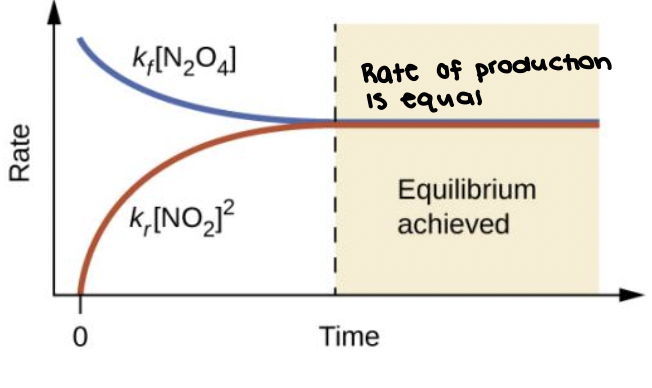
on a rate and time graph, when is equilibrium reached?
equilibrium is reached when both reactant and product rates merge to become the same value.
In chemistry, what does the equilibrium quotient Q mean?
Q is the ratio of product concentrations to reactant concentrations at any point during a reaction.
what does a q value help us determine when compared to K values?
It helps determine the direction a reaction will proceed to reach equilibrium
If Q is larger than K, which way will a reaction proceed in order to reach equilibrium?
Proceeds to the left
If Q is smaller than K, which way will a reaction proceed in order to reach equilibrium?
proceeds to the right
What does the equilibrium expression K mean?
The equilibrium constant K represents the ratio of product concentrations to reactant concentrations at equilibrium in a chemical reaction
It indicates the extent of the reaction at equilibrium
it will determine when a reaction will reach equilibrium
What are the 2 different types of equilibrium constant K values
Kc and Kp
Kc
relates different concentrations
Kp
relates partial pressures instead of []
can be mixed and matched to have some be [] and some be partial pressures
Can relate Kp to Kc through the ideal gas law
K p=K c×(RT)Δn
What type of values (I.C.E) do we use in the K value?
only equilibrium values
When trying to solve for a third K value when given 2 k values, what 2 different methods can you use to solve for K3?
The property that the K equation 1 x K equation 2
make a net K equations by cancelling out the 2 givens
How can K tell us the composition of an equilibrium mixture (more reactants or products)
we can use K to tell us if there are more products or more reactants
Q is used to tell us the direction of a reaction to establish an equilibrium
the magnitude of K tells us what the equilibrium mixture itself is like
A small K (K<10-3) means the equilibrium mixture is mostly
reactants
A large k (k>103) means the equilibrium mixture is mostly
products
an intermediate K value (10-3<K<103) means the equilibrium mixture is
mostly equal
What are 3 ways to use K?
use K to determine the equilibrium mixture
to predict the direction of reaction
predict the equilibrium system’s response to stress
what is the le chatelier principle
Le Chatelier's Principle: It states that if a system at equilibrium is disturbed, the system will shift to counteract the disturbance and restore equilibrium.
what are some LCP changes
adding or removing substances
changing temp
changing pressure or volume
adding a catalyst or inert gas
what effect does adding a catayst have
will lower the Ea for the reverse and forward rxn
what effect will an inert gas have on Kc or Kp value
will not change K