BIOL 121 Midterm 1 UBC
 Call Kai
 Learn
Learn Practice Test
 Spaced Repetition
 Match
Match Flashcards
 Knowt Play
1/69

There's no tags or description
Looks like no tags are added yet.
Name | Mastery | Learn | Test | Matching | Spaced | Call with Kai | Chat |
|---|
No analytics yet
Send a link to your students to track their progress
70 Terms
What is the ploidy of a chromosome?
The number of unique chromosomes
Haploid cells:
# of chromosomes = n
Diploid cells:
# of chromosomes = 2n
The number of centromeres =
number of chromosomes
Haploid
23 different types of chromosomes
Diploid
2 x 23 = 46 different types of chromosomes
Triploid cells:
# of chromosomes = 3n
Locus
A specific location on a chromosome
Homologous pair
Two pairs of chromosomes that have alleles for the same gene at specific loci (can be replicated or not)
Gene
A specific region of DNA that encodes a functional RNA or protein product
Allele
Different versions of a gene
After replication,
sister chromatids have identical alleles
Homologous chromosomes may or may not...
have the same alleles
In which phase does DNA replication occur?
S phase
Unreplicated chromosomes
Consists of a single, long DNA double helix wrapped around proteins
Replicated chromosome
Consists of two copies of the same DNA double helix
Condensed replicated chromosomes
Consists of DNA condensed around its associated proteins, resulting in a compact chromosome that is 10,000 times shorter than its original length
Mitosis Interphase:
After chromosome replication, each chromosome is composed of two sister chromatids. Centromeres have replicated.
Mitosis prophase:
Chromosomes condense and spinal apparatus begins to form.
Mitosis prometaphase:
Nuclear envelope breaks down. Microtubules contact chromosomes at kinetochores.
Mitosis Metaphase:
Chromosomes complete migration to middle of cell
Mitosis Anaphase:
Sister chromatids separate into daughter chromosomes, which are pulled apart to opposite poles of the spindle apparatus
Mitosis Telophase:
Nuclear envelope reforms, and chromosomes de-condense
Mitosis Cytokenisis:
Cell division begins, actin myosin ring causes plasma membrane to begin pinching in. Cell division is complete, two daughter cells form.
What can mitosis help with?
Growth, wound repair, asexual reproduction
Mutations can cause errors during
DNA replication and and DNA repair (ex from UV, leading to differences in nucleotides)
differences between meiosis and mitosis
1. Mitosis is division of somatic cells, meiosis is the division of sex cells, 2. 2 genetically identical daughter cells are produced in mitosis, 4 genetically unique daughter cells are produced in meiosis, 3. Mitosis has no crossing over but meiosis does, 4. Mitosis is one division, meiosis is 2 divisions.
What would allow a cell to be ready for mitosis?
The cells have not crossed over and they have replicated
What would allow a cell to start meiosis 1?
The cell is replicated and diploid
Mutations can affect
parts of or whole chromosomes
Nondisjunction
A replication mistake leading to too many or too few chromosomes in daughter cells. Chromosomes don't separate properly. (In mitosis, a daughter cell is haploid and one is triploid, in meiosis, a chromosome doesn't separate at the centromere during anaphase).
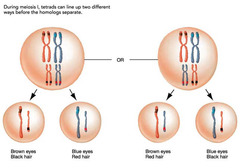
Independent Assortment
The random orientation of homologous chromosome pairs during metaphase I allow for the production of gametes with many different assortments of homologous chromosomes
Crossing over
The exchange of genes between homologous chromosomes, resulting in a mixture of parental characteristics in offspring in meiosis after DNA replication. Cutting the chromatids and swapping chromatid regions.
Genetic recombination
The exchange of genetic material between different organisms which leads to production of offspring with combinations of traits that differ from those found in either parent. A form of variation generation.
Genetic recombination and crossing over are NOT
synonymous
Unlinked genes notation
A1/A3 ; B2/B5
Linked gene notation
A1,B2/A3,B5
Meiosis occurs to produce
gametes
At what stage of meiosis scopes crossing over and recombination occur?
Prophase 1
What can cause genetic variation?
Crossing over with genetic recombination (which alleles end up on which chromosome), independent assortment of chromosomes (which allele end up in the same/which gamete), random fusion of gametes (which alleles need up in the same individual).
Mutation is the source of
variation
Mutation:
permanent change in the nucleotide sequence
Phenotype:
Observable properties of an organism, includes physical appearance & development & behaviour, influenced by genotype and environment (why non-identical phenotypes of the same genotype exist), they can be more or less heritable
What determines the heritable influence off a phenotype?
Many genes that can determine a single phenotype and single genes that can influence more than one phenotype
Alleles are not inherently dominant or recessive:
dominance depends on the relative influence of each allele on a specific phenotype under specific environmental conditions
Alleles of genes segregate...
independently (they are located on other chromosomes)
When writing punnent squares, make sure to literally say:
My predictions match my data!
For both incomplete dominance and codominance,
the heterozygotes show a different phenotype than either homozygote
Wild type
refers to the most common form of the allele or phenotype or the original allele/phenotype that was observed in nature
Autosome
Any chromosome that is not a sex chromosome
Humans have how many autosomes?
44 (22 pairs)
Humans have how many sex chromosomes?
2 in each diploid pair
The Y chromosome is much
smaller than the X chromosomes in humans
xx
female
xy
male
X chromosome has
over 1400 genes and contains over 150 million base pairs
Y chromosome has
over 200 genes and contains 5o million base pairs
X chromosome contains many genes that are essential for
development, specifically of intelligence and social cognition
Y chromosomes carry few genes but these are essential for
the expression of male specific traits, ex SRY gene
Physical linkage
Two different genes are on the same chromosome
Sex linkage
The gene is located on one of the sex chromosomes (the gene is either x or y linked)
How do X chromosomes function similarly top autosomes in females?
Diploid for x linked genes, can be homozygous or heterozygous
What occurs since the X chromosome in males have no homologue? (same with Y)
Males only have one copy of a sex linked gene and cannot be homo or heterozygous
Gender
Continuum - socially constructed roles, behaviours, and identities of girls, women, boys, men and gender diverse people
Sex
Continuum - a set of biological attributes, primarily associated with physical and physiological features including chromosomes, gene expression, hormone levels and function, and reproductive/sexual anatomy
Sexual Orientation
Continuum - the direction of romantic, sexual, and emotional feelings
Square represents what in a pedigree?
Male
A circle represents what in a pedigree?
Female
Shade represents what in a pedigree?
Affected
Un-shaded represents what in a pedigree?
Un-affected