filix mas (male fern)
 Call Kai
 Learn
 Practice Test
 Spaced Repetition
 Match
 Flashcards
 Knowt Play
1/7

There's no tags or description
Looks like no tags are added yet.
8 Terms
part used
the dried rhizomes and frond (whole blade + stalk) bases of Drypteris filix mas, family polypodiaceae
should be used within one year after collection as a long storge↓ activity and interior becomes brown
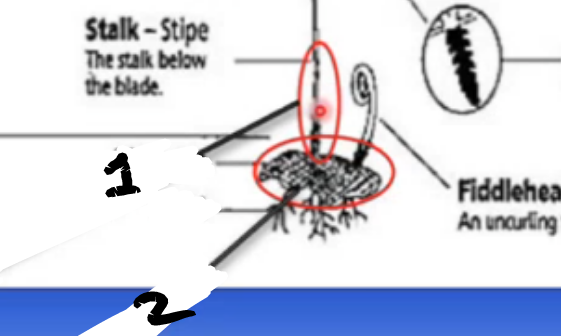
morphology (whole organ)
1- frond base
2- rhizome densely covered with numerous brown membranous scales ramenta (triangular in shape, one cell in thickness, and has 2 characteristic: 2 small unicellular glands at the base + margin shows 2-celled teeths/projection

histology
1- cuticle
2- hypodermis
3 - starch
4- sclerenchyma capsule
5- endodermis
6- pericycle
7- xylem
8- phloem
9- parenchyma
ground tissue is rounded parenchyma cells containing starch
cells leave large intercellular spaces lined by a thin cuticle for unicellular club-shaped internal trichomes to grow (secrete a greenish-oleo-resin)
T.S contains dictystele VB
key elements
1- little odor
2- Sweet and astringent taste at first but becomes bitter and nauseous
3- shows green starchy interior
4- par. with glandular hair and starch
5- scalariform xylem vessels
6- ramenta with 2-celled marginal teeth
7- starch
8- non-lignified hypoderm
active constituents
1- filmarone (yellow amorphous ester of hilicic acid and aspidinal) + (tricyclic phlavoglucinal derivative
2- filic acid
3- aspidinal
4- flav aspidic acid
5- lavaspidinal
6- albaspidin
7- fixed ails
8- resin
9- starch
uses
1- vermifuge to tapeworms (kills and expels them)
2- irritant poison (in large doses)
toxicity
not taken with castor oil purgative (↑ absorption of filmarone) causes blidness → can be taken with saline purgative
adulterants
1- lady fern (show ramenta but with an entire margin and no glandular trichomes)
2- shield fern (show numerous unicellular, spherical glandular trichomes)