Lecture 4: Ancient Fishes
 Call Kai
 Learn
 Practice Test
 Spaced Repetition
 Match
 Flashcards
 Knowt Play
1/51

There's no tags or description
Looks like no tags are added yet.
52 Terms

Likely evolutionary origin of fishes
Invertebrate chordate ancestors.

Proposed chordate-to-vertebrate lineage progression
Subphylum Urochordata (tunicates) → Subphylum Cephalochordata (lancelets) → Subphylum Craniata, Infraphylum Vertebrata (hagfish).

Original function and evolutionary transition of pharyngeal gill slits
Filter feeding and gas exchange → evolved into respiratory gills.

Original chordate function and evolutionary transition of the notochord
Semi-rigid supportive axial rod → evolved into vertebrae.

Embryonic structure that differentiates into the brain and spinal cord
Dorsal hollow nerve cord.

Significance and evolutionary modification of the muscular post-anal tail
Provided propulsion and mobility in early chordates → evolved into a muscular elongate body.
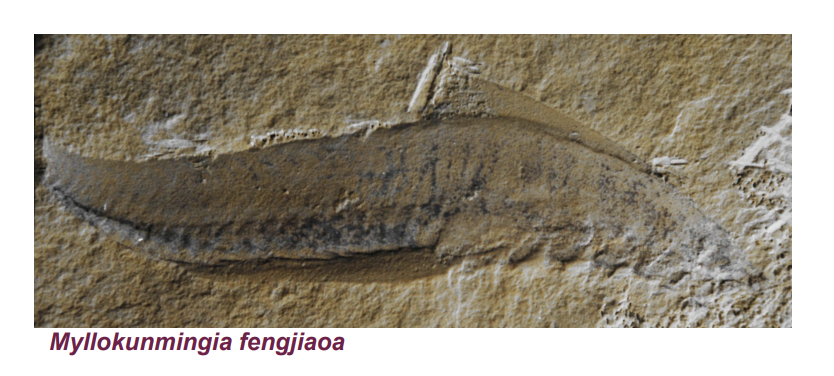
Geological timing of first fish fossils and early fossil record status
First fossils appeared in the Early Cambrian (541–485 mybp); no fossil record exists of the very first transitional fishes.
Evolutionary radiation event marking the emergence of early fishes
The Cambrian explosion.
Ecological evidence supporting a marine origin of fishes
The ocean is the exclusive habitat of all non-vertebrate chordates.
Geological evidence supporting a marine origin of fishes
Marine sedimentary deposits contain nearly all early vertebrate fossils.
Primary scientific rationale for studying extinct fishes
The vast majority of species that have ever existed are extinct.

Two major groups of extinct jawless fishes (Agnatha)
Conodonts and Ostracoderms.
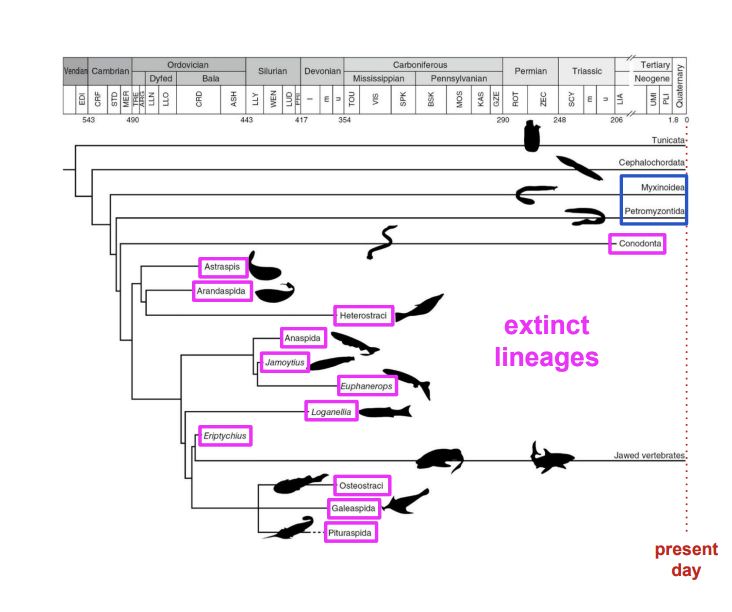
Two extant groups of jawless fishes (Agnatha)
Hagfish and Lampreys.

Etymological derivation of "Conodont"
Cone-shaped teeth.

Primary geological application of conodont microfossils
Biostratigraphy (dating and correlating sedimentary rock strata).

Diagnostic anatomical traits of Conodonts
V-shaped muscle blocks (myomeres), cartilaginous cranial skeleton, eyes housed in otic capsules, and a notochord.

Ostracoderms
An extinct grade of jawless fishes covered in bony external armor plates ("shell-skinned").
Four obsolete taxonomic superclasses of Ostracoderms
Pteraspidomorphi, Anaspidomorphi, Thelodontomorphi, and Osteostracomorphi.
Fossil record onset and fin anatomy of Ostracoderms
Emerged in the Upper Cambrian (∼500 mya); true paired fins were generally absent.
Feeding mechanism of Ostracoderms
Muscular pumping pulled water into the pharynx to filter organic matter from bottom sediment or consume soft-bodied invertebrates.
Skeletal and connective structures derived from neural crest cells in fishes
Gill arches, craniofacial connective tissues, and dermal bones.
Sacabambaspis
An early armored, jawless pteraspidomorph fish known from the Late Ordovician (∼450 mybp).
Superclass Gnathostomata
Taxonomic superclass comprising all jawed vertebrates.

Prevailing evolutionary hypothesis for vertebrate jaws and its supporting evidence
Hypothesis: Jaws evolved from anterior pharyngeal gill arches. Evidence: Mixed; transitional fossils are lacking, and the earliest jawed fossils already possessed derived jaw features.
Ecological consequence of jawed fish diversification on jawless fishes
Jawed fish predation on jawless taxa likely contributed to the decline and extinction of many agnathan lineages.
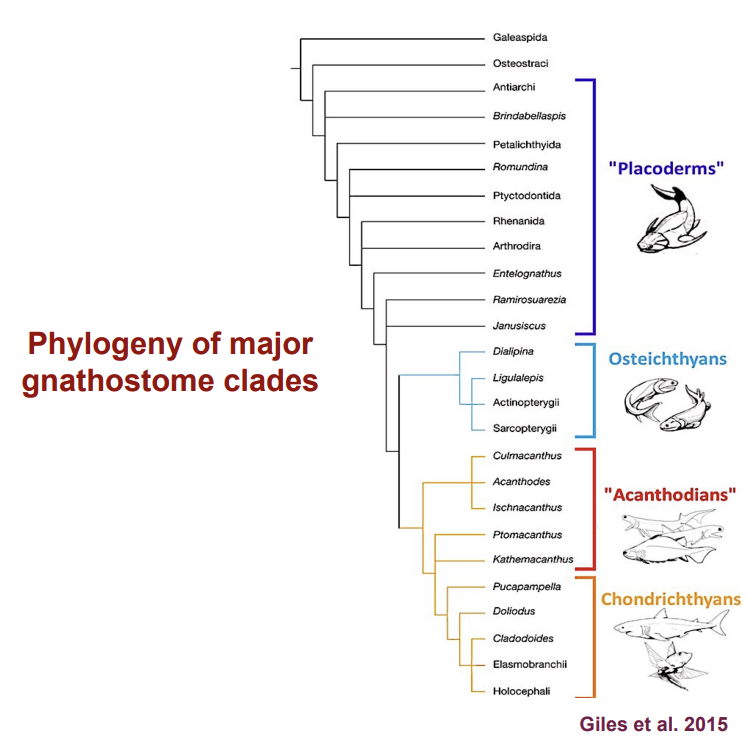
Earliest known class of jawed vertebrates
Placoderms (Placodermi).
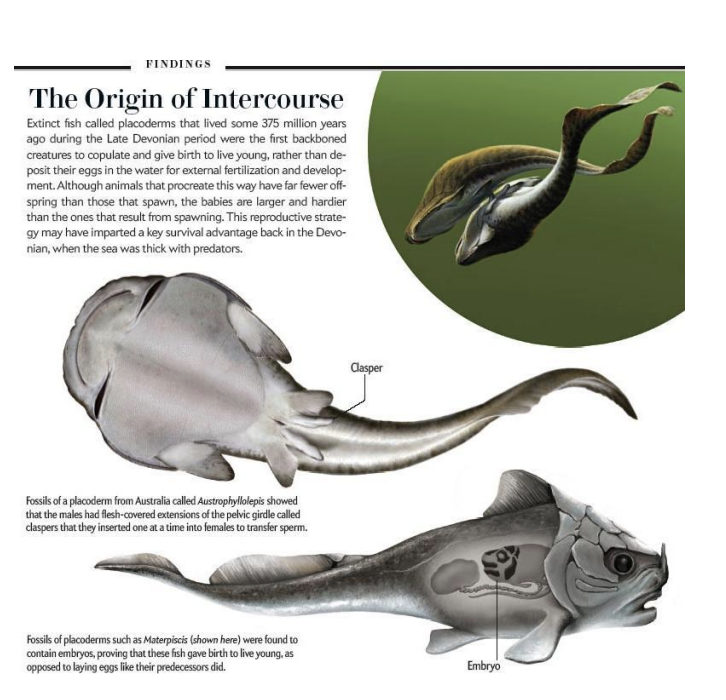
Two reproductive innovations first documented in Placoderms
Internal fertilization and viviparity (live birth).
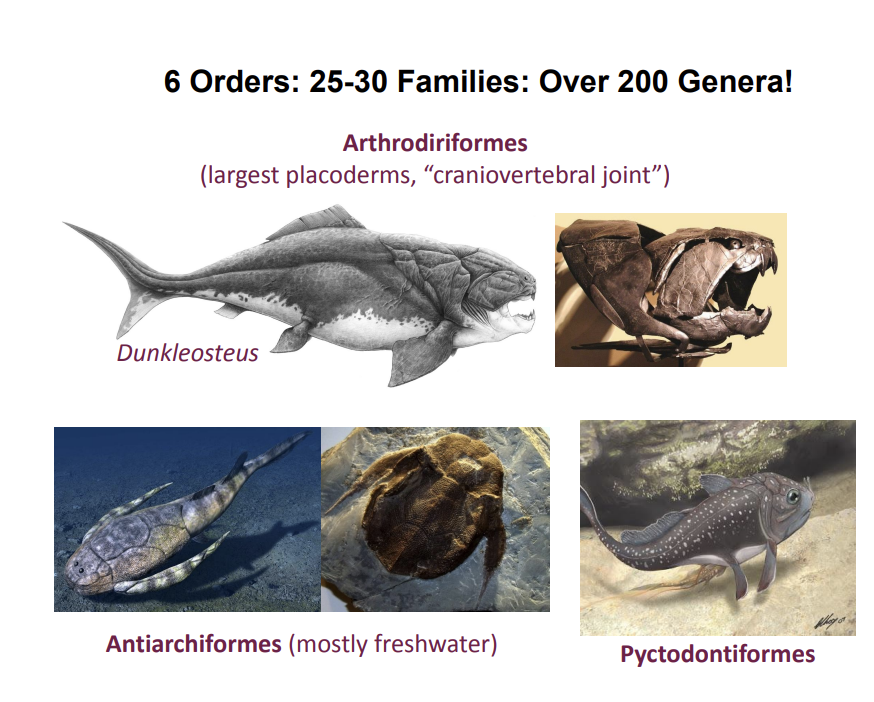
Key physical and anatomical adaptations of Placoderms
Anterior heavy bony armor plating, heterocercal caudal fin, paired fins, and self-sharpening dermal gnathal plates instead of replaceable teeth.
Habitat distribution and ecological niches of Placoderms
Originated in marine systems before radiating into freshwater; filled both benthic and pelagic open-water predatory niches.

Class Acanthodii ("Spiny Sharks")
Early jawed fish class emerging in the late Ordovician/early Silurian characterized by strong, rigid fin spines.
Morphology and ecological habits of Acanthodians
Covered in small, diamond-shaped scales; inhabited both marine and freshwater environments as active pelagic predators.
Zhu et al. (2022) fossil discoveries regarding early jaw evolution
Identified earliest jawed teeth dating to 439 mybp and demonstrated both placoderms and acanthodians possessed jaws by 436 mybp.
Diagnostic skeletal tissue of Class Chondrichthyes
Tessellated (prismatic) calcified cartilage.

Cladoselachimorpha tooth morphology
Cladodont dentition, featuring a prominent, tall central cusp flanked by multiple smaller lateral cusps.
Superorder Ctenacanthimorpha diagnostic morphological trait
Two dorsal fins, each anchored by a prominent, ornate spine.

Superorder Xenacanthimorpha habitat and dentition
Predominantly freshwater; characterized by pleuracanth teeth (two large lateral cusps flanking a small central cusp).

Three extinct orders belonging to Subclass Holocephali
Petalodonts, Iniopterygians, and Eugeniodontids.

Two infraclasses comprising Subclass Euselachii
Infraclass Hybodonta (extinct sister lineage to modern elasmobranchs) and Infraclass Elasmobranchii (extant sharks, rays, skates, and relatives).

Class Osteichthyes vs. Subclass Sarcopterygii
Osteichthyes includes all bony fishes; Sarcopterygii denotes the lobe-finned fishes characterized by muscular, bone-supported fin bases.
Two extant lineages representing Subclass Sarcopterygii
Coelacanths (Actinistia) and lungfishes (Dipnoi).

Fish-like anatomical characteristics of Tiktaalik roseae
Internal gill arches, dermal body scales, and webbed fin rays.

Tetrapod-like transitional features of Tiktaalik roseae
Dorsoventrally flattened skull, mobile neck (loss of opercular bony connection), and a functional proto-wrist joint.

Defining morphological feature of Subclass Actinopterygii
Ray-finned fishes whose fins are supported by radiating, dermal lepidotrichia.
Palaeoniscoids
An ancestral, basal assemblage of ray-finned fishes exhibiting primitive body plans foundational to modern actinopterygians.
Living representatives of Infraclasses Cladista and Chondrostei
Cladista: bichirs and reedfishes; Chondrostei: sturgeons and paddlefishes.
Two major subdivisions comprising Neopterygii
Holostei (gars and bowfins) and Teleostei (modern teleost fishes, representing most bony fish diversity).
"The Age of Fishes"
The Devonian Period.
The Hangenberg Event
An end-Devonian mass extinction episode that eliminated approximately 96% of vertebrate species.
Phylogeny and subdivision of Conodonts
Considered paraphyletic; historically divided into Euconodonts ("true" conodonts) and Paraconodonts.
Phylogenetic branching sequence of ancestral chordates and early jawless vertebrates
Cephalochordata (lancelets) → Urochordata (tunicates) → Cyclostomes (hagfishes and lampreys).
Phylogenetic placement of Acanthodians relative to Chondrichthyans and Osteichthyans
Acanthodians are more closely related to Chondrichthyans (forming a paraphyletic stem group leading to Chondrichthyes) than to Osteichthyans.
Two foundational core concepts for analyzing ancient fish diversity
Defining diagnostic traits of major extinct and extant groups. 2. Evolutionary transition and boundaries between jawless (Agnatha) and jawed (Gnathostomata) fishes.