NPB Module 2: Musculoskeletal System
 Call Kai
 Learn
 Practice Test
 Spaced Repetition
 Match
 Flashcards
 Knowt Play
1/65

There's no tags or description
Looks like no tags are added yet.
66 Terms
Definition: Cartilage
Connective tissue that protects and supports other tissues
What is in cartilage?
Cells, extracellular matrix, and ground substances
Cartilage does Not have
Nerves, Blood supply, Lymphatic vessels
Definition: Proteoglycan
attracts water to provide resistance to compression

#1
GAG Chain

#2
Core Protein

What is this structure called?
Proteoglycan
Purpose of Proteoglycans
the collagen network holds the swollen gel in so the tissue pushes back when compressed
Extracellular matrix (ECM)
produced by the cells within a tissue
Cartilage Cell Differentiation: Mesenchymal Stem Cells
found in the perichondrium and differentiates into chondroblasts during growth/repair
Definition: perichondrium
a dense, irregular layer of connective tissue that surrounds most of the body's hyaline and elastic cartilage
Cartilage Cell Differentiation: Chondroblast
found in growing cartilage and produce most of the matrix
Cartilage Cell Differentiation: Chondrocyte
mature and less metabolic activity, no blood supply and maintain the matrix

1
Perichondrium

2
Chondroblasts

3
Chondrocytes
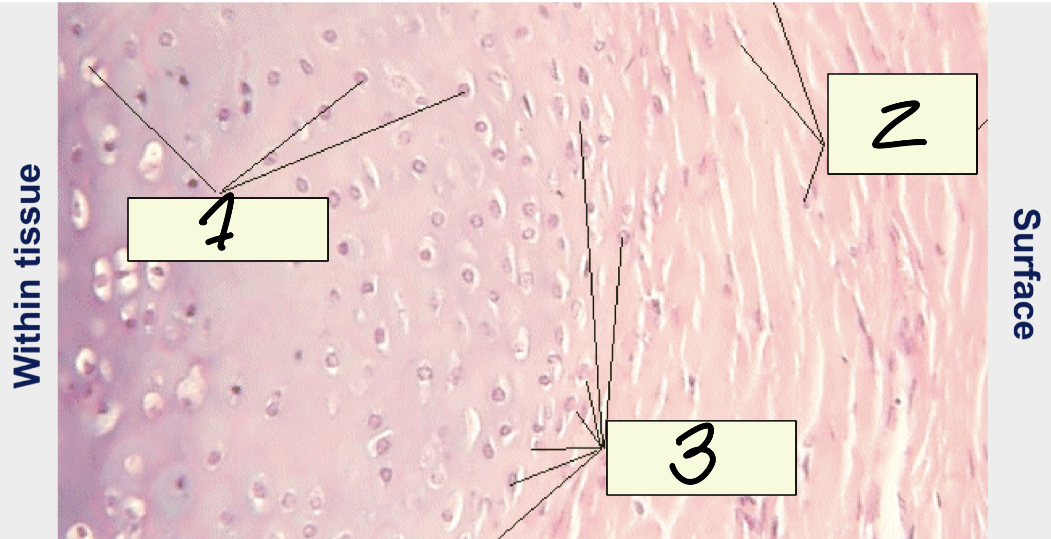
1
Chondrocytes
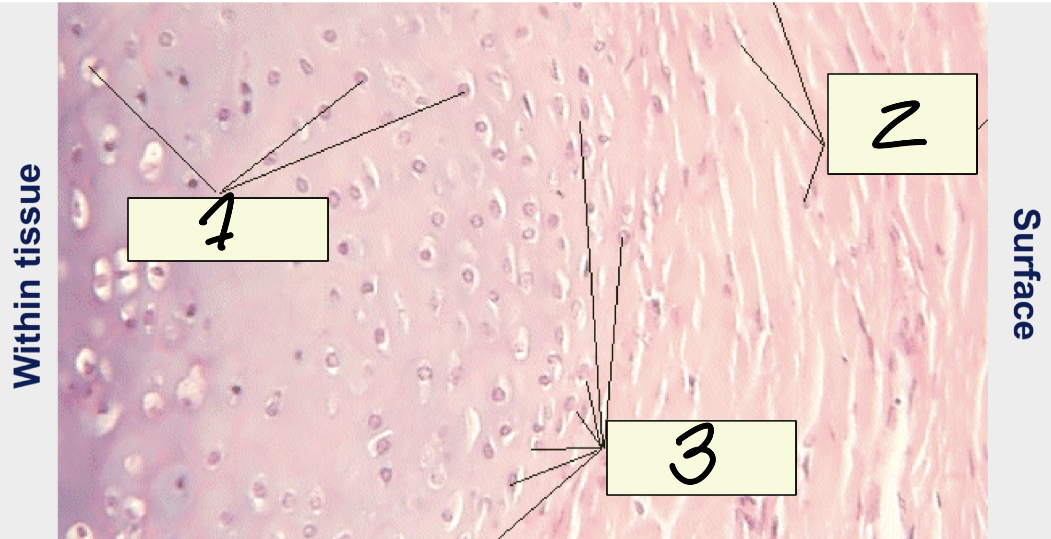
2
Fibroblasts

3
Chondroblasts

what is this image showing?
Cartilage cells differ by location and morphology
what are chondrocytes embedded in?
the matrix
What is cartilage surrounded by?
Perichondrium

1
Perichondrium

2
Cartilage
Two layers of Perichondrium: Outer
fibrous, collagen-rich; Protective
Two layers of Perichondrium: Inner
Chondrogenic precursors, blood vessles; nutrition and repair
Cartilage Growth: Appositional Growth
Mitosis and differentiation of chondrogenic cells into chondroblasts
inner perichondrium
Cartilage Growth: Interstitial Growth
mitosis of chondrocytes and deposit new matrix

what growth is this?
Interstitial Growth

What growth is this?
Appositional Growth

What Cartilage is this
Hyaline

What Cartilage is this
Elastic

What Cartilage is this
Fibrocartilage
Hyaline Cartilage
most common
found in joints
Elastic Cartilage
yellowish
found where both elasticity and rigidity are needed (outer ear)
contains type II collagen and elastin
Fibro cartilage
Resists tension and compression
Type I collagen fibers
shock absorbers
Hyaline cartilage found in:
Shoulder joint
Elastic cartilage found in:
External ear
Fibrous cartilage found in:
intervertebral disc (in between spine)
why does joint cartilage heal so poorly?
No blood supply
No perichondrium
Few and slow chondrocytes
Vertebrate skeleton functions
support
protection of organs
blood cell production in marrow

1
Epiphysis
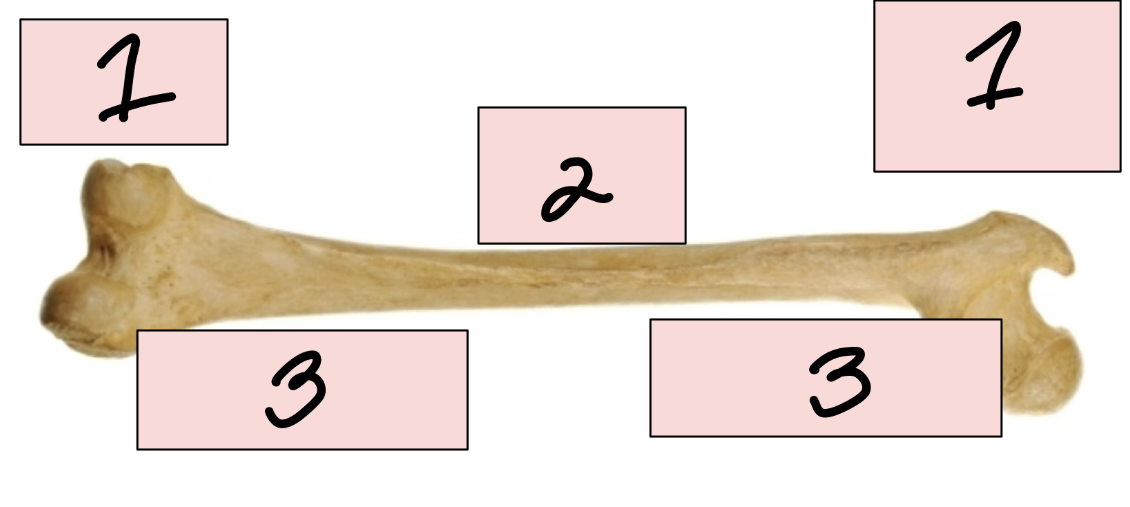
2
Diaphysis

3
Metaphysis

1
Medullary cavity

2
Compact bone

1
Compact Bone (cortical)

2
Trabecular bone (cancellous bone)
Cortical (compact) bone
Very dense
80-90% of the total bone mass
Protects the trabecular bone and the bone marrow
repaired slowly
Trabecular (spongy, cancellous)
network inside bone
10-20% of total bone mass
Provides internal support
Remodeled very quickly
Red marrow
blood-forming (hematopoietic)
at birth all available spaces are filled with red marrow
Yellow marrow
Contains adipocytes
Not blood forming (can covert back to red marrow after severe blood loss)
Converts to yellow with age
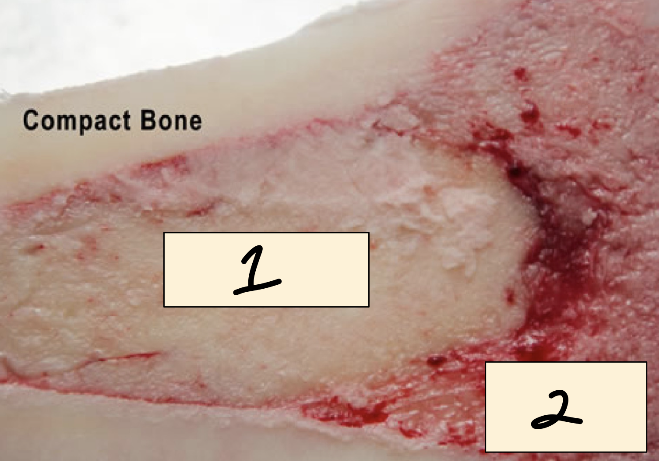
1
yellow marrow

2
red marrow
Osteoclasts ____ bone
resorb
Osteoblasts form ____ or ____
woven bone
Lamellar bone
Woven Bone
Formed quickly
distributed randomly
once mature it is more mineralized than lamellar bone
weaker and temporary
Lamellar bone
organized
formed slowly
stronger

1
Lamellar bone

2
Woven bone
Growth plates: child
open growth plates
Growth plates: Adult
Epiphyseal lines

1
Osteoclast (resorb bone)

2
Bone lining cells

3
Osteocyte

4
Osteoblast (build bone)