Biochem Unit 2 Exam
 Call Kai
 Learn
 Practice Test
 Spaced Repetition
 Match
 Flashcards
 Knowt Play
1/117

There's no tags or description
Looks like no tags are added yet.
118 Terms
What is the primary difference between enzymes and antibodies?
Antibodies bind a stable chemical structure
What are enzymes?
Proteins that catalyze reactions
Lower activation energy, but do not alter the energetics of reactions
Stabilize the reaction intermediate
Optimized to act selectively on one specific substrate
Typically produce a single product
Often regulated
How do enzyme increase reaction rates?
Orienting substrates
Promoting substrate proximity
Constraining structural vibrations
Stabilizing intermediates
What does ΔGŦ predict?
How fast equilibrium is reached
What does Km predict?
Time dependent equilibrium for [ES]
What are the 5 Michaelis-Menten Model Assumptions?
Simple Binding Mechanism
Initial rate conditions [P]≈0, negligible reverse reaction
Steady State: [ES] is constant
Free Ligand: ([S] » [E], so [S] ≈ [S] + [ES])
Enzyme conserved
If substrate concentration is doubled, does V0 also double?
No, it will go up but not double
If graph is Time vs Product concentration?
V0
If graph is Substrate concentration vs Initial velocity?
Km
If graph is Substrate concentration vs ES complex?
Kd
All the different K’s table

What is Kcat?
Kcat is the turnover number of an enzyme, often on ‘rate limiting’ step
What is the best way to compare catalytic efficiencies?
Look at the ratio Kcat / Km.
This is termed the specificity constant or enzyme efficiency
high Kcat good
In Vmax = Kcat[Etotal], what is rate limiting
Kcat
What is Line-weaver Burke equation?

What are the 3.5 kinds of enzyme inhibition?
Competitive
Uncompetitive
Mixed
Special mixed - Non competitive
Inhibition trends table

What are the 4 structural contributions to rate enhancement
Promoting substrate proximity (2-5 fold enhancement)
Orientation of substrates (2-5 fold enhancement)
Constrict structural vibrations (up to 108 fold enhancement)
Stabilizing intermediates (up to 108 fold enhancement)
What are the catalytic triad and mechanisms like between different Serine Proteases?
All Serine Proteases have catalytic triad and nearly identical mechanisms
What is Chymotrypsin
Type of Serine protease
What are the two kinetic steps of Chymotrypsin? (Also draw it)
Acylation
Deacylation

What is the catalytic triad of Chymotrypsin? What does it do?
Serine, Histidine, and Aspartate in close proximity to each other
Prepares nucleophile
What is the hydrophobic/substrate recognition pocket of Chymotrypsin? What does it do?
What binds the bulky/aromatic group
Provides specificity
What is the oxyanion hole of Chymotrypsin? What does it do?
Stabilizing the intermediates, since the intermediates have the negatively charged oxygen that is bound in the oxyanion hole.
What are the 7 steps for Chymotrypsin cleavage?
Substrate binding (hydrophobic pocket)
Nucleophilic attack by Ser
Made possible because Ser is deprotonated due to close proximity of His (acts as a general base), and protonated/positively charged His is stabilized by Asp
Oxyanion hole stabilizes after nucleophilic attack
Release of first product/ half the peptide that is not bound by the hydrophobic pocket (C=O double bound reformed as well)
Water enters active site and is activated by His and Asp
Water attacks carbonyl carbon (Hydrolysis of acyl enzyme)
oxyanion hole stabilizes intermediate again
Bond by Ser and peptide breaks, and C=O double bond reforms (Reforming catalytic Serine)
Release of second product by hydrophobic pocket
What are lipids function?
Fuel and enrgy storage
Insulation/water proofing
Membrane components
How many double bonds does a saturated lipid have
0 double bonds
If you want a more rigid membrane, what kind of lipid will you want
Saturated
If you want a more fluid membrane, what kind of lipid will you want
Unsaturated
is the melting point lower or higher for saturated lipids
Saturated lipids have a higher melting point than desaturated lipids
Draw the structure of a Diacylglycerol

Diacylglycerols promote what?
Diacylglycerols promote membranes
C-3 is what for diacylglycerols?
Head group
Why can steroid hormone receptors function inside the nucleus rather than on the plasma membrane?
Steroid hormones are hydrophobic, thus can cross the membranes
How is the lipid desaturation percentage for organisms in hot springs different from human lipids?
Decreased desaturation, because it would allow for increased surface area alignment, decreases mobility, and creates a more stable, solid membrane structure at high temps
What membrane behavior is changed by desaturation?
Lateral Fluidity
What do flippases do?
Move outer phospholipid to inside of membrane
What do floppases do?
Move inner phospholipid to outside of membrane
What does scramblase do?
Move lipids in either direction, toward equilibrium
Tracking of single-particle tagged lipids show “hopping” between regions. What could form these “molecular fences”?
Membrane regions of different lipid composition (“lipid rafts”)
Large protein-protein complexes in the membrane
Intracellularly-anchored membrane proteins
What is the driving force behind membrane lipid rafts and lateral movements?
Brownian motion
What are the 3 molecules and kinds of passive transport?
All go down an electrochemical gradient
O2 - passive diffusion
Na+ - Diffusion through an aqueous channel
Glucose - Facilitated diffusion with a carrier protein
What are the two components to electrochemical gradients?
Concentration (moves from high concentration to low concentration)
Charge

In this equation, what is C1 and C2 ? What does C2/C1 equal? What is Z, F and ψ?
C1 - Where it originates
C2 - where moving towards
C2/C1 = Q
Z - Charge of ion
F - Faraday’s constant
ψ - Electrical potential (Volts, V)
How does active transport work?
Directly couples ATP to move solutes against an electrochemical gradient
What are the types of Primary Active Transport?
V-, P-, and F-type ATPases
ABC family transporteres
How could you prevent an ABC family transporter from running backwards?
Promoting certain vibrations using a “Brownian ratchet”
What is Secondary Active (Facilitated Diffusion) transport?
Use ions moving down gradient to facilitate solute moving aginst its gradient
What are the types of Secondary Active (Facilitated Diffusion)?
SLC family proteins
Phospholipid scramblases
What are the 3 types of transport systems?
Uniporter
Move 1 thing in either direction, depending on gradient at time
Symporter
Move two things in one direction
Antiporter
Move two things in different directions
What kind of lipids pack tighter?
Saturated Lipids
How is membrane potential produced? What is Resting potential caused by?
Membrane potential = Sodium-potassium pump (Na+/K+)
Resting potential = Various leak channels
How does the Sodium Potassium pump work? What is charge outside and inside the membrane
Pumping out 3 Na+ changes while only letting 2 K+ in.
Keeps inside negative and outside positive
Why is ATP hydrolysis favorable?
Released phosphate and ADP are resonance stabilized
Relief of charge repulsion (phosphates are negatively charged)
Increased entropy
Cell sequesters ADP to decrease product concentration (LeChatelier’s principle)
Because has a negative delta G, can compensate for reactions that have positive delta G
What are channelopathies
Diseases caused by mutations in channels
There are different proposed classifications of GPCR’s, with high sequence similarity within a class and low similarity between classes. The differences between GPCR's of the same class is due to what kind of evolution?
Divergent Evolution (Diff function, high homology)
What are the elements of signal transduction
Reception
Relay
Transduce and amplify
Transduction
Integrate
Feedback
Response
Distribute
What is sensitivity in signal transduction?
The affinity of a receptor for the ligand determines if it can respond to low concentrations of that ligand, or if a higher concentration is needed
What is amplification in signal transduction?
A single signal can trigger a large response by activating many downstream proteins
What is modularity in signal transduction?
May be a different response from same ligand and receptor depending on pre-existing recruitment
Signaling pathways have different “modules” (groups of proteins) that can combine in different ways to lead to different responses
What is desensitization/adaption in signal transduction?
A cell’s response can eventually decrease when it begins signaling constantly
What is integration/divergence? What are the two kinds?
Integration: multiple signals combine to determine a response.
Divergence: one signal branches out to produce multiple responses.
Need two inputs to produce signal
Logic gates - “And/Or” - need two ligands to make signal, or need just one
Pleiotropy - one ligand makes multiple types of signal
What is localized response?
Signal activates but immediately downstream, message remover stops signal. Makes a really fast response
Usually happens with scaffolding proteins for all key players in signal
Signaling produces a response in a specific part of the cell.
Difference between feedback and feedforward loop?
Feedback - Signal goes off and downstream message comes back and tells signal to turn off
Feedforward - Signal goes off and downstream message comes back and tells signal to do more
What are the 4 general types of Signal Transducers
G protein-coupled receptor
Receptor enzyme (tyrosine kinase)
Gated ion channels
Nuclear receptor
hormone binding allows the receptor to regulate the expression of specific genes
What is an agonist?
Molecule (often drug or natural ligand) that binds to receptor and activates it, mimicking the action of a naturally occurring substance
What is an antagonist? What kind of inhibition does it have?
Molecule that binds to a receptor but does not activate it. Instead, it blocks the receptor, preventing agonists from binding and triggering a response
Competitive inhibition since it has no chemistry
What is a G-protein? What are the two states? What is its intrinsic activity?
Binds Guanosine nucleotides
GDP-bound - inactive
GTP-bound - active
Intrinsic GTPase activity (GTP hydrolysis)
What are GEFs?
GEFs (Guanine nucleotide exchange factor) promote GTP replacing GDP → activity
What are the amino acids that can be phosphorylated?
Ser, Tyr, and Thr
What are the amino acids that can be phosphomimetic?
Asp, Glu
What are GAPs?
GAPs (GTPase-activating protein) terminate activity by promoting hydrolysis
Non-small cell lung cancer is frequently driven by a KRAS G12C mutation that inactivates the GTPase. How does this mutation affect KRAS activity?
GTP cannot be hydrolyzed to GDP, so KRAS is perpetually active
What is the structure of G-protein?
Heterotrimer, a, B, y subunits
a is homologoous to small GTPase
Inactive (GDP) bound trimer associates with GPCR
What does Ligand-bound GPCR act as? How does it do it?
Ligand-bound GPCR act as GEF (Guananine nucleotide exchange factor)
Ga dissociates from GPCR
Ga and Gby propagate downstream signals
What does RGS (regulator of G protein signaling) act as?
RGS acts as GAPs for Ga
What is name of Gby
Obligate dimer, always bound together
What is the GPCR signaling pathway
•Ligand binds to its GPCR.
•Activated GPCR acts as a GEF, replacing GDP with GTP on Gα.
•Gα–GTP separates from Gβγ and the receptor.
•Gαs–GTP activates adenylyl cyclase.
•Adenylyl cyclase converts ATP → cAMP.
•cAMP binds to regulatory unit of PKA and activates it.
•Active PKA released and phosphorylates downstream proteins.
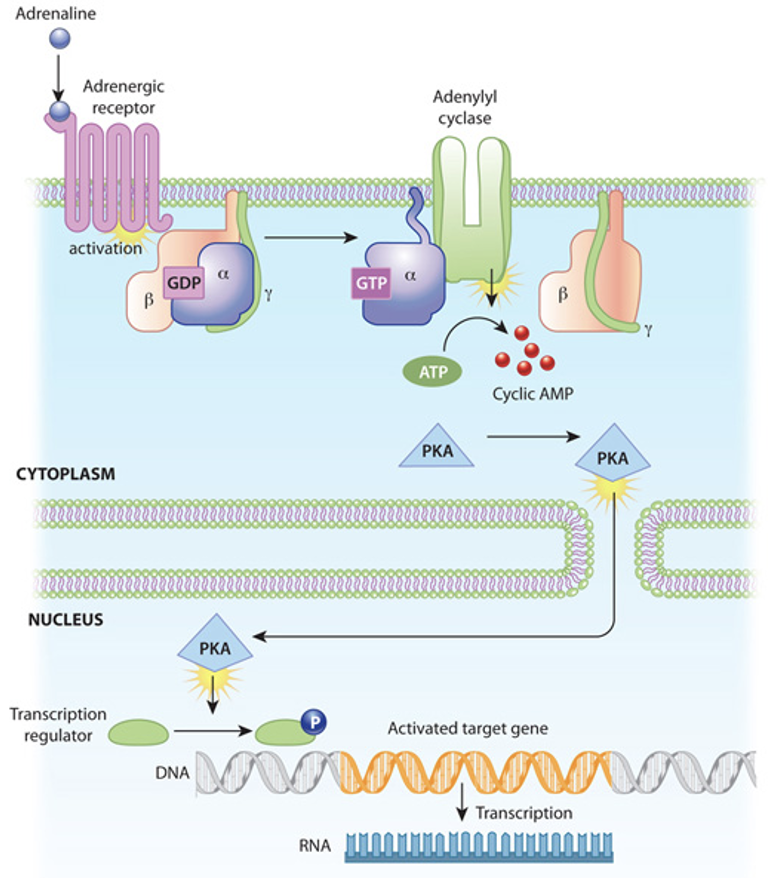
What is the secondary messenger in the PKA pathway?
cAMP
What is the Phospholipase C (PLC) pathway?
GPCR alpha subunit activates phospholipase C (PLC)
PLC cleave PIP2 into IP3 and DAG
DAG stays near the membrane and activates protein kinase C (PKC) which phosphorylates downstream proteins
IP3 goes into the ER and causes it to release calcium, which activates other proteins
What is the secondary messenger in PLC?
IP3, DAG, Ca2+
What are the 5 secondary messengers?
Amplify signal
cAMP (PKA)
Ca2+ (PLC)
DAG (PLC)
IP3 (PLC)
PIP3
How does PKA recognize its substrates?
Has a negatively charged active site
Phosphorlyate proteins at 3 aa residues (all have OH group, PKA looks for hydroxy to add phosphate to)
Serine
Tyrosine
Threonine
Kinases phosphorylate other proteins at S, T, and Y residues. How could you mutate these residues to create a “perpetually” phosphorylated enzyme?
G
E
R
A
E (glutamate) because it can mimic the negative charge of a phosphate group, making the enzyme behave as if it is phosphorylated

Negatively-charged amino acids are sometimes used to “mimic” phosphorylation. Which of the following is a difference between these mimics and authentic phosphorylation?
A. Geometry
B. Charge density
C. Phosphoester bond
D. Can be removed by Phosphatase
E. All of the above
E. All of the above
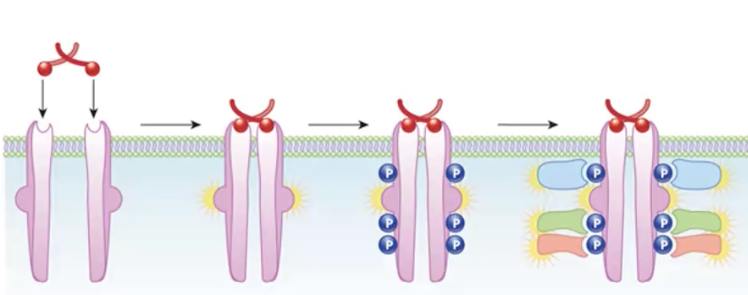
What are RTKs (Receptor Tyrosine Kinases)?
Extracellular receptors that auto transphosphorylate their own tyrosines in dimers
How does Autophosphorylation work with RTKs
Dimeric ligand binds extracellular domain of the receptor
Receptor dimerizes, activates kinase activity
Receptor undergoes trans-autophosphorylation
Intracellular substrates are recruited via pY binding domains (SH2 and PTB)
Signaling complex is formed
Downstream signaling cascade is initiated
What does Grb2 do? What is it comprised of
Grb2 is a Signaling adapter protein
Has SH2 and SH3 domains
SH2 domains - phosphorylated tyrosine
SH3 domains - polyproline helix
How does Downstream Insulin Signaling work (example of RTK)
Growth signal
Recruit Shc domain (scaffolding protein), binds Sos, sos binds Ras (GTPase) that causes cell phosphorylation and results in cell proliferation
Metabolic signal
Recruit IRSs domain (scaffolding protein) - binds p85 and p110 and makes PiP3
How is RTKs general pathway
Subunits of the receptor are separate until bound by ligand, and then they dimerize
After dimerized, they transautophorphorylate (add phosphate groups to each other) on tyrosine residues
Phosphotyrosine provides a binding site for certain domains of other proteins
SH2 domain of GRB2
SH3 domain of GRB2 binds polyproline helices of other downstream proteins like SOS
With RTKs, what does PI3 kinase do?
PI3 kinase turns PIP2 → PIP3, which can act on downstream effectors
What is an oncogene? What is an example of one?
Activates gene, make to much of something, make cancer
PI3K is an oncogene and concerts PIP2 to PIP3, which acts as a membrane localized secondary messenger
What is a tumor suppressor
Normally slows cell growth and prevent cancer
Mutation: deactivates gene - gets rid of “break genes” make more of something, cause cancer
PTEN is a tumor suppressor and catalyzes the reverse reaction, turning off signaling
How do you perform a Proteomics experiment?
Measure PTMs (Post translational modifications)
Mass Spec
MS1 scans give you intact peptide mass, select peptides for fragmentations
MS2 (MS) scans give you peptide sequence and PTM localization

How do ATP hydrolysis and phosphoryl transfer drive the shown reaction?
A. Entropy of hydrolysis contributes heat to the reaction
B. Phosphate used to avoid LeChatlier’s penalty
B. Phosphate used to avoid LeChatlier’s penalty, because “Greater stability of ADP prevents the phosphoryl transfer back reaction and no water produced”
What is Keq?
Concentration of products/ Concentration of reactants
What is Reduction and Oxidation?
Reduction: Decrease oxygen, increase hydrogens
Oxidation: Increase oxygen, decrease hydrogens
What type of reaction is a dehydrogenase
Oxidation since it removes hydrogens
What does NAD+ (Nicotinamide Adenine Dinucleotide) do?
Accepts 2e- and H+(hydride ion) to generate NADH
Nicotinamide ring reactive part of molecule
NADPH used as reducing power in anabolic rxns
What does FAD (Flavin Adenine Dinucleotide) do?
Accepts 2e- and 2H+ (as hydride ion + a proton, or two hydrogen atoms) to generate FADH2
Isoalloxazine ring reactive part