Kinesiology Upper Extremity Study Guide
 Call Kai
 Learn
 Practice Test
 Spaced Repetition
 Match
 Flashcards
 Knowt Play
1/49

There's no tags or description
Looks like no tags are added yet.
50 Terms
Process
A projection or prominence of a bone
Spine
A sharp, slender projection of bone
Fossa
A shallow depression or hollow
Foramen
An opening or hole in a bone
Condyle
A rounded projection at the end of a bone, usually forming a joint
Epicondyle
A projection located above or near a condyle
Tubercle
A small, rounded projection
Tuberosity
A large, roughened projection
Crest
A prominent ridge of bone
Trochanter
A large projection found on the femur (femur only)
Head
A rounded end of a bone that often articulated with another bone
Neck
A narrowed region connecting the head to the rest of a bone
Facet
A small, smooth, flat surface where bones articulate
Notch
An indentation along the edge of a bone
Angle
A corner or bend in a bone
Sulcus (groove)
A narrow channel or depression in a bone
Tubercle vs. Tuberosity
Small bump vs. large, rough bump
Fossa vs. foramen
depression vs. opening
Spine vs. crest
prominent projection vs. ridge
Condyle vs. epicondyle
joint-forming rounded projection vs. projection near or above a condyle

- Spine: prominent ridge on the posterior surface
- Acromion process: broad, flattened projection at the outer end of the spine
- Coracoid process: hook-like projection on the anterior side
- Glenoid cavity (fossa): shallow socket on the lateral side. articulates with the head of the humerus
- Supraspinous fossa: depression above the spine
- Infraspinous fossa: large depression below the spine
- Subscapular fossa: broad, shallow depression on the anterior surface
- Superior border: upper edge of the scapula
- Medial (vertebral) border: edge closest to the spine
- Lateral (axillary) border: thick outer edge
- Superior angle: upper corner near the medial border
- Inferior angle: bottom tip of the scapula
- Subscapular notch: notch near the base of the coracoid process


- Head: large, rounded proximal end
- Anatomical neck: narrow groove immediately around the head
- Surgical neck: narrow region below the tubercles
- Greater tubercle: large lateral projection near the head
- Lesser tubercle: small anterior projection near the head
- Intertubercular sulcus (bicipital groove): groove between the greater and lesser tubercles
- Deltoid tuberosity: roughened area on the lateral shaft
- Radial groove: groove on the posterior shaft
- Capitulum: rounded distal surface on the lateral side
- Trochlea: spool-shaped distal surface on the medial side
- Medial epicondyle: projection on the inner side of the distal humerus
- Lateral epicondyle: projection on the outer side of the distal humerus
- Olecranon fossa: deep depression on the posterior distal humerus
- Coronoid fossa: depression on the anterior distal humerus, above the trochlea
- Radial fossa: depression on the anterior distal humerus, above the capitulum

Origin
The attachment generally considered more fixed or closer to the trunk
Where the muscle starts
Insertion
The attachment generally considered more movable; it often moves toward the origin when the muscle contracts
Where it attaches to the bone it moves

Supraspinatus
Infraspinatus
Teres minor
Subscapularis
SITS
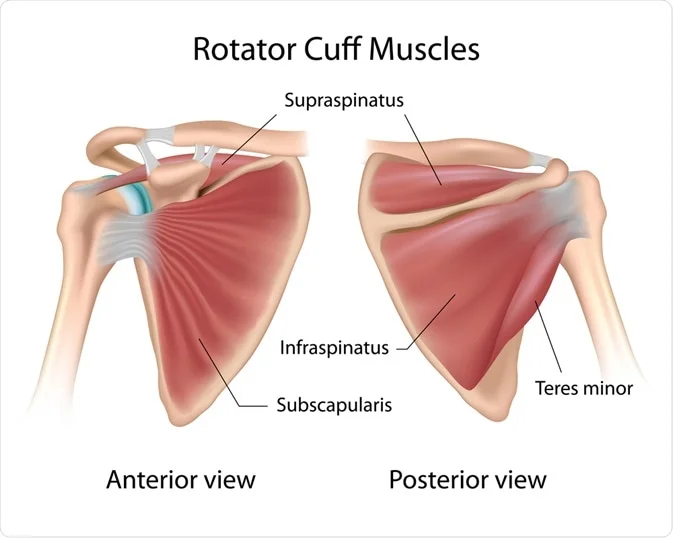
Supraspinatus
O: Supraspinous fossa of scapula
I: Greater tubercle of humerus
Main action: Initiates shoulder abduction
Infraspinatus
O: Infraspinous fossa of scapula
I: Greater tubercle of humerus
Main action: External (lateral) rotation
Teres minor
O: lateral border of scapula
I: Greater tubercle of humerus
Main action: external rotation; assists adduction
Subscapularis
O: Subscapular fossa of scapula
I: Lesser tubercle of humerus
Main action: interal (medial) rotation
Deltoid
O: Lateral third of clavicle, acromion, and spine of scapula
I: Deltoid tuberosity of humerus
Main action: abduction; anterior fibers flex and internally rotate, posterior fibers extend and externally rotate
Pectoralis major
O: medial clavicle, sternum, and upper costal cartilages
I: lateral lip of intertubercular sulcus of humerus
Main action: adduction, internal rotation, and horizontal adduction; assists flexion
Latissimus dorsi
O: lower thoracic and thoracolumbar region, iliac crest, and lower ribs
I: floor of intertubercular sulcus of humerus
A: extension, adduction, and internal rotation
Teres major
O: inferior angle and adjacent lateral border of scapula
I: medial lip of intertubercular sulcus of humerus
A: extension, adduction, and internal rotation
Coracobrachialis
O: coracoid process of scapula
I: Medial shaft of humerus
A: shoulder flexion and adduction
Biceps brachii
O: long head: supraglenoid tubercle; short head: coracoid process
I: radial tuberosity and bicipital aponeurosis
A: elbow flexion and forearm supination; assists shoulder flexion
Triceps brachii (long head)
O: infraglenoid tubercle of scapula
I: olecranon of ulna (all three heads)
A: elbow extension; long head assits shoulder extension and adduction
Trapezius
O: occipital bone, ligamentum nuchae, and spinous processes of cervical thoracic vertebrae
I: lateral clavicle, acromion, and spine of scapula
A: elevation, retraction, depression, and upward rotation of scapula (different fibers)
Serratus anterior
O: outer surfaces of upper ribs (usually ribs 1-8 or 1-9)
I: anterior surface of medial border of scapula
A: protraction and upward rotation; holds scapula against rib cage
Rhomboid major
O: spinous processes of upper thoracic vertebrae
I: medial border of scapula below the spine
A: retraction and downward rotation
Rhomboid minor
O: lower cervical/upper thoracic spinous processes and associated ligament
I: medial border near the root of the scapular spine
A: retraction and downward rotation
Levator scapulae
O: transverse processes of C1-C4
I: superior part of medial border of scapula
A: elevation and downward rotation
Pectoralis minor
O: Ribs 3-5 near their costal cartilages
I: coracoid process of scapula
A: protraction, depression, and downward rotation; stabilizes scapula
Muscle I Actions to memorize
Supraspinatus: initiates abduction
Infraspinatus: External rotation
Teres minor: External rotation; assists adduction
Subscapularis: Internal rotation
Deltoid: Abduction; anterior fibers flex; posterior fibers extend
Pectoralis major: Adduction, internal rotation, horizontal adduction
Latissimus dorsi: Extension, adduction, internal rotation
Teres major: Extension, adduction, internal rotation
Coracobrachialis: Flexion and adduction
Biceps brachii: Elbow flexion, forearm supination; assists shoulder flexion
Triceps brachii, long head: Elbow extension; assists shoulder extension and adduction
Trapezius: Elevation, retraction, depression, upward rotation
Serratus anterior: Protraction, upward rotation
Rhomboids: Retraction, downward rotation
Levator scapulae: Elevation, downward rotation
Pectoralis minor: Protraction, depression, downward rotation
Shoulder movement: Flexion v. extension
Flexion: moving the arm forward and upward
Extension: moving the arm backward or returning it backward from a flexed position
Ex: Anterior deltoid assists flexion; latissimus dorsi assists extension
Abduction vs. adduction
Abduction: moving the arm away from the body’s midline
Adduction: moving the arm towards the body’s midline
Ex: deltoid produces abduction; pectoralis major assists adduction
Internal vs. external rotation
Internal (medial) rotation: rotating the humerus inward toward the body
External (lateral) rotation: rotating the humerus outward, away from the body’s midline
ex: subscapularis internally rotates; infraspinatus externally rotates
Protraction vs. retraction
Protraction: moving the scapula forward, away from the spine
Retraction: pulling the scapula backward, toward the spine
Ex: serratus anterior protracts; rhomboids retract
Elevation vs. depression
Elevation: raising the scapula, as in shrugging
Depression: lowering the scapula
Ex: upper trapezius and levator scapulae elevate, lower trapezius can assist depression
Horizontal adduction
Bringing the arm across the chest, as when hugging someone
Upward rotation
rotating the scapula so the glenoid cavity faces more upward, allowing the arm to reach overhead. Trapezius and serratus anterior work together