Polymers
 Call Kai
 Learn
 Practice Test
 Spaced Repetition
 Match
 Flashcards
 Knowt Play
1/59

There's no tags or description
Looks like no tags are added yet.
60 Terms
What is a polymer
A large molecule made of repeating monomer units
Monomer
small molecule that bonds with other monomers to form a polymer
Repeating unit
structural segment of a polymer chain that recurs continiously to bulid a polymer
Polymer backbone
The main chain of atoms connecting rhe repeating units
Degree of polymerization
number of repeating units in a polymer chain
Natural vs Synthetic polymer
Natural - found in natures (DNA, Proteins, cellulose)
Synthetic - manufactured (nylon, polyethylene, PLA )
How can we classify polmer
By Origin
By Chain structure
By Monomer composition
By Stereochemistry
Linear polymer
straight chains,
Chains can pack closely together
have higher crystallinity than comparable branched structures.
Branched polymer
chains with side branches
Branches prevent chains from packing closely
lower density and crystallinity.
Crossed linked polymer
chains chemically connected
Restricts chain movement
often increases stiffness and dimensional stability.
Network Polymer
highly interconnected chains,Cannot flow like ordinary linear thermoplastics
What the difference between homopolymer and Copolymer
Homopolymer - one type of monomer. Ex - Polyethylene
Copolymer - two or more type of monomers.
Types of Copolymer
Random - Monomers distributed randomly
Block - long sections of each polymer
Alternating - Monomers alternate regularly
Graft - One polymer chain attached to another backbone
Tacticity
How side groups are arranged along the polymer backbone
Isotactic vs Atactic vs Syndiotactic
Isotactic - side groups on the same side.
Atactic - groups arranged randomly .
Syndiotactic - side groups alternate sides.
Geometric Isomers
describes the arrangment of the groups around the double bond
Cis vs Trans Isomers
Cis = groups positioned on the same side
Trans = groups positioned on the opposite sides
What is the general polymer structure
Backbone - main chain of the polymer
Side group - groups attached to the backbone
Repeat unit - smallest repeating structural unoit
Molecular weight - depends on the side and number of repeating units
Polymer chains- can coil, bend,and become entangled
PLGA in biomedical application
PLGA - absorbable sutures and drug delivery
breaksdown through hydrolysis of ester bonds
Polyurethane biomedical application
Polyurethane - pacemaker leads insulations and medical devices
provides flexibility and mechanical strength
PHEMA biomedical application
PHEMA - Soft contact lenese
absorbs water, making it useful for soft contact lenses
Silicone hydrogel biomedical application
Silicone hydrogel - contact lenses
allows oxygen and ions to pass through
PTFE biomedical application
Medical tubing and grafts
PDMS/silicone biomedical application
Medical devices and implants
Polymer molecular weight formula
M = xMo
M = Molar mass
x = degree of polymerization
Mo = Molar mass of the repeating unit
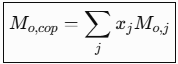
Copolymer mean repeat-unit molar mass equation
xj = mole fraction of repeat unit j
Mo,j = molar mass of repeat unit j
Average number molecular weight (Mn)
Xi = number fraction of chains
wi = weight fraction of chains
Mi = molecular weight of chains

Weight Average molecular weight (MW)
wi = WEIGHT FRACTION OF CHAINS
Mi = molecular weight of chains

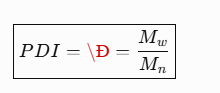
Polydespersity Index/ PDI/ Dispersity
note
PDI = 1 monodisperse (same chain molecular weight)
PDI greater than 1 - polydisperse (different chain molecular weight)
Degree of polymerization
Xn = Mn/Mo
Weight average degree of polymerization
Xw = Mw/Mo
Avogadros number and molar pass
Na = 6.022×10²3 mol^-1
1 Da = 1.66033×10^-27
relationship between particle mass and molar mass
Molar mass = Na * average particle mass
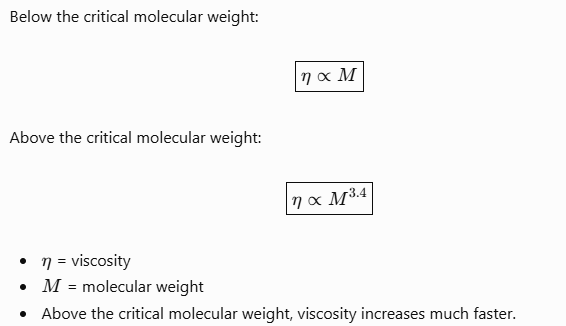
Polymer viscocity and molecular weight
Polymer Crystallinty
%Crystallinity = Crystalline portion/Total material * 100
Polymerization
Process of joining monomer to form polymers
What is step growth polymerization
Monomers or short chains react together to form larger chains
chain growth polymerization
Monomers add to an active growing chain
What are the 3 stages of chain growth polymerization
Initation - an active site is created to start chain growth
Propagation - Monomers continously add to the growing chain
Termination - chain growth stops
Condensation polymerization
Polymer formation that release a small molecule
Addition polymerization
Polymer formation without releasing a small molecule
living polymerization
a form of chain growth polymerization with a limited chain termination and chain transfer reaction are absent
ATRP/ Atom transfer radical polymerization
uses a transition metal catalyst to reversibly abstract a halogen atom from an initiator, making a low concentration of propagating radicals to minimize chain termination
RAFT/Reversible Addition-Fragmentation Chain Transfer
relies on a sulfur-based agent to rapidly swap active and dormant polymer states via degenerative chain transfer without altering the net radical concentration.
NMP/Nitroxide-Mediated Polymerization
employs a stable nitroxide radical to thermally cap and uncap growing polymer chains, keeping the majority of the system in a dormant state
ROMP/Ring opening metathesis polymerization
uses a transition metal alkylidene catalyst to split open strained cyclic olefins, keeping a highly reactive metal center at the active chain end to drive linear growth
What is crystallinity
degree of regular packing in a polymer
What does increased crystallinity generally do
Increases stiffness and strength
What is annealing
heating and cooling polymer to change its structure and properties
How does higher molecular weight affact strength
It generally increase chain entanglement and tensile strength
Whats Tg
Glass transition temperature
When amorphous polymer regions become more mobile and flexible
What us Tm
The melting temperature of crystalline regions
What is the difference between Tg and Tm
Tg affacts amorphous regions
Tm melts crystalline regions
Free Volume
space between polymer chains that allows them to move.
Viscosity
Materials resistance to flow
How does molecular weight affact viscosity
Higher Mw increases viscosity
What is shear thinning
occurs when a polymer's viscosity decreases as the shear rate increases
Creep
strain increases under constant stress
What is stress relaxation
Stress decrease under constant strain