~L9-10: Nervous Overview & APs
 Call Kai
 Learn
 Practice Test
 Spaced Repetition
 Match
 Flashcards
 Knowt Play
1/96

Earn XP
Description and Tags
97 Terms
The nervous system has three anatomical components:
Central Nervous System
Peripheral Nervous System
Enteric Nervous System
The central nervous system consists of:
_________: has more __________
_________: mostly connects with ____
Brain: neurons
Spinal cord: PNS
Most nervous tissue is found within:
The CNS
The PNS consists of:
_______: groups of ________
___________: interact with _________
Ganglia: cell bodies
Peripheral Nerves: non-neuronal cells/organs
Enteric Nervous System is made of ______ cells in the ___________. Communication is by:
neural cells - digestive tract - to the CNS via the PNS
Nervous tissue has two classes of cells:
Neurons
Neuroglia
Neurites are projections from the cell body(_______) such as:
soma - axon - dendrite
Neuroglia are _____ cells that _____ and ______ neurons. They make up ______ of nervous tissue.
glial - protect - maintain
Within the CNS, the glial cells that are present are:
___________
___________
___________
___________
Astrocytes
Ependymal Cells
Microglia
Oligodendrocytes
Ependymal cells are a type of _______ tissue and are found within the ___ and their function is to:
epithelial - CNS
Line ventricles and secrete CSF
Oligodendrocytes are found in the ____ and their function is to:
CNS
Produce myelin sheath (fats + protein) around axons
Astrocytes are found within the _____ and their function is to maintain homeostasis in the _________ environment:
Regulate __________, __________, and __________ concentrations.
Recycle and buffer ___________
Regulate ________ flow
CNS - extracellular
ion - nutrients - oxygen
Neurotransmitters
CSF
Microglia are within the _____ and are _____ cells that perform ______ functions.
CNS - WBC - immune
The glial cells within the PNS are:
_________: function similar to ___________
_________: function similar to ___________
Schwann cells: oligodendrocytes
Satellite Cells: astrocytes
Series of cavities within the CNS:
Ventricles
The four compartments of a neuronal cell:
Axon
Axon terminal
Cell body/Soma
Dendrites
Receives input from other cells
Dendrites
Recieves input and produces proteins
Cell Body / Soma
Transports action potentials
Axon
Converts action potentials into chemical signals
Axon terminals
Within a neuron, information flow is from _________ → _________ → _________
dendrite → axon → axon terminal
Between neurons, information flow is from _________ → _________ → _________
sensory neuron → interneuron → motor neuron
White matter is made of _________ _____ which are found within the perimeters of the _______ and around the core of the ___________
myelinated axons - brain - spinal cord
Grey matter consists of:
_________ and __________ cells
___________, ___________, __________ on neurons
Astrocytes & Microglial cells
Axon terminals, dendrites, and cell bodies
Electrical signals are ________________ of the plasma membrane that occur _______ neurons
brief changes of transmembrane potential - within
Chemical signals are ________________ in synapses that occur _______ neurons
the release of neurotransmitters - between
Neural pathways mediate both/either involuntary and voluntary
both
Two key types of spinal reflexes are the _________and ________ reflexes.
Withdrawal - stretch/jerk
The stretch reflex is a _________ reflex including ____(multi)____ neurons
monosynaptic - motor - sensory
The withdrawal reflex is a _________ reflex including ____(multi)____ neurons
multisynaptic - motor, sensory, inter
Neurons can be classified by their organ systems:
somatic
Visceral/autonomic
Which neuron group includes the following:
Motor Neurons: Skeletal Muscle
Sensory Neurons: Integument and Skeletomuscular System
Somatic Nervous System (not ALWAYS considered voluntary)
Which neuron group includes the following:
Motor Neurons: non-skeletal muscle
Sensory Neurons: Smooth/cardiac muscle, glands, adipose tissue
Visceral/autonomic nervous system
Afferent axons such as the ones on __________carry information to/from the spinal cord
Efferent axons such as the ones on __________ carry information to/from the spinal cord.
sensory neurons - to
motor neurons - away
The spinal cord is organized into ___ pairs __________.
In adults, inferior to ____ is only ______ and no _________.
31 - topographically
L1 - nerves - spinal cord tissue
Each spinal cord segment processes information from different regions in the body:
Cervical: ____________
Thoracic: ____________
Lumbar: ____________
Sacral: ____________
Upper limbs
Trunk
Lower limb
lower limb / ano-genital region
The ______________ region(s) of the spinal cord have more gray matter because:
Cervical & Lumbar: there are more muscles in the limbs
A simple spinal reflex circuit comes through the ______ gray matter and leaves through the ________ gray matter.
dorsal - ventral
Dorsal white matter projects to/from the brain _________ information.
Lateral white matter projects to/from the brain for _______________.
to - sensory
from - voluntary motor control
All neurons are post-mitotic meaning:
Cannot return to the cell cycle, once a neuron dies, it cannot be replaced
Neurons can die from:
Trauma to the ____________ or _____________
Excitotoxicity: _____________
cell body - axon
excessive excitatory synaptic activity
Axons in the _______ may repair and regrow with the help of _________.
PNS - schwann cells (local glia)
Apoptosis: (clue: mode of death)
A neuron dies due to the lack of active axon terminals
In the ______, axons cannot repair because of the presence of ___________.
CNS - Astrocytes
Resting membrane potentials are created by __________ which are always _________.
leak channels - open
RMP arises from the unequal _________ of ions due to different ______ channel _________.
permeability - leak - abundance

When K+ moves outside of the cell, it will create an __________ which will __________.
electrical force/net (-) charge inside cell - push some K+ back in
_____________ is the Vm when no net movement occurs. This occurs when ___________ are ______ and NOT _____________
Equilibrium potential (Eion) - diffusion and electrical force - equal and opposite - concentration gradient
Any value of Vm other than ____ indicates a net force. This is created by a ____________.
E ion - changing electrochemical gradient
The net force is represented by the ____________ gradient
electrochemical
chemical gradient __ electrical gradient = electrochemical gradient
+
The RMP is a weighted average of ___________. This means that ions will/won’t experience a net force at RMP.
individual equilibrium potentials - will
The net force experienced by K+ (Eion = -90mV) at RMP (-70mV) is ________ because:
small and outwards - RMP is less negative than K+ Eion
The net force experienced by Na+ (Eion = +55mV) at RMP (-70mV) is ________ because:
large and inwards - RMP is much more negative than Na+ Eion
When a neuron is at rest, ____ is the most permeable ion. Each permeable ion will move the membrane towards ________.
K+ - it’s own Eion
Vm is ________ minus __________
outside —- inside
Ion concentrations and therefore transmembrane potential are maintained by ____________.
Na+ and K+ gradients are maintained by ___________
Cl- gradient is maintained by ___________.
Active transport
Primary — Na+/K+ ATPase Pump
Secondary — Co-transport w/ K+
Signals therefore potentials in an _______ membrane are driven by the activity of __________
excitable - gated ion channels
Graded potentials occur at the ________ and include:
__________ potentials generated from __________ gated ion channels
__________ potentials generated from __________ gated ion channels
Dendrites
post-synaptic - chemically
Receptor/generator - mechanically
Action potentials are powered by __________ on the _________
voltage-gated ion channels - axon
Graded potentials change the ________ in response to a ________
RMP - stimulus
Depolarizing receptor potential is created by a _________ stimulus.
A hyperpolarizing receptor potential is created by a _________ stimulus.
pressure - light
A graded potential’s amplitude depends on the ___________.
number of ion channels that open
A membrane potential signal degrades/retains with distance
degrades
Ion _________ have a very small impact on RMP.
pumps
A graded potential has two parts:
___________ current: ______________
___________ current: ______________
Transmembrane: stimulus opens gated channels on dendrite, ions flow in membrane
Electrotonic: current spreads and fades sideways
Action potentials in an axon are generated by the activity of ____ and ____ ___________ ion channels.
Na+ - K+ - voltage-gated
In an action potential:
_______ channels open during depolarization and close ____________.
_________ feedback.
_________ channels open during repolarization and close ____________
_________ feedback
Na+ - Repolarization
positive
K+ - RMP
negative
________ have only one _________ gate.
________ have a _______ and _______ gate.
VGKC - activation
VGNC - activation & inactivation
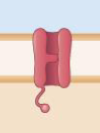
An ______ inactivation gate is _______ at rest.
The activation gate opens _______ after a ______________.
VGNC - open - rapidly - suprathreshold depolarization
Further depolarization is prevented by:
VGNC inactivation gates
An action potential must be triggered by a __________, _________ down the axon, ________ dimensions, and have a __________.
threshold - propagate - fixed - refractory period
Membrane potential in neurons are altered rapidly by ____________ through the activity of _________, creating _______ and _______ potentials.
changing membrane permeability - gated ion channels - graded - ion
An action potential depolarization will spread __________ from the axon _______
distally and proximally - hillock
Myelin speeds conduction through the process of ________________.
saltatory propagation
Hyperpolarization is driven by:
K+ leaving the axon responding with a delay.
___________ and myelination increase conduction speeds.
large axon diameters
What occurs to an action potential at a synapse?
converted to chemical signal, then graded potential
Parts of a synapse:
Presynaptic specialization (axon terminal)
[Synaptic cleft]
Postsynaptic specialization
What do axon terminals do in response to an action potential?
Release neurotransmitter into synaptic cleft via synaptic vesicles/exocytosis
What is the role of VGCCs?
Convert AP depolarizations into vesicular release of NT
The four steps of a synapse:
Pre-synaptic excitation
Vesicle Fusion
Transmitter Release
Receptor Binding
Following presynaptic excitation, ________ will occur triggered by ___________
vesicle fusion/exocytosis - rapid inflow of Ca2+ from VGCCs
During receptor binding, NT will bind to __________.
Ligand-gated Na+ channels
How is a postsynaptic potential generated?
Na+ flows in form ligand gated channel → depolarization
Postsynaptic potentials are __________ potentials
graded
Why do PSPs have a latency time after a synapse is activated and what is responsible for the slow return to baseline?
Latency: time for NT exocytosis
Slow decay: NT is gradually removed
PSPs can be:
____________: NT binds to receptors that increase _____ permeability, moving Vm toward AP threshold.
____________: NT binds to receptors that increase _____ permeability, keeping Vm below AP threshold.
EPSP (excitatory): Na+
IPSP (inhibitory): K+ or Cl-
Larger PSPs can be generated by: (2)
more receptors/ion channels
more ligand/NT
Summation of _____ trigger an AP at the axon hillock. _______ can subtract from the __________ caused by _______.
EPSPs - IPSP - depolarization - EPSPs
Summation can be _________ or ___________.
Temporal - spatial
Spatial summation:
PSPs from different synapses overlap, summing their depolarizations
Temporal summation:
consecutive PSPs from the same axon overlap in time
How do agonist drugs work? What is their effect on cellular activity?
mimics a NT - enhances activity
How do antagonist drugs work? What is their effect on cellular activity?
block NT from binding to receptors - blocks activity
Endocytosis:
the reformation/recycling of synaptic vesicles at the axon terminal
Neurotransmitters can be recycled by:
__________ - e.g. __________
__________ mediated recycling - e.g. __________
__________ action - e.g. __________
Reuptake - dopamine
astrocyte/glial - glutamate, GABA
Enzyme - acetylcholine