KAAP 230 Lab Practical 2
 Call Kai
 Learn
 Practice Test
 Spaced Repetition
 Match
 Flashcards
 Knowt Play
1/84

There's no tags or description
Looks like no tags are added yet.
85 Terms
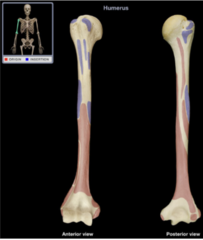
long bone
longer than they are wide, ex: femur, humerus

short bone
roughly square shaped, ex: carpals (hand bones), tarsals (foot bones)

flat bone
thin, flat, or curved, ex: skull, sternum, ribs
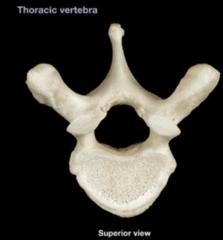
irregular bone
irregularly shaped, ex: vertebrae, pelvis, mandible

sesamoid bone
small, round bones embedded in tendons & muscles, ex: patella
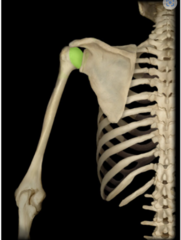
head (articulation)
the prominent expanded end of a bone

condyle (articulation)
a rounded knob that articulates with another bone
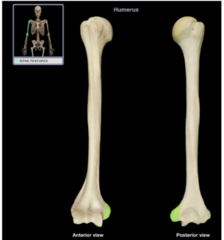
epicondyle (projection)
projection superior to a condyle, attachment site for muscles and ligaments

facet (articulation)
smooth, flat, slightly concave or convex surface
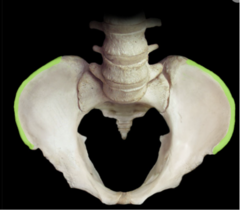
crest (projection)
narrow ridge, attachment site for muscles and ligaments

spine (projection)
sharp, slender, or narrow process

process (projection)
bony prominence

line (projection)
slightly raised, elongated ridge

protuberance (projection)
bony outgrowth or protrusion
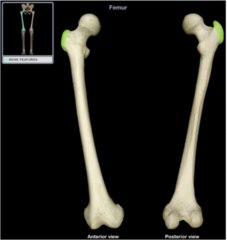
trochanter (projection)
massive process, only on the femur

tuberosity (projection)
rough surface
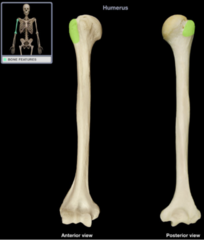
tubercle (projection)
small, rounded process
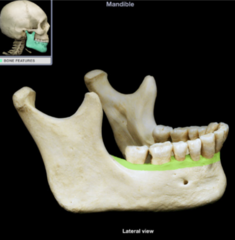
alveolus (depression)
pit or socket
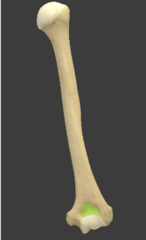
fossa (depression)
shallow, broad, or elongated basin

sulcus (depression)
a groove for a tendon, nerve, or blood vessel
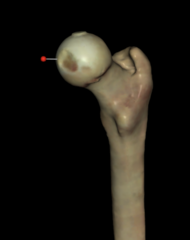
fovea (depression)
small pit

canal (passages)
a tubular passage or tunnel in a bone
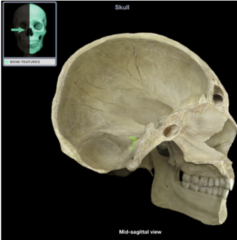
meatus (passage)
an opening into a canal

foramen (passage)
a round hole through a bone

fissure (passage)
a slit through a bone

vertebral column
cervical (7), thoracic (12), lumbar (5), sacrum (5, fused), coccyx (4, fused)

C1 (atlas)

C2 (axis)

odontoid process

bifid spinous process
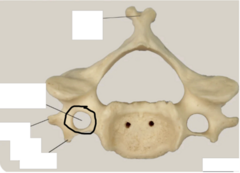
transverse foramen

transverse costal facet

superior costal facet

inferior costal facet

lumbar vertebrae

body (vertebrae)

lamina

pedicle

vertebral arch
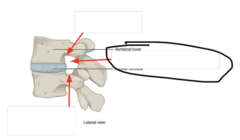
intervertebral foramen

inferior vertebral arch
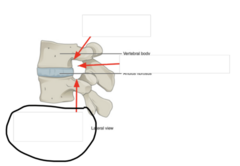
superior vertebral arch
boney joints
two bones that form a solid bone, (left and right maxillae, epiphysis and diaphysis)
fibrous joints
bound by collagen fibers, sutures, gomphoses, syndesmosis (slightly movable)
cartilaginous joints
linked by cartilage, synchondrosis (long bones in children), symphysis (joined by fibrocartilage, slightly movable)
synovial joints
contains synovial fluid, freely moving, common joint in the body

types of synovial joints
ball and socket, condyloid, saddle, gliding, hinge, pivot
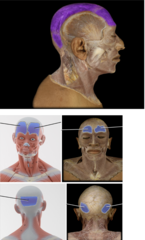
occiptofrontalis
elevation of eyebrows, creases skin of forehead, moves scalp backward and forward

orbicularis oculi
closes eyelids (blink/wink), sphincter muscle (contract to close & relax to open)

orbicularis oris
closes lips, protrudes lips (pucker)

zygomaticus major
elevation of corner of mouth (smile)

buccinator
compression of cheek (ex: inflating a balloon)
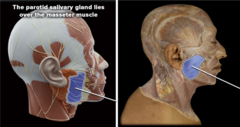
masseter
elevation of mandible (ex: closing mouth), protraction of mandible

temporalis
elevation of mandible (ex: closing mouth), retraction of mandible, assists the masseter

lebator labii superioris
elevation of upper lip (sneer)

depressor labii inferioris
depression of lower lip (pout)

mentalis
wrinkles skin of chin, raises and protrudes lower lip

platysma
elevates and creases skin of neck (ex: expression of horror), depression of lower lip and angle of mouth

mylohyoid
elevation of floor of mouth

sternohyoid
depression of hyoid bone, origin: sternum & clavicle, insertion: hyoid bone

omohyoid
depression of hyoid bone, immediately lateral to sternohyoid

thyrohyoid
elevation of larynx, depression of hyoid bone, origin: thyroid cartilage of larynx, insertion: hyoid bone

sternothyroid
depression of larynx, origin: sternum, insertion: thyroid cartilage of larynx

sternocleidomastoid
ipsilateral lateral flexion (single), contralateral rotation (single), neck flexion (paired), origin: clavicle & sternum, insertion: mastoid process of temporal bone & lateral one-half of superior nuchal line of occiptal bone
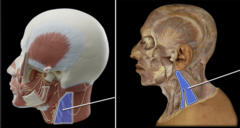
scalene
neck flexion (paired), ipsilateral lateral flexion (single), weak contralateral lateral rotation (single), accessory muscle to breathing (anterior and middle: elevation of rib 1, posterior: elevation of rib 2)

trapezius - upper (superior)
superior fibers: elevation of scapula; superior rotation of scapula (glenoid cavity directed superiorly), origin: occipital bone (superior nuchal line), nuchal ligament, insertion: clavicle (lateral)

trapezius - middle
middle fibers: retraction (adduction) of scapula, origin: C7 and upper thoracic v, insertion: scapula (spine and acromion)

trapezius - lower (inferior)
inferior fibers: depression of scapula, origin: spinous processes of T1-T12 vertebrae, insertion: scapula (base of spine)

latissimus dorsi
adduction of arm, extension of arm, medial rotation of arm, origin: sacral and lumbar spines via thoracolumbar fascia, ilium (iliac crest), ribs (lower four), spinous processes of T6-12 vertebrae, scapula (inferior angle), insertion: intertubecular sulcus of the humerus
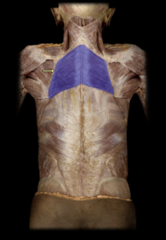
rhomboid major
retraction (adduction) of scapula, elevation of scapula, origin: spinous processes of T2-T5 vertebrae, insertion: medial border of scapula

rhomboid minor
retraction (adduction) of scapula, elevation of scapula, origin: spinous processes of C7-T1 vertebrae, insertion: medial border of scapula

ilicostalis (erector spinae)
lateral flexion of vertebral column (single), extension of vertebral column (paired), depression of ribs

longissimus (erector spinae)
lateral flexion of vertebral column (single), extension of vertebral column (paired), depression of ribs

spinalis (erector spinae)
lateral flexion of vertebral column (single), extension of vertebral column (paired), depression of ribs

quadratus lumborum
lateral flexion of trunk (single), extension of trunk (paired), fix/depress rib 12

pectoralis minor
stabilizes scapula (holds it against thoracic wall), protraction (abduction) of scapula (assists serratus anterior), lateral rotation of scapula (e.g., depresses the acromion), origin: Ribs 3-5, insertion: scapula (coracoid process)

pectoralis major
adduction of arm, medial rotation of arm, clavicular head: flexion of arm, sternocostal head: extension of arm (from flexed position), origin: sternum, clavicle and costal cartilages of ribs 1-6, insertion:
intertubecular sulcus of humerus

serratus anterior
protraction (abduction) of scapula, superior/upward rotation of scapula (directs glenoid cavity superiorly), stabilizes scapula (holds it against thoracic wall), origin: ribs 1-9, insertion: medial border of scapula

external intercostals
elevate ribs (aid in inspiration)

internal intercostals
elevate ribs during inspiration and depress ribs during expiration, innervated by the intercostal nerves, muscle fibers run inferoposteriorly

diaphragm
compress abdominal cavity, prime mover of inspiration, expand thoracic cavity

rectus abdominis
forward flexion

external oblique
forward flexion (pair), ipsilateral lateral flexion, contralateral rotation
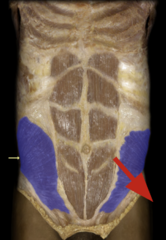
internal oblique
forward flexion (pair), ipsilateral lateral flexion, ipsilateral rotation

transverse abdominis
compresses abdominal cavity