D.2 Electrical Fields
 Call Kai
 Learn
Learn Practice Test
 Spaced Repetition
 Match
Match Flashcards
 Knowt Play
1/14

There's no tags or description
Looks like no tags are added yet.
Name | Mastery | Learn | Test | Matching | Spaced | Call with Kai | Chat |
|---|
No analytics yet
Send a link to your students to track their progress
15 Terms
What is the elementary charge?
The magnitude of charge of a proton or electron.
1e = 1.6×10⁻¹⁹C
Conservation of charge
(Net) Charge cannot be created or destroyed and can only be transferred.
Coloumb’s Law
The force of attraction or repulsion between two charges is proportional to each charge and inversely proportional to distance between their centres squared.
Force of attraction or repulsion formula

What does permittivity (ε₀) refer to?
The ability of a substance to store electrical energy in an electric field.
What is an electrical field, what do the arrows and density of the field lines show?
An electrical field is a region where a charge experiences a force.
The arrows show the direction of the force on a positive test charge.
The density of the field lines indicates the relative strength of the field.

What is electric field strength and its formula?
The force per unit charge acting a positive test charge at that point in the field.

Alternative Electric field strength formula
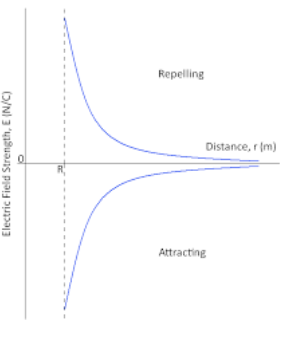
It is positive in value when repelling and negative in value when attractive.

Predict the graph of E (Electric Field strength) against r
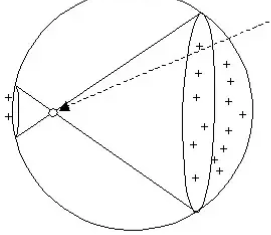
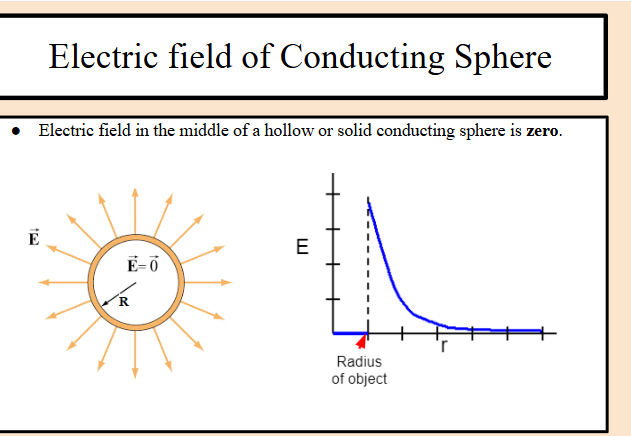
Why is the electric field inside a conducting sphere 0?
As electric fields from many far charges on the right cancel those from few close charges on the left.

What would the field look like between parallel charged plates?
The field lines will be parallel and equally spaced in the middle (uniform field)
There will be ‘edge effects’ as they bulge out near the sides of the plate

Uniform Electrical field strength between two parallel plates formula

Milkan’s Oil drop Experiment setup
There were two parallel plates set at a specific distance from each other with a known adjustable voltage between them creating an electric field with a known magnitude and direction.
He drilled a very small hole in the centre into the top plate. A fine mist of oil is sprayed into a chamber above the two plates, the drops pass into a region between two metal plates and are viewed using a microscope.
Milkan’s Oil drop Experiment Steps 1-4
Step 1:
A fine mist of oil is sprayed into a chamber above the plates:
Oil is used instead of water as it doesn’t evaporate quickly. Which means the mass of the drop remains constant.
As the drop passes through the spray nozzle they are charged by friction they can also be ionised by X-rays. Some drops lose electrons and become and vice versa.
Step 2:
When no voltage was applied the drop fall at terminal velocity
Since air is much less dense than oil the buoyancy force becomes negligible.
The viscous drag is balancing the weight force
6πηrv = mg = (ρV)g , 6πηrv = ρ(4/3πr3)g , v = 2ρr2g/9η , r = √(9ηv/2ρg )
Step 3:
With the radius now known the mass of the drop could be calculated
m = ρ(4/3πr3)
Step 4:
When the correct voltage is applied the drop hovers.
Electrostatic force is balancing the weight force
F = Eq = (V / d)q , F= mg , (V / d)q = mg , q =mgd / V
Milkan’s Oil drop Experiment conclusions
By comparing the charges for each oil drop to the smallest charge he discovered he deduced they were all multiples of 1.6 × 10⁻¹⁹C.