Ch 4 Supply Chain Management
 Call Kai
 Learn
 Practice Test
 Spaced Repetition
 Match
 Flashcards
 Knowt Play
1/40

There's no tags or description
Looks like no tags are added yet.
41 Terms
Inventory is usually
one of the company’s largest assets
Maintaining adequate finished product inventory allows a company to
fill customer orders immediately
Maintaining adequate materials inventory allows a company to
support manufacturing operations and the production plan while avoiding delays
Inventory
the quantities of goods and materials that are held in stock
Inventory is an
asset
Too much inventory is
a liability and ties up capital (more space = more money)
The 4 main categories of inventory
Raw materials, Work in Progress (WIP), Finished goods, and repair and operating (MRO) supplies
Raw materials
Purchased items or extracted materials converted via the manufacturing process into components and products.
Every company that produces a product generally starts with some raw material, part, or starting material.
Work-in-Progress
A good or goods in various stages of completion throughout the plant, spanning from raw material that has been released for initial processing up to fully processed material awaiting final inspection and acceptance as finished goods (the black hole of inventory)
Finished Goods
Those items on which all manufacturing operations, including final testing, have been completed. These products are available for sale and shipment to the customer (make to order/make to stock)
Maintenance, Repair, and Operating (MRO)
Items used to support general operations and maintenance, such as maintenance supplies, spare parts, and consumables, and are used in manufacturing and supporting operations
Why hold inventory?
To meet demand (cycle stock): immediately fill orders
To buffer against uncertainty in demand or supply (safety stock): uncertainty in demand or supply or both
To decouple supply from demand (strategic stock)
To decouple dependencies in the supply chain (strategic stock)
The goal of inventory management is
to help a company be more profitable by lowering the cost of goods sold and increasing sales
The 3 levels of internal inventory are meant to
Meet customer demand, Buffer against uncertainty in demand and supply, Decouple supply from demand, Decouple dependencies in the supply chain
Cycle stock
Inventory that a company builds to satisfy its’ immediate demand
Safety stock
also known as “buffer stock,” is inventory above and beyond what is needed to meet anticipated demand. A quantity of stock planned to be in inventory to protect against fluctuations in demand or supply
Strategic stock
Additional inventory beyond cycle and safety stock generally used for a specific purpose or future event and a defined period
Pipeline inventory
Inventory in the transportation network and the distribution system being held by wholesalers, distributors, retailers, or consumers. The ownership of this inventory has been transferred to the trading partners
Obsolete inventory
Inventory items that have met the obsolescence criteria established by the company. Stock that is expired, damaged, or no longer needed. Will never be used or sold at total value
Costs relating to inventory
Direct, indirect, variable, fixed, carrying, order
Indirect costs
cannot be traced directly to the unit produced (e.g., overhead; MRO items, buildings, equipment, etc.)
Direct costs
directly traceable to unit produced (e.g., materials, labor, etc.)
Variable costs
dependent on the unit volume produced varies with output level (e.g., materials, labor, utility power, etc.)
Hidden costs of inventory
Having too much or too little inventory on hand
Having too much inventory can result in effects like
Financial resources tied up in inventory
Underlying problems being hidden rather than being exposed and solved, including quality problems not being immediately identified.
No incentive for process improvements.
Having too little inventory can result in effects like
Production disruptions creating the need for expediting and additional costs.
Longer delivery replenishment lead times.
Reduced responsiveness.
Lost revenue
Inventory turnover ratio
Costs of goods sold/average inventory at cost
To set target inventory levels for all products and materials, you need to address these three fundamental questions:
1. When to review inventory?
2. When to order inventory?
3. How much inventory to order?
Periodic review system
Inventory levels are reviewed at a set frequency, e.g., weekly or monthly
Continuous review system
As soon as inventory falls below a pre-determined level (i.e., a reorder point), a replenishment order is automatically triggered
Reorder point (ROP)
The lowest inventory level at which a new order must be placed to avoid a stockout

Reorder point without safety stock
Demand (D) = 150 month / 30 days = 5 units/day
Lead Time (LT) = 10 days
Safety Stock (SS) = 0 units
Reorder Point (ROP) = D x LT + SS = (5) x (10) + (0) = 50 units
Reorder point with safety stock
Demand (D) = 150 month / 30 days = 5 units/day
Lead Time (LT) = 10 days
Safety Stock (SS) = 25 units
Reorder Point (ROP) = D x LT + SS = (5) x (10) + (25) = 75 units
Fixed time period ordering system
— Inventory is checked in fixed periods against a target inventory level.
— If the inventory is less than the target, a quantity necessary to bring inventory back up to the target level is ordered.
— The amount of inventory ordered will potentially vary from period to period based on the remaining inventory at each time interval checked
Q = R - IP
Q = order quantity
R = target inventory level
IP = current inventory position
Fixed-order quantity system
If the review determines that an order should be placed, then the order for a pre-defined quantity for that item is placed
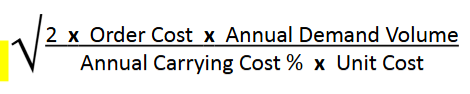
The economic order quantity (EOQ) model
a fixed-order quantity model. A quantitative decision model based on the trade-off between annual inventory order costs and annual inventory carrying costs
Order costs
incurred each time an order is placed
Order preparation costs
Order transportation costs
Order receipt processing costs
Material handling costs
NOT STORAGE COST

Carrying costs
incurred for holding inventory
Cost of capital - specified by senior management
Taxes - on inventory held in warehouses
Insurance - based on estimated risk or loss over time and facility characteristics
Obsolescence - deterioration of product during storage and shelf-life
Storage - facility expense related to product holding rather than product handling

ABC system
An ABC system classifies inventory based the degree of importance:
1. Determine annual usage or sales for each item.
2. Determine % of total usage or sales that each item represents.
3. Rank items from highest to lowest %.
4. Classify items into groups:
A: Highest Value
B: Moderate Value
C: Least Valuable
A method to determine which inventories should be counted and managed more closely than others. Focus limited resources on the items that have the highest inventory value. A items are given the highest priority
Single period model
an inventory system in which inventory is only ordered for a one-time stocking (ex: Christmas trees)
Radio frequency identification (RFID)
does not require a direct line of sight to read a tag