L2 Brain Anatomy
 Call Kai
 Learn
Learn Practice Test
 Spaced Repetition
 Match
Match Flashcards
 Knowt Play
1/22

There's no tags or description
Looks like no tags are added yet.
Name | Mastery | Learn | Test | Matching | Spaced | Call with Kai | Chat |
|---|
No analytics yet
Send a link to your students to track their progress
23 Terms
Draw out the anatomical organization of the nervous system.

A ______ section is cut in the vertical plane, from the crown of the head down, yielding a frontal view of the brains internal structures
Coronal

A ______ section, is usually viewed looking down on the brain from above.
Horizontal

A ______ section is cut lengthways from front to back and viewed from the side
Sagittal

What are the divisions of the brain during development?
The developing brain first divides into the forebrain, midbrain, and hindbrain.
Forebrain → telencephalon + diencephalon
Midbrain → mesencephalon
Hindbrain → metencephalon + myelencephalon
What major brain structures develop from each brain division?
Telencephalon → cerebral cortex, basal ganglia, limbic system
Diencephalon → thalamus + hypothalamus
Mesencephalon → tectum + tegmentum
Metencephalon → cerebellum + pons
Myelencephalon → medulla oblongata

What is Brodmann known for?
Dividing the cortical areas of the brain (known as Broanmann’s Areas)
• These divisions are correlated with their brain functions

What is the telencephalon and what are its main structures/functions?
Neocortex → perceptions, thoughts & planning
Allocortex → emotions & personal memory
Basal ganglia → reward, movement & routines
What are the basal ganglia and their two pathways?
Basal ganglia are involved in reward, movement & routines.
Direct pathway → excitatory (promotes activity/movement).
Indirect pathway → inhibitory (reduces activity/movement).
What are the main structures of the diencephalon and their functions?
Epithalamus → seasonal rhythms (pineal gland)
Thalamus → cortical relay system
Hypothalamus → maintains body homeostasis through regulatory behaviours
What is the function of the thalamus?
Acts as a cortical relay system.
Filters and integrates information entering and leaving the cerebral cortex.
Contains many nuclei (nut).
What is the function of the hypothalamus?
Maintains body homeostasis through regulatory behaviours.
Contains many nuclei that control the pituitary gland.
Helps regulate basic body functions through its influence on hormones.
What does the hypothalamus regulate?
Drinking & eating
Body temperature & sleep
Salt regulation
parental behaviour
What is the mesencephalon and its main divisions?
Mesencephalon = midbrain
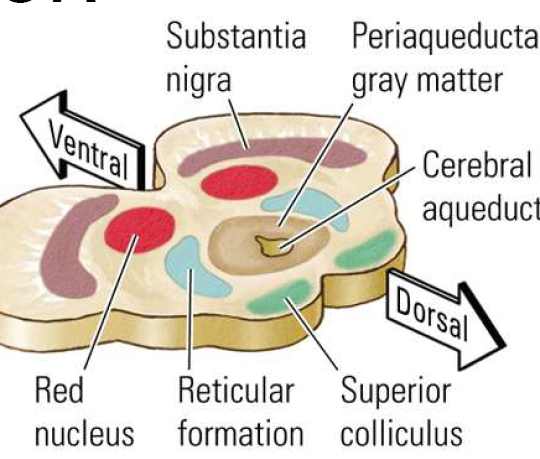
Divided into tectum (“roof”) and tegmentum (“floor”)
Tectum → sensory; Tegmentum → motor
What is the function of the tectum?
The tectum is mainly sensory.
Superior colliculi → visual control
Inferior colliculi → auditory control

What is the tegmentum?
The tegmentum is mainly involved in motor functions.
ex.) species -typical behaviours, such as mating & fighting
Contains structures including the substantia nigra, red nucleus, reticular formation, Ventral Tegmental area , and periaqueductal gray.
What is the metencephalon?
A subdivision of the hindbrain.
Contains the pons and cerebellum.
What is the pons and what does it do?
Pons = “bridge” → connects upper and lower parts of the brain.
Major relay between the cerebellum and neocortex.
Helps control unconscious behaviours like breathing, swallowing, bladder control, balance & posture.
What is the cerebellum and what does it do?
Cerebellum = “little brain”
Involved in sensory processing and motor behaviour/skills
Important for motor learning

What is the myelencephalon and what does it do?
Myelencephalon → medulla oblongata
Controls unconscious behaviours
Regulates breathing, heart rate, blood pressure, sneezing & coughing
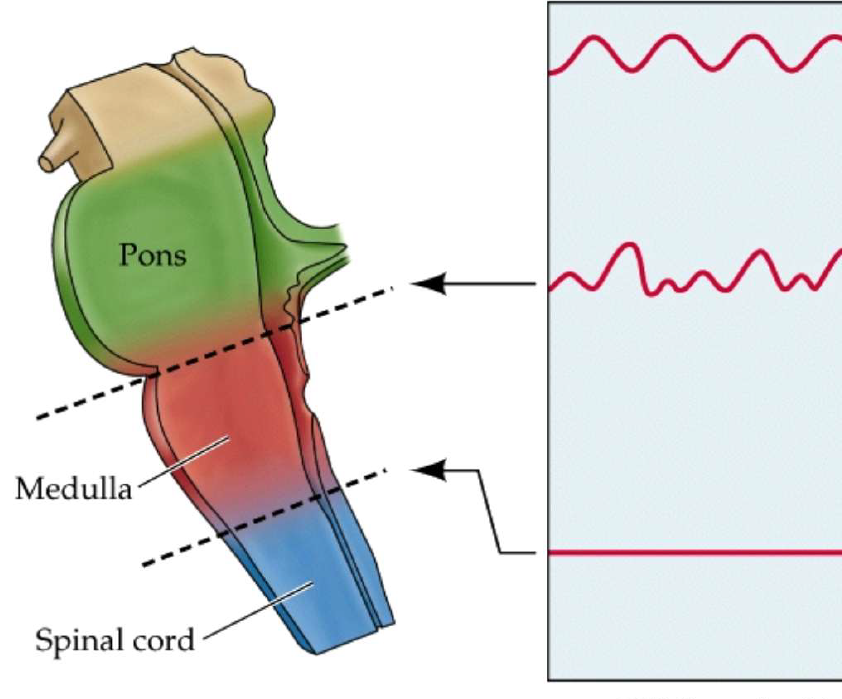
What is the reticular formation and what does it do?
Also called the reticular activating system (RAS).
Responsible for arousal/alertness and helps regulate wakefulness.
Sends signals upward to areas including the cerebral cortex.
What is the substantia nigra and what is it associated with?
Substantia nigra cells produce dopamine and are involved in movement.
In Parkinson’s disease, these cells/pigmentation are lost.
This causes hypokinesia → reduced movement, including bradykinesia, akinesia & rigidity.
What movement problems are associated with Parkinson’s disease?
Bradykinesia → slow movement
Akinesia → difficulty starting voluntary movement
Rigidity → increased muscle tone