Gen Chem 1: Chapter 1: Matter & Measurement
 Call Kai
 Learn
Learn Practice Test
 Spaced Repetition
 Match
Match Flashcards
 Knowt Play
1/52

There's no tags or description
Looks like no tags are added yet.
Name | Mastery | Learn | Test | Matching | Spaced | Call with Kai | Chat |
|---|
No analytics yet
Send a link to your students to track their progress
53 Terms
Scientific Method

hypothesis
tentative explanation of an observation or experimental result
theory
tested explanation of an observation or experimental result
law
describes/predicts what will happen
does NOT explain why it happens
laws _____ behavior. theories ____ behavior
laws DESCRIBE behavior. theories EXPLAIN behavior
matter
anything that has mass and takes up space (volume)
atoms
fundamental unit of matter; smallest part of an element that retains that element’s identity
molecules
groups of atoms that are bind tightly together, and behave as a single unit
Matter Chart
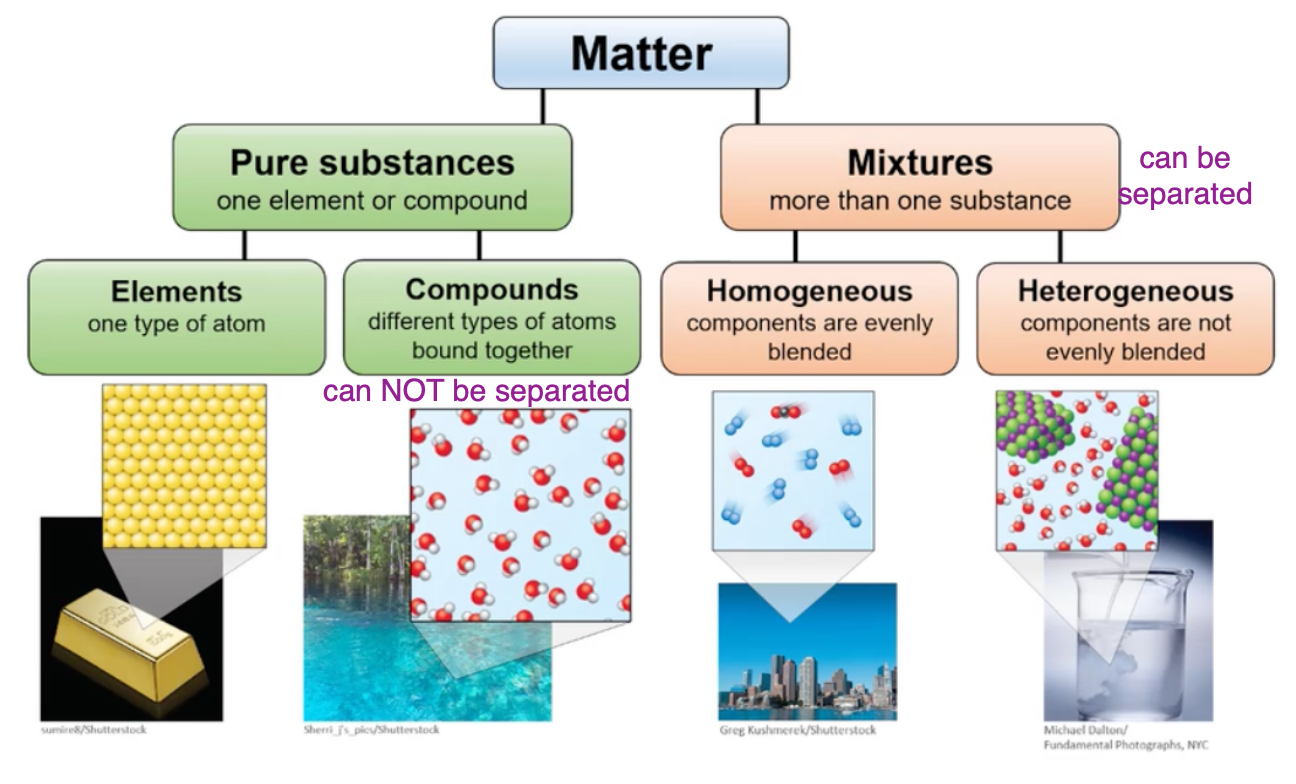
pure substances
one type of element or compound; bound to a fixed ratio
elements vs. compounds
elements- one type of atom
compounds- different types of atoms bound together
ionic vs. covalent compounds
ionic cmpd- when atoms exchange electrons to create charged ions (Metal(+) + Nonmetal(-))
covalent cmpd- when atoms share pairs of electrons
molecular compound is a combination of ___ + ____
Nonmetal (-) + Nonmetal (-)
mixtures
more than one substance
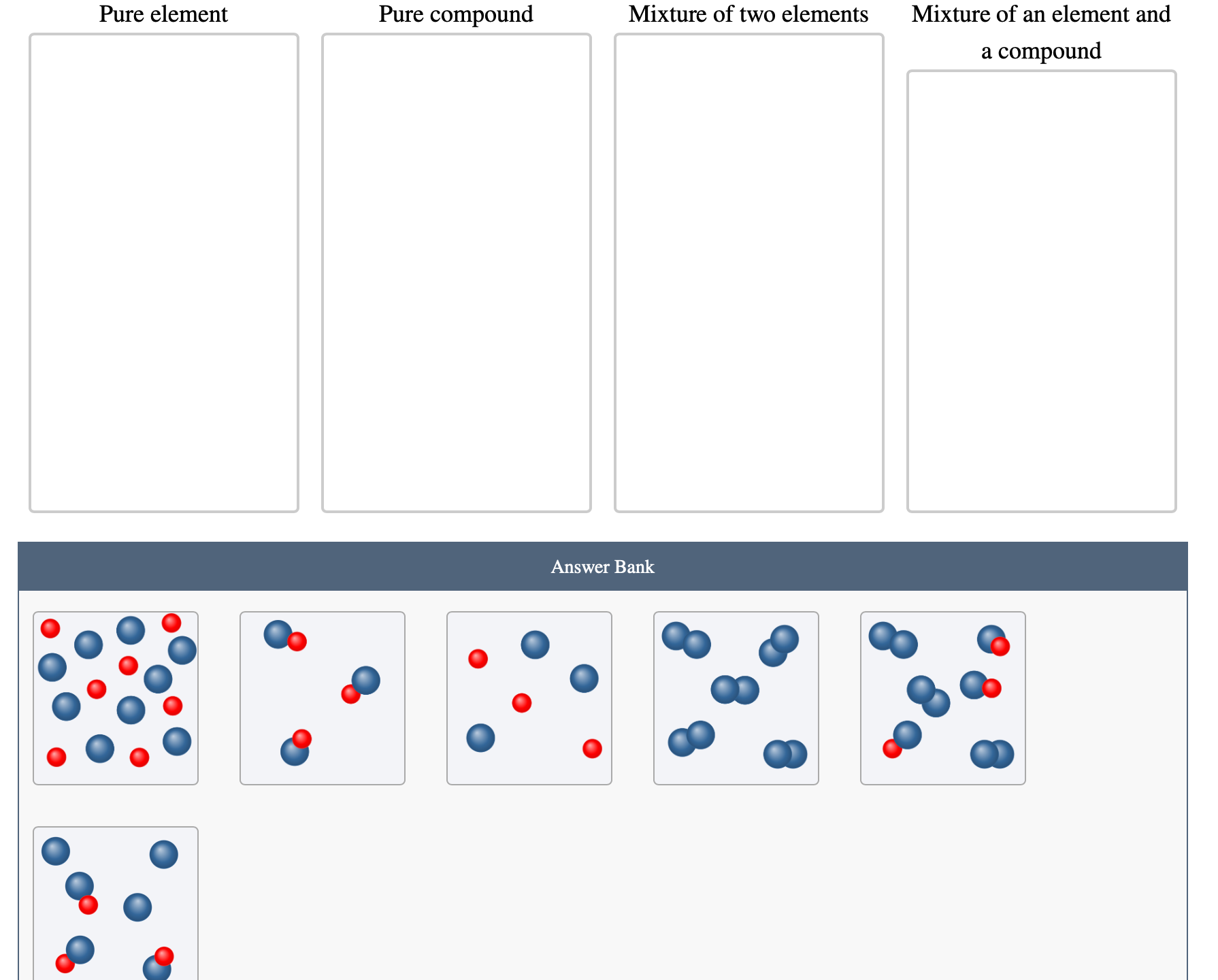

homogenous vs. heterogenous mixtures
homogenous- components are evenly blended (ex: salt water)
heterogenous- components are NOT evenly blended (ex: sand and water)
acid
releases a hydrogen ion (cation) (proton)
at 25 degrees C - substance that has pH below 7
solution with HIGH hydronium ion content
most acids are _____ compounds
molecular
6 Strong Acids
HCl - hydrochloric acid
HBr - hydrobromic acid
HI - hydroiodic acid
HNO3 - nitric acid
HClO3 - perchloric acid
H2SO4 - sulfuric aci
all are molecular cmpds
ionizes completely in water to INC hydronium ion concentration (highly reactive)
6 Strong Bases
NaOH - sodium hydroxide
LiOH - lithium hydroxide
KOH - potassium hydroxide
Ca(OH)2 - calcium hydroxide
Sr(OH)2 - stronium hydroxide
Ba(OH)2 - barium hydroxide
all ionic cmpds
stronger acid has the (stronger/weaker), (more/less) stable (more/less reactive & basic) conjugate base
conjugate base differs from the acid by __ ______.
stronger acid has the weaker, more stable (less reactive & basic) conjugate base
conjugate base differs from the acid by one proton
Ex: HCl(aq) —> H+(aq) + Cl-(aq)
the -OH from bases is called the ____ ____; is it nonmetal or metal
hydroxyl group; nonmetal
when the hydroxyl group bonds with a metal, it forms a ____ compound
ionic (ex: NaOH)
when the hydroxyl group bonds with a nonmetal, it forms a ____ compound
molecular (ex: methanol - CH3OH)
states of matter and each of their relationship to shape + volume
solids: have definite shape and volume
liquids: have definite volume; takes shape of container
gases: NO definite shape NOR volume
Phase Transitions
melting: solid to liquid
boiling (vaporization): liquid to gas
freezing: liquid to solid
condensation: gas to liquid
sublimation: solid to gas
deposition: gas to solid
physical properties vs. physical changes
physical properties: characteristics that we measure WITHOUT changing the substance’s identity
physical changes: changes that occur WITHOUT a change in the substance’s identity (phase transitions like solid to liquid)
chemical properties vs. chemical changes/reactions
chemical properties: characteristics that CANNOT be measured or observed WITHOUT a change in identity
chemical changes/reactions: changes that involve a change in identity; always involves formation of a different substance
energy
ability to do work
2 types of energy
potential energy: stored energy
kinetic energy: energy in motion
what 3 components play a role in potential energy
mass, gravity, height (so bigger hill will have more PE than smaller hill)
exothermic vs. endothermic processes
exothermic: give off heat
endothermic: absorb heat
in an exothermic reaction, is there more energy in reactants or products
REACTANTS have MORE energy (negative enthalpy)
Ex: Carbon + Oxygen —> Carbon Dioxide + Heat
in an endothermic reaction, is there more energy in reactants or products
PRODUCTS have MORE energy (pos enthalpy)
Ex: Water + Heat = Steam
mass
length
time
temperature
light intensity
electric current
chemical amount
mass —> kilogram (kg)
length —> meter (m)
time —> second (s)
temperature —> Kelvin (K)
light intensity —> candela (cd)
electric current —> ampere (A)
chemical amount —> mole (mol)
tera-
gigga-
mega-
kilo
hecto-
deka-
unit
deci-
centi-
micro
nano-
pico
T - 1012
G - 109
M - 106
k - 103
h - 102
da- 101
100
d 10-1
c - 10-2
m - 10-3
μ - 10-6
n - 10-9
p - 10-12
freezing point in ℉, ℃, K
℉ - 32 ℉
℃ - 0 ℃
K - 273.15 K
intensive vs. extensive properties
intensive properties: independent on the amount of matter present (color, temperature, density, hardness)
extensive property: depends on the amount of matter present (mass, volume, length, total energy, number of moles)
accuracy vs. precision
accuracy: how close the measured value is to the actual value
precision: closeness of a set of measurements
determine number of sig figs
4,908
5.00
1.0230
0.045
1,830
1.830 × 10³
4
3
5
2
ambiguous
4
Sig Figs in Multiplication & Division vs. Addition & Subtraction
Mul & Div - report same number of digits as are in the measurement with the fewest significant digits
Add & Sub - report answer with the same number of digits after the decimal as there are in the measurement with the fewest digits after the decimal
Sig Fig Rules for Logarithms
report same number of decimal places as the number of sig figs in the mantissa
ex: log(3.70×10^−7)=−6.432
Because 3.70×10^−7 has three significant figures, −6.432 has three digits after the decimal point.
speed =
time =
speed = distance/time
time = 1/speed
a chemical reaction that releases energy (an ——— reaction) results in ———(products/reactants) that are thermodynamically more stable
exothermic reaction
products more stable
When writing in scientific notation, the leading numbers must be between ___ and ___
1 and 10
ex: 617 will be 6.17 × 10²
for scientific notation,
when moving the decimal point to the LEFT, the exponent will be (i/pos)
when moving the decimal point to the RIGHT, the exponent will be (neg/pos)
moving decimal point to LEFT - POS
moving decimal point to RIGHT - NEG
burning candle - identify the different energies in the
flame
wax
flame: thermal energy & energy as light
wax: potential energy & chemical energy (energy stored between bonds of atoms)x
density of water = _____ g/mL
objects LESS dense than water (float/sink)
objects MORE dense than water (float/sink)
density of water = 1 g/mL
objects LESS dense than water (float)
objects MORE dense than water (sink)
ammonium (NH4+) behaves as a (nonmetal/metal)
metal
polyatomic cations usually bond with _____ (metal/nonmetal) to form a(n) _____ compound
nonmetal; ionic compound
ex: NH4+
polyatomic anions usually bond with _______ (metal/nonmetal) to form a(n) ____ compound
metal; ionic compound
1 cm3 = ___ mL
1 mL
1 m3 = _____ L
103 L