Unit 3 Biology
 Call Kai
 Learn
 Practice Test
 Spaced Repetition
 Match
 Flashcards
 Knowt Play
1/123

There's no tags or description
Looks like no tags are added yet.
124 Terms
biological evolution
descent of modern organisms with modification from pre exisitng life forms
Biological Evolution
A dynamic between species and environment
Evolution consists of
natural/sexual selection, gene flow, genetic drift, migration
Ecology consists of
species interactions, dispersal, population dynamics, community structure, ecosystem functions, spatial structure
genetics and environment contriute to
phenotype
Why is evolution important
explains variety of life forms, evolutionary medicine, response to global change,
Evidence of Evolution
Biogeography, compairtive morphology, geoological discoveries
biogeography
similar species in same geographic region, different species in different regions w similar forms,
comparitive morphology
study of similiarities and differences in body plans
Homologous structures
human leg, dog leg, seal flipper
developmental homology, example
both the human and chik fetus have gill pouches and tails
vestigial structures
sturctures that might have lost hteir primary function, but still exist: ex. tailbone
Geological discoveries
deeper layers contain simpler fossils than shallow layers
• Some fossils seem to be related to known species
• From one layer to the next, some fossils appear, other dissapear
Darwin observed the
galapagos finches
Darwins facts of the theory of evolution
any species capable of increasing size exponentially
increase is rarely observed-populations remain stable
resources limited
-struggle for existence
individuals in species vary
some vary to help survival
variation is inherited
- certain traits are inherited and increase prob of reproduction and survival
Darwins two conclusions
Overproduction and struggle for
existence
Heritable individual variation
other darwin conclusons
Natural selection acts only on heritable traits
(no “Lamarckian” inheritance of acquired characteristics)
• Traits may be more or less beneficial depending on
circumstances
• Populations evolve-not individuals
What is sexual selection
“advantage which certain individuals have
over others of the same sex and species,
solely in respect to reproduction” -Darwin
• Natural selection for mating success
• The selection for phenotypic differences that
increase mating success-within or between
sexes
What is asymetrical investment in offspring, how does it cause ss
(cost of producing eggs vs. sperm)
• females invest directly in offspring
• males invest in mating opportunities
Intersexual selection
Female reproductive success is not limited by access to mates -
prediction: females will be choosy, to maximize the quality of
their offspring, since they have to invest so much in each
how does the female choose
Non-adaptive: sensory bias, species recognition
• Directly adaptive: phenotypic trait infers higher fitness
• Indirectly adaptive: phenotypic trait signals higher
fitness
Intrasexual selection
Male reproductive success is limited by access to mates
- prediction: males will be competitive, to maximize
their opportunities to mate (with whomever they can)
these processes lead to
seuxal dimorphism
sexual dimorphism
where males and female exhibit different physical or behavioral traits than other sex (ex. peacock)
male-male competition
i) precopulatory (fighting)
ii) postcopulatory (sperm competition)

natural selection vs sexual selection
natural selection produces better adapted organisms, acts on both sexes. sexual selection produces organisms to increase mating success, acts on 1 sex.
Sexual reproduction
the production of haploid gametes by
meiosis, and then fusion of these
gametes to produce a zygote
females in sexual reproduction
the form of the organism that
carries the most provisioning for the
offspring (i.e., the egg).
Costs of SR
slow population growth and energetically costly
Benefits of SR
increases genetic variability (recombination)
provides greater resistance to disease
greater resistence to changing environments'
parthenogens
asexual reproduction
asexual vs sexual reproduction
asexual produces MORE and FASTER
Asexual Reproduction
reproduction with no meiosis, fertilization
• fusing of haploid cells, budding, fission
• occurs in aphids, weevils, few fish and
reptiles
• more common in plants
sexual reproduction is
advantageous
Population, what do they do
A group of individuals of the same species
living in the same area at the same time, evolve
Darwin understood what, and missed what
population evolution, not the heritable unit
Darwin’s theory of pangenisis (inocrrect)
Gemmules: tiny particles are shed by all parts of the body, delivered to
the reproductive organs, and then passed on to offspring via gametes.
Aristotle’s idea
homonucleus
Mendel’s theory of heredity
Parents pass discrete, heritable factors (genes) to
offspring that are responsible for inherited
traits

Alleles
alternate forms of a gene (know dominant recessive, hetero and homozygous)
Microevolution
Change in the frequency of alleles in a population
– Change in the gene pool of a population
gene pool
All genes in a population
• All alleles in a population
How do we know if a population is evolving
Measure the frequencies of alleles in a
population over generations
• If no change in allele frequencies, then no
evolution. Population is at equilibrium.
Hardy-Weinberg Theorem does what
describes population equilibrium. No change in allele frequency. It
assumes no evolutionary forces are occurring
Hardy-Weinberg Theorem
frequency of allele in population for a gene in two allele system
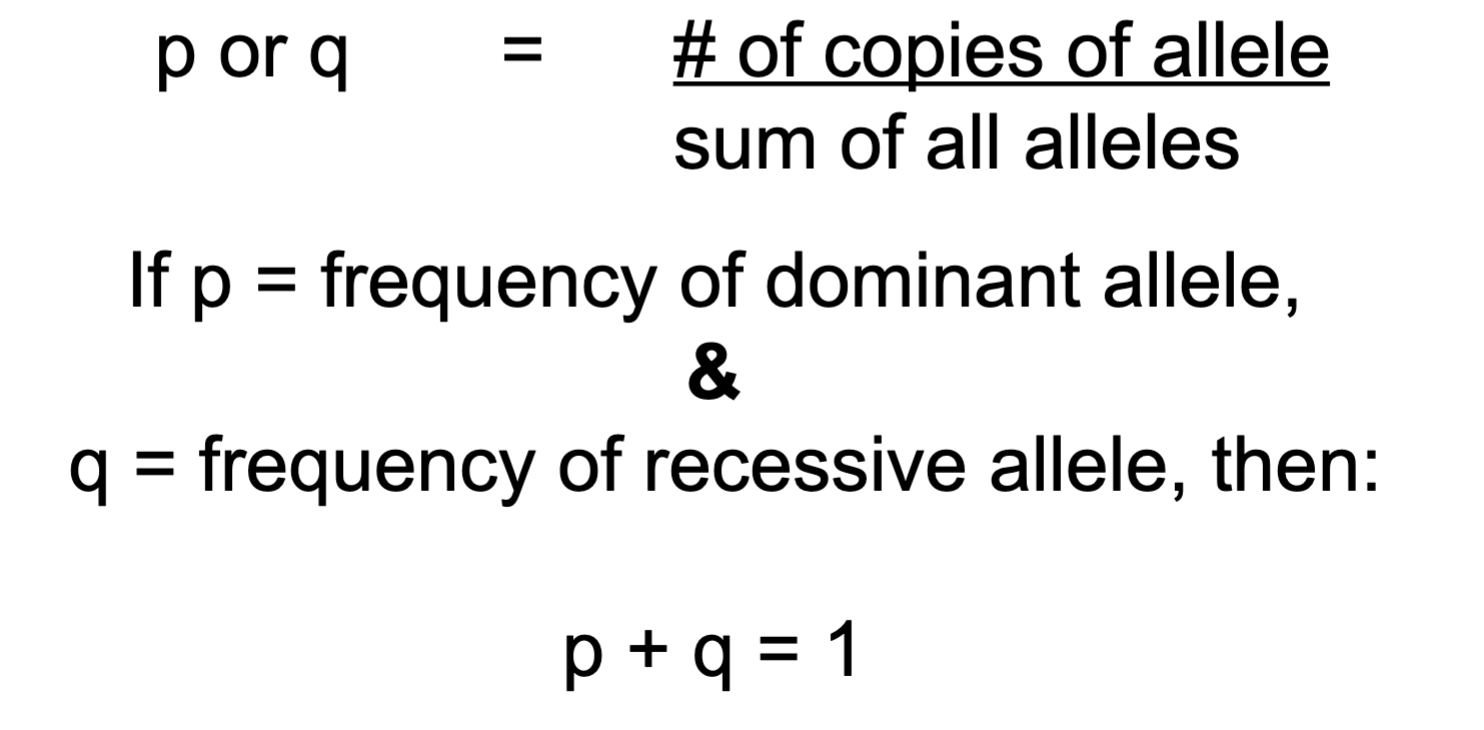
If population is at genetic equilibrium, then
Frequency of alleles will remain constant
over generations
2. The H.- W. equation predicts the genotype
frequencies (and allele frequencies) in the
next generation:

even if the genotypes in the population ad up to 1,
allele frequency can STILL change
allele frequencies changing means
popualtion is evolving
What factors throw off genetic equilibrium? What causes microevoluton?
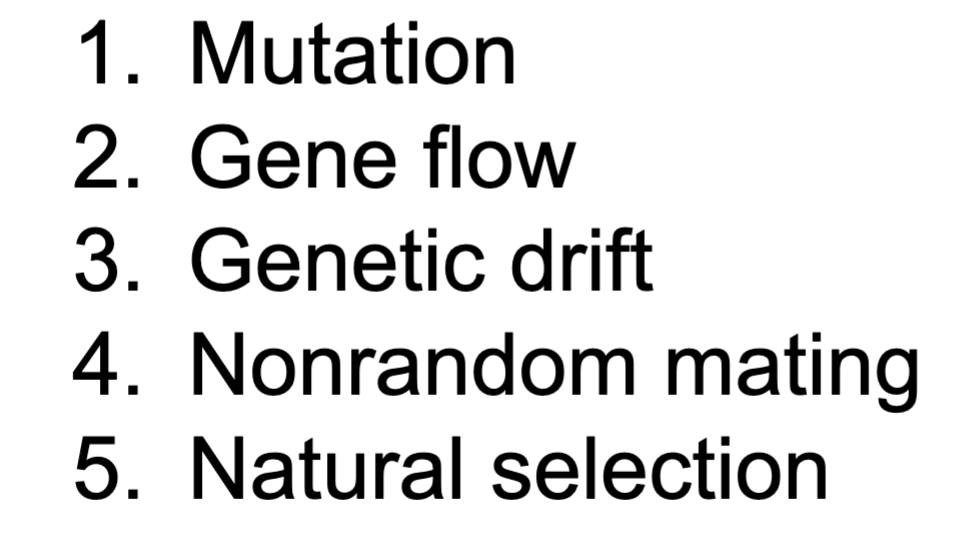
gene flow
genetic drift
purifying selection
how to calculate gene frequency
Hardy Weinburg Equilibrium
Causes of Microevolution
1. Mutation
2. Gene flow
3. Genetic drift
4. Nonrandom mating (or sexual
recombination)
5. Natural selection
mutations, what they are and what they do
change in nucleotide sequence of DNA passed on between generations: heritable source of all genetic variation, introduces new alleles to germline
what causes mutations
mistakes in DNA replication, DNA damage by chemical mutagens/radiation/radical damage, viruses
What is gene flow, what does it do
genetic exchange with other population (migration), reduces differences between populations, counters differences that result from mutation/natural selection/genetic drift
What is genetic drift, what does it do
chance events that alter frequencies of alleles in population, reduces genetic variation
two types of genetic drift
bottleneck effect and founder effect
bottleneck effect
large reduction in population size reduces gene pool
Effect of population size on genetic drift
stronger in smaller populations
founder effect
seabird carries seeds from mailnland to remote island, changes phenotype of island flowers
Examples of founder effect
Afrikaner population of dutch- huntingtons disease
why is mating definitely not random
genotypes would be balanced, expected
Natural selection
shapes organisms to environments, only natural selection creates adaptations
forms of NS
stabilizing selection, directional, and disruptive
stabilizing selection
favors average individual (normal bell curve)
directional selection
favors individuals that vary in 1 direction from mean (skewed)
disruptive selection
favors individuals that vary in both directions from mean (dip in middle)
Pesticide resistance- pesiticides kill susceptible insects, resistant insects survive and reproduce, resistance has heritable basis, more common with each generation, what kind of selection?
directional selection
Fitness
evolutionary- contribution an individual makes to gene pool of next generation, relative to contribution of others
adaptation ___ fitness
increases
adaptation is both
a trait acquired through natural selection or process by which these traits are acquired
Genome
the gene set of an organism, plus noncoding DNA
complex set of integrated genes,regulatory sequences, structural elemtents
changes in gene sequences, locations, and expressions lead to what
evolution
synonymous substitution (silent)
does not affect protein functioning (one AA changes, no difference)
nonsynonymous substitution (missense)
usually deletrious but can be selectively neutral or advantageous

natural selection acts on mutations in these two ways
positive (darwinian) selection, and purifying selection
Positive Darwinian Selection
promotes spread of beneficial alleles
amino acid position under positive selection show higher rates of nonsynonymous substitutions
Purifying Selection
hinders spread of deletrious alleles
amino acid position under PS shows higher rates of synonymous substitution
how do we test for there two types of selection
dN/dS ratio
dN
number of nonsynonymous substitutions/number of all possible non synonymous substitutions
dS
number of synonymous subtitutions/number of all possible synonymous substituions
dN/dS =1
1 neutral evolution (USUAL NULL HYPOTHESIS)
dN/dS >1
positive darwinian selection
dN<dS
negative, purifying selection (TRUE FOR MOST CODONS)
neutral vs adaptive variation impact on evolutionary fitness
fitness goes up w adaptive, stays same w neutral
Kimura’s Neutral Theroy of Evolution
most genetic variation arises through accumulating neutral mutations (synonymous mutations/mutations to non coding regions)
if mutation doesnt give organism advantage or disadvantage, genetic drif determines whether it becomes common in population
Neutral mutations in populations
more likely to become fized in smaller populations. probability of fixation = 1/N, N is population size
more likely to be produced at higher rate in larger populations
fixations rate of neutral mutations is independent of population size
smaller population has ___ new mutations, w ___ chance of being fixed.
fewer, higher. Large populations is the opposite
Darwinian Selection vs Kimura’s Neutral Theory

The molecular Clock
rate of neutral DNA substitutions over time is clock like, can be used to calculate evolutionary time scales
1) divergence time between species
2) rates of neutral evolution given divergence time
Calculating DNA substitution rate steps
sequence DNA of closely related species and evaluate % of base pair differences D
independetly estimate time from fossil record T
divergence rate D/T
How point mutations have larger effects than just mutations
hox genes and homeobox sequence
hox genes
encode transcription factors and determine cell fates (master regulkators)
Homeobox sequence
180 bP sequence controls the body plan. mutation in this sequence is devastating