BSC 215: Lab Exam One
 Call Kai
 Learn
Learn Practice Test
 Spaced Repetition
 Match
Match Flashcards
 Knowt Play
1/179

Earn XP
Description and Tags
Lab 1: look back at slides for anatomical term labeling! Lab 2: know how to label animal cell and organelles
Name | Mastery | Learn | Test | Matching | Spaced | Call with Kai | Chat |
|---|
No analytics yet
Send a link to your students to track their progress
180 Terms
Anatomical position:
Ventral side facing you, palms up
When in a medical setting, is right and left from your perspective or the organisms?
From perspective of organism (opposite)
What are the four major elements found in the body?
Hydrogen
Carbon
Nitrogen
Oxygen
What are the five key properties of water?
Universal solubility
High heat capacity (water absorbs a lot of heat before it gets hot)
High heat of vaporization (large amounts of heat are required to turn from liquid to gas)
Reactivity
Adhesion/Cohesion (water molecules attracted to other molecules and each other)
What’s the difference between solvents and solutes?
Solvents are what solutes dissolve in
Hydrophilic:
Polar molecules; attracted to water
Hydrophobic:
Nonpolar molecules; do not interact with water
Acids:
Donate H+ ions (has more H+ than bases)
Bases:
Accept H+ ions (have less H+ ions)
pH buffers consist of…
A weak base and its conjugate acid or a weak acid and its conjugate base
Acidosis:
When blood is too acidic (less than 7.35)
Alkalosis:
If blood is too basic (pH above 7.45)
What do carbonic acid and bicarbonate act as?
Crucial buffers in the body; allows CO2 to convert into carbonic acid when dissolved in water
What is a normal blood pH?
7.35-7.45
What two systems help with acidosis and alkalosis?
Metabolic and respiratory
The plasma membrane is semi-permeable because it’s made up of…
Phospholipid bilayer
In the plasma membrane, what do proteins do?
Provides a mean of transport through membrane
In the plasma membrane, what does cholesterol do?
Makes membrane more rigid
In the plasma membrane, what do carbohydrates do?
Recognition patterns for cells and organisms
What are two examples of passive transport?
Diffusion
Osmosis
Passive transport:
No energy needed
Active transport:
Uses energy
Bulk transport:
Involves membranous vesicles to move larger substances
What are two examples of bulk transport?
Endocytosis
Exocytosis
What are the three typical ways molecules cross the plasma membrane?
Passive transport
Active transport
Bulk transport
Diffusion (passive):
Movement of molecules from high to low concentration (down the gradient)
Osmosis (passive):
The diffusion of water across a selectively permeable membrane; moves from low to high concentration
Osmotic pressure:
Fluid pressive required to exactly oppose osmosis
Tonicity:
Relative concentration of solutes in two fluids
Isotonic:
Extracellular and intracellular solute concentrations are equal
Hypertonic:
Extracellular solute concentration higher than intracellular solute concentration; water moves out of cell; causes shrinking
Hypotonic:
Extracellular solute concentration is lower than intracellular concentration; water moves into the cell; swelling (hypo=hippo)
Cell cycle acronym:
I-PMAT
Interphase:
Cell participates in typical behavior and function; prepares for division
Interphase cycles:
G1 (cells increase in size, organelles replicated)
G0 (progress stopped at G1)
S phase (DNA replication)
G2 (protein synthesis)
Prophase:
Chromosomes condense, spindle fibers form, nuclear envelope breaks down
Prometaphase:
Kinetochores appear
Metaphase:
Chromosomes align in middle
Anaphase:
Sister chromatids separate and move to opposite poles
Telophase:
Nuclear envelope forms around separated chromosomes
Cytokinesis:
Division of cytoplasm into two daughter cells
DNA wound around __________ cores
Histone
Euchromatin:
Active chromatin
Heterochromatin:
Darkly stained; more tightly compacted/inaccessible
Humans are _________, meaning we contain ___ chromosomes
Diploid; 46
Tissues:
Collection of cells that are similar in structure and preform a similar function
Histology is the study of…
Tissues
Cytology is the study of…
Cells
What are the four basic types of tissues?
Epithelial
Connective
Muscular
Nervous
What are the two main components of tissues?
Unique cells
Extracellular matrix
What does it mean that epithelial tissue is avascular?
No blood supply
What are some functions of epithelial tissue?
Protection, absorption, filtration, excretion, secretion
With epithelial tissues, what could be their arrangement?
Simple (one layer) or stratified (multiple layers)
What could be the epithelial tissue shape?
Squamous (flat)
Cuboidal (cube)
Columnar (column)

What kind of tissue is this?
Simple squamous epithelium
What is the function of simple squamous epithelium?
Simple diffusion
What is the location of simple squamous epithelium?
Kidneys

What kind of tissue is this?
Simple cuboidal epithelium
What’s the function of simple cuboidal epithelium?
Absorption/secretion
What is the location of simple cuboidal epithelium?
Thyroid

What kind of tissue is this?
Simple columnar epithelium
Function of simple columnar epithelium:
Absorption/secretion
Location of simple columnar epithelium:
Gallbladder

What kins of tissue is this?
Pseudostratified ciliated columnar epithelium (ciliated!!)
Function of pseudostratified ciliated columnar epithelium:
Secretes/propels mucus
Location of pseudostratified ciliated columnar epithelium:
Nasal cavity

What kind of tissue is this?
Stratified squamous non-keratinized epithelium (see nuclei)
Function of stratified squamous non-keratinized epithelium:
Protection
Location of stratified squamous non-keratinized epithelium:
Esophagus

What kind of tissue is this?
Stratified squamous keratinized epithelium (sharp divide; no nuclei)
Function of stratified squamous keratinized epithelium:
Protection
Location of stratified squamous keratinized epithelium:
Epidermis
How can you tell the difference between keratinized and non-keratinized tissues?
Keratinized has no nuclei, whole non-keratinized you can see nuclei

What kind of tissue is this?
Stratified cuboidal epithelium
Function of stratified cuboidal epithelium:
Absorption/secretion
Location of stratified cuboidal epithelium:
Ducts of salivary glands

What kind of tissue is this?
Transitional epithelium (looks pseudostratified, but isn’t due to location)
Function of transitional epithelium:
Distention
Location of transitional epithelium:
Urinary bladder

What kind of tissue is this?
Loose (areolar) connective tissue (high volume of matrix)
Function of loose areolar connective tissue:
Support/protection
Location of loose areolar connective tissue:
Walls of hollow organs
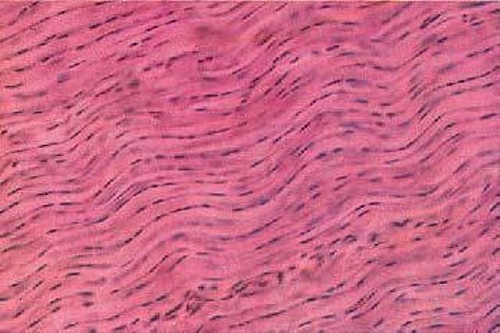
What kind of tissue is this?
Dense regular connective tissue (uniform direction)
Function of dense regular connective tissue:
Resist unidirectional stress
Location of dense regular connective tissue:
Tendons/ligaments

What kind of tissue is this?
Dense irregular connective tissue (irregular direction)
Function of dense irregular connective tissue:
Resist stress from all directions
Location of dense irregular connective tissue:
Around joints

What kind of tissue is this?
Dense elastic connective tissue (black fibers)
Function of dense elastic connective tissue:
Stretch/recoil
Location of dense elastic connective tissue:
Blood vessels

What kind of tissue is this?
Reticular connective tissue (looks like grapes; high contrast)
Function of reticular connective tissue:
Internal structure/support
Location of reticular connective tissue:
Spleen

What kind of tissue is this?
Adipose connective tissue (looks like fat)
Function of adipose connective tissue:
Insulation/shock absorption
Location of adipose connective tissue:
Surrounds heart
What cell type is in adipose tissue?
Adipocytes
What is cartilage?
Tough, flexible tissue that is resistant to tension and compressing forces
What are the three types of cartilage?
Hyaline
Fibrocartilage
Elastic cartilage