Bio Exam 2 LOs- Cell Membrane, Transport, Energetics, and Enzymes
 Call Kai
 Learn
Learn Practice Test
 Spaced Repetition
 Match
Match Flashcards
 Knowt Play
1/51

Earn XP
Description and Tags
Vocabulary practice flashcards covering cell membranes, transport mechanisms, energetics, thermodynamics, and enzyme kinetics from Biology Exam 2 learning objectives.
Name | Mastery | Learn | Test | Matching | Spaced | Call with Kai | Chat |
|---|
No analytics yet
Send a link to your students to track their progress
52 Terms
Saturated Lipid Composition
A membrane lipid composition that results in less fluidity and lower permeability.
Unsaturated Lipid Composition
A membrane lipid composition that results in greater fluidity and higher permeability.
Diffusion
The movement of a substance down its concentration gradient (from high to low concentration) across the lipid bilayer.
Osmosis
The movement of water across a membrane due to differences in solute concentration.
Hypertonic Solution
A condition relative to the outside of the cell where the inner solution has more solutes, causing water to move into the cell and leading to cell swelling.
Hypotonic Solution
A condition where the inner solution has less solutes relative to the outside, causing water to move out of the cell and leading to cell shrinkage.
Isotonic Solution
A condition where solute concentrations are equal on both sides of the membrane, resulting in no net water movement.
Facilitated Diffusion
The passive transportation of ions and molecules down their electrochemical gradient using a transmembrane protein.
Passive Transport
Transmembrane protein-mediated movement (via channels or carriers) that does not require an input of energy.
Active Transport
Transmembrane protein-mediated movement via pumps (ATP-driven or gradient-driven) that requires an input of energy.
Channels
Transmembrane proteins involved in passive transport that create an openable or closable tunnel specific to one molecule or ion.
Carriers
Transmembrane proteins involved in passive transport that bind to a solute (ion or molecule) and change shape to carry it across the membrane.
ATP-driven Pumps
Active transport proteins that utilize ATP hydrolysis (losing one phosphate group) to move an ion or molecule against its concentration gradient, such as the Na+/K+ ATPase pump.
Gradient-driven Pumps
Active transport proteins that move two or more ions/molecules, using potential energy from a passive transport process moving one substance with its gradient to move another against its gradient.
ATP (Adenosine Triphosphate)
The primary cellular energy source that powers transport pumps and provides energy for nonspontaneous reactions.
Coupled Reactions
A process in which energy released by an exergonic (spontaneous) reaction drives an endergonic (nonspontaneous) reaction.
Free Energy
The usable energy in a chemical system available to do work.
Exergonic Reaction
A spontaneous chemical reaction that results in a decrease in free energy.
Endergonic Reaction
A nonspontaneous chemical reaction that requires energy input and results in an increase in free energy.
Entropy
A measure of randomness or disorder in a system, represented as ΔS.
Enthalpy
The amount of potential energy (heat) contained within chemical bonds, represented as ΔH.
Exothermic Reaction
A reaction that releases energy, characterized by a negative change in enthalpy (−ΔH).
Endothermic Reaction
A reaction that absorbs energy, characterized by a positive change in enthalpy (+ΔH).
Active Site
The specific region of an enzyme where amino acid residues actively bind to the substrate, featuring a unique shape specific to one substrate.
Substrate Saturation
The state where reaction rate levels off as substrate concentration increases because all enzyme active sites are fully occupied.

Reaction Profile Diagram
A plot of free energy over the course of a chemical reaction, showing energy levels of reactants, activation energy (Ea), peak energy at the transition state, and products.

Exergonic vs. Endergonic Profiles
Graphs demonstrating free energy changes, where an exergonic reaction shows a net decrease in free energy and an endergonic reaction shows a net increase in free energy.
Structures of fats
primarily consist of glycerol and fatty acids, forming triglycerides, phospholipids, and steroids, which are essential for cellular functions and energy storage.
Glycerol (3-carbon alcohol molecule) in fats
Each carbon is attached to a hydroxyl (OH) group, the carbon backbone is held together by single covalent C-C and C-H bonds
Double bonds in fatty acids (fats)
occur between carbon atoms, resulting in kinks in the fatty acid chains that affect the fluidity and melting points of fats. UNSATURATED
amphipathic
hydrophobic and hydrophilic regions within a molecule
Are fats amphipathic?
No, mostly hydrophobic
Are steroids amphipathic?
Sometimes, depends on R-group
Are phospholipids amphipathic?
Yes, head vs tail
Fats

Steroids basic structure
four fused rings, three 6-carbon rings, one 5-carbon ring, possible r-groups
Steroid
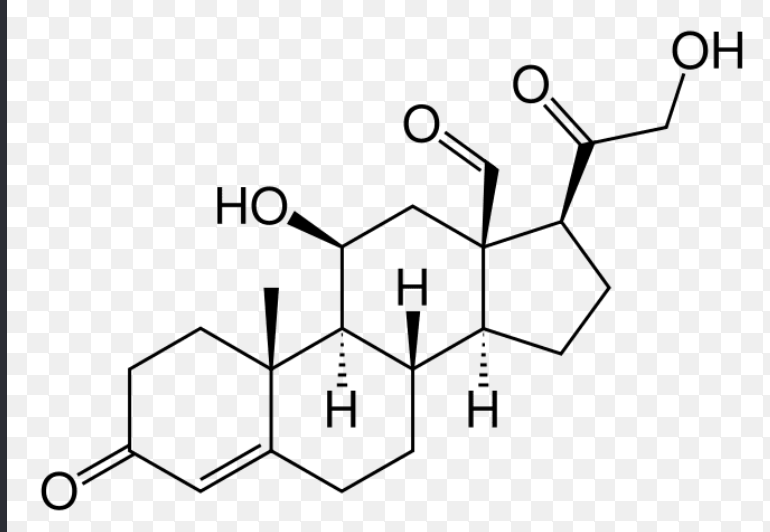
phospholipd head
polar, contains PO4-, hydrohilic
phospholipid tail
fatty acid, hydrophobic
phospholipid

Fatty acid tails - saturated
bond = single
shape = straight
packing = tight
fluidity = low
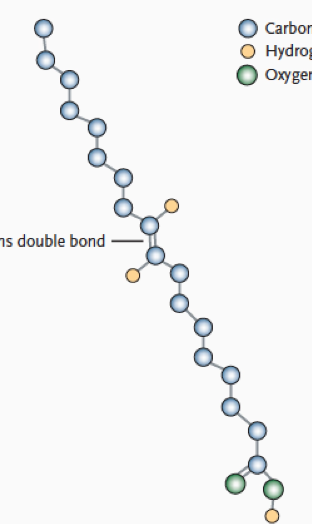
fatty acid tails - trans
bond = at least one double
shape = straight
packing = tight
fluidity = low
similar to saturated
hydrogen atoms sit on opposite sides
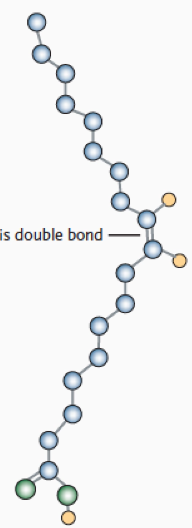
fatty acid tails - cis
bond = at least one double
shape = bent
packing = loose
fluidity = high
hydrogen atoms sit on same side
Trans
Cis
vesicles
water molecules impact how phospholipids spontaneously form bilayers in water.

Number of bonds to determine if a lipid is saturated?
Single
Number of bonds to determine if a lipid is unsaturated?
Double
Function of fats
energy processing + storage
Function of steroids
membrane structure, cell signaling (hormones), gene regulation
function of phospholipids
membrane structure + all membrane functions (proteins, etc.)