Lecture 4: Chemical Reactions and Organic Chem
 Call Kai
 Learn
 Practice Test
 Spaced Repetition
 Match
 Flashcards
 Knowt Play
1/21

There's no tags or description
Looks like no tags are added yet.
22 Terms
Naming Branched Alkanes
- Step 2 numbering: number the chain from the end that gives substituents the lowest possible locants.
- Step 3 substituents: identify and locate branches. An alkyl group is named by changing -ane to -yl, such as methyl, ethyl or propyl.
- Halo groups: attached halogens are named fluoro-, chloro-, bromo- or iodo-.
- Step 4 repeated groups: use di-, tri- or tetra- for identical substituents and include every locant.
- Step 5 assemble name: alphabetise different substituent names, use commas between numbers and hyphens between numbers and words.

what are Alkenes and Naming them
Structure: unsaturated hydrocarbons containing at least one C=C double bond. General formula: CnH2n for an open-chain alkene with one double bond.
Naming: choose the longest chain containing the double bond, number it to give the double bond the lowest locant, and replace -ane with -ene.
Alkynes (Structure ans Formula) and Naming
- Structure: unsaturated hydrocarbons containing at least one C≡C triple bond.
- General formula: CnH2n-2 for an open-chain alkyne with one triple bond.
- Naming: choose and number the longest chain containing the triple bond, then replace -ane with -yne and give the bond its lowest locant.
Benzene (Aromatic Compound) and Naming
Benzene: C6H6, a six-membered carbon ring with delocalised bonding
compounds containing benzene rings are called aromatic compounds.
Single substituent: name the group followed by benzene, for example chlorobenzene
Two substituents: use numbers or the common prefixes ortho 1,2; meta 1,3; and para 1,4.
Benzene Naming (CH3, NH2 and OH):
CH3: Toluene
NH2: Aniline
OH: Phenol
These are now place 1

Alcohols (Structure and Naming)
Functional group: an alcohol contains a hydroxyl group, -OH, replacing a hydrogen atom in a hydrocarbon.
- IUPAC naming: choose the longest chain containing -OH, number it to give -OH the lowest locant and replace the final -e of the alkane with -ol.

Ether Naming and Structure
Ether: an oxygen atom single-bonded to two alkyl or aromatic carbon groups, represented as R-O-R'.
- Common ether naming: list the two attached groups alphabetically, followed by ether; for example methyl propyl ether.
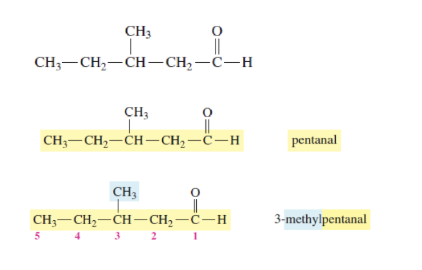
Aldehyde Naming and Structure:
Carbonyl group: a C=O group present in both aldehydes and ketones.
Aldehyde: the carbonyl carbon is bonded to at least one hydrogen and is normally at the end of a chain.
IUPAC rule: choose the longest chain containing the aldehyde carbon, count that carbon as carbon 1 and replace the final -e of the alkane with -al.
Ketone Naming and Structure
Carbonyl group: a C=O group present in both aldehydes and ketones.
Ketone: the carbonyl carbon is bonded to two carbon atoms and lies within a chain.
IUPAC rule: choose the longest chain containing the carbonyl, number it to give C=O the lowest locant and replace the final -e with -one.

Chemical Reaction
process in which one set of substances (reactants) are converted into a new set of substances (products)
Chemical Change
occurs when a substance is converted into one or more new substances with different chemical properties
Possible Visible Evidence of a chemical reaction
heat released or absorbed, precipitate formed, colour changer and formation of gas
visible evidence suggests a reaction but the defining feature id formation of new substances
Law of Conservation of Mass
mass is neither destroyed nor created in a chemical reaction, atoms are only rearranged
What are the four major types of chemical reaction
synthesis (or combination), decomposition, single replacement and double replacement
Types of Double Replacement Reactions
Metathesis: compounds exchange ions to form different compounds
Acid-Base Neutralisation: H+ from the acid reacts with OH- from the base to form water, while the remaining ions form a salt.
When do Double Replacement Reactions usually occur
they usually proceed when either a precipitate, gas or weak ionised molecule (like water) is formed
Functional Groups
a specific group of atoms that gives a molecule chemical properties and reactions
Isomers
compounds with the same molecular formula, but different arrangements of atoms and therefore potentially different properties
What are the Two Groups of Isomers
Structural Isomerism: The molecules have the same molecular formula, but their atoms are connected differently
Stereoisomers: the molecules have the same molecular formula and the same connections between atoms, but their atoms are arranged differently in 3D space
What falls under the group of structural isomers
Chain Isomerism: have the same molecular formula, but different carbon chain arrangements (ex. One may have a straight carbon chain, while another has a branched carbon chain.)
Position Isomerism: The molecules have the same molecular formula and the same functional group. However, the functional group is attached at a different position on the carbon chain.
Functional Group Isomerism: The molecules have the same molecular formula but different functional groups

What falls under stereoisomers
Geometrical Isomerism: Occurs because rotation around a C=C double bond is restricted, therefore either cis or trans bonds form
Optical Isomerism: Typically occurs when a molecule contains a chiral carbon, which is a carbon atom bonded to four different groups. Get two non-superimposable mirror images of each other
Definition of Alkanes, Alkenes and Alkynes
Alkanes: saturated hydrocarbon with C-C and C-H bonds
Alkenes: non saturated hydrocarbon containing at least 1 C=C bonds
Alkynes: non saturated hydrocarbons containing at least one C=-C bond
CnH2n+2, CnH2n, CnH2n-2