TOPIC 4 IMPRESSION MATERIALS
 Call Kai
 Learn
 Practice Test
 Spaced Repetition
 Match
 Flashcards
 Knowt Play
1/109

There's no tags or description
Looks like no tags are added yet.
110 Terms
What is impression material?
Material used to take an impression of teeth and soft supportive tissues.

What are the ideal properties of impression material?
Non-toxic and non-irritant (biocompatible)
good flow
easy manipulation
dimensionally stable after setting
acceptable price and availability
good shelf life
acceptable setting time
pleasant taste, odor and color.
How are impression materials classified?
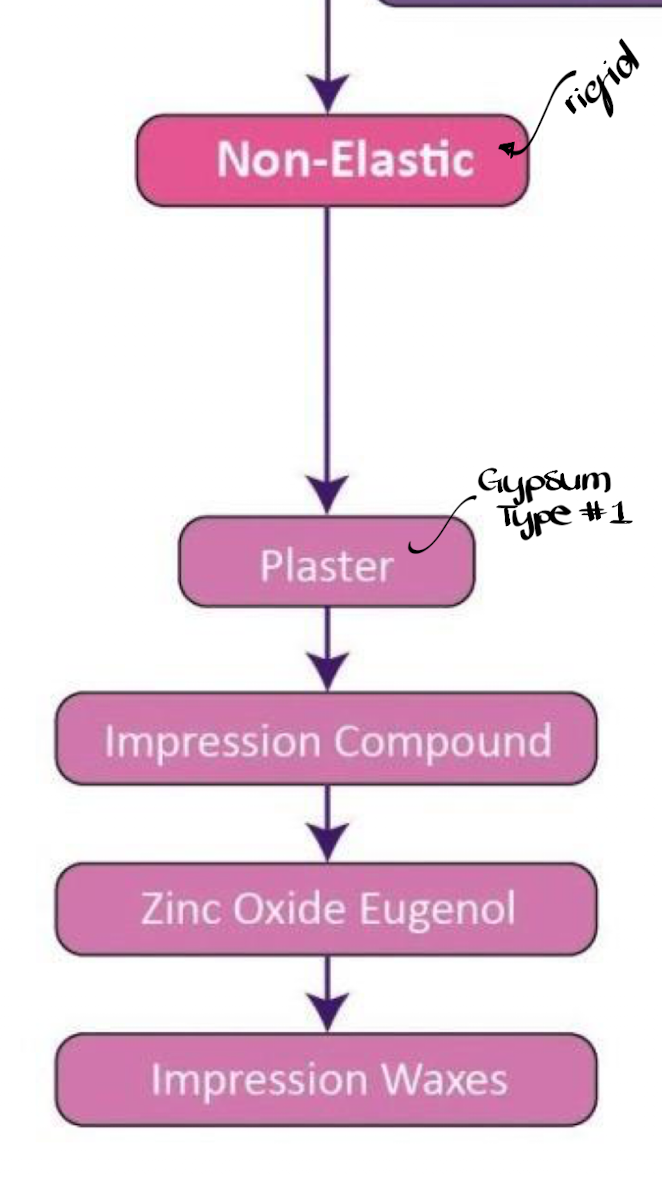
Non-elastic and elastic.

Name the four non-elastic impression materials.
Impression plaster
impression compound
zinc oxide eugenol (ZOE)
impression waxes

How are elastic impression materials classified?
hydrocolloids (agar reversible; alginate irreversible)
non-aqueous elastomers (polysulfides; polyethers; condensation silicone; addition silicone)
What are the non-aqueous elastomers?
polysulfides
polyethers
condensation silicone
addition silicone
What is impression plaster?
Earliest impression material in dentistry
rigid (has limited flow)
gypsum Type I; non-elastic.

For which patients is impression plaster used?
Edentulous patients
mild or no undercuts
final impression


What are the uses of impression plaster?
final impression of edentulous patient
bite registration.
What are the properties of impression plaster?
Setting time: 3–5 minutes
brittle and fractures easily.
What are the main properties of impression compound?
One of the oldest impression materials (not popularly used anymore)
rigid, reversible
thermoplastic (sets by physical changes)
What are the uses of impression compound?
preliminary impression of edentulous patient (special tray)
border molding
What is the composition of impression compound?
resin: 30
copal resin: 30
carnauba wax: 10
stearic acid: 5
talc: 25
→ coloring agents
Identify Type I impression compound.
BROWN CAKE
dip in hot water; primary impression; poor details.

Identify Type II impression compound.
GREEN STICK
pass over flame; border molding of custom tray.

How does Type I brown cake impression compound set?
Softened with heat, hardens with cooling.
What patients is Type I brown cake impression compound used for?
edentulous patients with MILD or NO undercut.
How does Type II green stick compound change appearance?
glossy when soft
matte when hard
What does overheating of Type II green stick compound cause?
causes oil loss
What are the components in impression compound?
wax
natural resin
filler and pigments
stearic acid
What is the function of filler in impression compounds?
gives viscosity, which makes it rigid
What is the function of pigments in impression compounds?
gives colour
What is the function of stearic acid in impression compounds?
lubricant material, allowing workability
At what temperatures does impression compound soften?
45–60°C max
At what temperatures does impression compound harden?
37°C
What is ZOE and what type of material is it?
Zinc oxide eugenol
non-elastic impression material.
How many tubes does ZOE have?
TWO tubes, base and catalyst

What does the ZOE base tube contain?
zinc oxide - white (cap)
What does the ZOE catalyst tube contain?
eugenol - coloured (cap)
What is the main impression use of ZOE?
Secondary/final impression for edentulous patients
high surface details
no undercuts (otherwise it’ll break)

What other uses does ZOE have?
temporary filling
bite registration material
What are the casting instructions for ZOE?
mix on glass slab
pour with stone (Type III gypsum), NOT plaster.
What are the handling instructions for ZOE?
Very thin and brittle
handle with care after taking an impression**
What are the advantages of ZOE?
cheap material
accurate surface details **
dimensionally stable **
What are the disadvantages of ZOE?
May cause irritation/allergy **
thin, brittle, sticky
long setting time 5–15 minutes **
What is the effect of eugenol in ZOE?
SEDATIVE effect
may cause burning sensation or irritation.
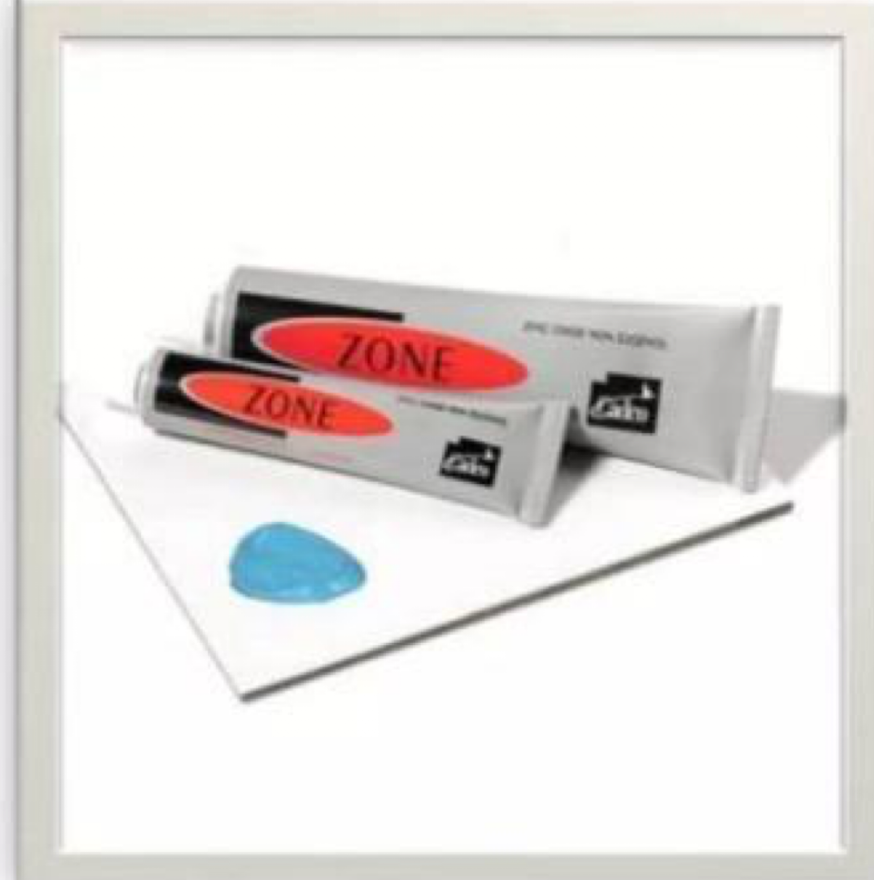
Why are non-eugenol pastes used?
OVERCOME burning sensation caused by eugenol
used in eugenol-irritant patients
may incorporate bactericides and other medicaments.

What are impression waxes?
Non-elastic thermoplastic materials
do NOT set by chemical reaction
When do impression waxes flow?
at mouth temperature
When are impression waxes soft?
at room temperature
What are impression waxes used for?
Correct small imperfections (e.g., airblows) in other impressions.
→ especially ZOE impressions.
What is the composition of impression waxes?
Low-melting paraffin wax and beeswax
What is the approximate ratio of the composition of impression waxes?
Low-melting paraffin wax and beeswax 3:1
Why is the approximate ratio of the composition of impression waxes important?
3:1 ratio ensures the wax flows at room temperature
Why should a cast from impression wax be poured immediately?
To avoid DISTORTION, which readily occurs in wax
these materials are not commonly used.

What is agar reversible hydrocolloid?
Elastic organic hydrocolloid
extracted from certain types of seaweeds
What are the features of agar reversible hydrocolloid?
reversible material, so it can be reused. (can return to original state when heated)
What is agar used for?
Final impression
with high surface details
How is agar supplied?
Two forms:
Syringes
Tray material
What is the composition of agar? **
agar
borax
potassium sulphate
benzoate
additives
What is alginate irreversible hydrocolloid elastic impression material?
Irreversible impression material; replaced agar recently.
What is alginate used for?
Primary impression (poor details)
CAN be used with undercuts because it is elastic.
What are the two types of alginate?
normal-setting alginate
fast-setting alginate
What are the times for normal-setting alginate?
Setting: 2–5 min; working: 2 min; mixing: 60 sec.
What are the times for fast-setting alginate?
Setting: 1–2 min; working: 1–1.5 min; mixing: 30–45 sec.
What is the alginate composition according to the slide?
Potassium/sodium triethanolamine alginate 15%; calcium sulphate dihydrate 16%; zinc oxide 4%; potassium titanium fluoride 3%; diatomaceous earth 60%; trisodium phosphate 2%; coloring and flavoring agents.
What is the role of calcium sulphate dihydrate in alginate?
Reacts with potassium alginate to form a dihydrate insoluble alginate gel.
What is the role of zinc oxide in alginate?
Filler particles; affects properties and setting time.
What is the role of potassium titanium fluoride in alginate?
Accelerator; counteracts the inhibiting effect of hydrocolloid on stone setting; ensures good quality cast surface.
What is the role of diatomaceous earth in alginate?
Filler; controls consistency of mix and flexibility of set alginate.
What is the role of trisodium phosphate in alginate?
Retarder; controls setting time to produce regular or fast-set alginates.
How does powder/water ratio affect alginate setting time?
More powder decreases setting time (sets faster); less powder increases setting time (delayed setting).
How does water temperature affect alginate setting time?
Cold water increases setting time; warm water decreases setting time.
How can you tell that alginate has set?
Becomes rubbery; some alginates change color when set.
When should an alginate impression be poured?
Within 30 minutes; dimensions distort if left more than 24 hours.
What is the sequence for taking an alginate impression?
Select perforated tray → mix/load → make impression → wait 3 min → remove rapidly in one jerk → cut excess.
What is syneresis?
Impression dries out and shrinks.
What is imbibition?
Impression soaks water and expands.
What are the advantages of alginate?
Elastic; cheap; good taste; easy to mix and manipulate; comfortable to patient; hygienic.
What are the disadvantages of alginate?
Poor details production (primary impression); tears easily; poor dimensional stability.
What disinfectants are listed for impressions?
Iodophors; sodium hypochlorite; glutaraldehyde; phenyl phenol.
What are the three elastomer families listed?
Polysulfide; polyether; silicone (condensation and addition).
What is polysulfide elastomer supplied as?
Synthetic elastic elastomer; two pastes: white base and gray/brown accelerator.
What viscosities are available for polysulfide?
Light body (fluid); medium body (in between); heavy body (thick).
What are the polysulfide working, setting and pouring times?
Working 5–7 min; setting 8–12 min; pour within 30–60 min.
What are the advantages of polysulfide?
Good flexibility; tear resistance (opposite to alginate); high surface detail (final/secondary impression).
What are the disadvantages of polysulfide?
Long setting time; unpleasant odor; poor dimensional stability.
What is polyether used for and how is it supplied?
Elastic material for secondary impression; base and accelerator; light, medium and heavy bodies.
What are the polyether times and storage?
Working 2–5 min; slide lists mixing time 4–5 min; impression pouring up to 1 week of storage.
What are the advantages of polyether?
Easy to mix and handle; high accuracy; excellent surface details; dimensionally stable; good on undercuts (elastic).
What are the disadvantages of polyether?
Allergic reaction; rapid setting time; expensive; high stiffness.
What is silicone elastomer used for?
Elastic material used with stock and special trays for final impression; most used (slide annotation).
How is silicone elastomer supplied?
Two pastes OR paste and liquid; base gives thickness, catalyst accelerates reaction.
What viscosities are available for condensation silicone?
Light body; medium body; heavy body; very heavy body (putty).
What are the condensation silicone times?
Working 3 min; setting 6–8 min; pour within first 30 min.
What are the advantages of condensation silicone?
Excellent surface details; short setting time; easy to use; used with severe undercut.
What are the disadvantages of condensation silicone?
Hydrophobic (water-hating); irritant; pour immediately; very strong odor.
What consistencies and forms does addition silicone have?
Low, medium, high, very high consistencies; jars, cartridge, syringes and sausages.
What are the base and catalyst colors in addition silicone?
Base is colored; catalyst is white.
What are the addition silicone times?
Working 2–5 min; setting 3–7 min; pour up to 1 week.
What are the advantages of addition silicone?
Dimensionally stable; excellent surface details; non-toxic/non-irritant; easy to use; fast setting.
What are the disadvantages of addition silicone?
Expensive; short working time; cannot use with latex gloves; hydrophobic.
What is light-body addition silicone used for?
Usually combined with another addition silicone; final impressions for crowns and bridges.
What is medium-body addition silicone used for?
Can be used alone or in combination to take final impressions.
What is heavy-body addition silicone used for?
Can be used alone or in combination.
What is putty addition silicone used for?
Primary impression alone, or with another silicone for final impression; border molding in complete denture patients.
Why avoid latex gloves with addition silicone?
Latex affects polymerization; do not wear latex while mixing or use nitrile gloves.
What is the one-step putty-wash technique?
Mix putty base/catalyst and adapt to tray; immediately inject light body around prepared teeth; take impression; both polymerize simultaneously.
What is the two-step putty-wash technique?
Mix putty and adapt on tray with separator; take first impression; after setting remove separator; inject light body onto set putty and retake impression; allow to set and remove.
What is the main difference between one-step and two-step techniques?
One-step: putty and light body polymerize simultaneously. Two-step: putty sets first; light body added for second impression.