CHEM 101 - Midterm Exam #1
 Call Kai
 Learn
Learn Practice Test
 Spaced Repetition
 Match
Match Flashcards
 Knowt Play
1/117

There's no tags or description
Looks like no tags are added yet.
Name | Mastery | Learn | Test | Matching | Spaced | Call with Kai | Chat |
|---|
No analytics yet
Send a link to your students to track their progress
118 Terms
(Lesson 1: Matter, Formulas and Models; Energy) Formulas & Models
What type of formulas are these?

Molecular Formulas → tells you how much of each element is in the compound
(Lesson 1: Matter, Formulas and Models; Energy) Formulas & Models
What type of formulas are these?
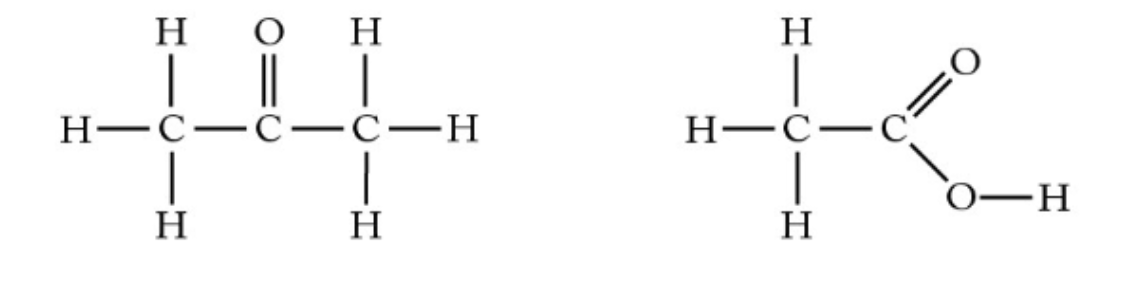
Structural Formulas
(Lesson 1: Matter, Formulas and Models; Energy) Formulas & Models
What type of formulas are these?

Condensed Structural Formulas
(Lesson 1: Matter, Formulas and Models; Energy) Formulas & Models
What type of models are these?

Ball-and-Stick Models
(Lesson 1: Matter, Formulas and Models; Energy) Formulas & Models
What type of models are these?

Space-Filling Models
(Lesson 1: Matter, Formulas and Models; Energy) Formulas & Models
Depending on the model, chemical bonds are represented as…
Lines connecting two atomic symbols or spheres
Overlap between two sphere
(Lesson 1: Matter, Formulas and Models; Energy) Elements vs. Compounds; Atoms vs. Molecules'
What is an ELEMENT?
a pure substance composed of only one type of atom
(Lesson 1: Matter, Formulas and Models; Energy) Elements vs. Compounds; Atoms vs. Molecules'
What is a COMPOUND?
a pure substance composed of 2 or more elements chemically bonded in a fixed proportion
(Lesson 1: Matter, Formulas and Models; Energy) Elements vs. Compounds; Atoms vs. Molecules'
What is a MOLECULE?
2 or more atoms bonded together
(Lesson 1: Matter, Formulas and Models; Energy) Diatomic Elements
What are the DIATOMIC ELEMENTS?
Iodine (I2)
Hydrogen (H2)
Nitrogen (N2)
Fluorine (F2)
Oxygen (O2)
Chlorine (Cl2)
Bromine (Br2)
(Lesson 1: Matter, Formulas and Models; Energy) Physical & Chemical Changes
What is a PHYSICAL CHANGE?
a change in the form or appearance of the substance (not chemical composition)
(Lesson 1: Matter, Formulas and Models; Energy) Physical & Chemical Changes
What is a CHEMICAL CHANGE?
the transformation of one or more atoms or molecules into one or more different molecules
(Lesson 1: Matter, Formulas and Models; Energy) Forms of Energy
What is ENERGY?
the capacity to do work
(Lesson 1: Matter, Formulas and Models; Energy) Forms of Energy
What is KINETIC ENERGY?
energy of motion
(Lesson 1: Matter, Formulas and Models; Energy) Forms of Energy
What is POTENTIAL ENERGY?
energy by virtue of position or composition
(Lesson 1: Matter, Formulas and Models; Energy) Forms of Energy
What is the LAW OF CONSERVATION OF ENERGY?
energy can not be created or destroyed, but it can be converted from one form to another
(Lesson 1: Matter, Formulas and Models; Energy) Forms of Energy
When you form bonds…
energy is released
(Lesson 1: Matter, Formulas and Models; Energy) Forms of Energy
When you break bonds…
energy is absorbed
(Lesson 1: Matter, Formulas and Models; Energy) Potential Energy as a Measure of Stability
When is there more stability?
when there is more negative energy
(Lesson 1: Matter, Formulas and Models; Energy) Potential Energy as a Measure of Stability
Do oppositely-charged particles attract or repel?

attract (PE < 0)
(Lesson 1: Matter, Formulas and Models; Energy) Potential Energy as a Measure of Stability
Do like-charged particles attract or repel?

repel (PE > 0)
(Lesson 1: Matter, Formulas and Models; Energy) Potential Energy as a Measure of Stability
Are positive energies repulsive or attractive?
repulsive
(Lesson 1: Matter, Formulas and Models; Energy) Potential Energy as a Measure of Stability
Are negative energies repulsive or attractive?
attractive
(Lesson 1: Matter, Formulas and Models; Energy) Potential Energy as a Measure of Stability

highest in energy → A (most positive)
most stable → C (most negative)
(Lesson 1: Matter, Formulas and Models; Energy) Phase Transitions
What is SUBLIMATION?
solid → gas
(Lesson 1: Matter, Formulas and Models; Energy) Phase Transitions
What is MELTING?
solid → liquid
(Lesson 1: Matter, Formulas and Models; Energy) Phase Transitions
What is VAPORIZATION?
liquid → gas
(Lesson 1: Matter, Formulas and Models; Energy) Phase Transitions
What is CONDENSATION?
gas → liquid
(Lesson 1: Matter, Formulas and Models; Energy) Phase Transitions
What is FREEZING?
liquid → solid
(Lesson 1: Matter, Formulas and Models; Energy) Phase Transitions
What is DEPOSITION?
gas → solid
(Lesson 2: Expressing Experimental Results) Metric System
tera (T)
1012
(Lesson 2: Expressing Experimental Results) Metric System
giga (G)
109
(Lesson 2: Expressing Experimental Results) Metric System
mega (M)
106
(Lesson 2: Expressing Experimental Results) Metric System
kilo (k)
103
(Lesson 2: Expressing Experimental Results) Metric System
hecto (h)
102
(Lesson 2: Expressing Experimental Results) Metric System
deka (da)
101
(Lesson 2: Expressing Experimental Results) Metric System
deci (d)
10-1
(Lesson 2: Expressing Experimental Results) Metric System
centi (c)
10-2
(Lesson 2: Expressing Experimental Results) Metric System
milli (m)
10-3
(Lesson 2: Expressing Experimental Results) Metric System
micro (µ)
10-6
(Lesson 2: Expressing Experimental Results) Metric System
nano (n)
10-9
(Lesson 2: Expressing Experimental Results) Metric System
pico (p)
10-12
(Lesson 2: Expressing Experimental Results) Metric System
femto (f)
10-15
(Lesson 2: Expressing Experimental Results)
What is TEMPERATURE?
a measure of the average kinetic energy of the particles in a sample
(Lesson 2: Expressing Experimental Results) Reference: Temperature
What is CELSIUS based on? What is the freezing/boiling point of water?
Based on the properties of water
0°C = freezing point
100°C = boiling point
(Lesson 2: Expressing Experimental Results) Reference: Temperature
What is KELVIN based on? Are there negative Kelvin temperatures?
Based on the properties of gas
There are no negative Kelvin temperatures
(Lesson 2: Expressing Experimental Results) Chemists Make Measurements
What is an EXTENSIVE PROPERTY?
a property that is dependent on the amount of the substance present
(Lesson 2: Expressing Experimental Results) Chemists Make Measurements
What is an INTENSIVE PROPERTY?
a property that is not dependent on the amount of the substance present
(Lesson 2: Expressing Experimental Results) Measurement: Accuracy and Precision
What is ACCURACY?
proximity of a measurement to the true value of a quantity

(Lesson 2: Expressing Experimental Results) Measurement: Accuracy and Precision
What is PRECISION?
proximity of several measurements to each other (most precise = smallest difference between measurements)
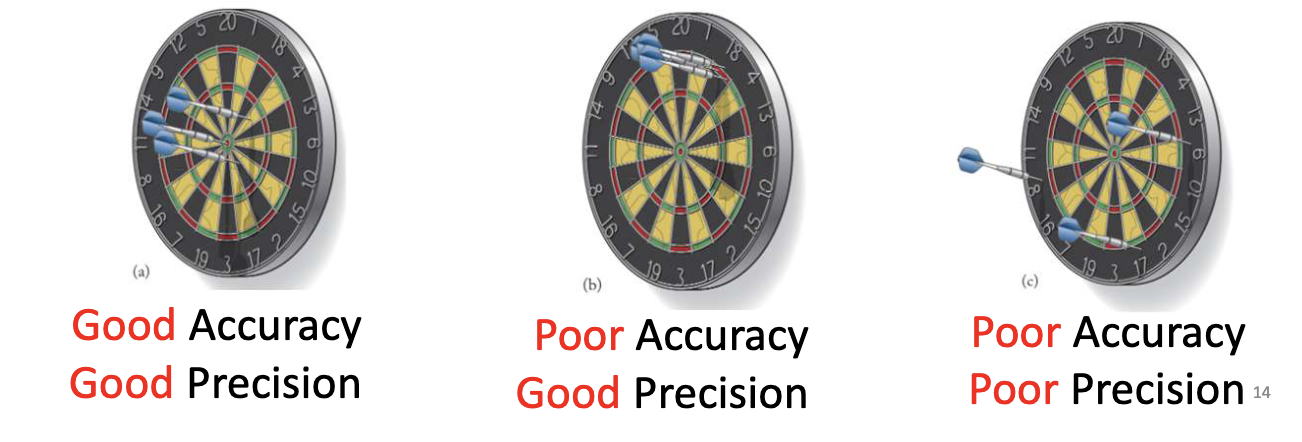
(Lesson 2: Expressing Experimental Results) Measurement and Uncertainty
What is UNCERTAINTY?
smallest measurable difference between measured properties
determines the limits of precision of a measurement
reducing uncertainty in measurements can mean more precise measurements
more decimal places = less uncertainty = more precision
(Lesson 3: COAST; Unit Conversions and Dimensional Analysis)
1 mL = _ cm3
1
(Lesson 3: COAST; Unit Conversions and Dimensional Analysis)
1 L = _ mL = _ cm3
1000
1000
(Lesson 3: COAST; Unit Conversions and Dimensional Analysis)
1 m3 = _ cm3
106
(Lesson 3: COAST; Unit Conversions and Dimensional Analysis)
1 m3 = _ L
1000
(Lesson 4: Rutherford; Navigating the Periodic Table) Atomic Structure and Subatomic Particles
Electrons
negative (-) electrical charge
(Lesson 4: Rutherford; Navigating the Periodic Table) Atomic Structure and Subatomic Particles
Protons
positive (+) electrical charge
(Lesson 4: Rutherford; Navigating the Periodic Table) Atomic Structure and Subatomic Particles
Neutrons
no electrical charge
(Lesson 4: Rutherford; Navigating the Periodic Table) Atomic Structure and Subatomic Particles
_______ and ________ have essentially the same mass.
Protons
neutrons
(Lesson 4: Rutherford; Navigating the Periodic Table) Atomic Structure and Subatomic Particles
_________ mass is so small that we often ignore it.
Electron
(Lesson 4: Rutherford; Navigating the Periodic Table) Discovering the Electron
How did J.J. Thomson discover the electron in 1897?
Thomson used a cathode ray tube.
A cathode ray is a stream of negative charged particles → electrons.
The rays traveled from the cathode (-) to the anode (+) and produced a glowing spot on the screen.
Electric and magnetic fields deflected the rays, showing that the particles were charged.
The rays bent toward the positive plate, proving that they had a negative charge.

(Lesson 4: Rutherford; Navigating the Periodic Table) The Atom, circa 1900 (Building Our Current Model)
What is the PLUM PUDDING MODEL?
put forward by J.J. Thomsom
It featured a diffuse positive sphere of matter with negative electrons embedded in it.
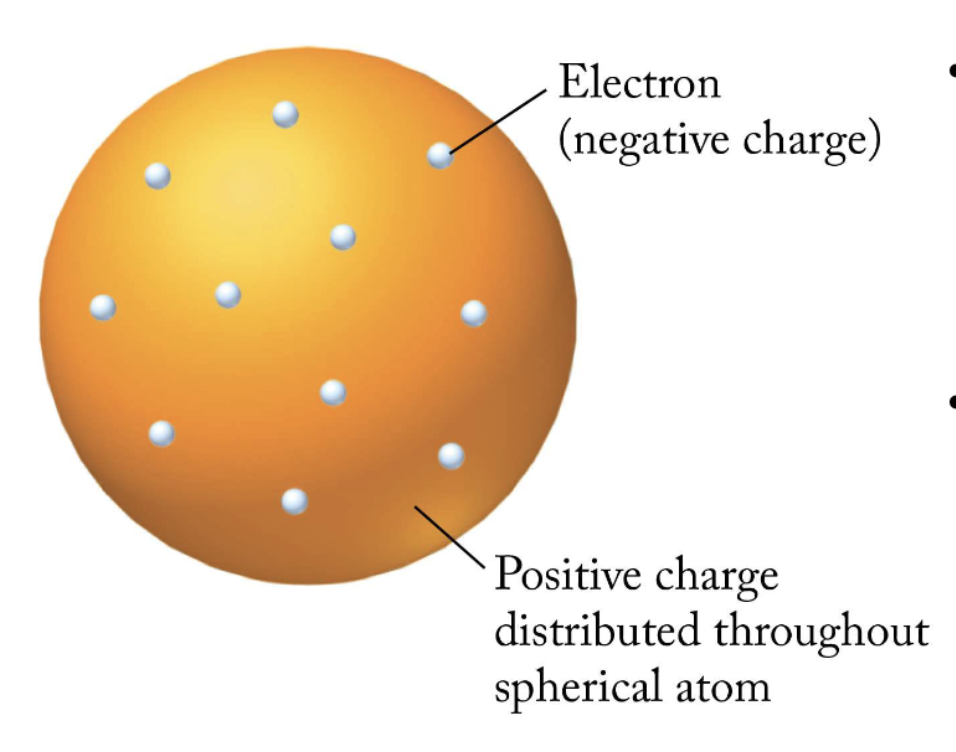
(Lesson 4: Rutherford; Navigating the Periodic Table) The Atom, circa 1900 (Building Our Current Model)
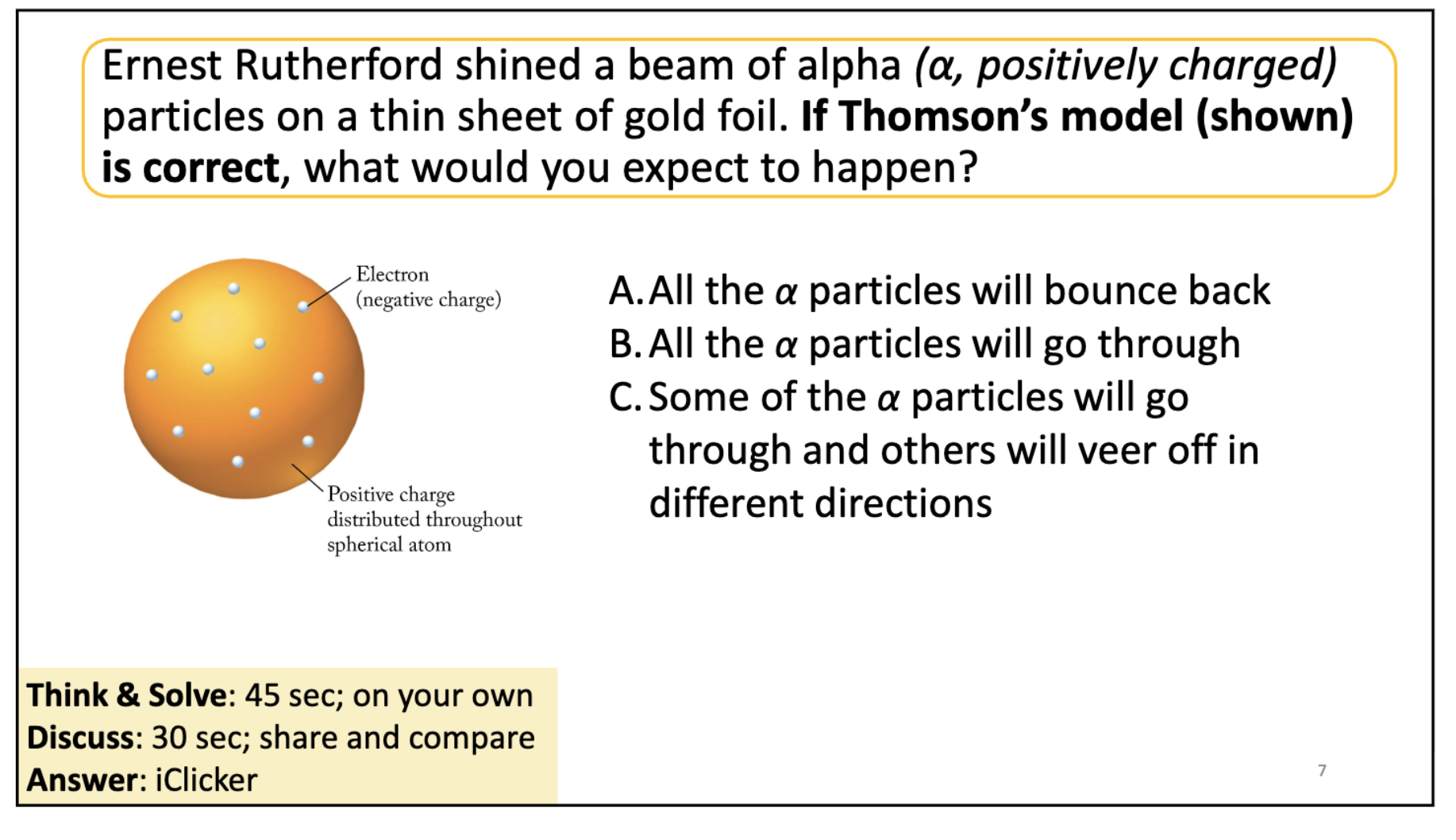
B (didn’t know there was a nucleus, thought just electrons)
(Lesson 4: Rutherford; Navigating the Periodic Table) Rutherford’s Gold Foil Experiment
Explain this experiment.
Rutherford fired positively charged alpha particles towards a thin sheet of gold foil.
Most particles passed through → atom is mostly empty space
Some particles deflected → positive charge is not evenly spread in the atom
Very few particles bounced back/deflected sharply → the atom contains a small, dense, positively charged nucleus
This meant Thomson’s Plum Pudding Model couldn’t be correct and led to the nuclear model of the atom…
nucleus = most of the atom’s mass

(Lesson 4: Rutherford; Navigating the Periodic Table)
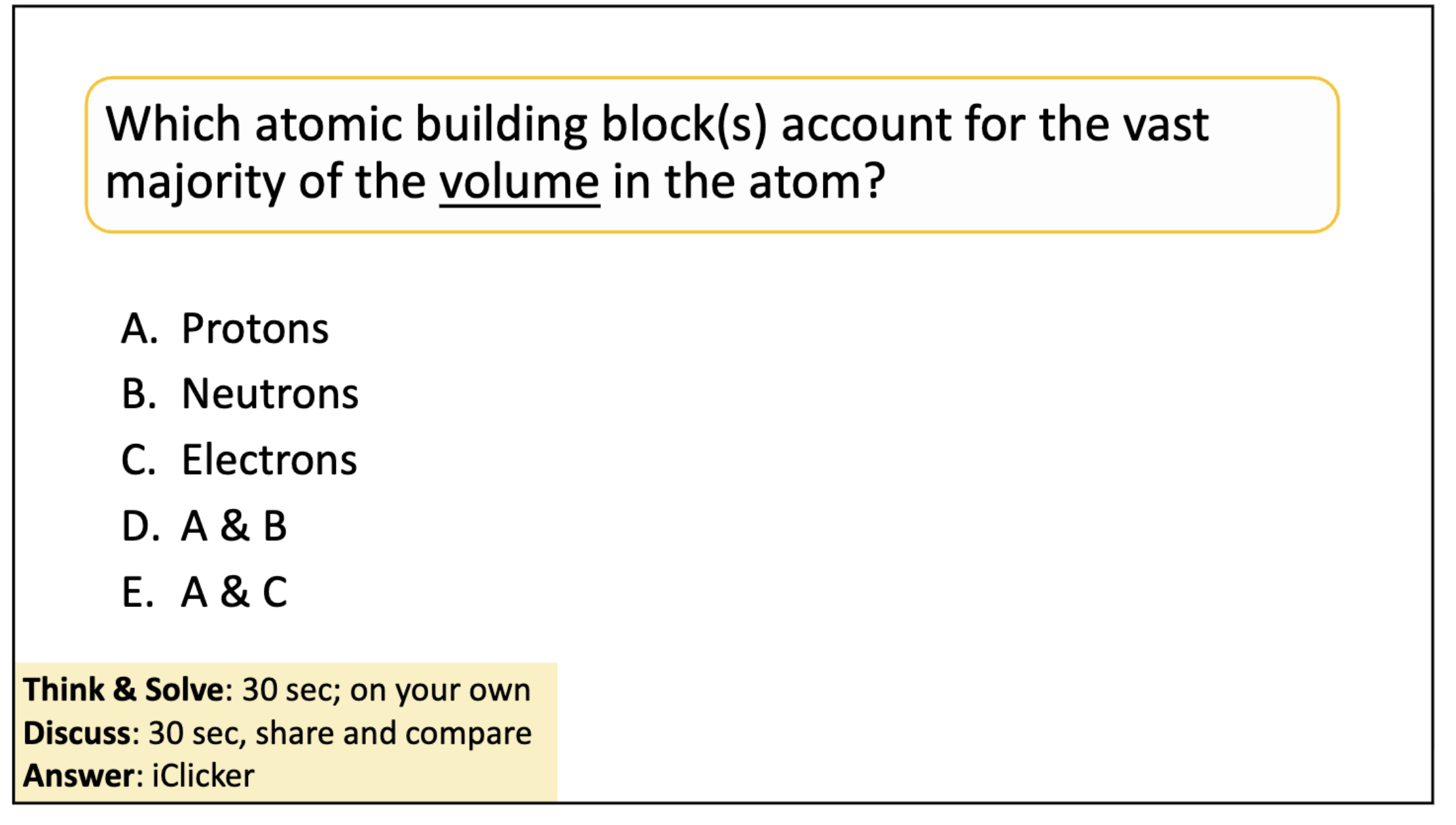
C
(Lesson 4: Rutherford; Navigating the Periodic Table) The Modern Periodic Table
Explain the properties of METALS (white).
Shiny, solid, conductor (of heat and electricity)
Malleable (pound into sheets) and ductile (pound into wire)
Solids at room temp, with one exception: Mercury is liquid

(Lesson 4: Rutherford; Navigating the Periodic Table) The Modern Periodic Table
Explain the properties of NONMETALS (light gray).
Solids (brittle), liquids, and gases
Nonconductors
(Lesson 4: Rutherford; Navigating the Periodic Table) The Modern Periodic Table
Explain the properties of METALLOIDS (dark gray).
Shiny (like metals → physical properties of metals) but brittle (like nonmetals → chemical properties of nonmetals)
Semiconductors
(Lesson 4: Rutherford; Navigating the Periodic Table) Commonly Used Names of Groups
What is GROUP 1?
Alkali Metals
form basic solutions in water
(Lesson 4: Rutherford; Navigating the Periodic Table) Commonly Used Names of Groups
What is GROUP 2?
Alkaline Earth Metals
(Lesson 4: Rutherford; Navigating the Periodic Table) Commonly Used Names of Groups
What is GROUP 16?
Chalcogens
(Lesson 4: Rutherford; Navigating the Periodic Table) Commonly Used Names of Groups
What is GROUP 17?
Halogens
discovered in sweat, halo-forming
(Lesson 4: Rutherford; Navigating the Periodic Table) Commonly Used Names of Groups
What is GROUP 18?
Noble Gases
don’t react w/ anything
(Lesson 5: Nuclides and Their Symbols) Isotopes Experimental Evidence
What are ISOTOPES?
When positively charged neon ions were passed through electric and magnetic fields, two bright spots were observed on the detector.
There must have been Ne+ ions with two different masses that were deflected at different angles.
Isotopes are atoms of an element containing the same numbers of protons but different numbers of neutrons.

(Lesson 5: Nuclides and Their Symbols) Symbols of Isotopes (Nuclides)
Label:
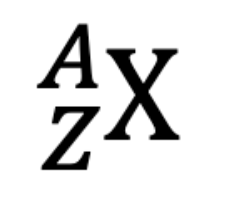
X represents the one- or two-letter symbol for the element
A represents the atomic mass of the isotope (# of neutrons + protons)
Z represents the nuclear charge or atomic number (# of protons)
# of electrons = # of protons -/+ (opposite of charge) # (charge)
(Lesson 5: Nuclides and Their Symbols) Average Atomic Mass
Given isotope masses and natural abundances, we can calculate the average atomic mass as a weighted average where…

mx = average atomic mass
a = natural abundance (as a decimal)
m = atomic mass
(Lesson 5: Nuclides and Their Symbols) Formula Mass (weight)
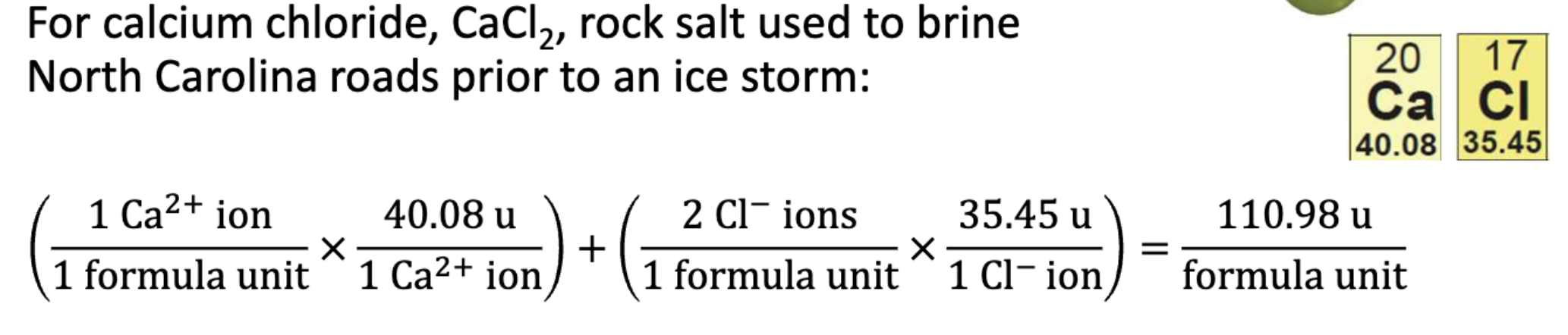
What is FORMULA MASS (WEIGHT)?
The formula mass (weight) is used for ionic compounds because there are no molecules present, just ions attracted to each other.
(Lesson 5: Nuclides and Their Symbols) Molecular Mass (weight)
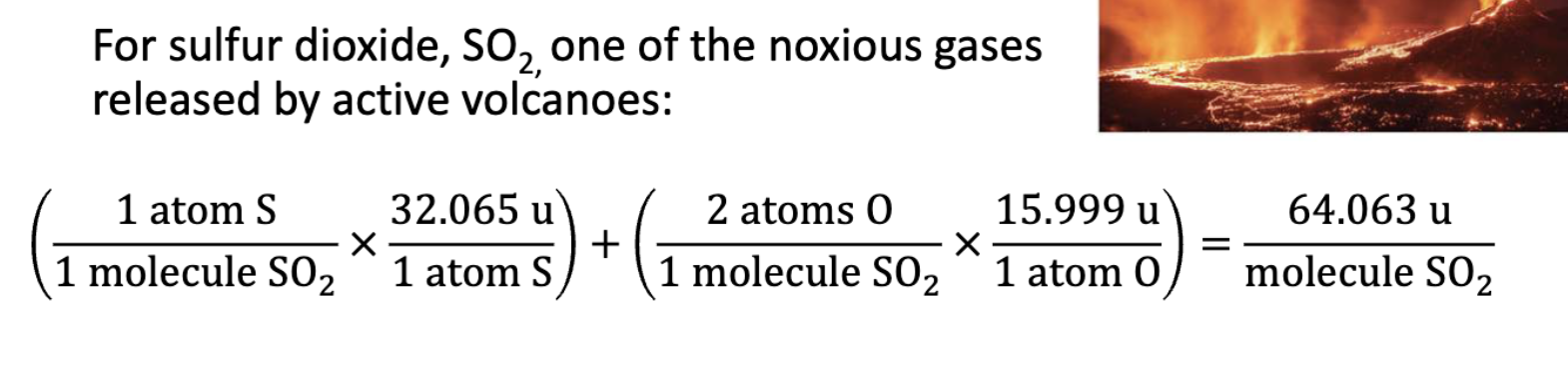
What is MOLECULAR MASS (WEIGHT)?
The molecular mass is the sum of all the average atomic masses of the atoms that are covalently bonded together.
(Lesson 5: Nuclides and Their Symbols) Mass Spectrometry
What is MASS SPECTROMETRY?
Mass spectrometry converts atoms into positively charged ions (M+) by removing an electron.
Ions are then separated based on their mass-to-charge ratio (m/z).
A mass spectrum plots…
x-axis: m/z ratio
y-axis: relative intensity
each peak represents an ion with a specific m/z

(Lesson 6: Moles and Molar Masses) Definitions: Moles and a Dozen
What is a MOLE?
One mole is used to describe a macroscopic amount of atoms or molecules (because they are so small)
Number of things
1 mole = 6.022 × 10²³ particles
(Lesson 6: Moles and Molar Masses) Molar Mass
What is MOLAR MASS?
The molar mass is the mass (in grams) of one mole of a substance (atom, molecule, or formula unit).
It has the same numerical value as the mass in u.
6.022 × 10²³ u = 1.000 g

(Lesson 7: The Electromagnetic Spectrum; Atomic Spectra; Quantum Theory; The Hydrogen Spectrum and the Bohr Model)
Describe the relationship between wavelength, frequency, and energy.
high frequency → short wavelength → high energy
(Lesson 7: The Electromagnetic Spectrum; Atomic Spectra; Quantum Theory; The Hydrogen Spectrum and the Bohr Model) The Nature of EMR Energy
Einstein used this same assumption (minimum amount of energy) to explain the photoelectric effect. What is the PHOTOELECTRIC EFFECT?
the release of electrons from a material as a result of electromagnetic radiation striking it
1 photon hits 1 atom to eject 1 electron

(Lesson 7: The Electromagnetic Spectrum; Atomic Spectra; Quantum Theory; The Hydrogen Spectrum and the Bohr Model) What about Bohr (and his model)?
What is the NIELS BOHR HYPOTHESIS?
Electrons can only exist at specific, quantized energy levels (n = 1, 2, 3, etc.)…
as n increases, the electron is farther from the nucleus, has greater energy, and the energy levels get closer
as an electron moves up, energy is absorbed as a photon of light
as an electron moves down, energy is released as a photon of light (Efinal - Einitial)

(Lesson 7: The Electromagnetic Spectrum; Atomic Spectra; Quantum Theory; The Hydrogen Spectrum and the Bohr Model) Bohr Model of the Hydrogen Atom
White light source gives…
continuum

(Lesson 7: The Electromagnetic Spectrum; Atomic Spectra; Quantum Theory; The Hydrogen Spectrum and the Bohr Model) Bohr Model of the Hydrogen Atom
Excited sample of gas gives…
line spectrum of discrete wavelengths

(Lesson 7: The Electromagnetic Spectrum; Atomic Spectra; Quantum Theory; The Hydrogen Spectrum and the Bohr Model) What Bohr Got Wrong
What did Bohr get wrong?
Electrons do not orbit the nucleus.
(Lesson 7: The Electromagnetic Spectrum; Atomic Spectra; Quantum Theory; The Hydrogen Spectrum and the Bohr Model)
What should you do if you can’t figure out if a jump from one energy level to the next is bigger/smaller compared to another one?
Compare |1/n2 - 1/n2| for both jumps (initial - final)
(Lesson 8: Electrons as Waves; Quantum Numbers; Atomic Orbitals) Do electrons behave as waves?
What happened in the double split experiment?
When electrons were fired toward two small slits, electrons hit the screen as individual dots, but after many electrons were fired, the electrons became subject to interference (just like waves) and formed alternating high- and low- density bands.

(Lesson 8: Electrons as Waves; Quantum Numbers; Atomic Orbitals) Interference
What is CONSTRUCTIVE INTERFERENCE?
2 waves in phase with each other add to give a wave with twice the amplitude.

(Lesson 8: Electrons as Waves; Quantum Numbers; Atomic Orbitals) Interference
What is DESTRUCTIVE INTERFERENCE?
2 waves out of phase with each other add to cancel each other out.

(Lesson 8: Electrons as Waves; Quantum Numbers; Atomic Orbitals) Wave Motion in Restricted Systems (Standing Waves)
Louis de Broglie proposed that the reason only certain orbits were allowed in the H atom was because…
the e- bound to the nucleus was like a standing wave; only certain orbits would have integer wavelengths

(Lesson 8: Electrons as Waves; Quantum Numbers; Atomic Orbitals) Wave-Particle Duality
What is WAVE-PARTICLE DUALITY?
Since electromagnetic radiation (EMR) can have particle behavior (photons), particles can have wave behavior
(Lesson 8: Electrons as Waves; Quantum Numbers; Atomic Orbitals) Wave-Particle Duality
What did Louis de Broglie predict?
Electrons (and any object with mass) are moving in a wave-like pattern
Predicted wave-particle duality
(Lesson 8: Electrons as Waves; Quantum Numbers; Atomic Orbitals)

D
(Lesson 8: Electrons as Waves; Quantum Numbers; Atomic Orbitals) What are the implications of the de Broglie wavelength?
Large object = large mass and speed = ____ wavelength
tiny
(Lesson 8: Electrons as Waves; Quantum Numbers; Atomic Orbitals) What are the implications of the de Broglie wavelength?
_____ wavelength (relative to the object) = No observed wave-like movement
small
(Lesson 8: Electrons as Waves; Quantum Numbers; Atomic Orbitals) What are the implications of the de Broglie wavelength?
_____ wavelength (relative to the object) = Object moves as wave
large
(Lesson 8: Electrons as Waves; Quantum Numbers; Atomic Orbitals) The Uncertainty Principle
What is the UNCERTAINTY PRINCIPLE?
We cannot simultaneously define the position and momentum of a quantum mechanical particle.
In the case of an electron, we choose to define its energy (proportional to momentum) exactly but accept limitation that we do NOT know its exact position.
(Lesson 8: Electrons as Waves; Quantum Numbers; Atomic Orbitals) The Uncertainty Principle
Using this equation, we can calculate the uncertainty of the position of an electron…

