Microbiology Lab Exam 2 (copy)
 Call Kai
 Learn
 Practice Test
 Spaced Repetition
 Match
 Flashcards
 Knowt Play
1/57

There's no tags or description
Looks like no tags are added yet.
58 Terms
List and describe the three classes of temperature specific bacteria.
Psychrophiles - love cold temps
10 - 20 degrees Celsius
Mesophiles - love medium temps
15 - 40 degrees Celsius
Thermophiles - love hot temps
44 - 72 degrees Celsius
Name and describe the class of bacteria that are osmotic pressure dependent.
Halophiles - love salt (NaCl)
3% NaCl
List and describe the classes of bacteria that are pH dependent.
Acidophiles - love acidity
less than 2 pH
Alkaliphiles - love basicity
9-11 pH
Name and describe the class of bacteria that is oxygen dependent. Also, list the three jar types and the oxygen availability they provide.
Microaerophiles - love low amounts of oxygen (less than air)
6-8% oxygen
No jar: 21% oxygen
Brewer’s jar: 0% oxygen
Candle jar: 6-8% oxygen
Name and describe the class of bacteria that is CO2 dependent.
Capnophiles - love high CO2
Describe selective media.
Selects for a group of bacteria while inhibiting the growth of other broad groups of bacteria, toxic to one group but not the other
mainly differentiates between Gram (-) and Gram (+)
e.g. NaCl, bile salts, stains, heavy metals, antibiotics
Describe differential media.
Separation of more narrowly defined groups of bacteria, typically between species within the same genus
Adds nutrients that one group uses but the other cannot
mainly differentiates between species unique metabolisms
e.g. sugars, amino acids, starch, lipids, RBCs, nucleic acids
Describe indicators. What types of media are they used in? What are the most common indicators?
They detect changes in media color, opacity, and development of uniquely colored colonies.
Used in both differential and selective media.
pH sensitive colorimetric compounds
List and describe the color changes of the six pH sensitive colorimetric compounds. (Arrows: left —> right = acidic —> basic)
Phenol red: yellow → pink/purple/red
Neutral red: red → yellow
Bromophenol blue: yellow → blue
Bromocresol purple: yellow → purple
Bromothymol blue: yellow → blue
Litmus
normally red → blue
in milk: pink/white → purple
Blood Agar Plate (BAP)
What does this test for?
List the key ingredient.
What is it differential for?
List the 3 types of results.
Does it have hemolysins that lyse RBCs?
5% sheep blood
Staphylococcus and streptococcus
Alpha hemolysis, beta hemolysis, and gamma hemolysis
Describe alpha hemolysis on a blood agar plate. What type of bacteria would cause this result?
lyse red blood cells
greening/browning of media around colonies
alpha strep (aka Smut)
Describe beta hemolysis on a blood agar plate. Which bacteria would produce this result?
lyse AND degrade RBCs
clearing of media around colonies
SA
Describe gamma hemolysis on a blood agar plate. Which bacteria would produce this result?
no lysing of RBCs = no change on media (stays red)
S. epi
Mannitol Salt Agar (MSA) Plate
What does this test?
List 3 key ingredients
What is it selective for?
What is it differential for?
Describe the results.
Does it ferment mannitol?
Mannitol (sugar), NaCl (salt), phenol red indicator (yellow → pink/purple/red)
Selective for bacteria that tolerate high salt environments
Staphylococcus (SA vs Sepi) and Bacillus (BS vs BC)
Results:
Positive for mannitol fermentation: turns yellow (SA and BS)
Negative for mannitol fermentation: stays red (Sepi and BC)
Eosin Methylene Blue Agar Plates
What is this test for?
List 5 key ingredients
What is it selective for?
What is it differential for?
Describe the results.
This test is a coliform differential
protein, sucrose, lactose, Gram (+) inhibitors: Eosin Y and methylene blue
Selective for Gram (-) rods
Differential for coliforms (Escherichia) - E.coli and E. aerogenes
Results:
E. coli: blue-green metallic sheen colonies (acidity causes dyes to bind)
E. aerogenes: larger colonies with pink/orange centers
Other Gram (-) rods: colorless colonies
MacConkey’s Agar Plates (MAC)
What does this test?
List 5 key ingredients.
Describe the results of the indicator.
Which ingredient also inhibits coliforms?
What is it selective for?
What is it differential for?
Describe the results.
Does it ferment lactose?
Protein, lactose, neutral red indicator (red → yellow) Gram (+) inhibitors: bile salts and crystal violet
Acid from lactose fermentation turn media different shades of red
Bile salts also inhibit coliforms
Selective for Gram (-) rods
Differential for Salmonella, Shigella, E. coli, and E. aerogenes
Results:
Salmonella and Shigella: transparent, tannish colonies due to no lactose fermentation
E. coli: colonies appear bright red due to lactose fermentation
Salmonella-Shigella Agar Plates (SS)
Which test is this super similar to?
What does this test for?
List 7 key ingredients.
Which ingredient inhibits Gram (+) and coliforms?
What is it selective for?
What is it differential for?
Describe the results (there is an exception).
super similar to MacConkey’s Agar Plates
Does it ferment lactose / produce H2S?
protein, lactose, neutral red indicator, sodium thiosulfate, ferric citrate, bile salts, NaCl
bile salts inhibit Gram (+) and coliforms
Selective for Gram (-) rods
Differential for salmonella, shigella, E.coli
Results:
Salmonella/shigella: transparent/tannish colonies (no lactose fermentation), with dark black centers (from generating H2S from thiosulfate, H2S reacts with iron ions to form black FeS ppt)
exception! shigella sonnei - delayed reddish colonies
E.coli: bright red colonies, but inhibited growth
Litmus Milk Tubes/Broths (LM)
What does it test for?
List the 2 key ingredients.
What is it selective for?
What is it differential for?
Describe the results.
Does it ferment lactose? Does it modify/breakdown casein?
Skim milk and litmus pH indicator (pink/white → purple)
Selective for Gram (+) rods
Differential for Bacillus species
Results:
Acid produced from fermentation of lactose (broth turns pink/white)
Modification/breakdown of casein
Clotting (Curd): clot/curd formation at bottom of tube
Proteolyzed (P): casein breakdown, clarifying at surface
Triple Sugar Iron (TSI) slants
What type of inoculation method?
When to record results and at what temperature?
List the 7 ingredients.
Differential for?
Scoring results (3 things to interpret)
What could the results NEVER be?
What does K/A mean?
Stab to bottom, lift straight up, then streak slant
Record results after 24 hours at 37 degrees celsius
Protein, sodium thiosulfate, ferrous sulfate, phenol red indicator, 3 sugars: Lactose (1%), sucrose (1%), glucose (0.1%)
Differential for Gram (-) rods
Scoring
Slant / butt
K = alkaline (red media), A = acidic (yellow media)
Gas production (cracks or bubbles) + or -
Production of H2S and FeS black ppt cloud in butt + or -
K/A means only glucose was fermented
results can never be A/K, only K/K, A/A, K/A
What is the chemical reaction for production of black precipitate?
Fe2+ + H2S → FeS (black precipitate)
What are two examples of amino acids for differential media?
tryptophan, phenylalanine
Staphylococcus Medium 110 (SM-110)
What three things does it test for?
List the 3 ingredients
Selective for?
Differential for?
This test determines if bacteria produce which enzyme? What does the enzyme do?
Results (colony colors)
2 additions?
Does it ferment mannitol? Does it hydrolyze gelatin? Does it produce pigments?
7.5% NaCl, Mannitol (sugar), gelatin
Selective for Gram (+) cocci
Differential for staphylococcus species
Mannitol-1-phosphate-5-dehydrogenase, breaks down mannitol
Results:
S. aureus: orange colonies
S. epi: white colonies
Additions:
Bromothymol blue: exposes mannitol fermentation (yellow = acid)
Ammonium sulfate: exposes gelatin hydrolysis (clear zone around colonies)
Mitis-Salivarius (MS)
What does it test for?
List the three ingredients.
What do the last two ingredients do?
Selective for?
Differential for?
Determines if bacteria produce what enzyme? What does it do?
Results (colonies)
Does it break down sucrose?
Sucrose, crystal violet, tellurite
crystal violet: inhibits other Gram (+) species
tellurite: inhibits Gram (-), but at low % allows PV to grow large mucoid colonies
Selective for Gram (+) cocci
Differential for Streptococcus and enterococcus
Saccharase (inverstase), breaks down sucrose
Results:
S. mitis and E. faecalis: small dark blue colonies
S. salivarius: gum drop colonies
Proteus vulgaris (PV): large mucoid colonies
DNase
Utilizes what type of inoculation?
What does it test for?
Key ingredient
Determines if bacteria produce what enzyme? What does it do?
Results
Utilizes line inoculation
Does it degrade DNA?
DNA
Extracellular nuclease, degrades DNA
Results: Add 0.1M HCl to reveal DNA
Positive (+): clearing around line, cloudiness everywhere else
Negative (-): cloudiness all over the plate
Nutrient Starch
What does it test for?
What type of inoculation?
Key ingredient
Determines if bacteria produce which enzyme? What does it do?
Results
Does it degrade starch?
Line inoculation
1% Starch
Amylase, breaks down starch
Results: Add Gram’s iodine to reveal starch
Positive (+): dark purple with clearing around line
Negative (-): dark purple all over the plate
Nutrient Gelatin
What does it test for?
What type of inoculation?
Key ingredient
Determines which enzyme that bacteria produce? What does it do?
Results
Does it degrade gelatin?
Stab inoculation in gelatin media
Gelatin
Extracellular protease (gelatinase), degrades gelatin
Results: Place tubes in fridge after incubation
Positive (+): gelatin stays liquid
Negative (-) gelatin solidifies
Sulfide Indole Motility (SIM)
What 3 things does it test for? (Hint: It’s the name!)
What type of inoculation technique?
List the 3 ingredients
Differential for?
Results (for all 3)
H2S production, indole production, does it have motility?
Stabbing technique w/ inoculating needle directly down into solid medium into tube
Sodium thiosulfate, ferric ammonium citrate, and meat peptone (which contains tryptophan)
Differential for Gram (-) rods
Results:
Motility
(+) fuzzy or cloud stab
(-) clean stab
H2S production via breakdown of thiosulfate
(+) black Fes ppt cloud around stab
(-) no black ppt cloud around stab
Apply 8-10 drops of Kovac’s solution to reveal indole production (breakdown of tryptophan)
(+): reagent turns reddish purple
(-) reagent turns tannish yellow
Phenylalanine (PHE)
What does it test for?
What type of tube?
Key ingredient
Determines if what type of bacteria produces what type of enzyme?
What are the byproducts of phenylalanine breakdown?
Results (and steps)
Does it degrade phenylalanine?
Utilizes tube slants
Phenylalanine
Determines if Gram (-) rods produce phenylalanine deaminase
Byproducts: Phenylpyruvic acid (PPA) and ammonia (NH3)
Results: Add 10% FeCl3 (ferric chloride) reagent to reveal presence of PPA
Positive (+): reagent turns green
Negative (-) reagent stays orange/tan
Urea
What does it determine?
What type of tube?
List the 2 key ingredients
Determines if what type of bacteria produce what type of enzyme?
What are the byproducts of urea degradation?
Results
Does it degrade urea?
Utilizes broth tube
Urea and phenol red indicator
Determines if Gram (-) rods produce urease
Byproducts: ammonia (NH3) and CO2 which increases pH
Results:
Positive (+): Broth turns pink/purple/red
Negative (-): Broth remains orangish
Lysine Decarboxylase (LYS)
What does it test for?
What type of tube?
This type of test works only for what type of fermenters?
List the 3 key ingredients
What is the function of the oil? (sorry I spoiled one of the ingredients)
What has to happen first before lysine can be degraded?
Determines if bacteria produce which enzyme?
What is the byproduct of lysine degradation? How does it affect pH?
Results (explain color changes)
Does it degrade lysine?
Broth tube
Glucose fermenters only
Lysine, bromocresol purple, sterile mineral oil
The oil prevents O2 from diffusing into the broth, promoting fermentation of glucose
Glucose must be fermented first, then lysine can be used
Lysine decarboxylase
CO2, increases pH
Results:
Positive (+): broth turns purple after 48 hour incubation
Broth turns yellow after 24 hours due to glucose fermentation, then purple after 48 hours due to lysine fermentation
Negative (-): broth turns yellow after 48 hour incubation
Broth turns yellow due to glucose fermentation, lysine fermentation never happens so it doesn’t turn purple
Nitrate (NO3)
What does it test for?
List the three reagents and explain the color changes.
Describe the procedure and results.
Step 1 and results
Step 2 and results
Does it use nitrate (NO3) as a terminal electron acceptor in anaerobic respiration?
Three reagents:
Nitrate A (sulfanilic acid): turns red in presence of nitrite (NO2)
Nitrate B (dimethyl-alpha-naphthylamine): turns red in presence of nitrite (NO2)
Powdered zinc: turns red in presence of nitrate (NO3)
Procedure and results:
Add 10 drops of both Nitrate A and Nitrate B
Positive (+): red color, indicates nitrate has been reduced to nitrite via nitrate reduction by enzyme nitrate reductase
No red color: move to step 2 (powdered zinc)
Add powdered zinc
Positive (+): no red color, indicates nitrate has been reduced to N2 gas via denitrification
Negative (-): red color indicates nitrate is still present
Coagulase
What does it test for?
What is the procedure?
What does it determine?
Describe the results.
Does it cause blood clotting?
Add rabbit plasma to tube broth culture and incubate at 37 degrees Celsius for 1-3 hours
It determines if Gram (+) cocci produce coagulase enzyme which can form blood clots
Results
Positive (+): clot formation
Negative (-): no clot formation
Catalase
What does it test for?
Describe procedure
What does it determine?
Results
Does it degrade H2O2?
Dropping hydrogen peroxide onto TSA plate culture
It determines if bacteria produce catalase enzyme to break down H2O2
Aerobic bacteria must degrade toxic oxygen species (H2O2)
Results:
Positive (+): bubbles produced
Negative (-): no bubbles produced
Phenol Red Sugars (GLU, MAN, LAC, SUC, XYL)
What are the 3 key ingredients?
What does it determine?
Results
Does it ferment specific sugars?
Phenol red indicator, Durham tube, Sugars: glucose, mannitol, sucrose, lactose, xylose
Results
Positive(+): Production of acid (A) and/or gas (G+)
A: yellow broth
G+: gas trapped in Durham tube
Negative(-): No production of acid (alkaline K) or gas (G-)
K: pink/red/purple broth
G-: no gas trapped in Durham tube
Simmons Citrate Agar (Citrate)
What does it test for?
List the 4 key ingredients.
What is it selective for?
What is it differential for?
Describe the results
Does it degrade citrate?
Ingredients:
Bromothymol blue
NaCl and ammonium salts
Sodium citrate
Selective for gram (-) rods but can provide helpful info on Gram (+) rods
Differential for E. coli and E. aerogenes
Results
Positive (+): ammonium and citrate are broken down into ammonia and CO2 which increase the pH of the media turning it a vivid blue
E. aerogenes
Negative (-): ammonium is not degraded, pH stays neutral, media stays deep green
E. coli
Methyl Red (MR)
What does it test for?
List the 2 key ingredients
What does it determine?
What is it differential for?
Results
Does it undergo mixed acid fermentation?
Ingredients:
Methyl red indicator: red → yellow (added after incubation)
Buffered peptone glucose broth: rich in glucose and protein
Determines if Gram (-) rods produce large amount of mixed acids via mixed acid fermentation
Differential for E. coli and E. aerogenes
Results: After adding 8 drops of methyl red indicator
Positive(+): turns red, result of mixed acid fermentation
E. coli
Negative(-): indicator stays yellow, no fermentation
E. aerogenes
Voges-Proskauer
What does it test for?
3 key ingredients
Determines what?
Differential for?
Steps?
Results?
Does it undergo alcoholic fermentation?
Ingredients
Buffered peptone glucose broth - rich in protein and glucose
VP-A (alpha-naphthol) and VP-B (40% KOH) added after incubation (turns dark/red purple in presence of acetylmethylcarbinol)
Determines if Gram (-) rods produce acetylmethylcarbinol as an intermediate of alcoholic fermentation
Differential for E. coli and E. aerogenes
Steps:
1. Add 10 drops of VP-A (alpha-naphthol), shake gently, wait 1-2 minutes
2. Add 5 drops of VP-B (40% KOH), shake gently, incubate 20-40 min at 37 degrees Celsius
Results:
VP(+): turns dark red/purple, indicates alcoholic fermentation
E. aerogenes
VP(-): no color change, no alcoholic fermentation
E. coli
ONPG Test
What does it test for?
2 key ingredients
What are 2 intracellular enzymes necessary for lactose fermentation? What are their functions?
What is ONPG?
What is nitrophenol
3 steps
Results
Does the bacteria still possess B-galactosidase?
Ingredients:
1.0 mL of TSB culture
No indicator in broth
Add ONPG reagent before incubation
Enzymes:
lactose permease: allows lactose to enter the cell
some bacteria lose this enzyme but still have B-galactosidase
B-galactosidase: splits lactose into glucose and galactose
ONPG: (o-nitrophenol-B-galactoside), lactose analog that can enter the cell without lactose permease and later be broken down by B-galactosidase
Nitrophenol: colored component of ONPG that is severed from sugar by B-galactosidase producing vivid yellow color in broth
Steps:
1. Add 0.5mL of culture to sterile tube
2. Add 0.5mL of ONPG reagent to tube
3. Incubate at 37 degrees Celsius and check every 20 min up to 3 hours
Results:
Positive(+): vivid yellow color: B-galactosidase is present
Negative(-): no color change: B-galactosidase is not present
IMViC Test
Differential for?
What four tests?
Function of each test (review)
E. coli results
E. aerogenes results
Differential for E. coli and E. aerogenes
Indole, Methyl red, Voges-Proskauer, Citrate
Indole: Does it break down tryptophan (indole as a byproduct)?
Methyl red: Does it undergo mixed acid fermentation?
Vi: Does it undergo alcoholic fermentation?
Citrate: Does it degrade citrate?
E. coli results: +,+, -, -
E. aerogenes results: -, -, +, +

Which test is this? Interpret the results for each tube A - E.
SIM (Sulfide, Indole, Motility) Test
A: (-) H2S, (+) Indole, (-) Motility
B: (-) H2S, (-) Indole, (-) Motility
C: (+) H2S, (-) Indole, can’t tell for Motility
D: (-) H2S, (+) Indole, (+) Motility
E: (+) H2S, (+) Indole, (+) Motility (hard to tell bc of H2S)
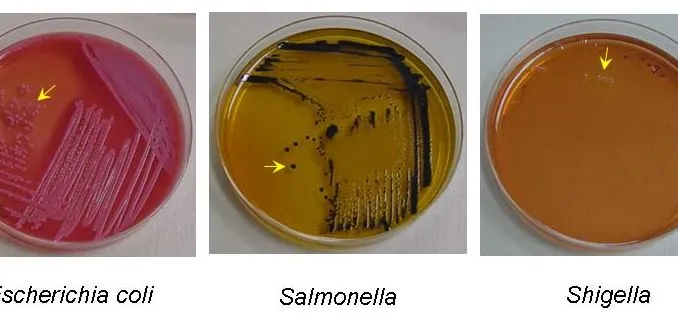
What test is this? Interpret each plate.
Salmonella-Shigella Agar Plate
E. coli: bright red colonies, red medium: (+) lactose fermentation, pH < 6
Salmonella/shigella: tannish colonies with dark black centers: generates H2S, yellow medium: (-) lactose fermentation

What test is this? Interpret the results.
Eosin Methylene Blue (EMB) Agar
Coliform differential
E. coli: blue-green metallic sheen colonies
E. aerogenes: larger colonies w/pink orange centers
Other Gram (-) rods: colorless colonies
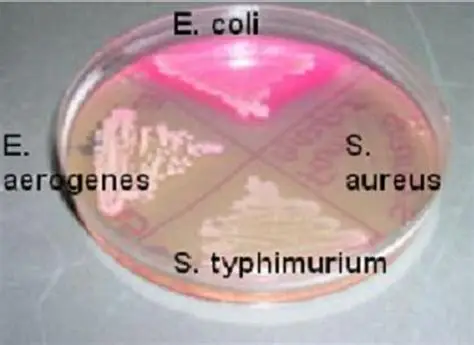
What test is this? Interpret the results.
MacConkey’s Agar
red media: lactose fermentation (E.coli)
tan media: no lactose fermentation (salmonella and shigella)
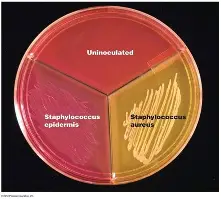
What test is this? Interpret the results.
Mannitol Salt Agar (MSA) - Does it ferment mannitol?
Yellow media: ferments mannitol
Red media: does not ferment mannitol
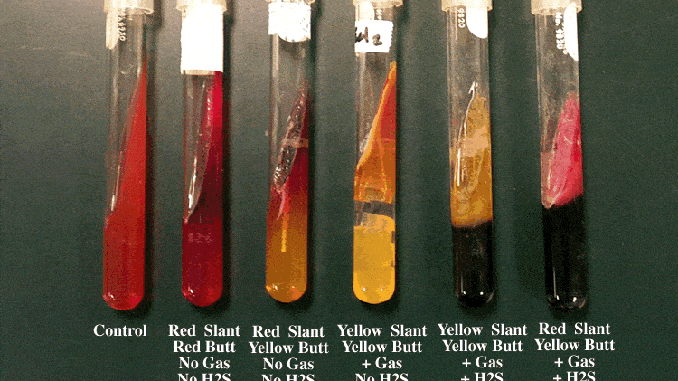
What test is this? Interpret the results.
Triple Sugar Iron (TSI) Slants
Slant/butt
Red: alkaline: K
Yellow: acidic: A
Bubbles/cracks: (+) Gas formation
Black precipitate: (+) H2S

What is this test? Interpret the results.
DNAse
clearing around the line, cloudiness everywhere else: (+) for DNAse
cloudiness all over the plate: (-) for DNAse
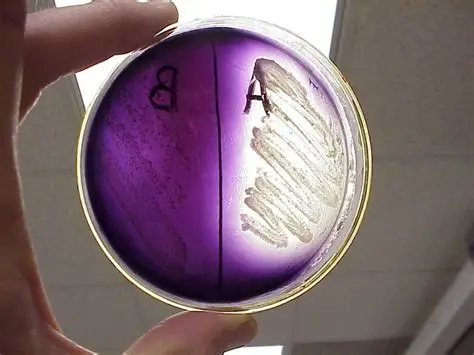
What is this test? Interpret the results.
Nutrient Starch - Does it degrade starch/have amylase?
Positive (+): Dark purple with clearing around line
Negative (-): Dark purple all over the plate
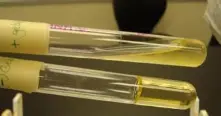
What test is this? Interpret the results.
Nutrient Gelatin - Does it degrade gelatin/possess extracellular protease (gelatinase)?
Solid tube (bottom): (-) for gelatinase
Liquid tube (top): (+) for gelatinase

What test is this? Interpret the results.
Nitrate
Tube 1: No change with Nitrate A and B, nitrite absent
Tube 2: Turns red with Nitrate A and B, nitrite present: (+) nitrate reduction
Tube 3: No change with zinc added: (+) nitrate reduction
Tube 4: Turns red with zinc: (-) nitrate reduction

What test is this? Interpret the results.
Phenylalanine - Does it degrade phenylalanine?
Positive (+): slant turns dark green (right tube)
Negative (-): slant stays the same color (left tube)

What test is this? Interpret the results.
Coagulase - Does it cause blood clotting?
Positive (+): clot formation
Negative (-): no clot formation
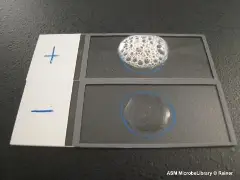
What test is this? Interpret the results.
Catalase - Does it degrade H2O2?
Positive (+): Produces bubbles
Negative (-): Does not produce bubbles

What test is this? Interpret the results.
Urea - Does it degrade urea?
Positive (+): Broth turns pink/purple/red (right tube)
Negative (-): Broth remains orangish (left tube)

What test is this? Interpret the results.
Lysine decarboxylase (LYS) - Does it degrade lysine?
Positive (+): broth turns purple after 48hr incubation due to lysine fermentation
in the first 24 hours it turns yellow due to glucose fermentation
Negative (-): broth turns yellow after 48hr incubation
doesn’t turn purple: no lysine fermentation
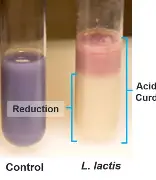
What test is this? Interpret the results.
Litmus Milk - Does it ferment lactose? Does it modify/breakdown casein?
Positive (+): Broth turns pink/white, clarification at the top, clots form
Negative (-): No color change, clots, or clarification
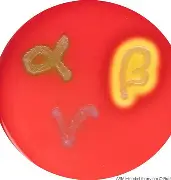
What test is this? Interpret the results.
Blood Agar Plate - Does it have hemolysins that lyse RBCs?
Greening/browning of media: alpha hemolysis (degrades RBCs)
Clearing of media: beta hemolysis (degrades AND lyses RBCs)
No change in media(stays red): gamma hemolysis (does neither)
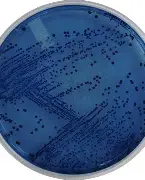
What test is this? Interpret the results.
Mitis Salivarius (MS) - Does it break down sucrose?
Large mucoid colonies: PV
Small dark blue colonies: S. mitis and E. faecalis
Gum drop colonies: S. salivarius
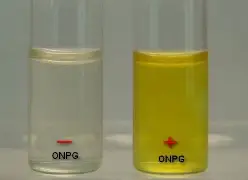
What test is this? Interpret the results.
ONPG
Positive (+): vivid yellow color - B-galactosidase is present
Negative (-): clear - B-galactosidase is not present