Acq/Exp & Neurons/Receptors
0.0(0)
Studied by 0 people Call Kai
 Learn
Learn Practice Test
 Spaced Repetition
 Match
Match Flashcards
 Knowt Play
Card Sorting
1/21

Earn XP
Description and Tags
Last updated 6:49 PM on 4/3/23
Name | Mastery | Learn | Test | Matching | Spaced | Call with Kai | Chat |
|---|
No analytics yet
Send a link to your students to track their progress
22 Terms
1
New cards
What area of the brain is involved in cue-controlled drug-seeking?
dorsal striatum
* hypothesis: is it involved in the start?
* hypothesis: is it involved in the start?
2
New cards
How do we test if the dorsal striatum is involved from the start?
1. inactivate the area prior to exp
2. compare lesioned rats w/controls if their acquisition differs
2. compare lesioned rats w/controls if their acquisition differs
3
New cards
Area 1
detects cue light/drug association
- involves lever press/cravings
- detector + effector --\> acquisition AND expression
- involves lever press/cravings
- detector + effector --\> acquisition AND expression
4
New cards
Area 2
when association is established, actionable effects are passed to Area 2
- effector \= executes --\> expression ONLY
- effector \= executes --\> expression ONLY
5
New cards
What are the 3 inactivation techniques?
1. electrolytic lesions
2. chemical lesions (excitotoxic)
3. optogenetics
2. chemical lesions (excitotoxic)
3. optogenetics
6
New cards
electrolytic lesion
lesion created by passing an electric current through the tip of an electrode positioned in the brain
7
New cards
chemical lesion (excitotoxic)
- overactivation of AMPA + NMDA receptor
- too much Ca++ enters cell
- enzymatic overload damages cell
- too much Ca++ enters cell
- enzymatic overload damages cell
8
New cards
optogenetics
treatment that uses combo of light stimulation + genetics to manipulate the activity of individual neurons
9
New cards
6 steps to optogenetics
1. piece together genetic construct
2. insert construct into virus
3. inject virus into brain (aspin is expressed in target neuron)
4. insert optrode, fiber-optic cable + electrode
5. laser light of specific wavelength opens ion channels in neurons
6. activity in neurons is modulated by light
2. insert construct into virus
3. inject virus into brain (aspin is expressed in target neuron)
4. insert optrode, fiber-optic cable + electrode
5. laser light of specific wavelength opens ion channels in neurons
6. activity in neurons is modulated by light
10
New cards
What do inactivation techniques allow us to test?
involvement of specific areas/cells in various behaviors
11
New cards
How do we know which neuron/receptor/NTs are active in an area?
1. measure lvls of **mRNA** that codes a NT to know what neurons are prevalent in an area
2. measure lvls of NTs directly in live animals during expression (**microdialysis**)
12
New cards
What are the clinical implications if: increased DA is present during cue light in reinstatement phase?
- can target DA neurons (ex. antagonist)
- where are the neurons projecting from?
- can we block relapse?
- where are the neurons projecting from?
- can we block relapse?
13
New cards
behavioral effects
relapse/reinstatement
14
New cards
3 ways to block behavioral effects (relapse) on a neuro-lvl?
1. antagonist - block DA
2. optogenetics - suppress firing
3. DREADDS
2. optogenetics - suppress firing
3. DREADDS
15
New cards
antagonist
can be used systematically (intravenous) or local* (lab)
16
New cards
DREADDS
designer receptors exclusively activated by designer drugs;
* can bind to excite/inhibit
* engineered GPCRs activated by drug-like molecules
* packaged into viral vector + injected
* allows cellular activity to be controlled in a defined spatial/temporal manner
* can bind to excite/inhibit
* engineered GPCRs activated by drug-like molecules
* packaged into viral vector + injected
* allows cellular activity to be controlled in a defined spatial/temporal manner
17
New cards
pros + cons of lesions
pro - disables specific area, quick, cheap
con - destroys connections, rough, outdated
con - destroys connections, rough, outdated
18
New cards
pros + cons of optogenetics
pro - better spatial + temporal resolution (in ms/can turn on-off)
con - $$, multiple surgeries, rats restricted by fibre-optic
con - $$, multiple surgeries, rats restricted by fibre-optic
19
New cards
pros + cons of DREADDS
pro - better spatial resolution, simple execution, cost effective, rats behave normally
con - slightly worse temporal resolution (prolonged effect 20-60mins)
con - slightly worse temporal resolution (prolonged effect 20-60mins)
20
New cards
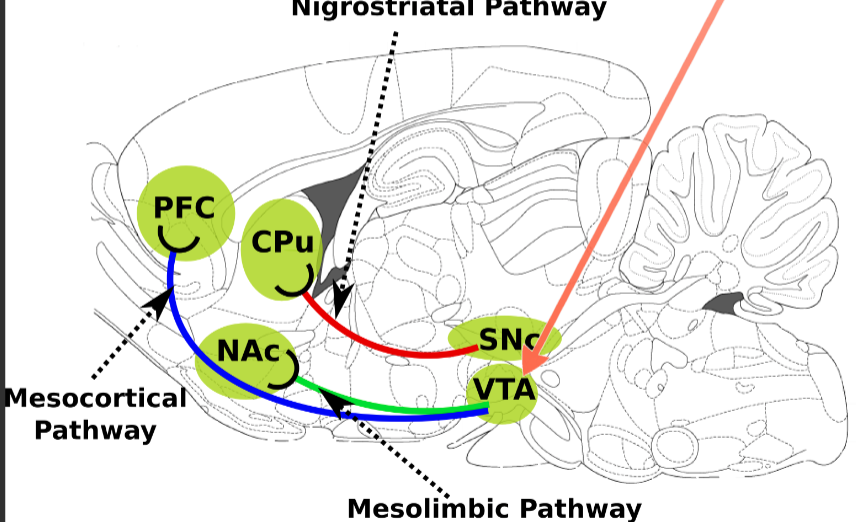
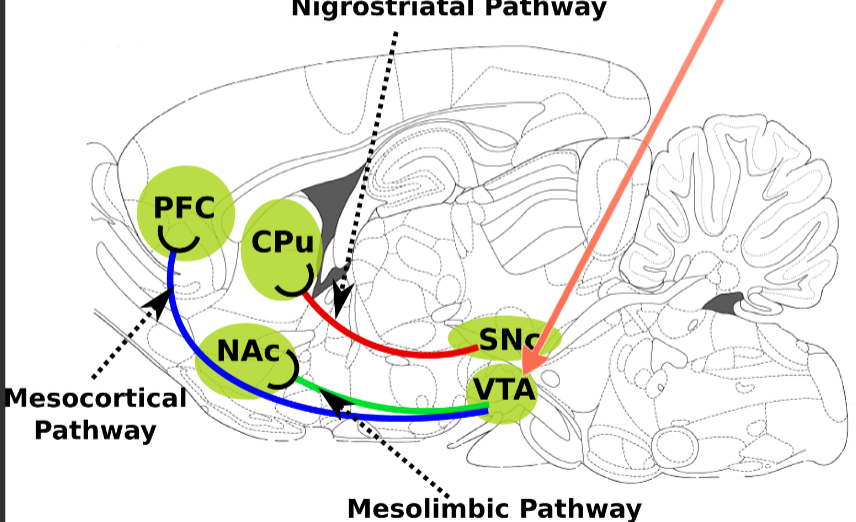
mesolimbic pathway\*\*
VTA → NAc
* neurons release DA
* express AMPA/NMDA receptors (Glu)
* neurons release DA
* express AMPA/NMDA receptors (Glu)
21
New cards
nigrostriatal pathway
SNc → CPu
22
New cards
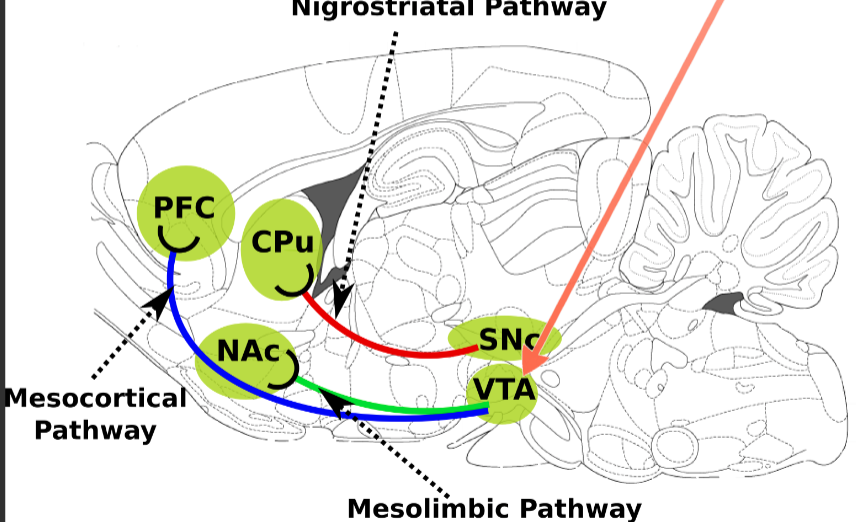
mesocortical pathway
VTA → PFC