
CH 6

0.0(0)
Studied by 0 people
call kaiCall Kai
learnLearn
examPractice Test
spaced repetitionSpaced Repetition
heart puzzleMatch
flashcardsFlashcards
GameKnowt Play
Card Sorting

1/44

encourage image

There's no tags or description

Looks like no tags are added yet.

45 Terms

1
New cards

What are the four components of a reflex pathway?

1) Input signal (regulated variable & specialized sensor)

2) Integrating center (Acts as an integrating centre)

3) Output signal (Muscles and other tissues controlled by effectors)

4) Response

2
New cards
What seven types of proteins drive cellular communication and function?

1) Enzymes

2) Membrane transporters

3) Signal molecules

4) Receptors

5) Binding proteins

6) Immunoglobulins

7) Regulatory proteins.

3
New cards

Whats is proteins central role in cell communication

  • Proteins play a central role in cell communication by acting as messengers, receptors, and structural components...

  • Transmit and interpret signals between and within cells

  • Detect external signals and initiate intracellular responses for key process within the body


4
New cards
What are the two primary types of physiological signals used by the body's 75 trillion cells?

1) Electrical signals (changes in cell membrane potential),

2) Chemical signals (molecules secreted into ECF/blood; most common)

5
New cards
How are cell-to-cell communication methods categorized?

Local communication

  • Gap Junctions, Contact-dependent signals, and Autocrine/Paracrine signals.

Long-distance communication

  • Endocrine hormones, Neurotransmitters, and Neurohormones.


6
New cards
What are Gap Junctions and where are they found?
Protein channels that form direct cytoplasmic bridges between adjacent cells to allow rapid electrical and chemical passage; found in cardiac and smooth muscle.
7
New cards

What two structures compose intercalated disks in cardiac tissue and what are their roles?

1) Desmosomes: Strong protein that surrounds sarcomeres and bind neighbouring sarcomeres. Allow force to be transferred.

2) Gap Junctions: Provide electrical connection. Electrical signals are rapidly transmitted via these protein pores providing the basis for SYNCHRONOUS CONTRACTION.

8
New cards

What are the intercalated disks

Intercalated disks contain desmosomes that transfer force from cell to cell, and gap junctions that allow electrical signals to pass rapidly from cell to cell.

<p>Intercalated disks contain desmosomes that transfer force from cell to cell, and gap junctions that allow electrical signals to pass rapidly from cell to cell.</p>
9
New cards
What is Contact-Dependent signaling and when does it occur?
Cell-to-cell communication requiring direct physical interaction between membrane-bound molecules on two adjacent cells; common in immune system function, growth, and development.
10
New cards
What is the difference between Autocrine and Paracrine signaling?
Autocrine signals act on the exact same cell that secreted them. Paracrine signals are secreted into extracellular fluid to diffuse to nearby adjacent cells (e.g., histamine, cytokines, eicosanoids).
11
New cards
How does locally produced IGF-1 drive muscle hypertrophy during exercise?
Mechanical stress causes muscle cells to release IGF-1 locally (autocrine/paracrine). IGF-1 binds cell surface receptors to activate mTOR pathways, stimulating protein synthesis and inhibiting protein degradation (via FoxO/MURF1).
12
New cards
What three systems and molecules mediate long-distance communication?

1) Hormones (released from endocrine cells)

2) Neurocrines: (released from neurons; neurotransmitters, neuromodulators, neurohormones)

3) Cytokines (are peptides, both local and long distance).
13
New cards
What defines a hormone and how does it reach its target?
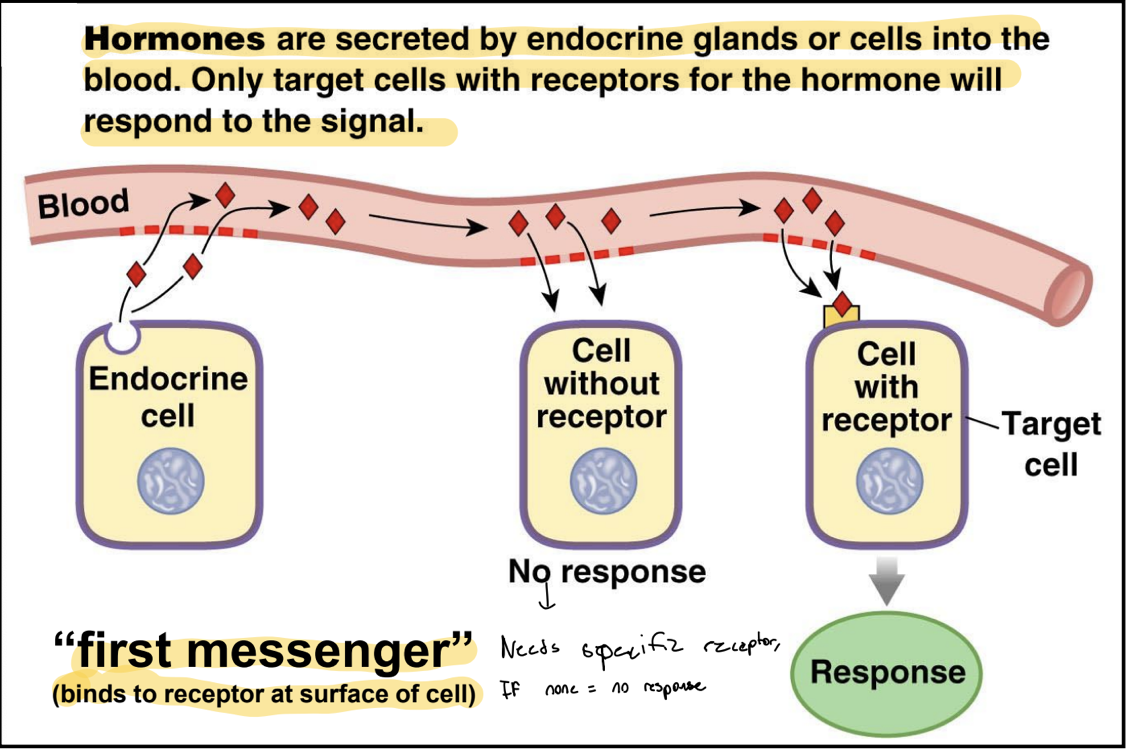
A chemical signal secreted by endocrine cells directly into the bloodstream; it travels throughout the body as a "first messenger" but only affects target cells containing specific receptors.
14
New cards

What is a Neurotransmitter?

A chemical signal released by a neuron that diffuses across a tiny extracellular gap (synaptic cleft) to bind receptors on an adjacent target cell.

<p>A chemical signal released by a neuron that diffuses across a tiny extracellular gap (synaptic cleft) to bind receptors on an adjacent target cell.</p>
15
New cards

How does Acetylcholine (ACh) trigger muscle contraction?

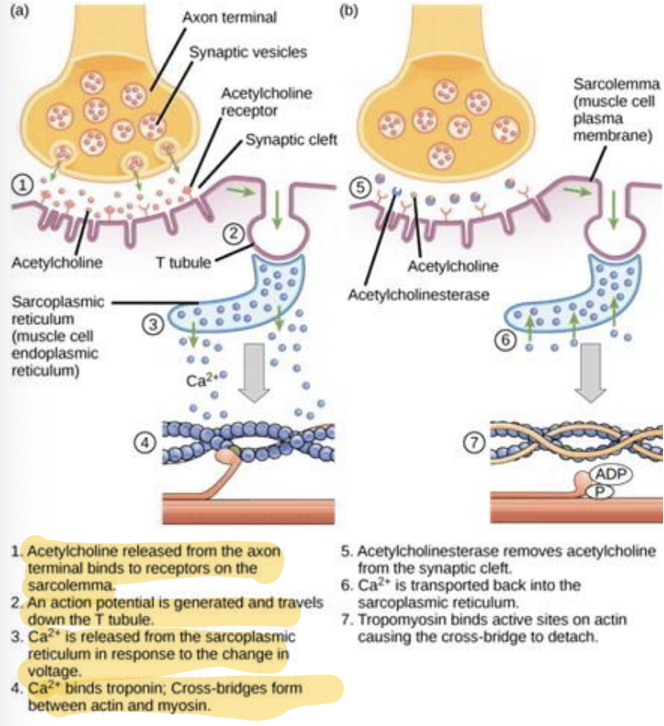
  • ACh is a neurotransmitter released from motor neurons into a neuron into the neuronmuscular junction

  • Diffuses across the synaptic cleft, binds sarcolemma receptors in the cell membrane

  • Generates an action potential down T-tubules, and causes Ca2+ release from the sarcoplasmic reticulum

<ul><li><p>ACh is a neurotransmitter released from motor neurons into a neuron into the neuronmuscular junction </p></li><li><p>Diffuses across the synaptic cleft, binds sarcolemma receptors in the cell membrane </p></li><li><p>Generates an action potential down T-tubules, and causes Ca2+ release from the sarcoplasmic reticulum</p></li></ul><p></p>
16
New cards

What is a Neurohormone and how does it act?

A chemical released by a neuron into the blood to travel to distant target cells. Binding to specific target-cell receptors initiates intracellular signal transduction.

<p>A chemical released by a neuron into the blood to travel to distant target cells. Binding to specific target-cell receptors initiates intracellular signal transduction.</p>
17
New cards

What are Signal Pathways

  • Receptor Proteins

  • A cell responds to a particular chemical signal only if the target has a receptor


18
New cards
What are the 5 universal steps of a cellular signal pathway?

1) Chemical signal (first messenger) is a ligand that binds to receptor proteins

2) Ligand-receptor binding activates receptor

3) Receptor activates one or more intracellular signal molecules

4) The last signal molecule modifies existing proteins or initiates the synthesis of new proteins

<p>1) Chemical signal (first messenger) is a ligand that binds to receptor proteins </p><p>2) Ligand-receptor binding activates receptor</p><p>3) Receptor activates one or more intracellular signal molecules</p><p>4) The last signal molecule modifies existing proteins or initiates the synthesis of new proteins</p>
19
New cards
Where do lipophobic signal molecules bind and why?
They cannot cross the phospholipid bilayer, so they bind to cell membrane receptor proteins on the outer cell surface.
20
New cards
Where do lipophilic signal molecules bind and how do they enter?
They easily diffuse through the cell membrane to bind to intracellular receptors located in the cytosol or nucleus.
21
New cards

How do response speeds differ between intracellular signal and cell membrane receptors?

Lipophilic molecules binding cytosolic/nuclear receptors cause SLOWER responses (changes in gene activity).

Lipophobic molecules binding cell membrane receptors cause RAPID cellular responses.

<p>Lipophilic molecules binding cytosolic/nuclear receptors cause SLOWER responses (changes in gene activity). </p><p>Lipophobic molecules binding cell membrane receptors cause RAPID cellular responses.</p>
22
New cards

What is Signal Transduction and what roles do transducers and kinases play?

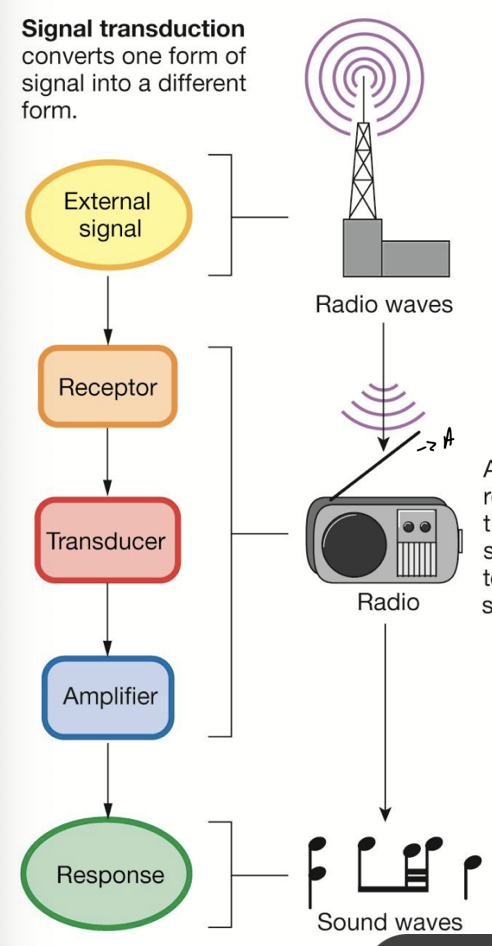
Transducer converts a signal from one form to another

Extracellular signal is the first messenger

Intracellular signal is the second messenger

  • A Protein Kinase is enzyme that adds a phosphate group to another protein (phosphorylation acts like on/off switch to generate responses changes in protein conformation, activity, location)

<p>Transducer converts a signal from one form to another</p><p>Extracellular signal is the first messenger</p><p>Intracellular signal is the second messenger</p><ul><li><p>A Protein Kinase is enzyme that adds a phosphate group to another protein (phosphorylation acts like on/off switch to generate responses changes in protein conformation, activity, location)</p></li></ul><p></p>
23
New cards
What is the functional difference between First and Second Messengers?

First messengers are extracellular chemical signals (hormones, neurotransmitters) that bind specifically to cell surface or intracellular receptors to initiate a signal transduction pathway receptors.

Second messengers are intracellular molecules (e.g., cAMP, Ca2+) rapidly synthesized/released inside the cytoplasm following receptor activation by a first messenger. They amplify and transmit the signal throughout the cytosol to modulate downstream target proteins and enzymes

24
New cards
What are signal cascades and signal amplification?

Cascades are sequential activation steps where one active molecule turns on the next.

Signal amplification occurs when a single receptor-ligand complex activates an amplifier enzyme, turning one ligand into many intracellular molecules (second messengers.)

<p>Cascades are sequential activation steps where one active molecule turns on the next. </p><p>Signal amplification occurs when a single receptor-ligand complex activates an amplifier enzyme, turning one ligand into many intracellular molecules (second messengers.)</p>
25
New cards

How do resistance and endurance training stimulate different cell signaling cascades?

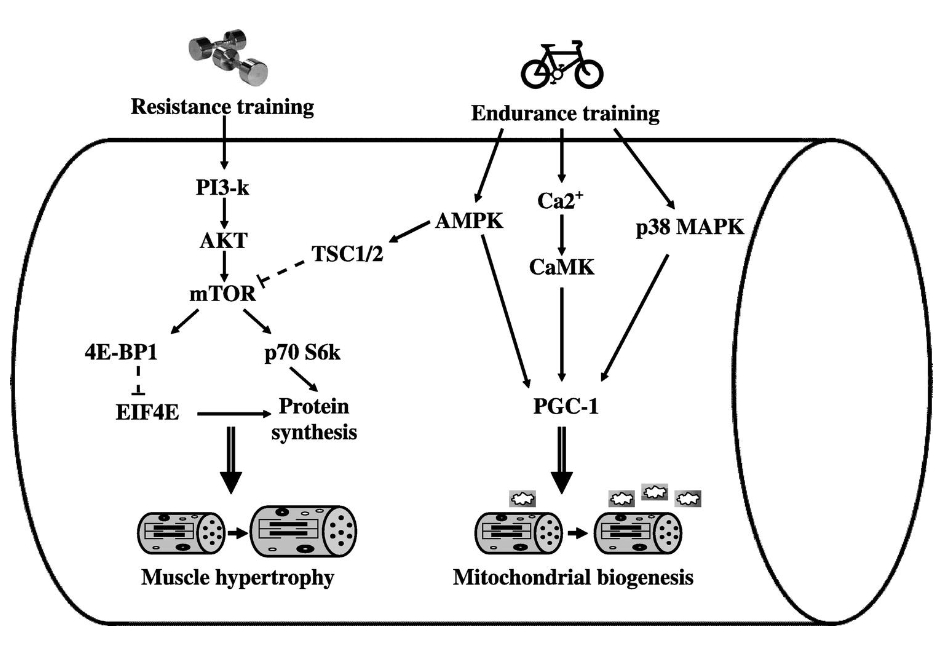
Resistance training activates mTOR to drive protein synthesis (hypertrophy). Needed for bulking season.

Endurance training activates AMPK and CaMK to increase PGC-1alpha, driving mitochondrial biogenesis.

Activation of these pathways is an example of a signalling cascade. Signal is amplified at each stage, allowing a small initial stimulus to produce a large cellular response.
<p>Resistance training activates mTOR to drive protein synthesis (hypertrophy). Needed for bulking season.</p><p>Endurance training activates AMPK and CaMK to increase PGC-1alpha, driving mitochondrial biogenesis.</p><p>Activation of these pathways is an example of a signalling cascade. Signal is amplified at each stage, allowing a small initial stimulus to produce a large cellular response. </p>
26
New cards

What are the four main categories of cell membrane receptors? (Whats there function aswell)

1) Receptor-channels (chemically gated ion channels)

  • Ligand Binding opens form closes the channel

2) G protein-coupled receptors (GPCRs)

  • Ligand binding a G protein-coupled receptor open an ion channel or alters enzyme activity. Most signal transduction uses g-proteins

3) Receptor-enzymes (catalytic)

  • Ligand binding to a receptor-enzyme activates an intracellular enzyme.

4) Integrin receptors (catalytic)

  • Ligand binding to integrin receptors alters enzymes or the cytoskeleton.
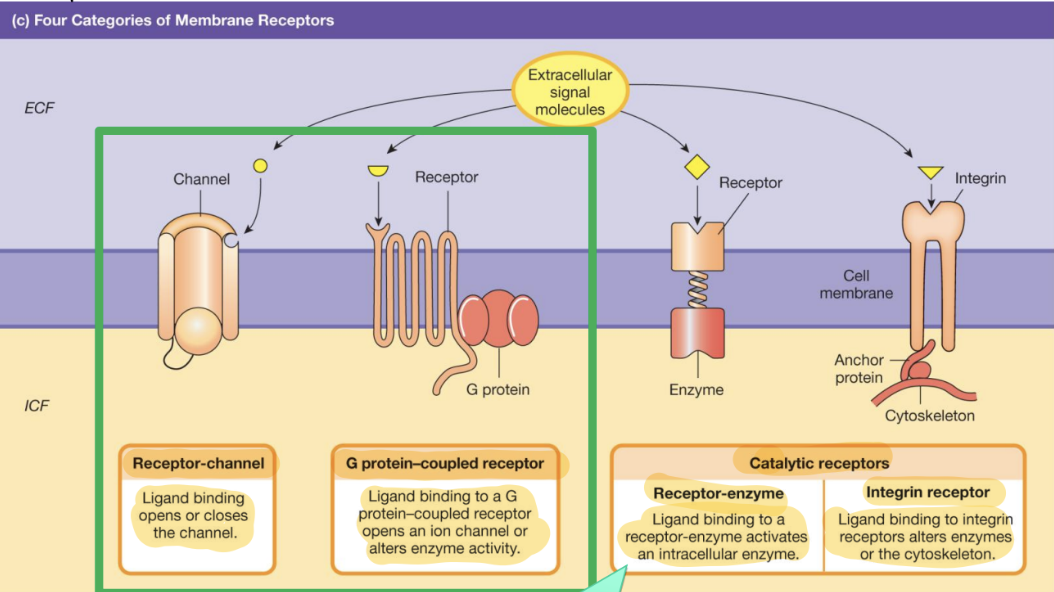

<p>1) Receptor-channels (chemically gated ion channels)</p><ul><li><p>Ligand Binding opens form closes the channel </p></li></ul><p>2) G protein-coupled receptors (GPCRs)</p><ul><li><p>Ligand binding a G protein-coupled receptor open an ion channel or alters enzyme activity. Most signal transduction uses g-proteins</p></li></ul><p>3) Receptor-enzymes (catalytic)</p><ul><li><p>Ligand binding to a receptor-enzyme activates an intracellular enzyme.</p></li></ul><p>4) Integrin receptors (catalytic)</p><ul><li><p>Ligand binding to integrin receptors alters enzymes or the cytoskeleton.</p></li></ul><p></p>
27
New cards

What happens during signal transduction using ion channels


Most Rapid Signal Pathways Change Ion Flow through Channels. By altering membrane permeability to ions (Na+, K+, Cl-), creating rapid flow an ion = rapid response form the cell (common in nerve and muscle).

28
New cards

Steps in signal transduction using ion channels

  1. Receptor-channels open or close in response to signal molecule binding

  2. Some changes are directly linked to G protein.

  3. Other channels respond to intracellular second messengers

  4. Electrical or mechanical signals also open or close ion channels


<ol><li><p>Receptor-channels open or close in response to signal molecule binding</p></li><li><p>Some changes are directly linked to G protein.</p></li><li><p>Other channels respond to intracellular second messengers </p></li><li><p>Electrical or mechanical signals also open or close ion channels </p></li></ol><p></p>
29
New cards
What are the steps of the GPCR Adenylyl Cyclase-cAMP pathway?

1) Signal binds GPCR -> activates G protein.

2) G protein turns on amplifier enzyme Adenylyl Cyclase.

3) Adenylyl Cyclase converts ATP to cAMP.

4) cAMP activates Protein Kinase A (PKA).

5) PKA phosphorylates proteins to produce response.

<p>1) Signal binds GPCR -&gt; activates G protein. </p><p>2) G protein turns on amplifier enzyme Adenylyl Cyclase. </p><p>3) Adenylyl Cyclase converts ATP to cAMP. </p><p>4) cAMP activates Protein Kinase A (PKA). </p><p>5) PKA phosphorylates proteins to produce response.</p>
30
New cards

What does cAMP regulate and what can happen

Regulates a variety of cell functions in nearly every tissue and organ.

Disruption in the system can contribute diseases

31
New cards
How does cAMP regulate heart function during exercise?

Epinephrine/Adrenaline binds GPCRs on heart muscle cells, generating cAMP and activating protein kinases to increase heart rate, contractility, vasodilation and muscle blood flow.

32
New cards
What are the steps and second messengers of the GPCR-Phospholipase C (PLC) pathway?
1) Ligand binds GPCR -> activates G protein. 2) G protein activates Phospholipase C (PLC). 3) PLC splits phospholipids into DAG (activates Protein Kinase C) and IP3 (diffuses to ER to release Ca2+ stores).
33
New cards
How does a Tyrosine Kinase (TK) receptor-enzyme function?
Ligand binding activates the intracellular enzyme side, transferring a phosphate group from ATP to tyrosine amino acids on target proteins (used by Insulin receptors).
34
New cards

Novel Signal Molecules

  • Calcium is an important intracellular

  • Calcium may be released from intercellular compartments by second messengers

    • Stored inside the endoplasmic reticulum by active transport

  • Released of Ca2+ creates Ca2+ signal

    • Known as Ca2+ spark

  • Binds calmodulin or other regulatory proteins


35
New cards
How does Calcium act as a novel intracellular signal molecule?
Ca2+ enters via gated channels or IP3 release from endoplasmic reticulum ('Ca2+ spark'). It binds Calmodulin or other proteins to alter enzyme activity, induce exocytosis, or trigger muscle movement.
36
New cards

Why are Gases are Ephemeral Signal Molecules

Soluble gases are short-acting paracrines or autocrines

Best known is Nitric oxide (NO)

– Produced by endothelial cells

– Diffuses into smooth muscle and causes vasodilation

– Synthesized by the action of nitric oxide synthase (NOS)

– Activates guanylyl cyclase → cGMP

– Acts as neurotransmitter and neuromodulator in brain

37
New cards

Why is Dilated vessels better.

Because there is increase in blood flow which delivers more O2 to certain areas where needed.

During excess, this heightened NO release, dilates the arteries supplying active muscle beds.

38
New cards
What features allow cells to modulate signal pathways?

Receptors exhibit specificity, competition, and saturation.

Cells regulate responses through agonists/antagonists

Multiple receptor isoforms

Up and down-regulation enable cells to modulate responses

Cells must be able to terminate signal pathways.

39
New cards
What is the difference between a receptor Agonist and Antagonist?
  • An Agonist binds a receptor and activates it, producing a response identical to the primary ligand.

  • An Antagonist binds a receptor and blocks its activity, producing no response.


<ul><li><p>An Agonist binds a receptor and activates it, producing a response identical to the primary ligand. </p></li></ul><ul><li><p>An Antagonist binds a receptor and blocks its activity, producing no response.</p></li></ul><p></p>
40
New cards
How does Epinephrine produce opposite vascular effects in intestinal vs. skeletal muscle vessels?

Target response depends on the receptor isoform:

Epinephrine binding to alpha-receptors in intestinal vessels causes CONSTRICTION (reduces blood flow);

binding to beta2-receptors in skeletal muscle vessels causes DILATION (increases blood flow).

<p>Target response depends on the receptor isoform: </p><p>Epinephrine binding to alpha-receptors in intestinal vessels causes CONSTRICTION (reduces blood flow); </p><p>binding to beta2-receptors in skeletal muscle vessels causes DILATION (increases blood flow).</p>
41
New cards
Why does Epinephrine dilate skeletal muscle blood vessels during exercise?
To increase blood flow and oxygen delivery to active skeletal muscle beds via beta2-adrenergic receptor activation.
42
New cards
How does Ozempic (semaglutide) act as a receptor agonist?
It acts as a glucagon-like peptide-1 (GLP-1) receptor agonist, mimicking the action of the natural GLP-1 hormone by binding to and activating the GLP-1 receptor.
43
New cards
What three physiological responses are triggered by Ozempic activating the GLP-1 receptor?

1) Stimulates insulin secretion

2) Inhibits glucagon release

3) Slows gastric emptying (helping lower blood glucose and supporting weight loss in type 2 diabetes and obesity).

44
New cards
What is Tonic Control in physiological regulation?

Regulation of a physiological parameter in an up-down fashion using a single continuous signal but changes in intensity.

Increasing neuron signal rate constricts blood vessels;

decreasing signal rate dilates them.

<p>Regulation of a physiological parameter in an up-down fashion using a single continuous signal but changes in intensity. </p><p>Increasing neuron signal rate constricts blood vessels; </p><p>decreasing signal rate dilates them.</p>
45
New cards

What is Antagonistic Control and how does it regulate heart rate?

Control using two opposing branches of the nervous system:

  • Sympathetic stimulation increases heart rate

  • Parasympathetic stimulation decreases heart rate.
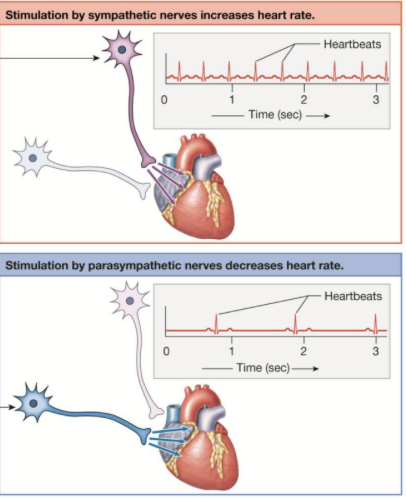

<p>Control using two opposing branches of the nervous system: </p><ul><li><p>Sympathetic stimulation increases heart rate</p></li><li><p>Parasympathetic stimulation decreases heart rate.</p></li></ul><p></p>


