PSYC 211 Lecture 3: The Action Potential
 Call Kai
 Learn
 Practice Test
 Spaced Repetition
 Match
 Flashcards
 Knowt Play
1/30

There's no tags or description
Looks like no tags are added yet.
31 Terms
Crystallization
Process of atoms or molecules arranging into a well-defined, rigid crystal lattice in order to minimize energetic state
Dendrites
Branched, treelike extensions that come off the soma, responsible for collecting info relevant to the cell
Soma/cell body
Where a neuron’s nucleus is located; many protrusions extend, one of which is the axon, and the rest are dendrites
Axon
Responsible for propagating info from the cell body to the axon terminals
Axon terminal/terminal button
The end of an axon
Synapse
The junction between an axon terminal and a downstream cell
Cation
Positively charged ion (examples: NA+, K+, CA2+, MG2+)
Anion
Negatively charged ion (example: CI-)
Electrostatic pressure
The repulsive force between similarly charged ions and the attractive force between oppositely charged ions
Voltage
The potential for electricity to flow; measured with an oscilloscope
Extracellular fluid in the brain
Is the “ground” and always has a charge of 0 mV
Membrane potential
The electrical charge across a cell membrane; most cells have a negative membrane potential between -40 and -90 mV
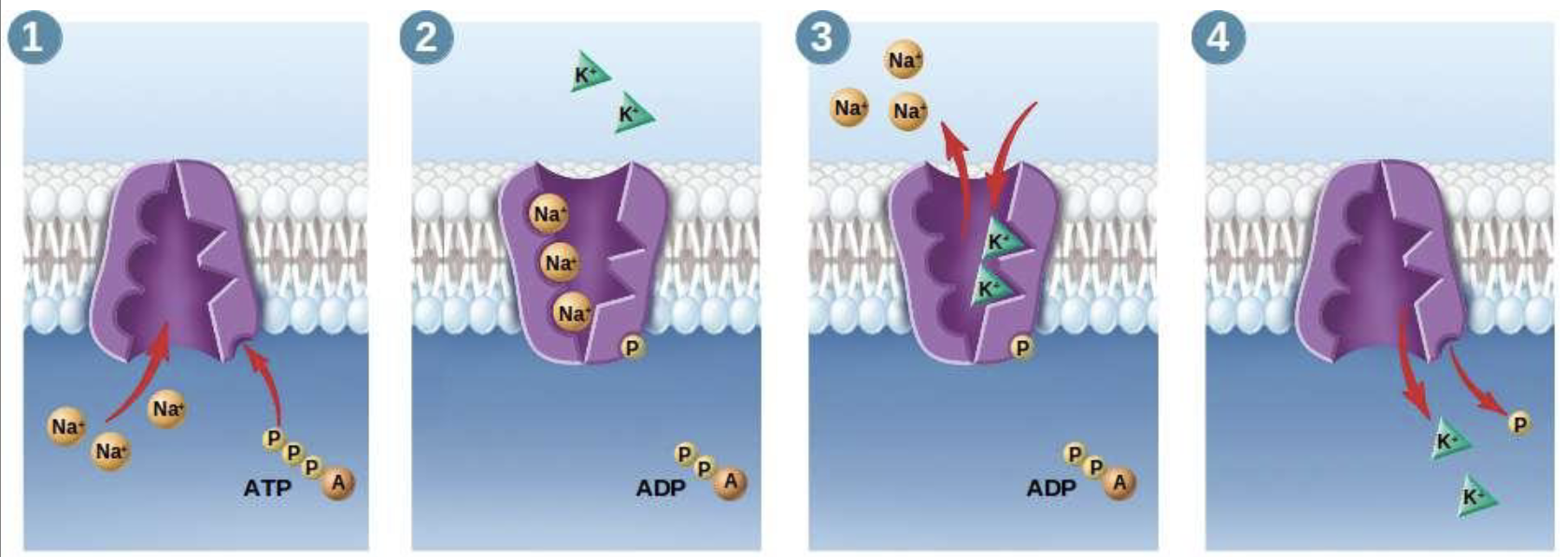
Sodium-Potassium pump
Uses the energy of ATP to push NA+ out of the cell and K+ into the cell
Forces ions to go where they otherwise wouldn’t
Creates a situation where there is 30x more K+ inside than outside the cell, and 15x more NA+ outside than inside the cell (concentration gradient never changes!)
Diffusion
If there is a concentration gradient and no barriers or forces in the way, then atoms and molecules will move from regions of high concentration to low concentration
Ion channels
Proteins that form a pore/hole in the cell membrane
Provide a path for ions to freely flow in or out of the cell
Most are bidirectional (two-way doors)
Leak channel
An ion channel that permanently stays open
Potassium leak channel
Selectively allows K+ ions to move freely in and out of the cell; the membrane potential gets clamped at -90 mV (at that point there is no net movement of K+)
Sodium leak channel
Permeable to NA+; at +65 mV, the force of diffusion is fully counteracted by the electrostatic pressure; the membrane potential clamps between -40 and -80mV depending on the neuron
Resting membrane potential
The membrane potential of a neuron when it’s not actively receiving or transmitting messages; neurons at rest stay at a set value between -40 and -80mV (depending on amount of K+ leak channels on their membrane)
Neuronal excitability
Neurons regulate their resting membrane potential primarily by controlling the amount of potassium leak channels on their membrane
Protein receptors/sensors
Cover the soma and dendrites of neurons; each receptor is sensitive to a distinct aspect of the extracellular environment
Ion channel receptors
Form holes in the membrane, which are gated by something (unlike leak channels)
When they get activated, their gate opens briefly, allowing specific ions to flow through the membrane
If an activated receptor allows Na+ to enter, it will make the membrane temporarily less negative
Depolarization
When the membrane potential of a neuron becomes less negative than it normally is at rest
Voltage-gated Sodium channel
Used to send messages; lines the entire length of an axon, but is especially concentrated at the start of the axon where the action potential starts
The Action Potential
A brief electrical impulse that propagates down the length of the axon due to the opening of voltage-gated sodium channels
Triggered when the membrane potential at the soma reaches the threshold of excitation
Can only propagate forward because all the voltage-gated sodium channels are inactivated in the direction it just came from (unidirectional)
Only naturally starts in the soma, and only travels to axon terminals
Voltage-gated Potassium channel
Used to quickly restore the resting membrane potential; covers the entire length of axon, and opens on upward swing of action potential
Voltage-gated Calcium channel
Used to trigger NT release from axon terminals; calcium is 1000x more concentrated outside than inside neurons, so it rushes in whenever it can
Refractory period
Post-action potential hyperpolarization; hard to trigger another action potential in this state
Synaptic transmission
The transmission of a chemical message/NT from one neuron to another via a synaptic connection
All-or-none law
The amplitude of the action potential remains constant (+40mV) as it propagates down an axon
There is no such thing as a strong or weak action potential
Rate law
The strength of the “message” is represented by the rate of firing (the # of action potentials per sec, rather than size or speed)