Genetic Policy
 Call Kai
 Learn
 Practice Test
 Spaced Repetition
 Match
 Flashcards
 Knowt Play
1/107

There's no tags or description
Looks like no tags are added yet.
108 Terms
Scleractinia
Hard Corals / Stoney Corals
Six tentacles or multiples of six (6,12,16, 24). Secrete calcium carbonate with polyps siting in top few centimeters in pits composed of their own skeleton known as corallites. Some species corallites fuse together creating ridges and valleys (brain coral) while some hard corals have distinct corallites (star corals). Growth is highly dependent on sunlight, warm temperatures (20 – 29 C or 68 to 84 F), and water quality (low nutrient and turbidity). Have symbiotic relationship with Zooxanthellae where zoo provide them with nutrients from photosynthesis in exchange for a home inside the polyp tissue giving color to their tissue. Branching corals, plate/sheet forming, encrusting, and boulder corals.
Octocorals
Gorgonians / Soft Corals
Have eight tentacles. Secrete flexible skeleton with a central core composed of gorgonin proteins and outer layer called the rind where polyps are embedded. Some species inner core will be composed of fussed spicules but are not as common. Grow in shallow and warm waters. Have two growth forms encrusting and branching but not as much is known about their growth. Octocorals usually get their coloring from pigments in the outer layer of their skeletal structure. Sea rods, sea whips, sea fans.
Hydrocorals
There is no set number of tentacles. Form calcium carbonate skeletons like stony corals, but these skeletons and polyp arrangements are different. Dependent on sunlight, warm temperatures (20 – 29 C or 68 to 84 F), and water quality (low nutrient and turbidity). Ex: Fire coral.
Black Corals
Similar to octocorals their skeleton is made of protein. However, their skeleton is inflexible and hard. Unlike other coral their polyps are not embedded in the skeleton giving the dead skeleton a smooth texture. Found in deep waters. Ex: Black corals.
Coral Sexual Reproduction
Produces new colony through broadcast spawning or internal brooding. Spawning occurs once a year at the end of summer when gametes (sperm and egg cells) are released into the water where they meet, settle, form larva, and become colonies (occurs with Gonochoric and hermaphroditic individuals). Internal brooding is when the coral gametes meet and develop in the polyp before being released into the water to settle and form colonies (occurs in hermaphroditic and gonochoric corals). For gonochoric males release sperm and females draw it in to fertilize. Many hermaphrodites tend to be self-incompatible.
Coral Asexual Reproduction
Occurs through fragmentation, budding, or polyp bail out. Common in branching corals when branches brake off from storms and settle, growing new colonies. Budding is when one coral polyp splits into two through tissue extension creating a daughter polyp. Polyp bail out is when individual polyps detach from the skeleton.
Hardbottom Reef
Close to shore and composed primarily of octocorals, sponges, and algae with low stoney coral coverage and low stony coral species diversity.
Patch Reef
High diversity of octocorals and stony corals. Usually, circular and surrounded by large boulder corals.
Shallow Offshore Reef
In highly energetic areas which large branching corals, lots of fire coral, Millepora comlanata
Deep Offshore Reef
Diverse array of giant barrel sponges, octocorals, and stoney corals.
CREMP
(Coral Reef Evaluation and Monitoring Project)
Started in 1996 it monitors short- and long-term changes in Florida reefs that may lead to changes in coral populations. Composed of camera survey collecting percent cover information and demographic surveys collecting population abundance data. Transect lines are 22 meters and run from offshore to inshore. Funded by EPA.
DRM
(Disturbance Response Monitoring)
Monitors shallow reef systems to understand how rising sea temperatures effect Florida reefs. The program also tracks Stoney Coral Loss Disease to provide informed health data to reef management.
Coral Rescue Project
Due to the wide spread of stoney coral tissue loss disease (SCTLD) in 2014 the coral rescue project was born (2018) rescuing susceptible species to preserve their genetic diversity and propagate them for reef recovery. Rescued corals are housed in zoos, aquariums, and universities throughout multiple states. Thes partners help propagate these corals to be out planted.
SCTLD
Stoney Coral Tissue Loss Disease starts internally effecting zooxanthellae first. Tissue cells next to the zooxanthellae then begin to rupture and die. When the cell death reaches the surface tissues it can be seen by the naked eye. But we still don’t know what causes it.
Genetic Drift
Different versions of genes (alleles) in a population change over generations due to random chance rather than natural selection. Types
Bottleneck, when a reduction in population size by diseases or disaster leaves behind random individuals from population.
Founder Effect, when a small group splits off to start a new colony carrying only a fraction of the population genetic diversity.
Gene Flow
Transfer of genetic material from one population to another.
Genetic Adaptations
Changes in population allele frequencies due to natural selection, leading to increases in fitness.
De Nuvo Mutations
Mutations that happen spontaneously.
Standing Genetic Variation
Presence of multiple alternative forms of a gene (allele) within a population before selective pressure begins. Ex: Unlike de novo mutations these genes already exist in the population, but it may be neutral, mildly harmful, or have no advantage in current conditions, however, new environmental conditions can cause natural selection to favor these alleles (selection fueled adaptations).
Gonochoric
Species have individuals that are both female and male.
Hermaphroditic
Organism possesses male and female parts.
Outcrossing
When eggs from one colony are fertilized by sperm from a genetically distinct colony from same species or hybrid species.
Intraspecific Diversity
Genetic diversity within a single species. Allows for adaptation to changing climates and diseases.
Interspecific Diversity
Total genetic variation between species within an ecosystem.
Thickets
Isolated colonies of branching corals (A. cervicornis and A. palmata) that form dense assemblages.
Coloniality
Formation of single coral composed of multiple polyp individuals that function independently or together.
Low Coloniality
Coral is solitary, has fewer polyps, or reduced integration between polyps (less integrated into multi polyp colony)
Microsatellite Genotyping
Identifying specific allele lengths in different microsatellite loci (short repeats) in coral DNA using loci specific primers and PCR.
Colonial Reproduction
Asexual reproduction.
Monoclonal
Coral colonies derived from a single polyp and have limited variation in alleles.
Diploid
When a cell contains two sets of chromosomes, one from each parent.
Haploid
One set of chromosomes produced form the same parent.
Polyploidy
When cell has more than two sets of chromosomes.
Heterozygous
Having two different alleles of the same gene.
Homozygous
Having two identical alleles of a particular gene.
Linkage Disequilibrium
When the frequency of association of their different alleles is higher or lower than what would be expected if the loci were independent and associated randomly.
Genetic Effective Population Size (Ne)
The number of individuals in an ideal population that should experience the same rate of inbreeding or change in genetic diversity as the real population. Used as bias adjustment for population abundances in genetic models to compensate for unusual sex ratios and variance in individual reproductive success.
Population Genetic Structure and Connectivity
The level of individual exchange among (flux) among geographically delineated subpopulations. This flux can be biased directionally as a result of natural or anthropogenic factors.
Genetic Connectivity
Is the dispersal of individuals among subpopulations that survive to reproduce.
Recombination
During Miosis and mitosis recombination occurs when similar molecules of DNA from each chromosome swap to create variation.
Local Adaptations
When individuals in the population display greater than mean fitness at one or more genetic traits at their home site compared to individuals translocated from another population. Occurs in populations through adaptive tradeoffs caused by antagonistic pleiotropy or conditional neutrality.
Adaptive Tradeoffs
When improving one aspect of fitness (performance, survival, etc) come at a cost to another and the best choice is reliant on context and priorities
Antagonistic Pleiotropy
Certain genes have beneficial effects early in an organisms life (survival / fertility) but cause detrimental effects later in life. Ex: 34 genes in fruit fly's cause genetic trade-offs, increasing survival but decreasing adult size. (same allele benefitable in one environment and harmful in other).
Conditional Neutrality
When a genetic variant (allele) has no fitness effect in one environment but beneficial or deleterious effects in another. The effects of conditional neutrality across multiple loci can create a pattern where each population outperforms others in its own habitat without any loci showing fitness tradeoffs.
Assisted Colonization
Conservation strategy that intentionally moves species to new habitats outside their historical range to help them survive and adapt.
Species Assimilation
When corals and their symbiose take up process and nutrients from other species.
Epistasis
The effect of a mutation on a trait is dependent on the presence or absence of mutations at different loci. If genes A and B are mutated and each mutation by itself produces a unique phenotype but the two mutations together produce the same phenotype as the A gene. Then A is epistatic and B is hypostatic. Ex: If no pigment can be produced other mouse coat color genes have no effect on the phenotype no matter if dominant or heterozygous. Here the genotype “cc” for no pigment is epistatic over other genes.
Inbreeding Depression (F)
Measured as the decline in the mean phenotypic performance with increasing population levels of homozygosity. It’s a 0-1 scale measured with generation rate of increase roughly equal to twice the effective population (F=1/(2Ne)).
Partial Dominance Hypothesis
Says deleterious recessive alleles are exposed to selection as homozygous genotypes.
Overdominance Hypothesis
Partial dominance hypothesis says deleterious recessive alleles are exposed to selection as homozygous genotypes and/or under the overdominance hypothesis leading to a heterozygous fitness advantage and homozygous fitness disadvantage.
Purging
Since inbreeding increases homozygosity, recessive deleterious alleles will be fully expressed, causing natural selection to increase selective pressure against them more effectively, purging them from the populations DNA over time. So, when deleterious alleles occur in homozygosis the fitness is greater than twice that of when they occur in heterozygosis due to the homozygous purging.
Identity Disequilibrium
The biased selection of individuals in a group which can create disequilibrium in the representation of the population.
This is when heterozygotes correlate more with other heterozygotes. So, when they have large effect deleterious alleles that are fully recessive, linkage and identity disequilibrium counteract genetic purging of that allele as recessive deleterious alleles can't be fully expressed. This is because selfing corals have higher inbreeding making their alleles homozygous whereas partly-selfing corals retain heterozygous alleles making it harder for them to expose and purge large recessive deleterious alleles.
Outbreeding Depression
When two distinct populations are bred, their combined genotypes can lead to more or less fitness. Outbreeding depression occurs when the combination leads to a decrease in fitness.
Extrinsic Outbreeding
A result of disruptive selection (when extreme traits are favored over intermediate traits dividing the population into two distinct groups) in populations connected by gene flow.
For example if (B) is for black coral and (b) is for white corals than (BB) is black coral, (Bb) is grey, and (bb) is white. If a population of corals grew in an environment of black rocks and white rocks, the corals with black coloration could blend in better to black rocks and white corals with white rocks. Leaving the grey corals to stand out in both environments and feel pressure towards the color extremes (disruptive selection).
Co Adapted Gene Complexe’s
Groups of interacting genes that evolved together through natural selection to work in harmony with a specific environment, creating an advantageous phenotype or physiological function. Located at different loci but their effect together is synergistic.
Ex: Alleles at multiple loci interact to optimize metabolic efficiency.
Intrinsic Outbreeding Depression
when genomic incompatibilities that evolved between parental populations are exposed in admixture offspring. It results from long periods of reproductive isolation with co-adapted gene complexes. Intrinsic outbreeding is also comparable with local adaptations and is affected by the same conditions. However, these co-adapted genes perform well in that environment for F1 generations but that function brakes down in F2 populations because segregation decreases the between population heterozygosity by half causing recombination to separate beneficial epistatic interactions more often.
Selective Sweep / Hitchhiking
When a new beneficial mutation increases fitness and spreads rapidly in the population due to natural selection. This causes elimination of genetic variation in nucleotide sequences near the mutation and causes linked alleles to “hitchhike” and become fixed as well.
Genetic Swamping
The replacement of local alleles caused by the establishment or reestablishment of excessive gene flow or other genetic input. Some gene flow between populations leads to local adaptation or novel gene variants but strong gene flow can stall adaptations by swamping locally beneficial genes. The severity is dependent on population size, genetic variation, and pattern of gene flow like isolation by distance (geographic distance), isolation by environment (similar environments will have highest gene flow), or counter-gradient gene flow.
Counter-Gradient Gene Flow
Flow rates are high in dissimilar environments.Counter-gradient gene flow specifically can introduce poorly adapted genes into populations swamping local genotypes. This cases assimilation of genotypes weather there is a fitness advantage or not leading to a decrease in population fitness and local adaptations.
Sympatric Species
The evolution of new species from a surviving ancestral species while both inhabit the same geographic region. Sympatric species that don’t hybridize do so because of polyploidy (when a cell of an organism has more than two sets of chromosomes) or ecological incompatibilities. While selection has filtered and retained what is useful some of these species may also have higher genetic loads from mildly deleterious alleles. So, attempts at assisted hybridization would likely have high risk and reward ratios.
Allopatric Species
A species population that becomes separated by geography cutting off gene flow and creating a new species. These species may be infertile which means introgressive gene flow can occur rapidly when secondary contact is elevated. This would cause outbreeding depression and the introduction of deleterious alleles or genetic damage from increased drift. Thus, assisted hybridization of allopatric species is not supported.
Line breeding
Mate animals with common ancestor to preserve desired traits while reducing inbreeding.
QLT
Selective breeding programs are usually guided by mapped marker data. These genomic maps allow the genotypes of individuals within a population to be sorted into groups based on phenotypic scores to identify regions of deoxyribonucleic acid (DNA) that influence a particular trait.
GWAS
Can identify SNPs (single nucleotide polymerase, a variation in a single base pair in a DNA sequence) linked to desired traits to estimate individual breeding values (estimate an animals genetic contribution to its offspring). It surveys more loci than QLT giving it greater precision.
MAS
Marker assisted selection
Uses genetic markers linked to the regions of DNA that influence traits to evaluate them against controls in replicated performance trials (common garden experiments).
Environmental Variances
Proportion of phenotypic variation among individuals that arises from differences in environmental conditions (temp, diet, location, etc…
Structural Variations
Like segmental duplicates, large incretions, tandem repeats, and translocations are population specific superseding individual nucleotide variation. This elevates risk and research opportunity because they have not been comprehensively mapped or surveyed.
DNA Binding Domain
A folded protein domain that contains at least one structural motif that recognizes double or single stranded DNA. It can recognize one sequence (a recognition sequence) or have an affinity to DNA. The DNA binding domain are part of a large protein with other domains that regulate activity of the binding protein.

Non-Homologous End Joining (NHEJ)
A DNA double strand break repair method that ligates broken DNA with ought requiring a homologous template. Enzymes and complexes come together and clamp down on the broken DNA. Damaged DNA is trimmed by nucleases and filled by specialized polymerases. Then DNA ligase seals the break. This can cause a loss of one or multiple codons (base pair made up of 3 codons) causing a frame shift (all codons are now different and will code for different proteins) or a premature stop codon preventing the rest of the gene from being read.
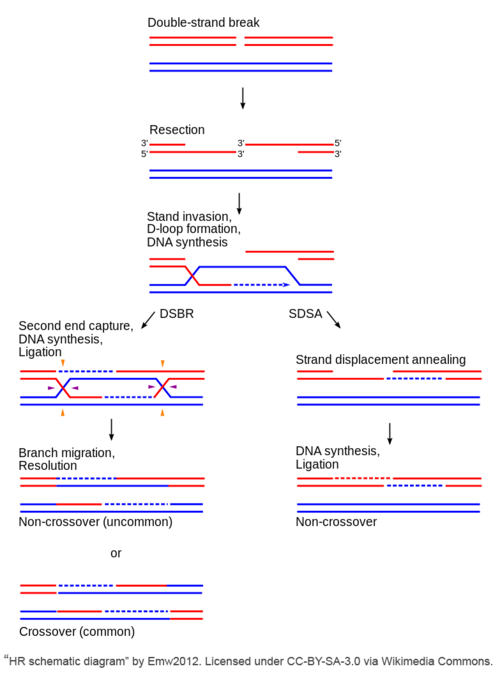
Homology Direct Repair (HDR)
Repairs double stranded breaks using homologous recombination but can only be done when there is a homologous piece of the damaged DNA in the nucleolus to serve as a template.
1) Enzymes will chew back the 5’ends of the strands creating an overhang.
2) The 3’ end of the broken DNA invades the homologous strand forming a D loop with one holliday junction and acting as primer. Polymerase then attaches and fills in the missing DNA from 5’ to 3‘.
3) The other 3‘ end from the top strand of broken DNA also forms a holliday junction and polymerase attaches and fills in the missing DNA from 5’ to 3‘.
5) Because there are two holliday junctions' recombination can happen. At the two junctions' both strands crossover swapping DNA with their homologous. However non-crossover can also happen where only one strand of DNA on each chromosome swaps with each other rather than all strands swapping.
Transgenesis
Transgenic is a term that describes an organism that harbors genes from another organism. Transgenesis is when a previously existing or new gene is inserted into the DNA via liposomes, enzymes, viral vectors, etc... then incorporated into the DNA using homologous recombination. This causes the preexisting gene to have total expression. In other cases, knock out animals are produced where a gene has been suppressed or the structure has been modified to inactivate it. Knock-in animals can also be produced when a gene is suppressed by replacing it with another that results in the gain or loss of function in a gene reveling the role that it plays.
Zinc-Finger Nucleases (ZFNs)
Use artificial restriction enzymes (REase, ENase, or restictase enzymes to cleave DNA near recognition sites in order to delete or add DNA. It’s composed of fused zinc finger DNA-binding domains to help target specific DNA as each zinc finger repeat can identify 9 to 18 base pairs while DNA cleavage domains, a nuclease enzyme, break the phosphodiester bonds between nucleotides. DNA is then removed or added before homologous recombination occurs. A single zinc finger can recognize 3 base pairs then create a 3-finger array that recognizes 9 base pairs (view image bellow).

Transcription Activator-like Effector Nucleases (TALENS)
These restriction enzymes can be used to cut specific sequences of DNA by fusing a TAL effector DNA-binding domain to a DNA cleavage domain. TAL effector DNA-binding domains identify and cut the DNA using transcription activator like effectors (TAL effectors). These are proteins secreted by bacteria when they infect plants. That plus the binding domain equipped with repeating 33 amino acid sequence containing divergent 12th and 13th amino acids positions (those two positions known as Repeat Variable Diresidue (RVD) show strong correlations with specific nucleotide recognition) help identify and cut the DNA. The DNA cleavage domain composed of nuclease enzymes, break the DNA apart.

Clustered Regulatory Interspaced Short Palindromic Repeats (CRISPR-Cas9)
Is a natural adaptive immune system found in bacteria that store fragments of viral DNA to recognize and destroy viruses. Cas9 is an enzyme that breaks down DNA guided by single guide RNA (sgRNA) to direct Cas to a complementary sequence. Cas makes a double strand break then repairs it using non homologous end joining and homology direct repair.
Gene Drives
Normally during sexual reproduction diploid organisms (have one chromosome form each parent) have a 50% chance of transmitting an altered germline gene. Gene-drive compromise specializes endonucleases such as Cas9 and binding RNAs so that when the endonuclease and RNA are together they convert gene-driven germline heterozygotes into homozygotes. This synthetic gene drive in CRISPER increases gene transition to almost 100%. This not only applies to target genes but off-target mutations where population increases in allele frequency will occur even when those mutations decrease fitness.

Replication
When a cells DNA replicates itself so it can divide in the nucleus of eukaryotes and nucleoid of prokaryotes.
Initiation
Helicase recognizes and binds to the origin of replication, an area of the DNA with a lot of A/T base pairs which have fewer hydrogen bonds making then easier to separate.
Topoisomerase ensures the DNA doesn't coil by making small nicks in the sugar back bone while Helicase begins to unzip the DNA.
Single stranded binding proteins (SSB) attach to each end of each base pair preventing them from coming back together.
Enzymes called primase form an RNA primer, so polymerase knows where to attach by synthesizing a short stretch of nucleotides complementary to the DNA template.
Elongation
The sliding clamp attaches to the DNA and Polymerase III is attached.
DNA polymerase adds nucleotides in the 5’ to 3’ direction but one strand of DNA runs in the 5’ to 3’ direction (leading strand) and the other in the 3’ to 5’ direction (lagging strand). So, the lagging strand can't be made continuously and is instead made in fragments called Okazaki fragments. To do so a new primer must be made for each fragment.
Termination
Once the lagging and leading strand are complete an exonuclease removes all the primers in the lagging strand. DNA polymerase I then replaces the primers with complementary DNA. The DNA sections in the lagging strand is then glued together by ligase.

Transcription
In the nucleus DNA from replication is used to make an RNA copy. This RNA will carry the instructions for making proteins to the ribosome where proteins are synthesized during translation.
Initiation
In preparation histones are acetylated to loosed DNA and histone methylation occurs to regulate what genes are available.
Transcription factors and mediator proteins bind to the TATA box (3) in the promoter region allowing RNA polymerase II (7) to bind to the complex forming the pre-initiation complex.
ATP dependent opening of DNA creates a transcriptional bubble.
An enhancer (2), short sequence of DNA many base pairs before the TATA box will come into close proximity of the pre-initiation complex where transcription factors (6) and mediator proteins (7) in the complex will bind to the enhancer. This is a form of regulation increasing the activity of the promoter starting transcription.
After synthesizing the first few nucleotides RNA polymerase II undergoes a conformational change and detaches from the promoter region releasing the transcription factors.
Elongation
RNA polymerase moves along the DNA template strand 3’ to 5’ creating an RNA strand from 5’ to 3’. All the T’s are replaced with Us.
The growing RNA strand detaches from the DNA allowing it to reanneal behind the transcription complex.
Proof reading occurs
Termination
RNA polymerase will transcribe past the stop sequence then cleave the RNA before releasing from the DNA.
Processing
A 7-methylguanosine cap is added to the 5’ end to protect the mRNA from degradation while a poly A tail is added to the 3’ end after cleavage stabilizing the mRNA.
Spliceosomes complex then removes the Introns (non-coding sequences) and ligates the exons (coding sequences) together.

Transcription Regulation
Usually regulated by promoters and enhancers.
Binding sites or regulatory proteins that regulate from afar like the enhancer region.
Transcription factors known as activators and repressors bind to DNA to influence RNA polymerase activity.
Epigenetic regulation such as DNA methylation and histone modifications.
Non-coding RNAs such as microRNAs (miRNA) and small interfering RNAs (siRNA) negatively regulate gene expression by degrading messenger RNAs who carry sequences of genes used in protein synthesis effectively silencing the gene.
Positive and negative feedback loops regulated by metabolic or hormonal pathways can also repress or enhance transcription.
Translation
In the cytoplasm of the cell mRNA from transcription is used by ribosomes to synthesize proteins. The ribosomes read the mRNA and assemble the corresponding amino acids to form polypeptide chains.
Initiation
The small ribosomal unit binds to the mRNA near the start codon (AUG)
The initiator tRNA binds to the start codon.
The large ribosomal subunit binds to form the initiation complex.
This positions the tRNA in the P site of the ribosome
Elongation
A tRNA with the complementary anticodon enters the A site and the ribosome forms a peptide bond between the amino acids in the P and A sites.
The ribosome shifts the tRNA from A to P site while the empty tRNA exits through the E site. With this cycle repeating to grow the polypeptide chain.
Termination
When a stop codon enters the A site, no tRNA binds and release factors recognize the stop codon releasing the polypeptide chain.
The ribosomal subunits then dissociate and are recycled.

DNA Methylation
The addition of a methyl group to a DNA nucleotide located within CpG dinucleotides (cytosines followed by guanines located in promoter regions of genes) that the cell uses to silence or dampen the expression of a gene.
Chromosome Structure
Histones are proteins found in cell nuclei. DNA in the nucleus is wrapped around 4 histones creating nucleosomes. The nucleosomes are then wound tightly together to form chromatin. Specifically, heterochromatin that makes the organisms genetic material hard to access to transcription factors, DNA replication, or repairs. So, modifications made to histones by covalently attaching certain groups, can unwrap the chromatin (euchromatin) allowing access to curtain genes. The four most common modifications are acetylation, methylation, phosphorylation, and ubiquitination.

Histone Modification
Acetylation - The addition of an acetyl group by histone acetyltransferase (HATs). Histones are positive but become neutral after acylation allowing the DNA to unwrap into euchromatin increasing transcription.
Methylation – Adding or removing a methyl group from a histone tail by histone methyltransferase (HMTs) and histone demethylase (KDMs). Methylation can increase or decrease gene transcription.
Phosphorylation – A phosphoryl group is added to a histone tail by protein kinase (PTKs). Protein phosphatase (PPs) dephosphorylates histones. Phosphorylation neutralizes the charge of the histone creating euchromatin and increasing transcription.
Ubiquitination – The addition of ubiquitin protein molecules or chains by ubiquitin ligase. Ubiquitinating enzymes remove these groups. Ubiquitination at H2A core usually represses gene expression as it prevents methylation while ubiquitination at H2B is necessary for methylation leading to activation or repression.
Epigenetics
The molecular level processes that effect gene expression without altering DNA such as DNA methylation, histone modifications and small noncoding /antisense RNAs.
Epigenetic Imprints
Cause genes to be expressed or not depending on weather they are inherited from the mother of father through the epigenetic process of DNA methylation and histone methylation which are established ”imprinted” in the germline (egg or sperm) of the parents. For example, temperature-induced changes in gene expression in C.elegans are strongly associated with histone modification and has persisted for many generations.
RNA-mediated Gene Silencing
This is when non-coding RNAs like microRNAs (miRNA) negatively regulate gene expression by degrading messenger RNAs who carry sequences of genes used in protein synthesis effectively silencing the gene. Small non-coding and antisense RNAs (single stranded RNA that is complementary to a messenger RNA and can hybridize it, blocking its translation into a protein) occurring in maternal cytoplasm can potentially affect zygotic transcription to produce epigenetic imprints but these often fade with cell division.
Holobiont
The combined coral host and numerous species living in and around it forming a unit.
Hologenome
The combined genome of all the bionts (coral hosts and bionts living in it).
Coral Holosymbiont Concept
The idea that physiological properties of a colony represent emergent properties of the coral host and its dinoflagellate symbionts, which together interact in key physiological roles.
Sequestered Germline
Dedicated cells set aside early in development that will produce gametes and pass genetic material to future generations.
Lateral Gene Transfer
Interspecies DNA exchange
Symbiont Shuffling
Process where corals alter the abundance of different symbionts in their tissues. Symbiont Shuffling an occur in a stable symbiosis leading to a symbiont community that can be inherited across generations in coral species through vertical symbiont transmission.
Vertical Symbiont Transmission
Passing of symbionts from parent to offspring. There are fitness benefits in providing youths with established microorganism communities such as disease resistance and environmental adaptation.
Conspecific
Belonging to the same species.
Genetic Conservation Unit (GCU)
The conspecific organisms residing within Florida designated geographic delineations because Florida coral populations have limited genetic connectivity and are genetically distinct due to local adaptation. So, they must be independent form other coral units when considering genetic management. In the absence of population genetic data for Florida corals population level genetic differences between Florida corals and non-Florida corals of the same species may be used to assist with GCU delineation.
Adaptive Evolution
Genetic change resulting from positive natural selection that improves the mean fitness of a population in it’s environment.
Admixture
When individuals from isolated populations interbreed to blend allelic variants creating novel populations
Assisted Evolution (AE)
Human facilitated acceleration of natural evolution through assisted gene flow, selective breeding, genomic manipulation, and assisted hybridization.
Assisted Gene Flow (AGF)
Any human-facilitated activity that involves the translocation of organisms within a species range to promote adaptation to anticipated local conditions.
Uncontained out planting of hybrid clones created from Eastern Caribbean donors onto imperiled Florida populations. Help increase gene flow and let natural selection select for heat tolerant genes form the population you introduced.
Translocation and admixture to better equip focal populations with genetic and phenotypic variation to combat selective pressure of future stressors. One of these include “climate adjusted provenancing” seeks climate adjustments by using imported germplasm to create novel adaptive genetic variation through the focal populations selection gradient. These Adaptive genetic variants are heritable.
Pros: When successful could increase the frequency of preadapted alleles for new climate conditions such as rising water temperatures while increasing genetic variation.
Cons: If small populations are preadapted to ‘non-targeted’ environmental factors like less heat tolerance then AGF may reduce fitness and decrease population growth. Also leads to maladaptive evolutionary trade-offs, extrinsic /intrinsic outbreeding depression, and disruptions in coevolved symbiont-host physiological interactions. Lastly, mildly deleterious alleles will be introduced as genetic drift would dominate over selection increasing the already high loads of vulnerable populations.
Selective Breeding (SB)
Anthropogenic (human facilitated) process of selecting parents with desired traits from a population to develop offspring with those desired characteristics or traits.
Genomic Manipulation (GM)
Procedures that encompass a wide range of old and new technologies and that alter the nucleotide composition of an organism’s DNA or the expression of its genes. When the alterations are carried to germ line cells, they become transmittible to other organisms by sexual reproduction.
Ex: Zinc Fingers, CRISPER, TALANS