FINAL CONSUMERS EVIDENCE LIST
 Call Kai
 Learn
 Practice Test
 Spaced Repetition
 Match
 Flashcards
 Knowt Play
1/54

There's no tags or description
Looks like no tags are added yet.
55 Terms
Competition and Consumer Act 2010 (Cth)
Covers most areas of the market, including:
product safety and labelling
unfair market practices
price monitoring
industry codes
industry regulation
mergers and acquisitions
Its purpose is to enhance the welfare of Australians by promoting fair trading and compeititon, and through the provision of consumer protections.
Replaced inconsistent state and territory legislations
the Australian Consumer Law
Formally the Competition and Consumer Act 2010 (Cth) sch 2.
Deals with:
misleading or deceptive conduct
unconscionable conduct
unfair practices
conditions and warranties
product safety and information
liability of manufacturers for goods with safety defects
country of origin representation
Treasury Laws Amendment (Acquisition as Consumer - Financial Thresholds) Regulations 2020 (Cth)
Amended the definition of ‘consumer’ by increasing the monetary threshold from $40,000 to $100,000
Responsive to decades of inflation
Meeting society’s needs
increasing the threshhold allowed the rule of law to continue to be upheld
Review of AI and the Australian Consumer Law (2025)
The protections that the ACL provides are ‘generally well adapted’ to address the risks of AI enabled goods and services.
Protections are ‘similar, and in soem cases enhanced’ compared to those in the EU, UK and Singapore.
By the treasury department
Temu approved for ACCC safety pledge despite denying liability for unsafe products (ABC News, 2026)
Temu signed up for Australian Product Safety Pledge despite denying liability for unsafe products
A 10-yo suffered burns from a hoodie bought off there
Shows struggle for legal system to enforce safety standards, particularly when considering online international stores such as Temu.
gives people confidence to try artificial intelligence, knowing the consumer laws still protect them
Quote by federal MP Andrew Leigh, the Assistant Minister for Productivity, Competition, Charities and Treasury (2025)
He also said that ‘Artificial intelligence should not feel like the wild west’
Talking about how these new technologies must be regulated to ensure that consumers’ rights are protected with rapidly changing software
so that justice can be achieved
Section 18
Section of the Australian Consumer law that outlaws misleading or deceptive conduct.
Part 1 of the section states:
A person must not, in trade or commerce, engage in conduct that is misleading or deceptive or is likely to mislead or deceive.
The test for misleading and deceptive conudct is purely objective: whether the conduct is likely to lead an ordinary consumer into error
ACCC v Coles Supermarkets Australia Pty Ltd [2026] FCA 598
Coles temporarily increased the price of each product by at least 15% for a short period of time, before placing it on a ‘Down Down’ promotion despite the price being higher or the same as the regular price
The Court found that ‘down down’ promotions on 13 products were false and misleading
Shows the effectiveness of the law in tackling issues surrounding deceptive and misleading conduct
Shows enforceability considering big companies such as coles
Misleading conduct? So what! (University of Melbourne, 2018)
Highlights how it is almost impossible to prove ‘deceptive’ conduct against large, modern companies, becasuse of the need to show deliberate dishonesty and knowledge on the part of the company’s directors.
This has a significant impact, as big companies often do not suffer the same impact to their reputation for misleading conduct. Often the remediation fees are less than the amount profited off of this misleading conduct.
Treasury Laws Amendment (Doubling Penalties for ACCC Enforcement) Act 2026 (Cth)
One thing it does is Doubles penalties for false or misleading conduct (to a maximum of $100 million per offence)
Off the back of a five-fold increase already in 2022
Shows government’s responsiveness to concerns over penalties’ effect on big companies, allowing justice to better be achieved.
(Australian Competition & Consumer Commission, 2023)
81% of social media influences reviewed by the ACCC were found to be making posts that could contain potentially misleading advertising, including not disclosing brand relationships or disclosing them using vague and confusing language. |
Limited enforceability as influencers are using rapidly changing methods of marketing
Shows that the law can struggle to keep up, especially in regards to modern technology
Something harder to regulate than simply big corporations
Part 2-3
Part of the Australian Consumer Law that outlines unfair contract terms
Dictates that a term in a ‘standard form consumer contract’ is void if it creates a significant imbalance in rights, is not reasonably necessary to protect legitimate business interests, and causes detriment
When a term in a standard form contract is unfair, it used to be declared void and no penalty would apply
Contracts Review Act 1980 (NSW)
Gives courts the power to refuse to enforce, vary, or declare void any contract found to be "unjust" at the time it was made
A powerful method for consumer protection that enables the judicial system to override the traditional principle that all signed agreements must be strictly performed.
Australian Securities and Investments Commission v PayPal Australia Pty Limited [2024] FCA 762
PayPal included a ‘Fee Error Term" in over 600,000 small business contracts, requiring users to report overcharging errors within 60 days or permanently forfeit the funds.
Federal Court found that this limit is an unfair contract term because it created a significant imbalance in rights
Demonstrates:
Resource efficiency (ASIC acting on behalf of over 600,000 users)
Protection of individual rights
Application of the rule of law (big company such as paypal)
HOWEVER, there was no penalty in this case, as the reference period for the contract term was right before unfair contract reforms contained in the Treasury Laws Amendment (More Competition, Better Prices) Act 2022 (Cth) took effect in Novermber 9, 2023
Treasury Laws Amendment (More Competition, Better Prices) Act 2022 (Cth)
Amendment to the Australian Consumer Law and ASIC regulations by introducing penalties relating to using unfair contract terms in standard form contracts
These penalties apply even just for proposing an unfair term in a standard form contract.
How the unfair contract terms regime is impacting the Australian construction industry (Pinsent Masons, 2026)
Highlights that the construction industry faced initial uncertainty when dealing with the new legislation of the Treasury Laws Amendment (More Competition, Better Prices) Act 2022 (Cth)
Wide-ranging reforms left some sectors scrambling to reform to avoid getting in legal trouble
However, sectors like the construction industry have been untouched so far by the new legislation
Commercial Bank of Australia Ltd v Amadio [1983] HCA 14
set a precedent that unjust contracts can be rescinded by the courts if a dominant party knowingly takes advantage of a weaker party’s direct vulnerability
Shows that common law achieves justice, but is slow and inefficient
considering that common law is entirely reactive,
Part 2-2
Part of the ACL that outlines the statutory concept of ‘unconscionable conduct’.
Sections 20-22
In considering unconscionable conduct, the courts will first address the matter under s21 and the factors in s22, before looking to section 20 (which applies the common law principle.
Home Building Act 1989 (NSW)
primary piece of legislation regulating residential building work, specialist trades (like plumbing and electrical), and supply contracts in New South Wales
establishes a strict licensing scheme managed by NSW Fair Trading that ensures contractors possess the
necessary qualifications
financial stability
integrity
to ensure consumers are adequately protected from substandard work and financial exploitation
Consumers warned not to deal with Andrew Perez trading as Affordable Property Maintenance APM Pty Ltd (NSW Fair Trading, 2023)
NSW Fair Trading warning against Andrew Perez
The Case & Act: NSW Fair Trading v Andrew Perez (t/as Affordable Property Maintenance) under the Home Building Act 1989 (NSW). Perez operated completely unlicensed, took illegal deposits, and left residential building work unfinished.
Responsiveness (Strength): Highly effective administrative mechanism. It bypasses court delays to immediately weaponise information, instantly alerting the community and disrupting the rogue operator to prevent further harm.
Enforceability (Limitation): Fundamentally reactive. Action was only taken after consumers lost money, shifting the ultimate burden of compliance onto individual consumer vigilance (e.g., checking online registers).
Fair Trading Act 1987 (NSW)
ALSO INCLUDES THE ACL
Formally constitutes NSW Fair Trading, and gives it a legal mandate to
regulate marketplace conduce
monitor business behaviour
administer state consumer protection laws
(NSW Fair Trading, 2025)
19,811 consumer complaints received by NSW Fair Trading in the 2024-25 FY
They issued $1.58 million in fines, suspended 55 licences, and cancelled 29 licenses in this period
Demonstrates consumer awareness of it as an effective legal response
Demonstrates responsiveness to misconduct plus their strong enforceability mechanisms
NSW Fair Trading utilises dispite resolution and mediation before legal escalation, showing a high degree of resource efficiency
Business taken to court after allegedly making false claims about link to Bondi terror attack (Nine News, 2026)
Bondi United, an online clothing store, told customers that proceeds from sales would help victims of the Bondi terror attack, despite the business not having any connection to the shooting or those impacted.
In February 2026, NSW Fair Trading issued a public warning against the business, before commencing civil proceedings against them in July
Demonstrates high responsiveness (less than 2 months after the attack) plus demonstrates enforceability through taking them to court. Also resource efficiency, with the public warning being a low-cost measure of reducing any immediate harm.
Legal Aid Commission Act 1979 (NSW)
Governs the establishments and operations of Legal Aid NSW
dictates how government-funded legal assistance is administered and delivered across the state.
Legal Aid NSW
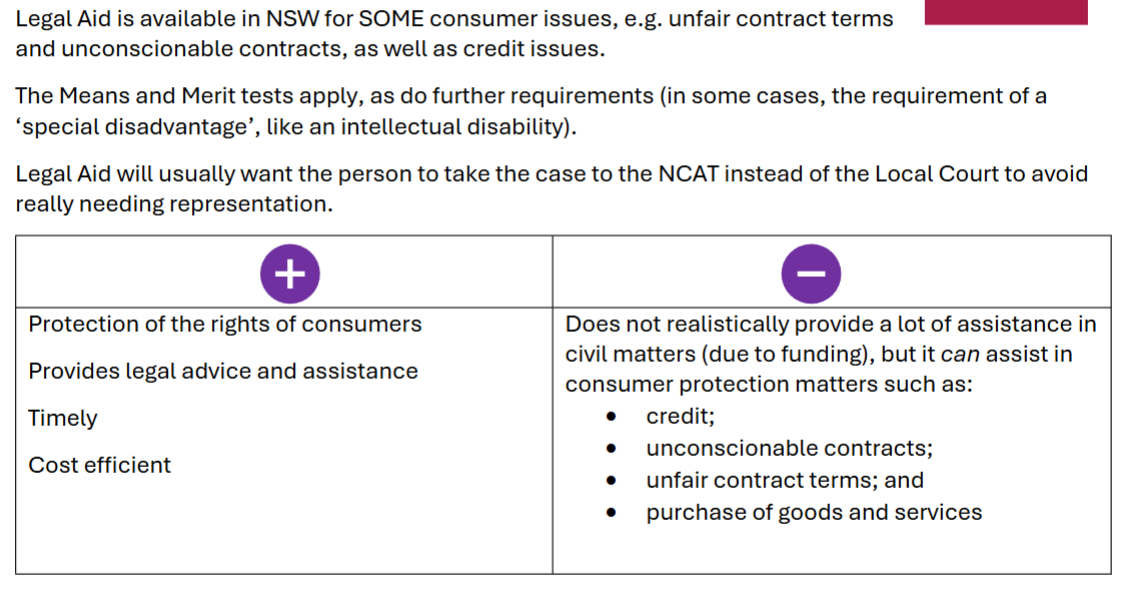
Legal Aid NSW seniors diary
Features practical guidance on navigating retirement village contracts, aged care agreements, scams, financial stress, and Centrelink issues.
Contains information on elder abuse, neighbour disputes, disaster recovery, driving fines, and family separation.
Integrates culturally safe care resources tailored for older ATSI people
Available physically at local libraries, Legal Aid offices, or via Members of Parliament (MPs), as well as through online order forms.
Highly accessible and meets society’s needs. However, fails to lead to any enforceability and may be a waste of resources.
It's vital that seniors are aware of their legal rights and where they can go to for free support and assistance
NSW Attorney General Michael Daley
Accessibility: Emphasizes that formal consumer protections mean nothing if vulnerable demographics do not know they exist. Educational tools bridge this gap by acting as signposts to free support avenues.
Resource Efficiency: Highlights a proactive approach to justice. Ensuring consumers are "aware of their legal rights" minimizes formal litigation, saving state resources by facilitating early intervention.
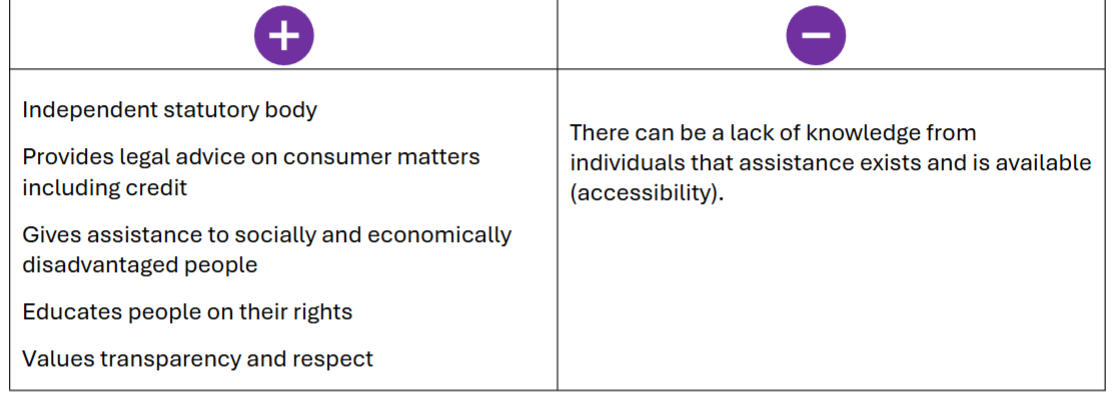
NSW Ombudsman
The _____ is a statutory ‘watchdog’ body dealing with complaints against the New South Wales Government.
If the business is run by the NSW government, or receives funding from the NSW government, then the _____ has the power to investigate consumer issues.
Civil and Administrative Tribunal Act 2013 (NSW)
Law that establishes the NSW Civil and Administrative Tribunal (NCAT)
NCAT is a ‘one-stop-shop’ for specialist tribunal services in NSW.
The amalgamated ‘super-tribunal consolidates the work of 22 former tribunals into a single point of access for specialist tribunal services in NSW to provide a more prompt, accessible, economical and effective service.
Consumer disputes are heard in NCAT’s Consumer and Commercial Division
NCAT can hear consumer claims up to $100,000
Demonstrating accessibility and resource efficiency (allowing everyday citizens to resolve relatively substantial disputes in a timely manner and not bogged down by the rigid and expensive court system.
A tribunal is an adjudicative body that is chosen, often by the government, to decide on legal questions based on a particular area of law.
If disputants cannot reach agreement, a tribunal can make legally binding orders on either or both parties to resolve the dispute. Therefore, this is a cost-effective dispute resolution process.
Section 236
Section of the ACL that gives NCAT the power to order remedies like refunds, repairs of compensation for consumer guarantee failutes
demonstrates how NCAT can achieve justice
Irons-McLean v Autonation NSW Pty Ltd & Stellantis (Australia and New Zealand) Pty Ltd [2025] NSWCATCD
Facts: Consumer bought a defective Jeep Wrangler (steering/power loss). NCAT declared it a "major failure" (s 260) and ordered a full refund of $93,524.65.
Responsiveness (⏱): Proves the value of expanding NCAT’s jurisdiction to $100,000. The law adapted to high modern car prices, keeping this large claim out of expensive civil courts.
Accessibility (💸): Replaced backlogged courts with a fast, informal, and low-cost tribunal where an everyday consumer could fight a massive global corporation (Stellantis).
Protection of Rights (🛡): Corrected the power imbalance, legally forcing a corporate dealer to honor consumer guarantees.
Section 224
Section of the ACL that gives the Federal Court the power to hand out large civil penalties.
ACCC v Lorna Jane Pty Ltd [2021] FCA 852
Court fined orna Jane $5 million for falsely claiming that their activewear eliminated COVID-19
Tribunals such as NCAT do not have the power to pursue multi-million dollar corporate misconduct. Formal courts are needed to increase enforcement by acting as a deterrent to the entire market
Hyundai Engine Class Action
Federal court class action against Hyundai for allegedly selling vehicles with engines that were manufactured or designed defectively between 2011-2026.
Demonstrates resource efficiency, as up to 500,000 affected vehicles are part of the one case. Tribunals couldn’t handle individual cases!
Meeting society’s needs + enforceability: the need for a powerful mechanism with sweeping accountability and compensation means is something that only the Federal Court can help with.
National Consumer Credit Protection Act 2009 (Cth)
Can be abbreviated to the NCCPA
Single national law when it comes to credit
This law combined regulations that were previously up to the states and territories
National Credit Code
The NCC
In Schedule 1 of the NCCPA
Administered and informed by the Australian Securities and Investments Commission (ASIC)
Treasury Laws Amendment (Responsible Buy Now Pay Later and Other Measures) Act 2024 (Cth)
Law that was introduced to regulate buy now pay later products in Australia
Aims to provide consumers with better protection and ensure that BNPLproducts are regulated in line with other credit products
Sections 104-108
Sections of the Australian Consumer Law that give the Commonwealth government the authority to set mandatory safety standards
P – Protection of Individual Rights: Highly effective. Prioritises the fundamental right to life, health, and bodily safety over business profits by strictly banning non-compliant goods and services (s 106/107).
E – Enforceability: Highly effective. Backed by heavy ACCC enforcement powers, including mandatory product recalls, court-ordered bans, and corporate fines that can scale to tens of millions of dollars.
R – Responsiveness: Moderately effective. Section 105 allows the Minister to instantly adopt existing global standards to address new dangers. However, formal legislation still struggles to keep pace with rapid tech innovations like AI-driven products or evolving battery hazards.
ACCC
enforces mandatory product safety and bans unsafe goods under the Competition and Consumers Act 2010 (Cth). ACL has Mandatory Standards which must be met.
has the power to conduct random national surveys of retail outlets to look for non-complying products
can invetigate allegations
can investigate goods sold by direct marketing (i.e. internet and television)
Enforceable response to product certification due to beiung able to obtain court undertakings and initiate prosecutiins. It can also arrange for product tests and arrange product recalls
Consumer Goods (Toppling Furniture) Information Standard 2024
Mandates warning labels for furniture carrying a risk of toppling
Enforces point-of-sale warnings that must be prominently displayed
Requires instruction manuals to include explicit safety instructions
Evaluation:
Protects individual’s right to safety information, however physical safety remains up to the buyer
Highly enforceable against Australian retial chains but not overseas e-commerce platforms eg Temu and AliExpress
High resource efficiency- easy to implement
Low responsiveness- took over a decade of lobbyinmg by consumer groups (Kidsafe)
Meets society’s needs, ending the old idea caveat emptor (buyer beware) in this area of consumer law
Most furniture suppliers fail mandatory toppling furniture safety rules (ACCC, 2025)
Joint ACCC and state/territory agency sweep revealed 90% of businesses sweeped were non-compliant in at least one product, and 52% for all products examined
Fewstone Pty Ltd v ACCC [2026] FCAFC 104
Appeal of 2025 case before the full Federal Court
Info: The Full Federal Court dismissed an appeal by Fewstone (trading as 'The Natural Blanket Company'), upholding a lower court ruling that the company made false or misleading representations. Fewstone claimed its blankets were "100% organic cotton certified" under international standards, when they actually contained synthetic blends and lacked valid, auditable supply-chain product certifications.
PEARRJAM: Strengthens Law enforcement and Enforcing rights by confirming that appellate courts will strictly penalise companies that use fake or unverified safety and quality badges. It delivers Just outcomes for honest competitors by preventing deceptive traders from greenwashing their products to cheat consumers.
Kidsafe
Example of a non-legal response to issues regarding product certification
Role: An independent, non-government organisation (NGO) that provides expert advice, raises public awareness, and audits safety standards (e.g., playground equipment, nursery gear).
Link to Law: Educates consumers on compliance with Australian Standards (AS/NZS) and bridges gaps left by the ACCC's baseline enforcement.
Effectiveness (Strengths):
Proactive: Prevents injuries through education before harm occurs (unlike reactive legal measures like recalls).
Resource Efficiency: Offers free, accessible specialist safety information to vulnerable consumers (parents).
Limitations (Weaknesses):
No Enforceability: Lacks legislative power to fine non-compliant manufacturers, ban dangerous goods, or mandate product recalls.
Resource Constraints: Relies heavily on community funding and voluntary corporate compliance.
Spam Act 2003 (Cth)
Mechanism: _____, regulated by the ACMA.
Rule: Outlaws unsolicited marketing (emails/SMS). Requires Consent, Sender Identification, and an Unsubscribe link.
PEARRJAM Evaluation
Responsiveness (➖): Reactive. Lagged behind early digital trends, but has evolved to capture smartphone push notifications and instant messaging.
Enforceability (➕): Strong domestically, weak globally. ACMA strictly fines local brands (e.g., Kmart, Domino's) millions for compliance failures, but cannot touch offshore/cross-border scammers.
Syllabus Link
Judgement: Highly enforceable locally, but limited responsiveness to rapid, globalized digital tech compromises total consumer protection.
Australian Communications and Media Authority
Role: An independent statutory authority responsible for regulating media, communications, and digital marketing services. Under the Spam Act 2003 (Cth), its role is to investigate consumer complaints, issue formal warnings, enforce financial penalties (infringement notices), and mandate structural corporate changes.
PEARRJAM Effectiveness Evaluation
Enforceability (➕): Robust Statutory Teeth
Mechanism: ACMA successfully utilizes Court-Enforceable Undertakings and heavy financial penalties as severe deterrents.
Effectiveness: It forces major domestic corporations (e.g., retail, banking, telecommunications giants) into long-term independent audits and mandatory system re-engineering, establishing high domestic corporate compliance.
Responsiveness (➖): Lagging and Border-Bound
Mechanism: ACMA operates as a reactive investigator rather than a proactive shield; it acts after widespread consumer breach reports accumulate.
Effectiveness: It faces severe operational limits regarding global marketing innovations. Because digital marketing effortlessly crosses borders, ACMA has zero jurisdictional enforceability over international scammers, leaving Australian consumers highly vulnerable to offshore spam infrastructure.
HSC Legal Studies Judgement
Synthesis: ACMA is highly effective at enforcing domestic compliance through aggressive financial remedies, but its lack of cross-border jurisdiction severely degrades its responsiveness to globalized, borderless digital marketing innovations.
Commonwealth Bank pays $7.5m for more spam breaches (ACMA, 2024)
The Legal Event: The ACMA penalized the Commonwealth Bank of Australia (CBA) $7.5 million in late 2024 for sending 170 million marketing messages without an unsubscribe option, violating the Spam Act 2003 (Cth).
PEARRJAM Application
Enforceability (➕): Massive Domestic Deterrent
Action: ACMA hit CBA with the $7.5M fine and legally bound them to a 3-year court-enforceable undertaking.
Effect: Proves ACMA can successfully enforce heavy financial and operational penalties on Australia’s largest institutions to force compliance.
Responsiveness (➖): Vulnerable to Corporate Loopholes
Action: CBA intentionally misclassified promotional messages (for loans/insurance) as "non-commercial service updates" to bypass unsubscribe laws.
Effect: Highlights that the law remains reactive, struggling to stay ahead of aggressive marketing innovations that exploit legislative definitions.
Essay Integration
Use it to prove: That while domestic mechanisms are fiercely enforceable against local corporate giants, corporate exploitation of statutory phrasing slows the law's immediate responsiveness.
CHOICE
Role: An independent, non-government consumer organization. Its role is to investigate digital marketing innovations, expose corporate deception through media campaigns (such as the annual _____ Shonky Awards), lobby the government for law reform, and empower consumers with self-help privacy tools.
PEARRJAM Application
Responsiveness (➕): Rapid, Proactive Investigation
Action: _____ actively investigates emerging marketing innovations (e.g., "dark patterns" in online checkout funnels, sneaky pre-ticked consent boxes, and aggressive SMS spamming) long before statutory bodies can draft regulations.
Effect: Fills the temporal gap where legal frameworks lag behind technological shifts, providing immediate public awareness and defensive consumer education.
Enforceability (➖): Absolute Lack of Sanction Powers
Action: _____ has zero legislative power to issue fines, arrest offenders, or force corporations to alter their spam infrastructure.
Effect: They rely entirely on "naming and shaming" to inflict reputational damage. If a predatory offshore spammer or defiant domestic company chooses to ignore public backlash, _____ cannot legally stop them.
HSC Essay Integration (The Synergy Link)
Judgement: While _____ is entirely toothless regarding enforceability, its extreme responsiveness serves as the vital public catalyst. It exposes corporate exploitation, mobilizing public pressure that ultimately forces enforceable legal mechanisms (like the ACMA or ACCC) to take statutory action.
Scamwatch
Educates people about how to recognise and avoid scams that appear to be genuine marketing
Provides up-to-date information on current scams and publicly announces this to protect consumers, outlining how they work, and what to look out for
Consumers and businesses can report scams directly to Scamwatch on their website
Scamwatch shares intelligence with law enforcement, banks, and digital platforms
Scamwatch feeds information to the ACCC’s enforcement ork
Kidfluencers
ABC Four Corners program from 2024
exposed how children with significant social media followings are being involved in influencer marketing.
Section 29
nfo: Section of the ACL that contains Explicit criminal and civil prohibitions against making false or misleading representations regarding product quality, pricing, values, or origin.
PEARRJAM: Highly effective tool for Enforcing rights, providing immediate statutory parameters for state regulators to dismantle corporate promotional deception.
ACCC v Clorox Australia Pty Ltd [2025] FCA 357
Info: The Federal Court ordered Clorox Australia to pay an $8.25 million civil penalty for making false or misleading environmental representations on its "GLAD to be GREEN" bags. Documented by HWL Ebsworth Lawyers in the report, $8.25 million penalty against GLAD bags supplier for greenwashing claims, the court found that claims the products contained "50% ocean plastic" were deceptive, as the materials were sourced up to 50km inland.
PEARRJAM: Directly reflects Changing ethical values by utilizing new ACL penalty provisions to clamp down on corporate environmental fraud
ACCC v Australian Gas Networks
Info: Open Federal Court proceedings launched by the ACCC alleging that prominent "Love Gas" advertising misled consumers by stating household gas would be entirely renewable within a generation without any reasonable scientific baseline.
PEARRJAM: Demonstrates highly responsive Law enforcement targeting contemporary corporate deception, ensuring big energy conglomerates are held strictly accountable to truth-in-advertising guidelines. [1]
fo: Corporate legal advisories from platforms like Viridian Lawyers in their tracking piece, Greenwashing and the ACCC: How Environmental Claims Impact Tech Startups, demonstrate that the ACCC has executed strict greenwashing sweeps, forcing companies to match visuals with their auditable supply chains.
PEARRJAM: Improves systemic Resource efficiency by establishing clear corporate reporting standards, forcing compliance transparency before lengthy and expensive federal litigation occurs.
Financial Rights Legal Centre
Contains a hotline
Info: Specialized community legal NGO offering free counsel, self-help kits, and representative backup for economically vulnerable consumers.
PEARRJAM: Enhances Accessibility by providing targeted support to low-income earners, protecting critical consumer rights where standard legal representation is unaffordable.
Section 87b
Section of the CCA that outlines court-enforceable undertakings
Info: Voluntary, legally binding corporate pledges brokered between the ACCC and businesses to correct market conduct without going to trial.
PEARRJAM: Superior Resource efficiency and temporal speed; skips multi-year court paths while instantly securing consumer remediation and compliance overhauls.
Privacy Act 1988 (Cth)
Overarching legislation for privacy in australia
Mandates clear 13 Australian Privacy Principles (APPs) and enforces absolute algorithmic transparency.