SE Lateral Exam
 Call Kai
 Learn
 Practice Test
 Spaced Repetition
 Match
 Flashcards
 Knowt Play
1/13

There's no tags or description
Looks like no tags are added yet.
14 Terms
Spectral Acceleration Parameters
Ss and S1 => mapped
Sms = Fa*Ss
Sm1 = Fv*S1
Fa and Fv => site coefficients per IBC 1613.2.3
Sds = 2/3*Sms
SD1 = 2/3*Sm1
Value for Gravity
g = 32.2 ft/sec² (used to convert parameters to function of g)
Seismic Load Combinations
E = Eh + Ev
Eh = p*QE = p*Vw for designing a wall
Ev = 0.2*SDs*DL
Hence, 0.6*DL+0.7*E = 0.6*DL - ((0.2*SDs*DL)*0.7) - (0.7*p*(QE))
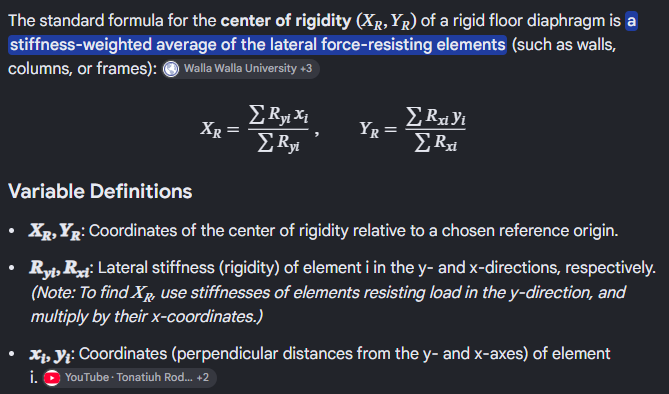
Center of Rigidity
Note: Only consider vertical elements parallel to the transverse axis
Torsional Shear Force
Remember to include accidental torsion if the problem calls for it

Direction Shear Force
(Vx*Rxj)/(Sum of Rx)
Note that you are only summing elements in the x (or y) direction

Axial Stiffness
Ka = E*A/L
Center of Mass
Xcm = Sum of (weighted objects * distance to origin) / Sum of weighted objects
Xcm = ∑wi*xi/∑wi
Ycm = ∑wi*yi/∑wi
Masonry Properties
From TMS 8.3.3
Allowable Compressive Stress for block: Fb=0.45*f’m
Fb = 1/3*fm for unreinforced block, TMS 8.2.2)
Allowable Tensile Stress for reinf. steel: Fs = 20ksi(Gr.40), 32ksi(Gr.60), or 30ksi(wire)
From TMS 4.2
Modulus of Elasticity in compression: Em = 900*f’m
Modulus of Elasticity in shear: Ev = 0.4*Em
Masrony Member Design for Flexure
Assume j = 0.85 to 0.95
Assume fs = Fs (stress in steel equals allowable steel stress)
Estimated required area of steel, Asreq = M/(Fs*j*d)
Use Asreq to determine n, p, k, j, and d
Verify j
Collector Forces

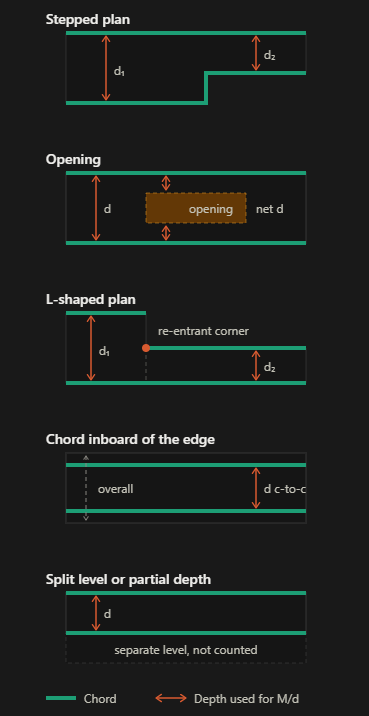
Chord Forces

Masonry - Allowable Shear Stress

Chord Forces - Depth of Chord and Exceptions
Note for the opening condition: if asked to find force at chord edge, it would still be the total depth of the diaphragm