4. Evaluating the Deviation - Clinical Binocular Vision Fall 2026
 Call Kai
 Learn
 Practice Test
 Spaced Repetition
 Match
 Flashcards
 Knowt Play
1/151

There's no tags or description
Looks like no tags are added yet.
152 Terms
What are the requirements for normal binocular vision?
-Healthy eyes and visual pathway
-Accurate monocular fixation OD/OS
-Integrated NM coordination of intraocular and extraocular NM systems
-Accurate bifoveal fixation
-Sensory correspondence system organized around the fovea as a center (normal correspondence)
-Similarity of final ocular images
-Sensory unification of 2 ocular images
What is strabismus d/t?
Break down of one or more normal BV components
What are the anomalies of strabismus divided into?
-Sensory anomalies
-Motor anomalies
-Both
How can a sensory anomaly of strabismus be described?
Can the 2 eyes be used/work together?
How can a motor anomaly of strabismus be described?
Can the 2 eyes physically align?
What are examples of sensory anomalies of strabismus?
Suppression, anomalous correspondence, amblyopia
What are examples of motor anomalies of strabismus?
paresis, 4th or 6th nerve palsies
Can a patient have both a motor and sensory anomaly of strabismus?
Yes
When does a sensory anomaly of strabismus develop?
If a strabismus is longstanding
What are the forms of ocular deviations/misalignments that can be present?
-heterphoria (phoria)
-heterotropia (tropia)
-fixation disparity
What is the definition of a phoria?
Latent ocular deviation
How to measure a phoria?
When fusion is disrupted; under dissociated viewing conditions
What is the unit on a phoria measurement?
prism diopters
What are the possible techniques for measuring a phoria in clinic?
-Alternating Cover Test
-Von Graefe
-Maddox Rod
-Modified Thorington

What is a fixation disparity?
Small ocular misalignment where foveal images fall within Panum's area (thus no diplopia)

When does a fixation disparity occur?
When patient is under focused or associated (both eyes open) viewing conditions

What is fixation disparity measured in?
Min of arc

A fixation disparity is typically less than ___ min of arc
< 30

What are the possible techniques to measure a fixation disparity?
-Borish Card
-Saladin Card
-Wesson Card
-Disparometer
-Bernell Box
What is a strabismus?
Manifest ocular deviation
When can you identify a strabismus?
When viewing binocularly (Associated viewing conditions)
What is the unit of strabismus?
Prism diopters
What are the techniques used to measure strabismus?
-Unilateral Cover Test
-Hirschberg
Strabismus is a condition in which _______ is not present under normal seeing conditions
binocular fixation
Strabismus is a condition in which the _______ of one eye fails to intersect the object of fixation
visual axis
What are common risk factors for strabismus?
-Prematurity/Low Birth Weight
-Maternal Smoking during Pregnancy
-Hyperopia (Esotropia)
-Anisometropia & Astigmatism (Exotropia)
-Fam Hx
-Neurological and CNS Conditions (Cerebral Palsy and Down Syndrome)
What are common etiologies for strabismus?
-Anatomical Abnormality
-Optical Abnormality
-Ocular Disease (Sensory)
-Innervational
What are some anatomical abnormalities that can lead to strabismus?
-EOM abnormalities
-Abnormal contents of the orbit
-Abnormal ligaments, tendons
What are some optical abnormalities that can lead to strabismus?
-Anisometropia
-High refractive error
With presence of ocular disease, what type of strabismus are young children more likely to develop? Older children/adults?
-Young children more likely to develop ET
-Older children/adults more likely to develop XT
What are some innervational abnormalities that can lead to strabismus?
-Intoxication
-Medications
-Trauma
-Disease
-Innervational Anomalies (Congenital, High/Low AC/A)
How to objectively assess the ocular deviation?
Determine specific characteristics of the angle of deviation

What are the characteristics of an ocular deviation that must be assessed?
-Direction
-Frequency
-Magnitude
-Laterality
-AC/A Ratio
-Cosmesis
-Comitancy

What terms describe the DIRECTION of an ocular deviation?
-Eso
-Exo
-Vertical
-Cyclotorsional
-Combination of Lateral + Vertical Deviation
What terms describe the FREQUENCY of an ocular deviation?
-Intermittent Strabismus
-Constant Strabismus
What should you determine if a strabismus is intermittent?
-Percentage of Time Strabismic (POTS)
-Percentage of Time Troped (POTT)
-Office Control Scale?

How to assess the MAGNITUDE of an ocular deviation?
-Amount of prism diopter of deviation at distance
-Amount of prism diopter of deviation at near
How to assess the LATERALITY of an ocular deviation?
-Right or Left Eye
-Alternating?
-Which eye prefers fixation?
What is the expected AC/A ratio?
4:1
True or False:
High AC/A treatment options are different than low AC/A treatment options for an ocular deviation
true
How much strabismus is cosmetically noticeable?
-Less than 10PD = not cosmetic usually
-10-20PD = may be cosmetically noticeable
-20+PD = cosmetically noticeable

What are the factors that will affect cosmesis (can make tropia look worse) with an ESOTROPIA?
-Negative angle kappa
-Wide bridge
-Epicanthal folds
-Small IPD

What are the factors that will affect cosmesis (can make tropia look worse) with an EXOTROPIA?
-Positive angle Kappa
-Narrow bridge
-No epicanthal folds
-Large IPD
What is a comitant deviation?
Magnitude is the same in all fields of gaze
What is a noncomitant deviation?
Magnitude is not the same in all fields of gaze
What features of the face should you directly observe when examining a patient?
-Lids
-Epicanthal Folds
-Head Tilts/Turns/Tips
Why should you directly measure the lids while examining a patient?
-Does the patient have a ptosis or pseudoptosis?
-Does the lid fissure width change with eye movement?
Generally patients will turn their head in the (same/opposite) direction as the paretic muscle
same
Why is direct observation important when examining a patient with an ocular deviation?
-Initially determine frequency, laterality, and direction of an ocular deviation before testing begins
-Determine cosmesis
Why is determining cosmesis of an ocular deviation in a patient important?
-May be important in treatment decisions
-Important consideration before referral for sx
-Often a concern of the patient/parent
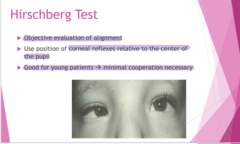
What is the Hirschberg Test?
Objective evaluation of the ocular alignment
What does the Hirshberg Test measure?
-Determine whether or not strabismus is present using the position of the corneal reflexes relative to the center of the pupil
-Identify the direction and laterality of an ocular deviation
-Estimate frequency and laterality
Who is the Hirshberg test good for?
Young patients within minimal cooperartion
Does the Hirschberg Test disrupt a patient's normal binocular status?
No -- both eyes are open for this test
How to perform the Hirschberg test?
-Patient will fixate binocuarly on a transilluminator at 50cm
-Evaluate the relative distance of the corneal reflex from the center of the pupil of each eye (symmetric or asymmetric)
-Will compare the results to Angle Kappa (monocular)
Is Angle Kappa test measured under (monocular/binocular) conditions?
monocualr
Is Angle Kappa generally symmetrical?
Yes

What is the most common value for Angle Kappa?
+0.50 nasal
Why is Angle Kappa usually at +0.50 nasal?
Fovea is NOT positioned on the pupillary axis but it is on the visual axis (temporally to the pupillary axis)
Angle Kappa has (good/poor) measurements for EF
poor

+ Angle Kappa = (Nasal/Temporal)
Nasal

- Angle Kappa = (Nasal/Temporal)
Temporal
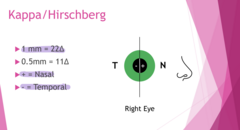
1 mm Angle Kappa = ____pd
22

Equal Reflexes on Hirschberg testing = ?
No strabismus
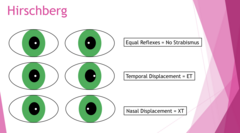
Temporal Displacement of reflexes on Hirschberg testing = ?
Esotropia

Nasal Displacement of reflexes on Hirschberg testing = ?
Exotropia
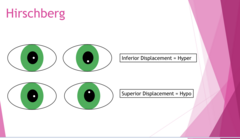
Inferior Displacement of reflexes on Hirschberg testing = ?
Hypertropia

Superior Displacement of reflexes on Hirschberg testing = ?
Hypotropia

What is the magnitude and direction of the deviation in this example of Hirshberg testing?
11pd Left Exotropia
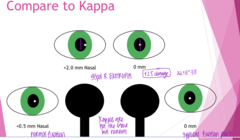
What is the magnitude and direction of the deviation in this example of Hirshberg testing?
33pd R Exotropia

What is the magnitude and direction of the deviation in this example of Hirshberg testing?
No strabismus is present
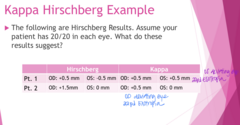
The results shown are Hirschberg Results. Assume your patient has 20/20 vision in each eye. What do these results suggest? (see pic)
-Patient 1: 22pd L Esotropia
-Patient 2: 22pd Exotropia
True or False:
It can be challenging to estimate mm deviations with Hirschberg test
true
What is the Krimsky test good for?
Estimating the magnitude of strabismus in young patients and patients with very reduced vision in one eye
How to perform the Krimsky test?
-Place prism over the fixating eye
-Change the prism power until the reflexes are symmetrical

Krimsky Test (Pic)
Krimsky Test (Pic)
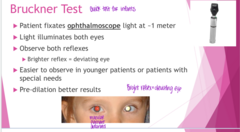
How to perform Bruckner Test?
-Patient fixates ophthalmoscope light at 1m
-Light will illuminate both eyes
-Observe both eyes reflexes
-Brighter reflex = Deviating eye

Bruckner testing is easier to observe in what patients?
in younger patients or patients with special needs

(Pre/post) dilation gives better results on Bruckner testing?
Pre
What are the possible ways to perform cover test?
-Unilateral Cover Test (UCT)
-Simultaneous Prism Cover Test (SPCT)
-Prism Alternate Cover test/Alternating Cover Test

What should be the cover test target for young children?
-Interesting target with details; sticker on the nose?
-A target you can ask questions about
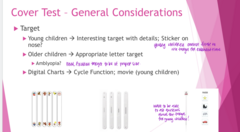
What should be the cover test target for older children?
Appropriate letter size
You need an _____ target for cover test
accommodative
When doing cover test, you need to make sure the patient keeps the target _____
clear
How to ensure that the patient is keeping the target clear during cover test?
Have the patient read the letter or describe the picture to ensure clarity
When doing cover test on amblyopic patients, what do yu have to adjust?
Adjust the letter size of the target accordingly
What questions will a unilateral cover test answer?
-Is strabismus present or not?
-Direction
-Laterality
-Frequency
-Estimate the magnitude of the deviation
What should be your instructions to the patient on unilateral cover test?
-Direct fixation to specific details of the target
-Instruct the patient to describe the target and to keep it clear
-May help to instruct your patient to "look" each time you cover. Make sure you are attentive
When performing unilateral cover test, you will want to have the patient fixate (monocularly/binocularly) on the target
binocularly
Where should you START when performing unilateral cover test?
at the midline
How to perform unilateral cover test?
-Cover one eye
-Observe what the uncovered eye is doing
When performing unilateral cover test, you should chase the _____ eye
deviated (cover the fixating eye with the paddle)

Example Unilateral Test with L Esotropia (Pic)
Example Unilateral Test with L Esotropia (Pic)

Example Unilateral Test with Alternating Esotropia (Pic)
Example Unilateral Test with Alternating Esotropia (Pic)

Example Unilateral Cover Test with L Hypertropia (Pic)
Example Unilateral Cover Test with L Hypertropia (Pic)
With unilateral cover test, which eye do you begin with?
Either R or L eye
During unilateral cover test, you need to allow the patient time to ______
re-fixate
Perform unilateral cover test enough times to determine what?
-frequency of deviation
-unilateral or alternating
-intermittent or constant
-estimate the magnitude based on the amount of movement
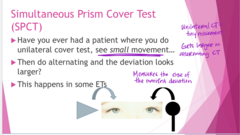
When to perform simultaneous prism cover test (SPCT)?
Patient where you do unilateral cover test, see small movement, then do alternating and the deviation looks larger.

What does simultaneous prism cover test (SPCT) measure?
The size of the MANIFEST deviation