Test 4 Concepts

0.0(0)
Studied by 0 people
call kaiCall Kai
learnLearn
examPractice Test
spaced repetitionSpaced Repetition
heart puzzleMatch
flashcardsFlashcards
GameKnowt Play
Card Sorting

1/21

encourage image

There's no tags or description

Looks like no tags are added yet.

22 Terms

1
New cards

Ch 16.3 DNA packaging & 16.4 The Nucleus

2
New cards

What is the structure of prokaryotic genomes

  • Most prokaryotic cells have a single circular DNA molecule with an average size of 20 kilobase pairs

  • Nucleoid = heavily compacted genetic material

  • The bacterial chromosome (nucleoid) is negatively supercoiled, extensively folded, and complexed to a few proteins

    • Only one chromosome


3
New cards

What is the structure of eukaryotic genomes. What is the size of the human genome

  • The human genome contains 3.2 x 10⁹ base pairs in 23 different molecules - 2 copies of each = 46 chromosomes

    • Total length: ~3.5 meters

    • Cell: 30 – 50 μm diameter

    • Nucleus: ~10 μm diameter

  • DNA compacted and wrapped around histone proteins to form chromatin


4
New cards

What are the types of histone proteins and what histones form a new structure

  • 5 different histone proteins

    • H1, H2A, H2B, H3, H4

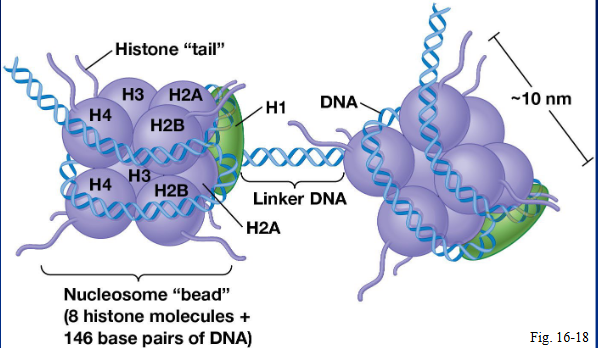
  • 2 copies each of H2A, H2B, H3, H4 form the histone octamer

  • DNA wraps twice around a histone octamer to produce a nucleosome core particle appearing as beads on a string


<ul><li><p><span style="color: rgb(255, 255, 255);">5 different histone proteins</span></p><ul><li><p><span style="color: rgb(255, 255, 255);">H1, H2A, H2B, H3, H4</span></p></li></ul></li><li><p><span style="color: rgb(255, 255, 255);">2 copies each of H2A, H2B, H3, H4 form the histone octamer</span></p></li><li><p><span style="color: rgb(255, 255, 255);">DNA wraps twice around a histone octamer to produce a nucleosome core particle appearing as beads on a string</span></p></li></ul><p></p>
5
New cards

What makes up the nucleosome

  • Core particles (DNA wrapped around histones) are separated by >50 bp = linker DNA

  • H2A, H2B, H3, AND H4 make up octamer

  • DNA wraps around the octamer

  • H1 rests over wrapped DNA and octamer

  • Total nucleosome length is ~200 bp


<ul><li><p><span style="color: rgb(255, 255, 255);">Core particles (DNA wrapped around histones) are separated by &gt;50 bp = linker DNA</span></p></li><li><p><span style="color: rgb(255, 255, 255);">H2A, H2B, H3, AND H4 make up octamer</span></p></li><li><p><span style="color: rgb(255, 255, 255);">DNA wraps around the octamer</span></p></li><li><p><span style="color: rgb(255, 255, 255);">H1 rests over wrapped DNA and octamer</span></p></li><li><p><span style="color: rgb(255, 255, 255);">Total nucleosome length is ~200 bp</span></p></li></ul><p></p>
6
New cards

How are nucleosome fragments separated in agarose gel and what does this tell us about enzyme activity w/ DNA

  • DNA fragments can be separated in agarose gel based on their size

  • DNA banding pattern in roughly 200 base pair increments

    • Shows that nuclease only has access to the linker DNA

    • Enzyme cannot access DNA wrapped around histone

    • Short term nuclease digestion causes the banding pattern

    • Referred to as a DNA ladder


<ul><li><p>DNA fragments can be separated in agarose gel based on their size</p></li><li><p>DNA banding pattern in roughly 200 base pair increments</p><ul><li><p>Shows that nuclease only has access to the linker DNA</p></li><li><p>Enzyme cannot access DNA wrapped around histone</p></li><li><p>Short term nuclease digestion causes the banding pattern</p></li><li><p>Referred to as a DNA ladder</p></li></ul></li></ul><p></p>
7
New cards

How is chromatid organized in the nucleus

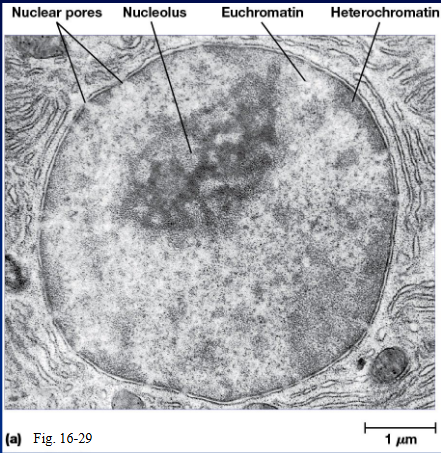
  • Decondensed = euchromatin

    • Available for transcription

  • Condensed = heterochromatin

    • Not available for transcription

  • Nucleosome → 30-nm chromatin → euchromatin → heterochromatin → chromosome


<ul><li><p><span style="color: rgb(255, 255, 255);">Decondensed = euchromatin</span></p><ul><li><p><span style="color: rgb(255, 255, 255);">Available for transcription</span></p></li></ul></li><li><p><span style="color: rgb(255, 255, 255);">Condensed = heterochromatin</span></p><ul><li><p><span style="color: rgb(255, 255, 255);">Not available for transcription</span></p></li></ul></li><li><p>Nucleosome → 30-nm chromatin → euchromatin → heterochromatin → chromosome</p></li></ul><p></p>
8
New cards

What is the difference between euchromatin and heterochromatin

  • Decondensed chromatin = euchromatin

    • Available for transcription

  • Condensed chromatin = heterochromatin

    • Not available for transcription; too compact

    • RNA polymerase and transcription factors cannot access chromatin

  • Some chromatin is in a euchromatin state while others are in a heterochromatin state

  • Chromatin can change states


<ul><li><p><span style="color: rgb(255, 255, 255);">Decondensed chromatin = euchromatin</span></p><ul><li><p><span style="color: rgb(255, 255, 255);">Available for transcription</span></p></li></ul></li><li><p><span style="color: rgb(255, 255, 255);">Condensed chromatin = heterochromatin</span></p><ul><li><p><span style="color: rgb(255, 255, 255);">Not available for transcription; too compact</span></p></li><li><p><span style="color: rgb(255, 255, 255);">RNA polymerase and transcription factors cannot access chromatin</span></p></li></ul></li><li><p>Some chromatin is in a euchromatin state while others are in a heterochromatin state</p></li><li><p>Chromatin can change states</p></li></ul><p></p>
9
New cards

What are the different histone modifications and how do they affect transcription

  • Chromatin ‘packing’ can be regulated by modifying specific lysine residues by:

  • Methylation

    • Histone methyltransferase = add methyl groups

    • Histone demethylase - remove methyl groups

    • Leads to tighter packing → less transcription

  • Acetylation

    • Histone acetyltransferase = add acetyl groups

    • Histone deacetylase = remove acetyl groups

    • Leads to looser packing → more transcription

  • Other chromatin remodeling proteins can reposition nucleosomes to make DNA more accessible


<ul><li><p><span style="color: rgb(255, 255, 255);">Chromatin ‘packing’ can be regulated by modifying specific lysine residues by:</span></p></li><li><p><span style="color: rgb(255, 255, 255);"><strong>Methylation</strong></span></p><ul><li><p><span style="color: rgb(255, 255, 255);">Histone methyltransferase = add methyl groups</span></p></li><li><p><span style="color: rgb(255, 255, 255);">Histone demethylase - remove methyl groups</span></p></li><li><p><span style="color: rgb(255, 255, 255);"><mark data-color="yellow" style="background-color: yellow; color: inherit;">Leads to tighter packing → less transcription</mark></span></p></li></ul></li><li><p><span style="color: rgb(255, 255, 255);"><strong>Acetylation</strong></span></p><ul><li><p><span style="color: rgb(255, 255, 255);">Histone acetyltransferase = add acetyl groups</span></p></li><li><p><span style="color: rgb(255, 255, 255);">Histone deacetylase = remove acetyl groups</span></p></li><li><p><span style="color: rgb(255, 255, 255);"><mark data-color="red" style="background-color: red; color: inherit;">Leads to looser packing → more transcription</mark></span></p></li></ul></li><li><p><span style="color: rgb(255, 255, 255);">Other chromatin remodeling proteins can reposition nucleosomes to make DNA more accessible</span></p></li></ul><p></p>
10
New cards

What is the structure of the nucleus

  • The nucleus has a double membrane

    • The outer membrane is continuous w/ the rough ER

  • Dense nucleolus

    • A biomolecular condensate composed of intrinsically disordered proteins

    • Site where ribosomal RNA fragments are synthesized

  • The inside of the nuclear membrane is lined by proteins called nuclear lamina

    • Nuclear lamina is made up of intermediate filament proteins (nuclear lamins)

  • Nuclear membrane has nuclear pores

    • Allows transport of molecules into and out of nucleus


<ul><li><p>The nucleus has a double membrane</p><ul><li><p>The outer membrane is continuous w/ the rough ER</p></li></ul></li><li><p>Dense nucleolus </p><ul><li><p>A biomolecular condensate composed of intrinsically disordered proteins</p></li><li><p>Site where ribosomal RNA fragments are synthesized</p></li></ul></li><li><p> The inside of the nuclear membrane is lined by proteins called nuclear lamina</p><ul><li><p>Nuclear lamina is made up of intermediate filament proteins (nuclear lamins)</p></li></ul></li><li><p>Nuclear membrane has nuclear pores</p><ul><li><p>Allows transport of molecules into and out of nucleus</p></li></ul></li></ul><p></p>
11
New cards

What do nuclear pores do

  • Allows movement of molecules in and out of the nucleus occurs through nuclear pores

  • 3000-4000 per nucleus


<ul><li><p>Allows movement of molecules in and out of the nucleus occurs through nuclear pores</p></li><li><p>3000-4000 per nucleus</p></li></ul><p></p>
12
New cards

How does nuclear transport work for molecules of different sizes

  • Molecules < 40 kiloDaltons may diffuse through pores freely

  • Most molecules that must cross the membrane are larger than 40 kDa

    • Like histones and RNA Polymerases

  • Most are ‘actively’ transported across the membrane (through the pores)


<ul><li><p><span style="color: rgb(255, 255, 255);">Molecules &lt; 40 kiloDaltons may diffuse through pores freely</span></p></li><li><p><span style="color: rgb(255, 255, 255);">Most molecules that must cross the membrane are larger than 40 kDa</span></p><ul><li><p>Like histones and RNA Polymerases</p></li></ul></li><li><p><span style="color: rgb(255, 255, 255);">Most are ‘actively’ transported across the membrane (through the pores)</span></p></li></ul><p></p>
13
New cards

What is the structure of the nuclear pore. What allows large proteins to travel through nuclear pores

  • The proteins that line the pore are called nucleoporins

    • Block the pore

    • Portions of nucleoporins extend into the pore and have many FG repeats (phenylalanine and glycine)

      • FG repeats are common in some intrinsically disordered proteins

      • Intrinsically disordered regions allow smaller molecules in and keep larger molecules out

  • Proteins larger than ~40kD cannot navigate through this flexible barrier

  • Proteins that are allowed to pass through the nuclear pore possess a nuclear localization signal (NLS)

    • A series of lysine and or arginine residues

    • Bound by the protein Importin which is able to navigate through the FG repeats and transport the cargo into the nucleus


<ul><li><p><span style="color: rgb(255, 255, 255);">The proteins that line the pore are called nucleoporins</span></p><ul><li><p>Block the pore</p></li><li><p><span style="color: rgb(255, 255, 255);">Portions of nucleoporins extend into the pore and have many FG repeats (phenylalanine and glycine)</span></p><ul><li><p><span style="color: rgb(255, 255, 255);">FG repeats are common in some intrinsically disordered proteins</span></p></li><li><p><span style="color: rgb(255, 255, 255);">Intrinsically disordered regions allow smaller molecules in and keep larger molecules out</span></p></li></ul></li></ul></li><li><p><span style="color: rgb(255, 255, 255);">Proteins larger than ~40kD cannot navigate through this flexible barrier</span></p></li><li><p><span style="color: rgb(255, 255, 255);"><mark data-color="yellow" style="background-color: yellow; color: inherit;">Proteins that are allowed to pass through the nuclear pore possess a nuclear localization signal (NLS)</mark></span></p><ul><li><p><span style="color: rgb(255, 255, 255);">A series of lysine and or arginine residues</span></p></li><li><p><span style="color: rgb(255, 255, 255);"><mark data-color="yellow" style="background-color: yellow; color: inherit;">Bound by the protein Importin</mark> which is able to navigate through the FG repeats and transport the cargo into the nucleus</span></p></li></ul></li></ul><p></p>
14
New cards

What is the nuclear localization signal (NLS)

  • A series of lysine and or arginine residues that can bind to importin and pass through FG repeats into the nucleus

  • Site directed mutagenesis to alter the NLS in the large T antigen protein
    expressed by the SV40 virus prevents the protein from entering the nucleus

    • Lys → Thr, basic to polar AA

    • T-antigens found all throughout cell but not the nucleus; it can’t get in w/o NLS and importin

  • The bright spots show nucleus; dark spots are the nucleolus


<ul><li><p><span style="color: rgb(255, 255, 255);">A series of lysine and or arginine residues that can bind to importin and pass through FG repeats into the nucleus</span></p></li></ul><ul><li><p>Site directed mutagenesis to alter the NLS in the large T antigen protein<br>expressed by the SV40 virus prevents the protein from entering the nucleus</p><ul><li><p>Lys → Thr, basic to polar AA</p></li><li><p>T-antigens found all throughout cell but not the nucleus; it can’t get in w/o NLS and importin</p></li></ul></li><li><p>The bright spots show nucleus; dark spots are the nucleolus</p></li></ul><p></p>
15
New cards

What is the process of nuclear import

  • Importin binds cargo protein w/ NLS and together they move into the nucleus

  • In the nucleus, importin binds Ran-GTP and then releases the cargo protein

  • Importin and Ran-GTP (bound to each other) move out of the nucleus

  • In the cytosol, Ran-GTP encounters its GAP, hydrolyzes its GTP to become Ran-GDP, and then releases importin

  • Ran-GDP diffuses back into the nucleus, encounters its GEF, and then releases GDP and binds a new GTP


<ul><li><p><span style="color: rgb(255, 255, 255);"><mark data-color="yellow" style="background-color: yellow; color: inherit;">Importin binds cargo protein w/ NLS</mark> and together they move into the nucleus</span></p></li><li><p><span style="color: rgb(255, 255, 255);">In the nucleus,<mark data-color="blue" style="background-color: blue; color: inherit;"> importin binds Ran-GTP and then releases the cargo protein</mark></span></p></li><li><p><span style="color: rgb(255, 255, 255);">Importin and Ran-GTP (bound to each other) <mark data-color="blue" style="background-color: blue; color: inherit;">move out of the nucleus</mark></span></p></li><li><p><span style="color: rgb(255, 255, 255);"><mark data-color="red" style="background-color: red; color: inherit;">In the cytosol, Ran-GTP encounters its GAP</mark>, hydrolyzes its GTP to become Ran-GDP, and<mark data-color="red" style="background-color: red; color: inherit;"> then releases importin</mark></span></p></li><li><p><span style="color: rgb(255, 255, 255);"><mark data-color="green" style="background-color: green; color: inherit;">Ran-GDP diffuses back into the nucleus, encounters its GEF</mark>, and then releases GDP and binds a new GTP</span></p></li></ul><p></p>
16
New cards

How what is the process of nuclear export

  • Most mRNA diffuses from the nucleus into the cytosol without exportin or Ran

  • Export of other RNA (rRNA, miRNA) from the nucleus requires proteins in the nucleus that possess a nuclear export signal (NES) to bind to the RNA

  • The protein exportin binds to the proteins with a NES and also binds to Ran-GTP and together this complex moves out of the nucleus

  • In the cytosol the Ran-GTP encounters its GAP, hydrolyzes its GTP to become Ran-GDP, and then releases the exportin and its cargo protein/RNA in the cytosol

  • The exportin and the Ran-GDP independently diffuse back into the nucleus where the Ran-GDP encounters its GEF, and then releases GDP and binds a new GTP


17
New cards

How does secondary active transport work

  • The location of the GAP (cytosol) and the GEF (nucleus) produce concentration gradients of Ran-GDP and Ran-GTP across the nuclear membrane

    • Ran-GDP is high in the cytosol and low in the nucleus, so it diffuses freely from the cytosol into the nucleus

    • Ran-GTP is high in the nucleus and low in the cytosol, so it diffuses freely from the nucleus into the cytosol

      • Ran always moves down its concentration gradient

    • The gradient of Ran-GTP provides the energy to cotransport exportin + cargo protein/RNA from the nucleus into the cytosol against their concentration gradient

    • The gradient of Ran-GTP provides the energy to cotransport importin out of the nucleus and create a concentration gradient of importin that is high in the cytosol and low in the nucleus

    • This gradient of importin provides the energy to cotransport cargo proteins from the cytosol into the nucleus against their concentration gradient


18
New cards

What is the Central Dogma of Molecular Biology

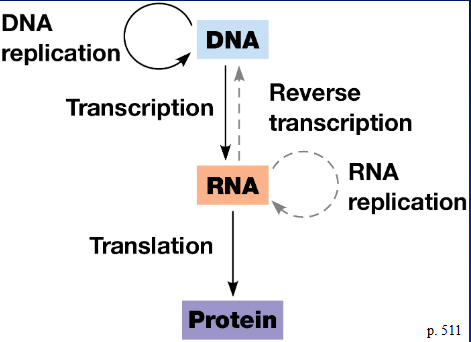
  • A DNA sequence dictates an RNA sequence

  • The RNA sequence then dictates an amino acid sequence (a protein)

<ul><li><p><span style="color: rgb(255, 255, 255);">A DNA sequence dictates an RNA sequence</span></p></li><li><p><span style="color: rgb(255, 255, 255);">The RNA sequence then dictates an amino acid sequence (a protein)</span></p></li></ul><p></p>
19
New cards

What is DNA

  • The encoded hereditary information

  • Functional unit = gene

    • The sequence of DNA that directs the synthesis of a polypeptide


20
New cards

What are the roles of RNA

  • RNA transcribed from DNA is translated into proteins

  • mRNA important in synthesis of proteins

  • rRNA important in synthesis of ribosomes

  • tRNA important in transport of RNA molecules to the ribosome


<ul><li><p>RNA transcribed from DNA is translated into proteins</p></li><li><p>mRNA important in synthesis of proteins</p></li><li><p>rRNA important in synthesis of ribosomes</p></li><li><p>tRNA important in transport of RNA molecules to the ribosome</p></li></ul><p></p>
21
New cards

What is the difference between prokaryotic and eukaryotic transcription

  • In prokaryotes, transcription and translation can happen simultaneously

    • Bc of lack of nucleus

  • In eukaryotes, transcription happens in the nucleus and translation happens in the cytosol


<ul><li><p>In prokaryotes, transcription and translation can happen simultaneously</p><ul><li><p>Bc of lack of nucleus</p></li></ul></li><li><p>In eukaryotes, transcription happens in the nucleus and translation happens in the cytosol</p></li></ul><p></p>
22
New cards

What is coupled transcription and translation in prokaryotes

  • Transcription and Translation can occur at the same time

  • A given strand of mRNA can be translated multiple times simultaneously

    • Ribosomes can attach to 5’ end and begin to move 5’ to 3’ along RNA

    • Another RNA can attach and begin translation as well

    • Forms structures called polyribosomes


<ul><li><p>Transcription and Translation can occur at the same time</p></li><li><p>A given strand of mRNA can be translated multiple times simultaneously</p><ul><li><p> Ribosomes can attach to 5’ end and begin to move 5’ to 3’ along RNA</p></li><li><p>Another RNA can attach and begin translation as well</p></li><li><p>Forms structures called polyribosomes</p></li></ul></li></ul><p></p>