Bird lab SPECIMENS
 Call Kai
 Learn
Learn Practice Test
 Spaced Repetition
 Match
Match Flashcards
 Knowt Play
1/181

There's no tags or description
Looks like no tags are added yet.
Name | Mastery | Learn | Test | Matching | Spaced | Call with Kai | Chat |
|---|
No analytics yet
Send a link to your students to track their progress
182 Terms

• Dark grayish-brown upperparts
• White throat and abdomen with dark “vest”
• Indistinct wing bars, but white edge on tertials
Olive-sided Flycatcher

• Small, uniformly dark grayish-brown
• No eye ring
• Long primary projection
• Indistinct pale wing bars and tertial edges
Western Wood-Pewee

WHW
• Drab olive with whitish gray wing bars
• Very reduced or absent eye-ring
• Bill is broad and pale underneath
• Grayish breast and abdomen
ENDANGERED
Willow Flycatcher

WHW
• Grayish olive-green (head especially gray)
• Whitish wing bars
• Whitish eye ring
• Relatively short, narrow, dark bill
• Notched tail
• Long primary projection
Hammond’s Flycatcher

WHW
• Olive-green with yellow to white wing bars
• Pale, teardrop-shaped eye ring
• Bill is broad and pale underneath
• Dull yellow breast and abdomen
• Head appears to have a short peak
Western Flycatcher

• Black with white abdomen
• Wags tail while perching and singing
Black Phoebe

• Brownish gray with pale rusty abdomen and undertail coverts
• Black tail
• Wags tail when perched
Say’s Phoebe

• Brownish gray upperparts, with pale gray throat and breast
• Very pale yellow abdomen and undertail coverts
• Underside of tail reddish with dark tips
• Short bushy crest
• Long, wide, black bill with slight hook
Ash-throated Flycatcher
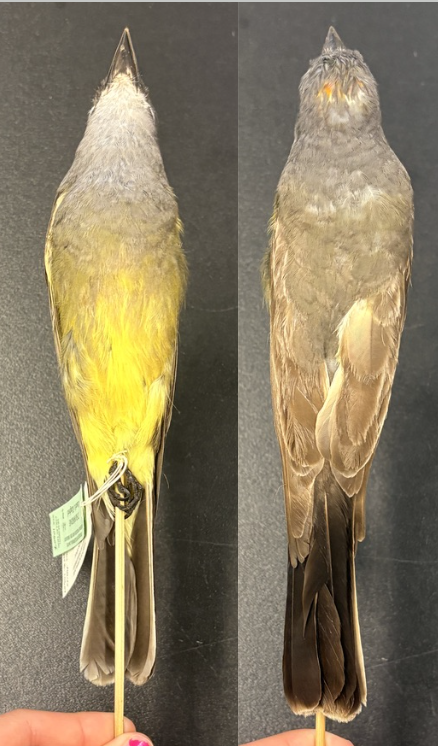
• Dark gray head and breast with sharply contrasting white chin
• Yellow abdomen
• Black tail with pale tips
• Pale edging on wing coverts
Cassin’s Kingbird

• Pale gray breast and head with less contrasting white chin
• Yellow abdomen
• Black tail with white edges on outermost feathers
• No pale edging on wing coverts
Western Kingbird

• Gray above and white below
• Black facial mask
• Small, black bill with short hook and tomial teeth
ENDANGERED
Loggerhead Shrike

• Greenish olive upper parts with dull yellow underparts
• Two yellow to white wing bars, with darkest part of wing
between them
• Incomplete, yellow to white eye ring
• Thick, hooked bill
• Blue-gray legs
Hutton’s Vireo
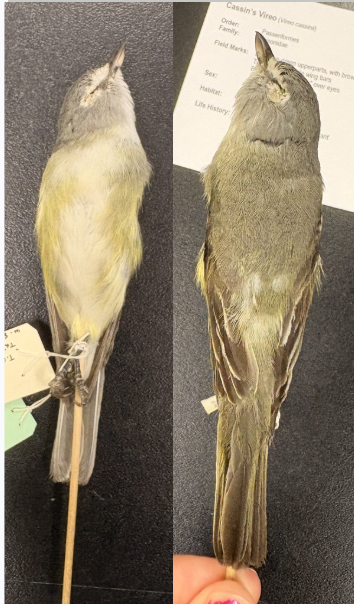
• Dull olive-green upperparts, with grayer crown, whitish underparts
• Two yellow to white wing bars
• Bold white "spectacles" over eyes
Cassin’s Vireo

• Grayish-olive upperparts, with whitish underparts
• No wingbars
• Whitish supercilium (“eyebrow”)
Western Warbling-Vireo
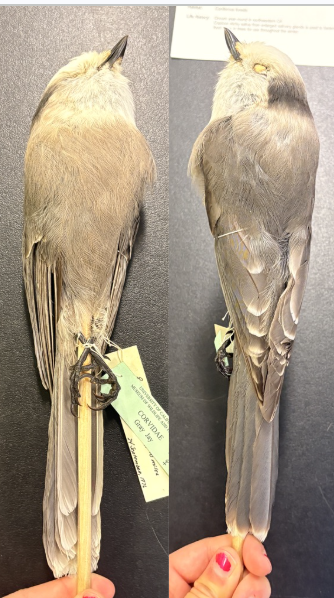
• Dark gray upperparts, with pale gray to white underparts
• Whitish throat, often extending to a collar around neck
• White head with black crown patch, varying in size, but no crest
• Flight feathers sometimes tipped white
Canada Jay

• Dull blue overall, with chin and throat streaked whitish
• No crest
• Sharp-pointed bill
• Short-tailed
Pinyon Jay

• Dark blue with black crest
• Blue streaks on forehead
• Grayish throat patch
Steller’s Jay

• Deep blue upper parts with whitish underparts
• Dark gray/brown back (compare CASJ)
• Blackish lores extend across crown
• Relatively massive bill
Island Scrub-Jay

• Blue upper parts with whitish underparts
• Dark cheeks and whitish supercilium (“eyebrow”), but no crest
• Presence of blue, streaky “necklace” varies
California Scrub-Jay

• Blue upper parts with grayish underparts– Blues and whites less bright than CASJ
• Dark cheeks and whitish supercilium (“eyebrow”), but no crest– supercilium may be less distinct than CASJ, but unreliable.
• Blue necklace can be weakly present, but less distinct than CASJ
Woodhouse’s Scrub-Jay

• Light gray with white on forehead, chin, and undertail
• Central rectrices black, and outer rectrices white
• Wings black, with white-tipped secondaries visible in flight
• Long, pointed black bill
Clark’s Nutcracker

• Brown to black upperparts with cinnamon to white underparts
• Black mask, breast band, and occipital feather tufts
(“horns” – not always visible)
• Contrasting yellow supercilium (“eyebrow”) and throat
• Outermost tail feathers edged white
Horned Lark

Very large size
Blue black upperparts
Forked tail
Females have grayish underparts, with brownish colla
Purple Martin FEMALE

Greenish blue upperparts with white underparts
No white patches around eyes or on sides of rump
Wingtips reach tail tip
Tree Swallow MALE

Greenish blue upperparts with white underparts
No white patches around eyes or on sides of rump
Wingtips reach tail tip
Females duller, with more brown on upper parts
Tree Swallow FEMALE

Uniform grayish-brown upper parts with dull white underparts
Grayish-brown chest, sides, flanks, but no breast band
Square tail
Northern Rough-winged Swallow

Grayish-brown upper parts with darker brown wings and tail
Brown breast-band with white throat and underparts
Slight notch in tail
Much smaller beak than WWPW
ENDANGERED
Bank Swallow

Glossy blue upperparts with orange rump
Pale forehead and dark chestnut throat
Square tail
Cliff Swallow

Blue-black upperparts with orange to whitish underparts
Rusty forehead and throat
Long, deeply forked tail
Barn Swallow

Very large size
Blue black upperparts
Forked tail
Adult male is entirely glossy blue black
Purple Martin MALE

• Solid black cap and throat with white cheeks
• Gray back, wings, and tail
• Conspicuous pale edging on wing coverts and flight feathers
Black-capped Chickadee
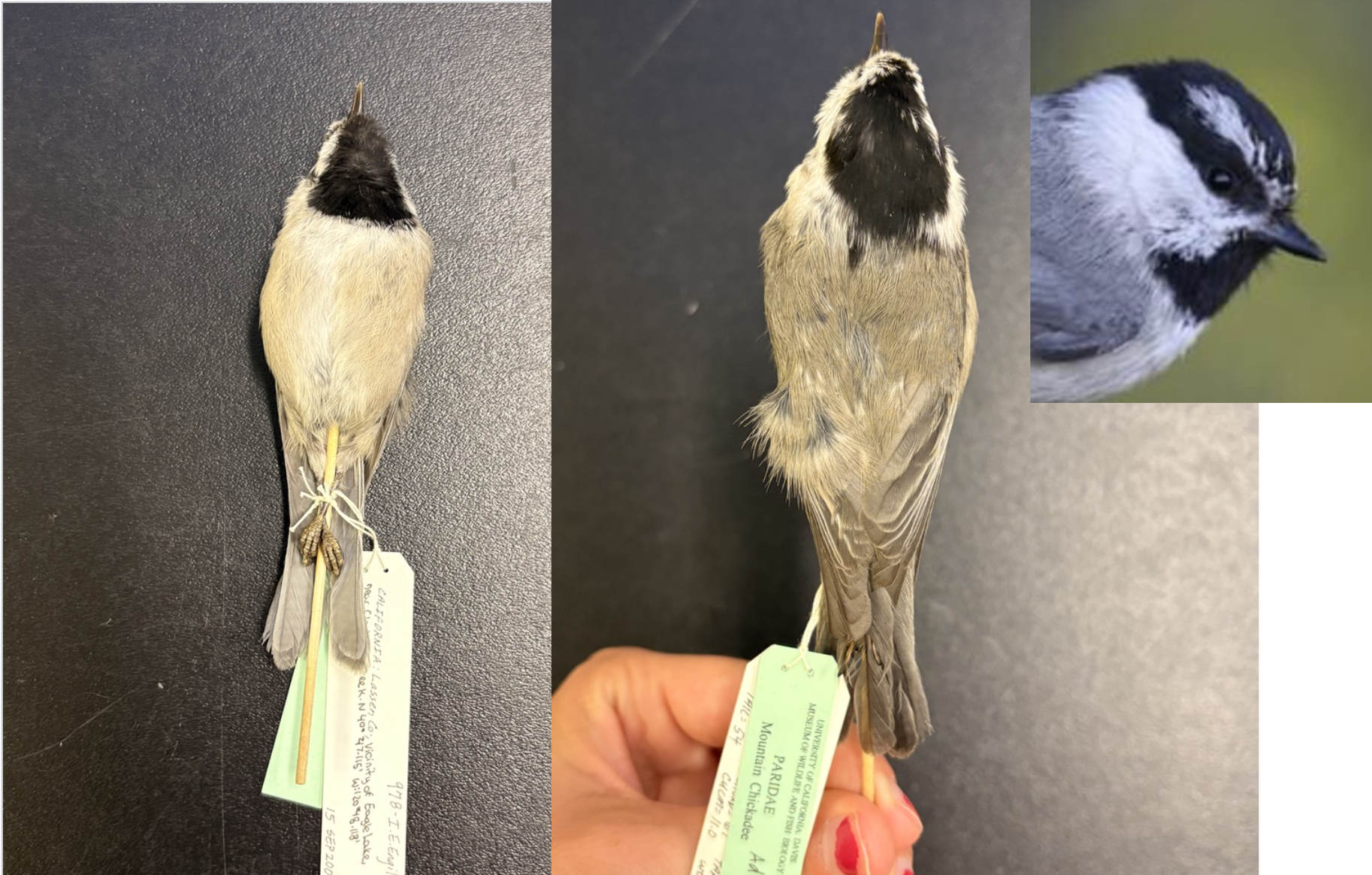
• Black cap and throat with white cheeks
• White supercilium (eyebrow), but white feather tips may wear off
• Gray back, wings, and tail
• Less conspicuous edging on wing coverts and flight feathers
Mountain Chickadee

• Solid dark brown to blackish cap and throat with narrower white cheeks
• Back, rump, and flanks rufous or chestnut (flanks may be gray)
• Whitish edging on inner secondaries and greater coverts
Chestnut-backed Chickadee

• Plain brownish-gray upper parts and underparts
• Pointed crest
Oak Titmouse

• Brownish-gray upper parts with pale gray to white underparts
• Rufous lesser wing coverts, forming a shoulder patch
• Yellow forehead, chin and throat
• Very small
Verdin

• Plain brownish-gray upperparts and underparts
• Long tail and short wings
• Very small
Bushtit

• Bluish-gray upperparts with rufous underparts
• Dark crown with white supercilium (eyebrow) and dark eye-line
• Males with black crown and wider black eye-line
Red-breasted Nuthatch MALE

• Bluish-gray upperparts with rufous underparts
• Dark crown with white supercilium (eyebrow) and dark eye-line
• Females with dark gray-blue crown and narrower black eye-line
Red-breasted Nuthatch FEMALE

• Dark gray to black crown with white face and breast
• Bluish-gray back
• Rusty undertail coverts and sides
• Short tail with white corners
• Large bill, nearly as long as head, and slightly upturned
White-breasted Nuthatch MALE

• Dark gray to black crown with white face and breast
• Bluish-gray back
• Rusty undertail coverts and sides
• Short tail with white corners
• Large bill, nearly as long as head, and slightly upturned
Females generally duller and grayer, especially the crown
White-breasted Nuthatch FEMALE

• Bluish-gray upperparts with buff to whitish underparts
• Gray-brown crown with dark eyeline and white cheeks
• Base of central rectrices white
Pygmy Nuthatch

• Dark brown upperparts streaked with white
• White underparts
• Whitish supercilium (eyebrow)
• Long stiff tail
• Thin curved bill
• Buffy band on wings seen in flight
Brown Creeper

• Grayish-brown upperparts, finely speckled with black and white
• Whitish underparts, streaked with gray on throat and breast
• Cinnamon rump
• Barred tail with dark terminal band and buffy tips
Rock Wren

• Rusty brown upperparts and abdomen with black and white speckles
• Grayish head and back
• White throat and breast
• Rufous tail with black barring, and no terminal band
Canyon Wren

• Brownish-gray upperparts with light gray underparts
• Faint supercilium
• Barring on flanks, tail, wings, sometimes extending to back
• Distinguished by lack of bold markings
Northern House Wren

• Dark to medium brown upperparts and underparts
• Paler supercilium and throat
• Dark barring on wings, tail, and underparts below breast
• Very short tail
Pacific Wren

• Upperparts cinnamon brown with whitish underparts
• Black triangle on back with white stripes
• Brown to black crown
• Bold whitish supercilium (eyebrow)
• Tail and wings barred
Marsh Wren

• Brown to grayish-brown upperparts with whitish underparts
• Conspicuous white supercilium
• Long tail with central rectrices barred, others tipped white
Bewick’s Wren

• Brownish upperparts with white streaks on back
• Whitish to cinnamon underparts with black spots
• White supercilium
• Barred wings and tail
Cactus Wren

• Gray upperparts with paler underparts
• Long, black graduated tail, underside mostly white
• Outer rectrices with extensive white patches
• Broad white tertial edges
• Obvious white eye ring
Blue-gray Gnatcatcher

• Dark gray overall
• Short wings and tail
• White eyelid obvious when blinking
• Stocky, with long legs
American Dipper

• Olive upperparts with paler underparts
• Two white wing bars
• Yellow crown patch, bordered by black stripes
• White supercilium
Golden-crowned Kinglet

• Olive green-gray upperparts with paler underparts
• Two white wing bars, with dark area below second wing bar
• Broken white eye ring
Ruby-crowned Kinglet

• Grayish-brown upperparts with paler pinkish-brown underparts
• Faint supercilium (eyebrow)
• Throat and breast may be lightly streaked
• Long graduated tail often held tilted up
• Iris color varies from gray to maroon depending on age
Wrentit

• Deep blue to blue-brown upperparts and underparts
• Chestnut breast, and possibly scapulars
• Yellow gape
• Relatively short wings and tail
• Males deep blue on head, back, wings, and tail with chestnut breast and scapulars, and blue-gray abdomen
Western Bluebird MALE

• Deep blue to blue-brown upperparts and underparts
• Chestnut breast, and possibly scapulars
• Yellow gape
• Relatively short wings and tail
• Female blue-brown to gray with deep blue on wings and tail, paler chestnut breast, and grayish abdomen
Western Bluebird FEMALE

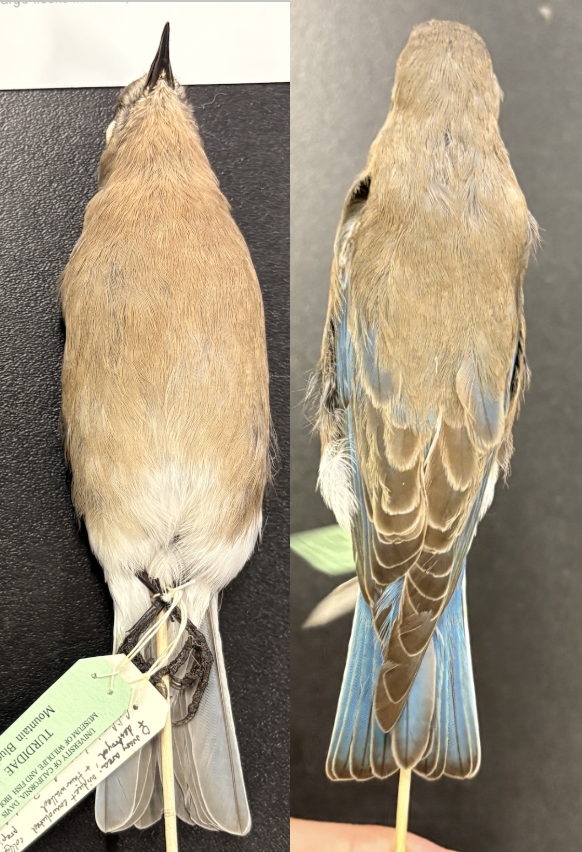
• Sky blue to blue-brown upperparts and underparts
• No chestnut coloration on breast or scapulars
• Thin, dark bill
• Relatively long wings and tail
• Male is sky blue overall with whitish abdomen and dusky wingtips
Mountain Bluebird MALE
• Sky blue to blue-brown upperparts and underparts
• No chestnut coloration on breast or scapulars
• Thin, dark bill
• Relatively long wings and tail
• Female is blue-brown with sky blue remiges and rectrices
Mountain Bluebird FEMALE

• Plain gray overall
• White eye ring
• Dark gray remiges with wide buffy band at the base
• White on outer rectrices
• Short, wide bill
• Relatively long tail
Townsend’s Solitaire ADULT

• Plain gray overall
• White eye ring
• Dark gray remiges with wide buffy band at the base
• White on outer rectrices
• Short, wide bill
• Relatively long tail
Townsend’s Solitaire JUVENILE

• Uniformly olive-brown upperparts, sometimes tinged rufous
• White underparts
• Triangular brownish-black spotting on breast and throat
• Buffy eye ring
has kinda a stomach window
Swainson’s Thrush

• Olive-brown upperparts with contrasting rufous rump and tail
• White underparts
• Large, rounded brownish-black spotting on breast and throat
• Thin whitish eye ring
Hermit Thrush

• Brown to dark gray upperparts with orange to dark red underparts
• White eye arcs
• Yellow bill
• Large and long-legged
• Males more richly colored, with blackish head
American Robin MALE

• Brown to dark gray upperparts with orange to dark red underparts
• White eye arcs
• Yellow bill
• Large and long-legged
• Females paler overall, especially on head
American Robin FEMALE

• Brown to dark gray upperparts with orange to dark red
underparts
• White eye arcs
• Yellow bill
• Large and long-legged
American Robin JUVENILE

• Gray-blue upperparts with orange underparts
• Bright orange supercilium and wing markings
• Gray breastband
• Large and “pot-bellied”
• Male is more richly colored with very dark breastband
Varied Thrush MALE

• Gray-blue upperparts with orange underparts
• Bright orange supercilium and wing markings
• Gray breastband
• Large and “pot-bellied”
• Female is paler overall, with grayer back and breastband
Varied Thrush FEMALE

• Plain brown upperparts with buffy underparts
• Orange undertail coverts
• No wing bars
• Buffy supercilium and strong, dark eye line and cheek
• Long, decurved, blackish bill
• Dark iris
California Thrasher

• Plain sandy-gray upperparts and underparts without streaks
• Tawny undertail coverts
• No wing bars
• Dark lores, but otherwise little head pattern
• Long, decurved blackish bill
• Dark iris
LeConte’s Thrasher

• Brownish-gray upperparts with off-white underparts streaked with brown
• White wing bars and tips of outer rectrices
• Whitish supercilium and malar, with black border at sides of throat
• Relatively short bill, only slightly curved
• Pale iris
Sage Thrasher

• Gray to gray-brown upperparts with whitish underparts
• Long tail and legs
• Bill slightly decurved
• White wing bars, and a large white wing-patch visible in flight
• White outer rectrices
• Thin, dark eye line
Northern Mockingbird ADULT

• Gray to gray-brown upperparts with whitish underparts
• Long tail and legs
• Bill slightly decurved
• White wing bars, and a large white wing-patch visible in flight
• White outer rectrices
• Thin, dark eye line
Northern Mockingbird JUVENILE

• Dark, glossy plumage with purplish and greenish iridescence
• Short, square tail, pointed wings
• Long bill, yellow in breeding season
• Plumage speckled when fresh, in fall in winter, gradually wearing off
European Starling MALE ALTERNATIVE

• Dark, glossy plumage with purplish and greenish iridescence
• Short, square tail, pointed wings
• Long bill, yellow in breeding season
• Plumage speckled when fresh, in fall in winter, gradually wearing off
European Starling MALE

• Dark, glossy plumage with purplish and greenish iridescence
• Short, square tail, pointed wings
• Long bill, yellow in breeding season
• Plumage speckled when fresh, in fall in winter, gradually wearing off
European Starling FEMALE
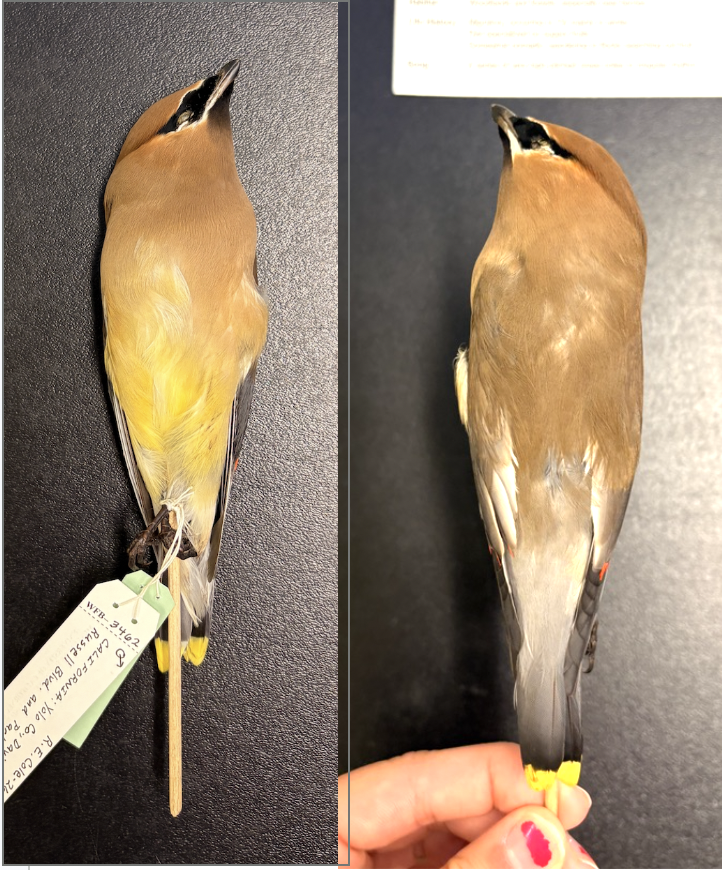
• Gray-brown upperparts and underparts, with pale yellow abdomen
• Black face mask with white edges and black chin
• Prominent crest
• Yellow or orange tipped tail
• Whitish undertail coverts
• Waxy red tips on the secondaries
Cedar Waxwing

• Glossy black to gray upperparts and underparts
• Ragged, crested head
• Long tail
• Red iris
Phainopepla MALE

• Glossy black to gray upperparts and underparts
• Ragged, crested head
• Long tail
• Red iris
Phainopepla FEMALE

• Brown upperparts with black streaks
• Stout, stocky appearance with short tail and wings
House Sparrow MALE

• Brown upperparts with black streaks
• Stout, stocky appearance with short tail and wings
House Sparrow FEMALE

• Gray-brown upperparts with buffy underparts
• Underparts vary from heavily streaked to entirely unstreaked
• Slender, short, straight bill
• White outer tail feathers
• Pale supercilium
• Long, usually dark legs, with long hallux claw
American Pipit

• Black wings with white or gray wing panel on secondaries
• Short, slightly notched, black tail
• Massive, pale greenish-yellow, conical bill
Evening Grosbeak MALE

• Black wings with white or gray wing panel on secondaries
• Short, slightly notched, black tail
• Massive, pale greenish-yellow, conical bill
Evening Grosbeak FEMALE

• Dark brown overall with pinkish abdomen and wing coverts
• Dark forecrown and gray hindcrown
• Cheeks may be gray or brown
• Bill is yellow in winter, and black in breeding season
• Long, notched tail and long wings
Gray-crowned Rosy-Finch

• Drab gray-brown overall with heavy blurry grayish streaking
• Short bill with curved culmen
• No pattern on head
• Relatively long, slightly notched tai4
House Finch MALE

• Drab gray-brown overall with heavy blurry grayish streaking
• Short bill with curved culmen
• No pattern on head
• Relatively long, slightly notched tai
House Finch FEMALE

• Relatively large with short, notched tail
• Culmen shallowly curved
• Dark cheek patch bordered with paler supercilium and malar
Purple Finch MALE

• Relatively large with short, notched tail
• Culmen shallowly curved
• Dark cheek patch bordered with paler supercilium and malar
Purple Finch FEMALE

• Large with short, notched tail
• Long, pointed, mostly straight culmen
• Weak face pattern
• Streaked undertail coverts
Cassin’s Finch MALE

• Large with short, notched tail
• Long, pointed, mostly straight culmen
• Weak face pattern
• Streaked undertail coverts
Cassin’s Finch FEMALE

• Greenish-yellow to brick red overall
• Dark wings and short, deeply-notched tail
• Mandibles curved and crossed at the tip
• Males typically brick red to reddish-yellow
Red Crossbill MALE

• Greenish-yellow to brick red overall
• Dark wings and short, deeply-notched tail
• Mandibles curved and crossed at the tip
• Females typically olive to greenish-yellow
Red Crossbill FEMALE

• Dark upperparts and whitish underparts streaked with brown
• Slender bill
• Short, notched tail
• Base of remiges and rectrices (except central pair) yellow
Pine Siskin

• Greenish upperparts with yellow underparts, including undertail
• Short-tailed with short, rounded wings
• Dark wing and underwing, with white at base of primaries
• Stout, dark gray bill
Lesser Goldfinch MALE

• Greenish upperparts with yellow underparts, including undertail
• Short-tailed with short, rounded wings
• Dark wing and underwing, with white at base of primaries
• Stout, dark gray bill
Lesser Goldfinch FEMALE
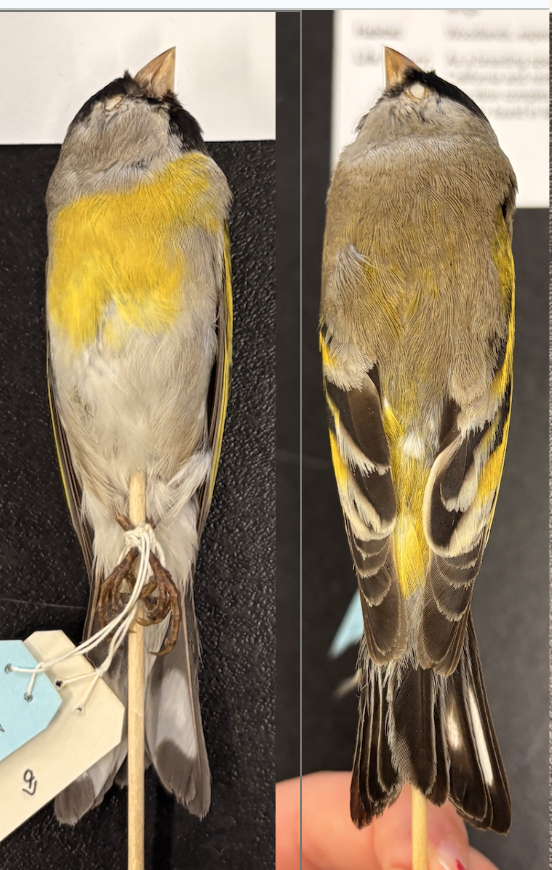
• Brownish-gray upperparts, head, and flanks
• White undertail coverts
• Yellowish-gray rump, breast, and wing bars
• Yellow-edged primaries and white underwing coverts
• Flesh-colored bill
• White band across dark tail
Lawrence’s Goldfinch MALE

• Brownish-gray upperparts, head, and flanks
• White undertail coverts
• Yellowish-gray rump, breast, and wing bars
• Yellow-edged primaries and white underwing coverts
• Flesh-colored bill
• White band across dark tail
Lawrence’s Goldfinch FEMALE

• Brownish to bright yellow upperparts and underparts
• White undertail coverts
• Dark wing with well defined wing bars and white underwing coverts
• Dark tail with white tips
• Bill gray in nonbreeding and pinkish in breeding season
American Goldfinch MALE ALTERNATIVE

• Brownish to bright yellow upperparts and underparts
• White undertail coverts
• Dark wing with well defined wing bars and white underwing coverts
• Dark tail with white tips
• Bill gray in nonbreeding and pinkish in breeding season
American Goldfinch MALE BASIC

• Brownish to bright yellow upperparts and underparts
• White undertail coverts
• Dark wing with well defined wing bars and white underwing
coverts
• Dark tail with white tips
• Bill gray in nonbreeding and pinkish in breeding season
American Goldfinch FEMALE