2. Introduction to the skull
 Call Kai
 Learn
 Practice Test
 Spaced Repetition
 Match
 Flashcards
 Knowt Play
1/90

There's no tags or description
Looks like no tags are added yet.
91 Terms
The skull is divided into 2 regions:
Neurocranium / Viscerocranium
Function of Neurocranium
Allow neurovascular passage between intracranial & extracranial anatomy
There are 2 sets of paired bones in the neurocranium:
parietal / temporal bones

Frontal /1

Parietal /2

Sphenoid / 1

Ethmoid / 1

Temporal / 2

Occipital / 1
What is the ‘dorsal (top) part of the skull ’?
calvarium
What is the ‘ventral (bottom) part of the skull‘?
Cranial base
What is the calvarium?
dorsal part of the skull
How many paired bones are in the viscerocranium?
12
How many bones are in the viscerocranium?
14

Vomer /1

Zygomatic / 2
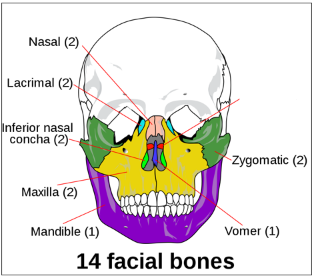
Palatine / 2

Nasal / 2
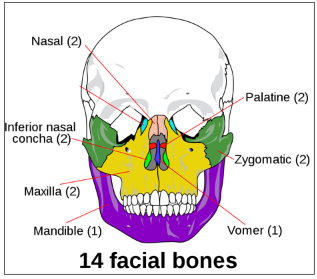
Lacrimal / 2

Inferior nasal concha / 2

Maxilla
At birth, the skull comprised of how many bones?
45
Size of skull increases with the development of _______?
the mandible and maxilla
What are cranial suture?
bony articulations that exist between the bones of the skull
What are cranial sutures separated by?
separated only by fibrous tissue comprised mainly of cartilage
What do cranial suture start off as?
They start as a series of ossification centres around a foetus’ brain
What do ossification centres allow?
allows for the rapid growth of the brain
When do ossification centres become suture?
As brain growth slows
What are the major sutures of the skull?
coronal / sagittal / lambdoid / squamosal

Sagittal suture

coronal suture
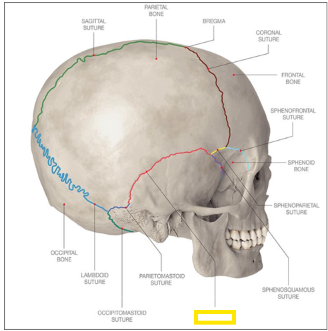
Squamous suture

Lamboid suture

occipitomastoid suture

Parietomastoid suture
What does the sagittal suture connect?
2 parietal bones and intersects with the frontal and occipital bone
What does the coronal suture connect?
frontal bone and the 2 parietals
Usually, which suture obliterates first?
Sagittal suture
What is the order of the sutures that obliterate from first to last? (must be in order)
Sagittal / coronal / lambdoid
What is the metopic suture?
divides the frontal bone in infants
When does the metopic suture fuse?
3-9 months
When does the metopic suture obliterate?
by age 7
What is metopism?
When the metopic suture line is retained into adulthood
What % of adult population has metopism?
~6%
What does fossa mean?
pit, cavity or depression
What are the 3 fossa’s found in the base of the skull?
Anterior / middle / posterior cranial fossa
What is the anterior cranial fossa comprised of?
frontal bone, ethmoid bone and sphenoid bone
What does the anterior cranial fossa accommodates?
frontal lobe
What is the shallowest of the cranial fossa?
Anterior cranial fossa
Ethmoid bone
important bone as the cribriform plate allows the transmission of the olfactory fibres

Ethmoid bone
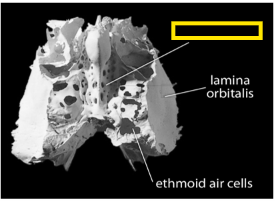
Cribriform plate

Lamina orbitalis

Ethmoid air cells
What is the middle cranial fossa comprised of?
sphenoid bone and the 2 temporal bones
What does the middle cranial fossa accommodates?
pituitary gland and the temporal lobes of the brain
Where does the pituitary gland sit in the middle cranial fossa?
sits in a depression in the sphenoid bone - sella turcica

sella turcica
What is the posterior cranial fossa comprised of?
occipital and the 2 temporal bones
What does the posterior cranial fossa accommodate?
the brain stem and cerebellum
Which is the deepest of the cranial fossa?
Posterior cranial fossa
What is the temporal fossa comprised of?
parietal, temporal, frontal and sphenoid bones
What muscle occupies the temporal fossa?
temporalis muscle
What is the temporal fossa?
shallow depression on the temporal region of the skull
What are the 2 fossae that sit behind the zygomatica arch
Infratemporal / Pterygopalatine fossae
Foramen
An opening, hole or passage usually through a bone
Fissure
A slit like groove
Basic function of Foramen and fissures
Transmit major nerves and blood vessels
What are the 6 Major foramina?
Supraorbital / Optic / magnum / rotundum / cribriform plate / Internal acoustic meatus
Supraorbital foramen:
it allows passage of the supraorbital vein, artery, and nerve into the orbit.
Supraorbital foramen location:
frontal bone
Optic foramen:
it allows the passage of the ophthalmic artery and nerve from the optic canal into the orbit.
Optic foramen location:
located in the sphenoid
Foramen magnum:
it allows the passage of the spinal and vertebral arteries and the spinal cord to pass from the skull into the vertebral column.
Foramen magnum location:
occipital bone
Foramina of cribriform plate:
it allows the passage of the olfactory nerve.
Foramina of cribriform plate location:
ethmoid bone
Foramen rotundum:
it allows passage of the maxillary nerve.
Foramen rotundum location:
sphenoid bone
Internal acoustic meatus:
it allows passage of the vestibulocochlear and facial nerves
Internal acoustic meatus location:
temporal bone
Superior orbital fissure:
it transmits many nerves including the oculomotor and nasociliary nerves, as well as the superior ophthalmic vein.
Where is the superior orbital fissure located?
Sphenoid bone
Inferior orbital fissure:
transmits the zygomatic branch of the maxillary nerve, the inferior ophthalmic vein, and sympathetic nerves
What is biparietal osteodystrophy?
Symmetrical, bilateral thinning of the parietal bones
What is the cause of biparietal osteodystrophy?
Cause unknown but possibly related to osteoporosis
What is the diploe?
Spongy inner bone
What is Craniosynostosis?
A birth defect where the bones in a baby’s fuse together too early
What is the name of the condition: A birth defect where the bones in a baby’s fuse together too early
Craniosynostosis
What does Craniosynostosis result in?
cranial deformation
What is Hydrocephaly?
Caused by the buildup of CSF in ventricles deep within the brain.