5.1 therapeutic skills
 Call Kai
 Learn
Learn Practice Test
 Spaced Repetition
 Match
Match Flashcards
 Knowt Play
1/23

Earn XP
Description and Tags
5.1 therapeutic skills
Name | Mastery | Learn | Test | Matching | Spaced | Call with Kai | Chat |
|---|
No analytics yet
Send a link to your students to track their progress
24 Terms
Emphatic response
emphatic understanding
emphatic affirmation
emphatic evocation
emphatic exploration
emphatic conjecture
emphatic understanding : what it does
Captures & articulates the client’s emotional experience, helping them stay with it & explore it.
emphatic understanding : when to use it
When you want to bring the focus onto the client’s emotional experience or facilitate experiencing.
emphatic understanding : how → typical language / tone
Warm
Accepting tone
Name an element of the client’s emotional experience
empathic affirmation : what it does
Validates & legitimises the client’s experience, especially when they judge, reject, or feel ashamed of it
empathic affirmation : when to use it
When the client criticises, doubts, or feels ashamed of what they are experiencing.
empathic affirmation : how → typical language / tone
Affirming tone; make the reasons for the experience explicit: “No wonder…”, “It makes sense…”
Emphatic evocation → WHAT — What it does
Brings the client into closer contact with an emotional experience, rather than simply describing it.
Emphatic evocation → WHEN — When to use it
When a primary emotion is present but not yet fully activated or experienced.
Emphatic evocation → HOW — Typical language / tone
Emotional or vulnerable tone; use bodily references, expressive or metaphorical language.
Empathic exploration → WHAT — What it does
Follows the emotional edge of the experience to discover what is emerging or meaningful.
Empathic exploration → WHEN — When to use it
When you notice an emotional marker or something meaningful that could be explored further.
Empathic exploration → HOW — Typical language / tone
Curious, tentative tone; invite the client to stay with & explore their experience.
Empathic conjecture → WHAT — What it does
Tentatively puts words to something implicit in the client’s experience & checks whether it fits.
Empathic conjecture → WHEN — When to use it
When an important aspect of the experience is present but the client has not yet put it into words.
Empathic conjecture → HOW — Typical language / tone
Tentative language: “I wonder if…”, “Could it be that…?”; always check the fit.
Empathic Responses in experiential therapy allow the therapist to
move from understanding the client's experience towards helping the client enter into, deepen, & transform that experience.
Empathy can do more than reflect experience
it can help the client stay with it, feel its legitimacy, deepen it, & discover what lies beneath it.
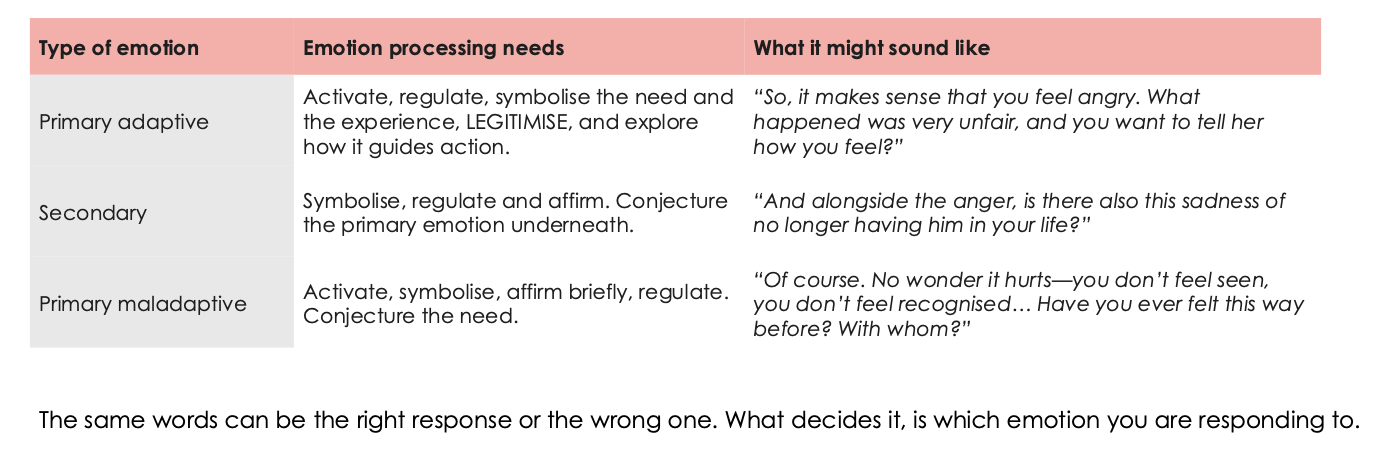
Emotions in Emotion Focused Therapy
Primary adaptive emotions (all emotions)
Primary maladaptive emotions (sadness, shame and fear)
Secondary emotions (usually anger, anxiety)
Instrumental emotions

Primary adaptive emotions (all emotions)
These are healthy, useful emotional responses to a situation that help us identify what we need & guide us towards an appropriate action.
Example: sadness after a loss → “I need comfort and connection.”
Primary maladaptive emotions (sadness, shame and fear)
These are deep emotional responses that were once useful but have become unhelpful because they are triggered automatically in situations where they no longer fit.
Example: feeling worthless whenever someone criticises you → the old emotional response is activated even when the criticism does not mean you are worthless.
Secondary emotions (usually anger, anxiety)
These are emotions we experience in response to another emotion—often because the primary emotion is difficult to access or tolerate.
Example: feeling angry because you are actually hurt (shame) or afraid.
Instrumental emotions
These are emotions expressed or displayed to influence another person or achieve a particular interpersonal outcome, whether consciously or unconsciously.
Example: displaying anger to make someone back down, even when anger is not the underlying feeling.
How to empathically respond to each emotion?