2: Mitosis and Meiosis
 Call Kai
 Learn
 Practice Test
 Spaced Repetition
 Match
 Flashcards
 Knowt Play
1/58

There's no tags or description
Looks like no tags are added yet.
Name | Mastery | Learn | Test | Matching | Spaced | Call with Kai | Chat |
|---|
No analytics yet
Send a link to your students to track their progress
59 Terms
What is the cell cycle?
The sequence of events a cell goes through as it grows, replicates its DNA, and divides.
What are the main stages of the eukaryotic cell cycle?
G₁: Cell growth and preparation for DNA replication
S: DNA replication
G₂: Preparation for cell division
M: Mitosis and cytokinesis

What is interphase?
The combination of G₁, S, and G₂, during which the cell grows, functions, produces proteins, and replicates DNA.
What happens during G₁?
Cell grows and performs normal functions.
Produces RNA, proteins, and enzymes.
Ensures sufficient energy (ATP).
Prepares for DNA replication.
May undergo differentiation.
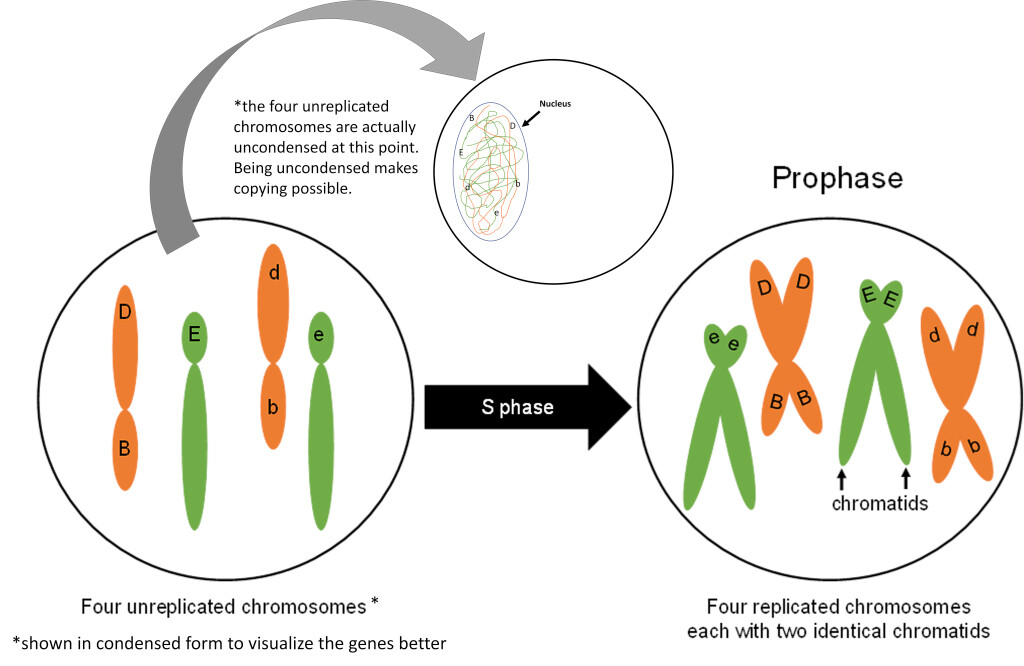
What happens during S phase?
DNA is replicated.
Each chromosome is copied into two sister chromatids.
The sister chromatids remain connected.
DNA amount doubles, but chromosome number remains unchanged.
What happens during G₂?
Cell continues growing.
Produces proteins needed for division.
Prepares cellular components for mitosis.
Checks DNA integrity and completion of replication
What happens during M phase?
Mitosis: Separation of replicated chromosomes into two nuclei.
Cytokinesis: Division of the cytoplasm into two daughter cells.
What is G₀?
A non-dividing state outside the active cell cycle. Some cells can re-enter the cycle, while others remain in G₀ long-term.
Which cells typically remain in G₀, and which can re-enter the cell cycle?
Mature neurons and cardiomyocytes: Very limited ability to re-enter.
Hepatocytes and lymphocytes: Can re-enter when stimulated.
Where are actively cycling cells commonly found in multicellular animals?
In tissues requiring growth, repair, or frequent replacement, such as skin, intestinal lining, and blood-forming tissues.
How do early embryonic cell cycles differ from later cell cycles?
Early embryos: Short G₁ and G₂ phases allow rapid division.
Later development: Longer gap phases allow growth, normal functions, and differentiation.
Why do cells divide?
Growth and development
Tissue repair
Replacement of old or damaged cells
Regeneration
Production of specialized cells and gametes
What is the main purpose of cell cycle checkpoints?
To prevent damaged or unprepared cells from progressing through the cell cycle.
What are the three main cell cycle checkpoints?
G₁/S checkpoint
G₂/M checkpoint
Mitotic spindle checkpoint
What does the G₁/S checkpoint check?
Whether the cell is ready for DNA replication and whether its DNA is sufficiently intact.

What does the G₂/M checkpoint check?
Whether DNA replication was completed correctly and whether the cell is ready to divide.

What does the mitotic spindle checkpoint check?
Whether chromosomes are properly attached to spindle fibres before sister chromatids separate.

What is the difference between positive and negative cell cycle regulation?
Positive regulation: Promotes progression through the cell cycle.
Negative regulation: Stops or delays progression when problems are detected.
Which proteins are involved in positive cell cycle regulation?
Cyclins
Cyclin-dependent kinases (CDKs)
CDK-activating kinase (CAK)
How do cyclins and CDKs promote cell cycle progression?
Cyclin binds to CDK.
CAK phosphorylates and helps activate the complex.
Active cyclin–CDK phosphorylates target proteins.
These changes promote progression through the cell cycle.
What is phosphorylation?
The addition of a phosphate group to a protein, which can change its activity.

Which proteins are involved in the negative regulation pathway?
p53: Responds to DNA damage.
p21: Inhibits cyclin–CDK complexes.
Cyclin–CDK inhibition stops cell cycle progression.
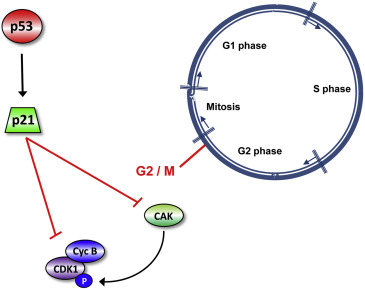
How does the p53–p21 pathway stop the cell cycle?
DNA damage activates p53.
p53 increases p21 production.
p21 inhibits cyclin–CDK complexes.
Cell cycle progression stops.
Why is p53 called the guardian of the genome?
It responds to DNA damage by promoting cell cycle arrest, allowing repair or triggering apoptosis if damage cannot be repaired. This prevents damaged DNA from being passed to daughter cells.
What happens if DNA damage can be repaired?
The cell cycle stops temporarily, DNA is repaired, and the cell may resume division.
What happens if DNA damage cannot be repaired?
The cell may undergo apoptosis (programmed cell death) to prevent severely damaged DNA from being passed on.
What is apoptosis?
Programmed cell death that removes cells that are damaged, unnecessary, or potentially harmful.

What happens if p53 does not function properly?
Damaged cells may continue dividing.
Mutations can accumulate.
Abnormal cell growth may lead to cancer.
What can happen if the mitotic spindle checkpoint fails?
Chromosomes may separate incorrectly (nondisjunction), producing daughter cells with abnormal chromosome numbers (aneuploidy).
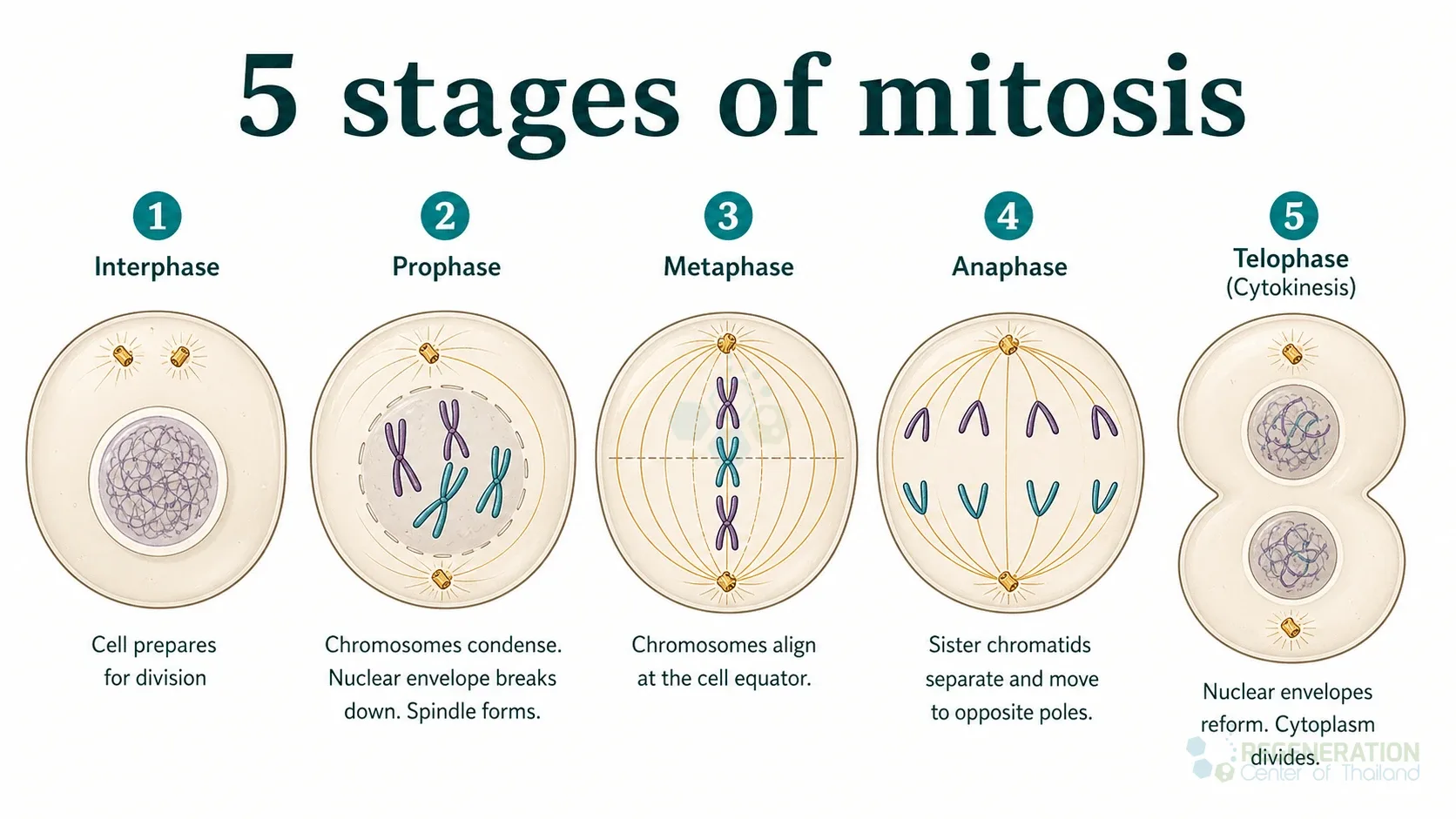
What are the stages of mitosis?
Prophase
Metaphase
Anaphase
Telophase
(Cytokinesis)
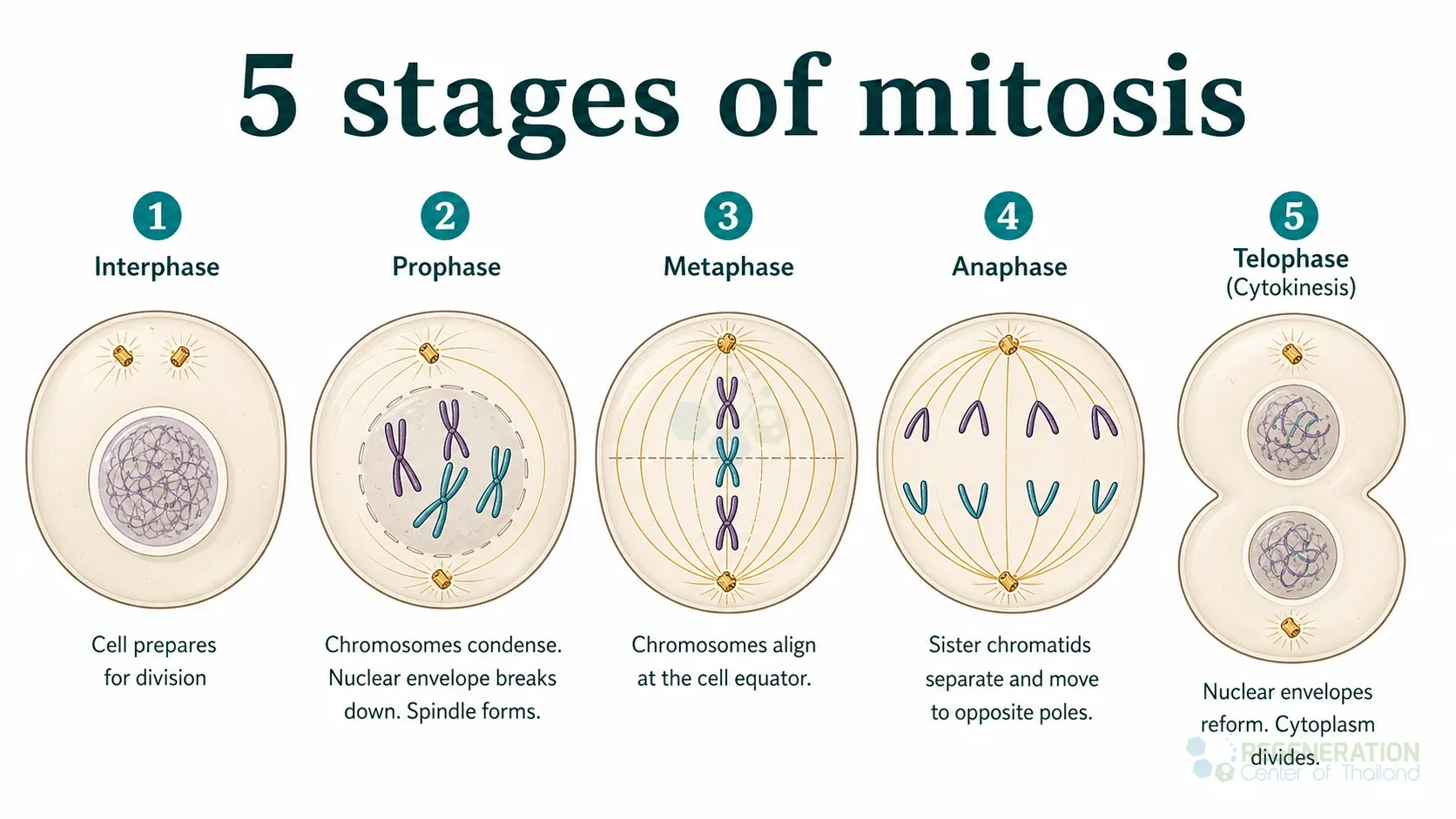
What happens during prophase?
Chromosomes condense and become visible.
Each replicated chromosome consists of two sister chromatids.
The cell prepares to separate its chromosomes.
What happens during metaphase?
Replicated chromoesomes align at the middle of the cell
Sister chromatids remain attached

What happens during anaphase?
Sister chromatids separate
They move toward opposite poles
Each seperated chromatid is now considered an individual chromosome

What happens during telophase?
Chromosomes reach opposite poles
New nuclei form around each set of chromosomes

What is cytokinesis?
Division of the cytoplasm, physically seperating one parent cell into two daughter cells.
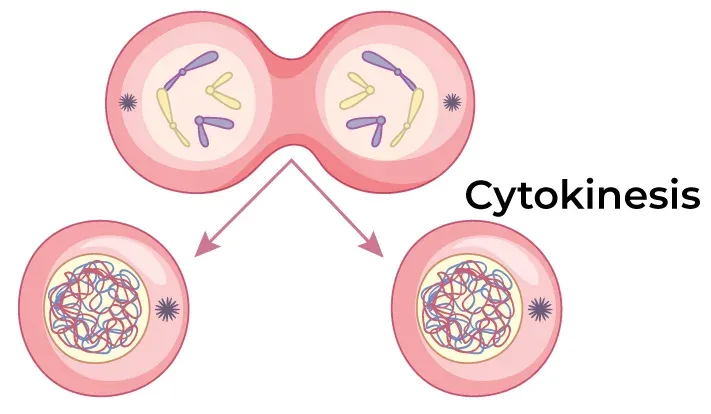
What does mitosis ensure in subsequent cell generations?
Each daughter cell normally receives a complete, genetically identical set of chromosomes, maintaining chromosome number and genetic continuity.
How can the stages of mitosis be identified in diagrams or micrographs?
Prophase: Condensed chromosomes
Metaphase: Chromosomes aligned at the centre
Anaphase: Sister chromatids moving apart
Telophase: Two new nuclei forming
Cytokinesis: cytoplasm dividing
Where is DNA located in eukaryotic cells?
In the nucleus with additional DNA in mitochondria and, in plants and algae, chloroplasts

Where is DNA located in prokaryotic cells?
In the nucleoid region of the cytoplasm, with additional DNA sometimes present in plasmids as prokaryotes lack a nucleus.
What are the main stages of the prokaryotic cell cycle?
Cell growth
DNA replication
Chromosome segregation
Binary fission (cell division)
What is binary fission?
The process by which a prokaryotic cell replicates its DNA, separates the chromosome copies, and divides into two daughter cells.
How does prokaryotic cell division differ from eukaryotic mitosis?
Prokaryotes generally divide by binary fission without a mitotic spindle or nucleus, while eukaryotes use mitosis to separate chromosomes.
What is the purpose of meiosis?
To reduce chromosome number from diploid (2n) to haploid (n) and generate genetic variation.
What are the two divisions of meiosis?
Meiosis I: Homologous chromosomes separate.
Meiosis II: Sister chromatids separate.
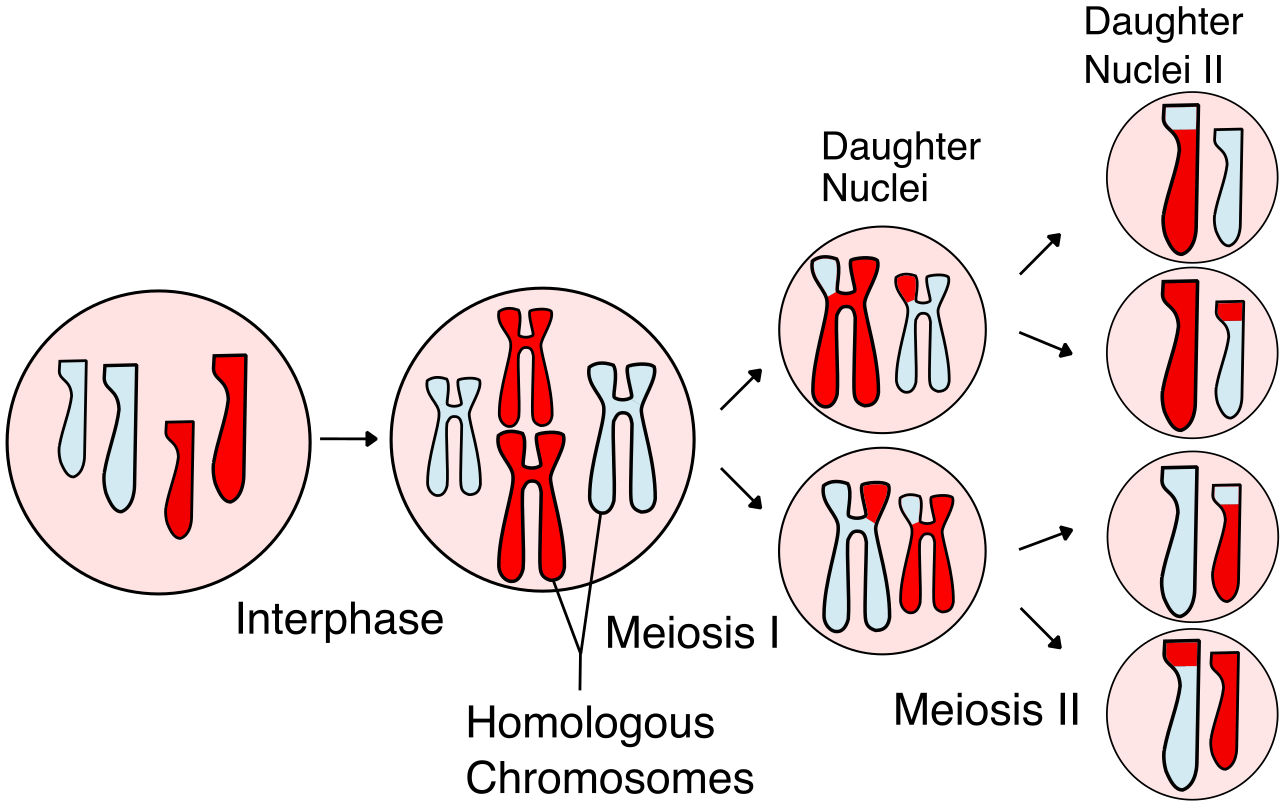
What happens during prophase I?
Chromosomes condense.
Homologous chromosomes pair (synapsis).
Crossing over occurs between non-sister chromatids.

What happens during metaphase I?
Homologous chromosome pairs align randomly at the cell's equator.

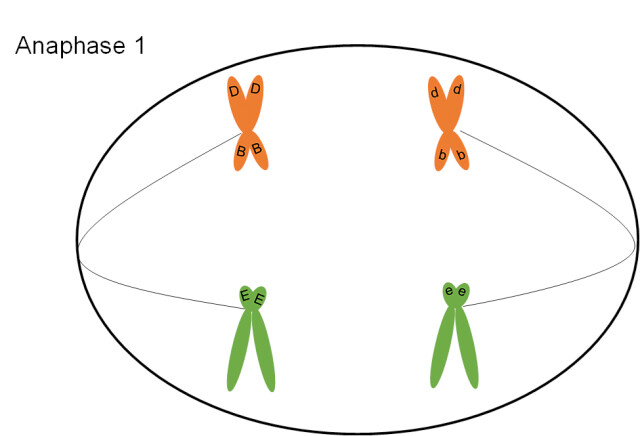
What happens during anaphase I?
Homologous chromosomes separate and move to opposite poles, while sister chromatids remain attached.
What happens during telophase I and cytokinesis?
Homologous chromosomes reach opposite poles and the cell divides, typically producing two haploid cells whose chromosomes still contain sister chromatids.

What happens during prophase II?
Chromosomes condense and a new spindle forms in each haploid cell.

What happens during metaphase II?
Chromosomes align individually at the equator of each cell.

What happens during anaphase II?
Sister chromatids separate and move toward opposite poles.

What happens during telophase II and cytokinesis?
Nuclei reform and cells divide, generally producing four genetically different haploid cells.

How can meiosis I and meiosis II be distinguished in a diagram?
Meiosis I: Homologous chromosome pairs align and separate.
Meiosis II: Individual chromosomes align and sister chromatids separate.
What is crossing over (DNA recombination)?
The exchange of corresponding DNA segments between non-sister chromatids of homologous chromosomes during prophase I.

What is the basic mechanism of crossing over?
Homologous chromosomes pair.
DNA breaks occur.
Corresponding DNA segments are exchanged and rejoined.
Recombinant chromatids are produced.
What is independent assortment?
The random orientation of homologous chromosome pairs during metaphase I, producing different combinations of maternal and paternal chromosomes in gametes.
Why does random alignment in metaphase I increase genetic variation?
Each homologous pair aligns independently, so different combinations of maternal and paternal chromosomes can be distributed into gametes.
How does distance between genes affect recombination frequency?
Genes farther apart on a chromosome are more likely to have a crossover occur between them.
Genes closer together are less likely to be separated by crossing over.
What is the maximum observable recombination frequency between two genes?
50%. Genes that are very far apart or on different chromosomes can appear to assort independently.