Semester ONE revision powerpoint
 Call Kai
 Learn
 Practice Test
 Spaced Repetition
 Match
 Flashcards
 Knowt Play
1/37

There's no tags or description
Looks like no tags are added yet.
38 Terms
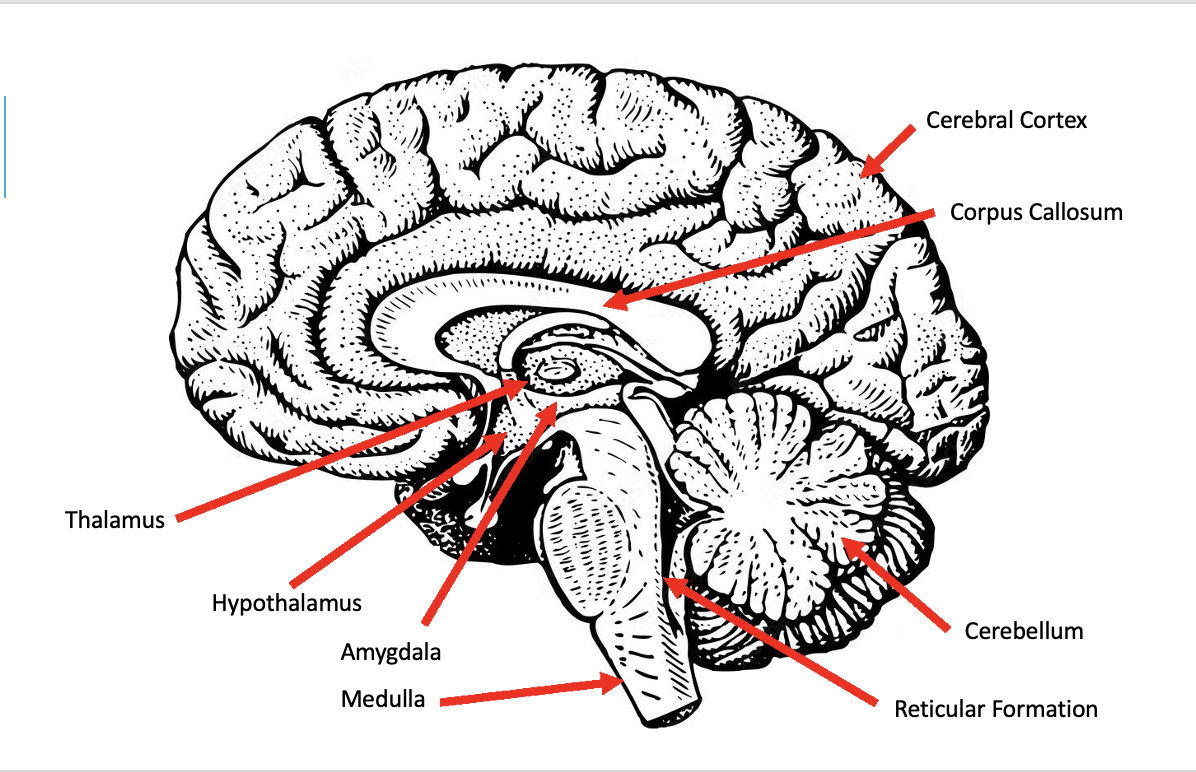
hindbrain
medulla, cerebellum
midbrain
reticular formation
forebrain
hypothalamus, thalamus
cerebral cortex
left and right hemispheres – contralateral control of the body
corpus callosum
lobes of the brain – frontal, parietal, temporal, occipital
localisation of functions – Broca’s area, Wernicke’s area, pre-frontal cortex, primary motor cortex, primary sensory cortex, primary auditory cortex, primary visual cortex
Cerebrum
•White and grey matter
Midbrain
Top portion of the brain stem that receives sensory messages from all senses(except smell) and sends information to the forebrain.
•Reticular formation – nuclei that run from brainstem and into the mid brain.
Hindbrain
Lower back part of the brain that coordinates sensory and motor messages entering and leaving the spinal cord and is responsible for balance and coordination.
•Medulla and Cerebellum
Forebrain
The largest part of the brain that plays a key role in cognition, emotion, behaviour and processing sensory information.
•Hypothalamus and Thalamus
The cerebral hemispheres
The cerebral cortex is divided into two hemispheres, which have particular specialties and functions.
The left hemisphere controls the right half of the body, and the right hemisphere controls the left half of the body.
This is contralateral control i.e. the motor cortex of each cerebral hemisphere is mainly responsible for control of movements of the contralateral (opposite) side of the body.
The corpus callosum
The left and right hemispheres are separated by a deep groove, a longitudinal fissure, but connected by a thick band of nerve fibres known as the corpus callosum.
Its functions include:
Physically connects the two hemispheres.
Transmits information registered in one hemisphere to the opposite hemisphere for processing.
Exchanges and integrates information continuously from both hemispheres.

Localisation of Function
Localisation of function is the theory that different areas of the brain are responsible for different behaviours, processes or activities.
If a certain area of the brain becomes damaged, the function associated with that area will also be affected.
Frontal lobe
The largest of the lobes.
Extremely well developed in higher mammals
Several functions:
Initiating movement of the body (motor functions)
Language
Planning
Judgement
Problem-solving
Aspects of personality
Regulation of emotions
Production of speech

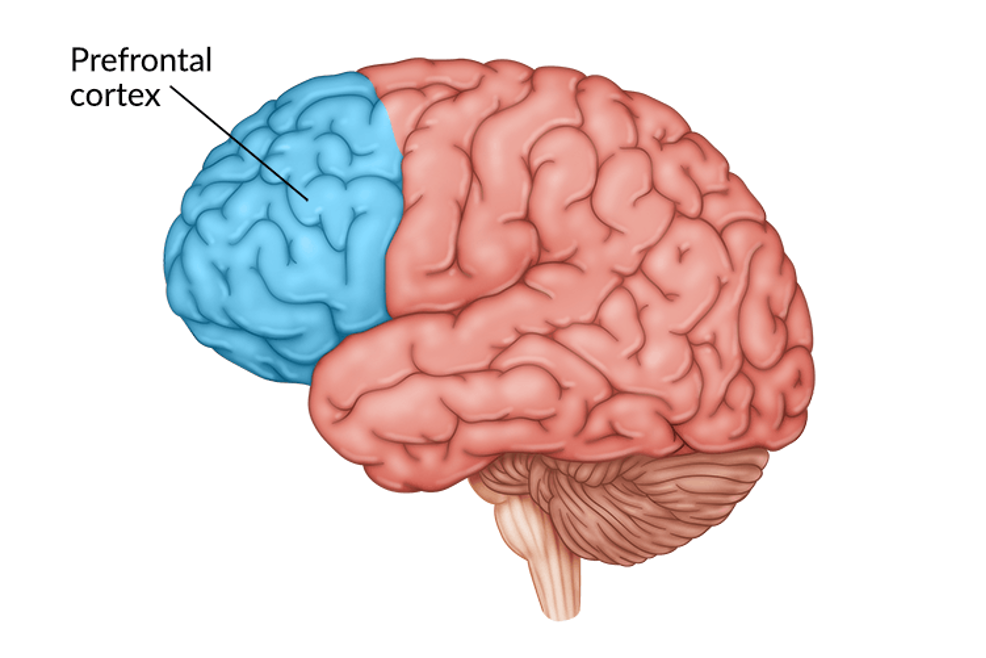
Pre-frontal Cortex
Contributes to personality, intelligence and social skills.
Executive functions – higher level cognitive processes e.g. decision making, planning, analysing, motivation, attention, problem solving, organisation, initiating action, goal-directed behaviour, self-monitoring and controlling responses.
Ability to predict possible consequences of our actions and control socially unacceptable responses.
Emotional regulation – the ability to apply procedures to control an emotion or set of emotions.
Occipital lobe
Perceiving visual information
Processing Visual Information
Perception of distance and depth
Involved in facial recognition

Temporal lobes
Perceiving, processing and interpreting auditory information
Understanding speech
Involved in facial recognition, recognising body language, long term memory formation and recognition of emotions.

Parietal lobes
Perceiving, processing and interpreting sensory information relating to touch.
Integration of sensory information
Spatial awareness.

Primary motor cortex
voluntary movement
Primary sensory cortex
perceives and processes sensory information
Primary auditory cortex
perceives and processes auditory information
Primary visual cortex
perceives and processes visual information
Broca’s area
controls the muscles required for speech.
Wernicke’s area
responsible for comprehension of language and production of meaningful speech.
Phineas Gage
Case study illustrating localisation of lobe function
Walter Freeman
(1936-1945) – role of prefrontal cortex using frontal lobotomy.
Roger Sperry
(1959-1968)– role of corpus collosum using split brain experiments
Cross-sectional
Infancy
Birth – 1 year

Adolescence
12 – 20 years

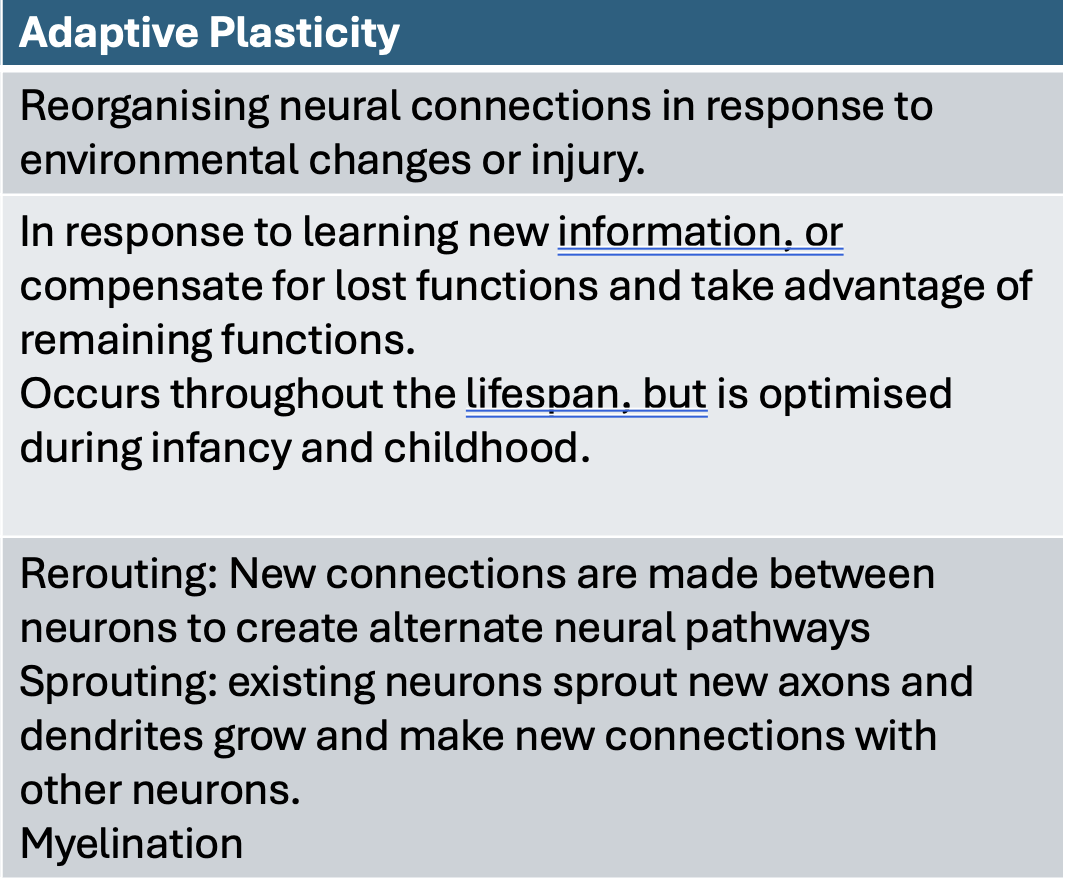
Neural Plasticity
•The ability of the brain to grow and reorganise.
Developmental Plasticity

Adaptive Plasticity
Cerebellum
volume peaks. Improved balance and fine motor skills
Amygdala
Grows in size during adolescence. Reactive to emotional stimuli. Plays a major role in fear responses. More likely to react instantly, rather than making considered decisions. They may interpret emotions of others and social cues. Aggressive behaviour.
Corpus callosum
thickens and strengthens communication between the hemispheres. This increased connection facilitates improved integration of logic, creativity, and memory, impacting areas like decision-making and self-awareness
Frontal lobe
"synaptic pruning," where the brain eliminates less-used connections and strengthens more active ones, impacting functions like planning and impulse control. The frontal lobes are among the last areas of the brain to fully mature, potentially not until late adolescence or early adulthood, which can contribute to risk-taking behaviours.
Prefrontal cortex
•Prefrontal cortex - responsible for complex cognitive functions like planning and decision-making, undergoes significant development and maturation.
•This area is the last part of the brain to fully develop, typically by the early to mid-20s.
•This period of growth involves changes like increased myelination and synaptic pruning, leading to more efficient information processing and strengthening connections with other brain regions.
•As it develops, the pre-frontal cortex will be able to better regulate the amygdala, improving decision making and allowing for improved relationships with others.