HCA104 Medical Terminology
 Call Kai
 Learn
 Practice Test
 Spaced Repetition
 Match
 Flashcards
 Knowt Play
1/152

There's no tags or description
Looks like no tags are added yet.
153 Terms
vascul/o
combining form meaning vessel.
결합형으로 '용기'를 의미.
-ac
suffix form meaning pertaining to.
~에 관련된 것을 의미하는 접미사 형태.
-crine
suffix meaning secrete.
'분비하다'라는 뜻의 접미사.
secrete: 분비하다
-gram
suffix meaning record of.
기록을 의미하는 접미사.
-um
suffix meaning structure.
구조를 의미하는 접미사.
-y
suffix meaning process of.
접미사 의미 과정
arthr/o
Joint : 관절
-opsy
Process of viewing : 관찰하는 과정
cyst/o
Urinary bladder: 방광
*all by itself specifically means urinary bladder not just bladder (other combining forms are used for other bladders, "cholecyst/o"= gall bladder 쓸개
fig. Male urinary tract
The anatomical diagram presents the male urinary system inside a frontal body outline. Labels point to the adrenal glands situated atop the kidneys, the kidneys positioned on either side of the spine, the ureters descending from the kidneys to the urinary bladder, the prostate gland located below the bladder, and the urethra extending from the bladder through the penis.

path/o
disease: 질병
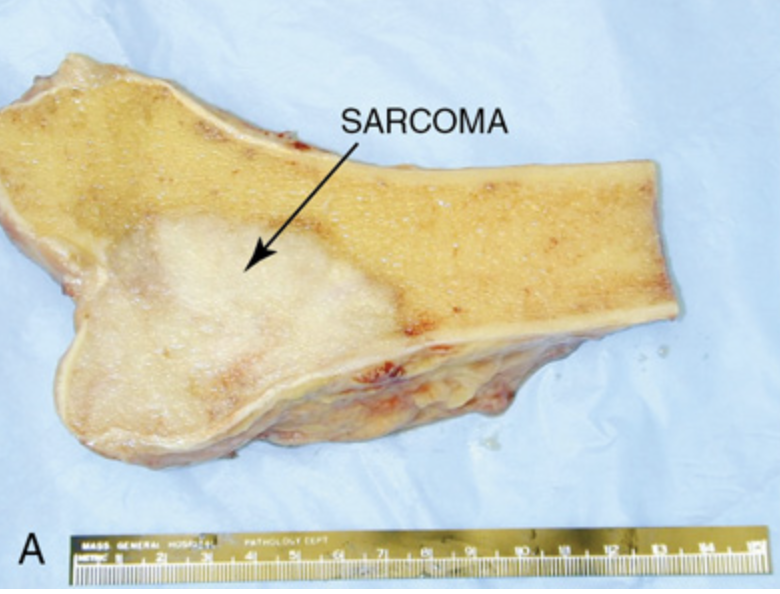
sarcoma
Malignant tumor arising from connective tissues: 육종, 결합조직에서 발생하는 악성 종양
fig. Sarcoma of the bone(osteosarcoma)
def. Sarcomas grow from connective (supportive) tissue such as bone, fat, muscle, and cartilage.
spinal cord
Long bundle of nervous tissue extending from the brain through the vertebral canal
척수, 뇌에서 이어져 척추관을 따라 내려가는 신경조직
spinal cord = 척수(그 안을 지나가는 신경조직)
즉 척추 ≠ 척수
nephr/o, ren/o
신장, 콩팥
nephr/o: 신장(콩팥)을 의미하며, 주로 신장의 비정상적인 상태(abnormal conditions) 나 수술적 처치(operative procedures) 를 설명하는 의학용어에 사용됩니다.
ren/o: 신장(콩팥)을 의미하며, 신장과 관련된 용어(terms describing the kidney) 를 만드는 데 사용됩니다.
both mean kidney...nephr/o is used when describing abnormal (Refer to the "Synonymous Word Parts" ) conditions and operative procedures - ren/o is used in terms describing the kidney
urethr/o
combining form meaning urethra (tube leading from the bladder to the outside of the body)
요도(방광에서 몸 밖으로 이어지는 관)를 의미하는 접두사
-ar
suffix form meaning pertaining to.
~에 관련된 것을 의미하는 접미사 형태.
nephr/o
kidney: 신장, 콩팥
neurology
Study of the nervous system: 신경학
nephr-
Greek root meaning kidney: 신장을 뜻하는 그리스어 어근
a-
prefix / without, not
없음, 아닌
Aseptic : 무균의
an-
prefix / without, not
없음, 아닌
Anemia : 빈혈
dia-
prefix / complete, thorough : 완전한, 철저한
diagnosis: 진단
-gnosis: knowledge
dia
prefix / through : 통과하여, 가로질러
dia- → through (통과하여) → Dialysis (투석)
-lysis = 분해, 분리
* 투석: 혈액 속의 노페물과 과도한 수분을 제거하는 치료방법.
신장은 원래 혈액속의 노페물과 여분의 수분을 걸러내는 역할을 한다. 신장이 제대로 작동하지 못하면 노페물이 몸에 쌓일 수 있다
투석 → 신장의 기능을 대신해줌
endo
prefix / within, inside : 안쪽, 내부
Endoscopy: 내시경 검사
exo
prefix / 바깥쪽, 외부 (outside, outward)
Exocrine : 외분비의
hyper-
과도한, 높은 (excessive, above normal)
Hyperthyroidism: 갑상선기능항진증 (신체 대사 빨라짐, 더위, 체중감소, 빠른 심장박동, 갑상선 호르몬 과다)
When thyroid hormone levels are high, the pituitary gland decreases TSH secretion to reduce stimulation of the thyroid gland.
1.갑상선에서 호르몬 T3, T4를 너무 많이 만들어요. ↑
2.뇌하수체는 갑상선 호르몬이 너무 많다는 것을 감지해요.
3.뇌하수체가 갑상선을 덜 자극하도록 TSH 분비를 줄여요. ↓
*Hyper = 높음: T3/T4 ↑, TSH ↓
Hypo-
부족한, 낮은 (below normal)
*Hypothyroidism: 갑상선기능저하증 (신체대사 느려짐, 추위, 피로감, 무기력, 체중증가)
When thyroid hormone levels are low, the pituitary gland increases TSH secretion to stimulate the thyroid gland.
1.갑상선에서 호르몬 T3, T4를 충분히 만들지 못해요. ↓
2.뇌하수체는 갑상선 호르몬이 부족하다는 것을 감지해요.
3.뇌하수체가 갑상선을 더 자극하기 위해 TSH 분비를 늘려요. ↑
Hypo = Low thyroid hormone, High TSH, Low T3, T4
(갑상선에서 호르몬 T3, T4을 충분히 만들지 못함)
aden/o
gland (샘, 선)
adenoma
Tumor of a gland : 선종, 샘에 생긴 종양
-oma
Tumor or mass : 종양 또는 덩어리
adenitis
Inflammation of a gland: 선염, 샘의 염증
-itis
Inflammation : 염증
arthritis
Inflammation of a joint : 관절염
bi/o
Life: 생명
biology
Study of life: 생물학
-logy
Study of : ~에 관한 학문
biopsy
Removal and examination of living tissue under a microscope : 생검, 살아 있는 조직을 채취하여 현미경으로 검사하는 것
carcin/o
Cancer, cancerous: 암, 암성의
carcinoma
Cancerous tumor : 암종, 악성 종양
A carcinoma is a cancerous tumor.
fig. Basal cell carcinoma
Def. This type of skin cancer grows from lining of the skin. Other carcinomas come from cells that line internal organs and glands within the body.
cardi/o
Heart: 심장
cardiology
Study of the heart: 심장학
cephal/o
Head: 머리
*used generally to refer to the head
cephalic
Pertaining to the head : 머리에 관련된
-ic
Pertaining to: ~에 관련된
If an infant is born with the head delivered first, it is a cephalic presentation.
cerebr/o
Cerebrum; largest part of the brain: 대뇌, 뇌의 가장 큰 부분
*Used to generally refer to the brain
cerebral
Pertaining to the cerebrum: 대뇌에 관련된
-al
Pertaining to: ~에 관련된
-vascular
Pertaining to blood vessels: 혈관과 관련된
what happens in a stroke?
Blood, containing oxygen and nutrients, is necessary to keep all cells alive. When blood cannot reach areas of the cerebrum, brain cells die and their functions are lost. Depending on where those brain cells dies, determines what happens in a stroke; for example: lose of movement, loss of speech, and changes in sensation.
산소와 영양분을 함유한 혈액은 모든 세포가 살아 있는 상태를 유지하는 데 필수적입니다. 혈액이 대뇌의 특정 부위에 도달하지 못하면 뇌세포가 죽고, 해당 세포의 기능이 상실됩니다.
뇌졸중이 발생했을 때 나타나는 증상은 손상된 뇌세포가 위치한 부위에 따라 달라집니다. 예를 들어, 운동 기능 상실, 언어 능력 상실, 감각의 변화 등이 나타날 수 있습니다.
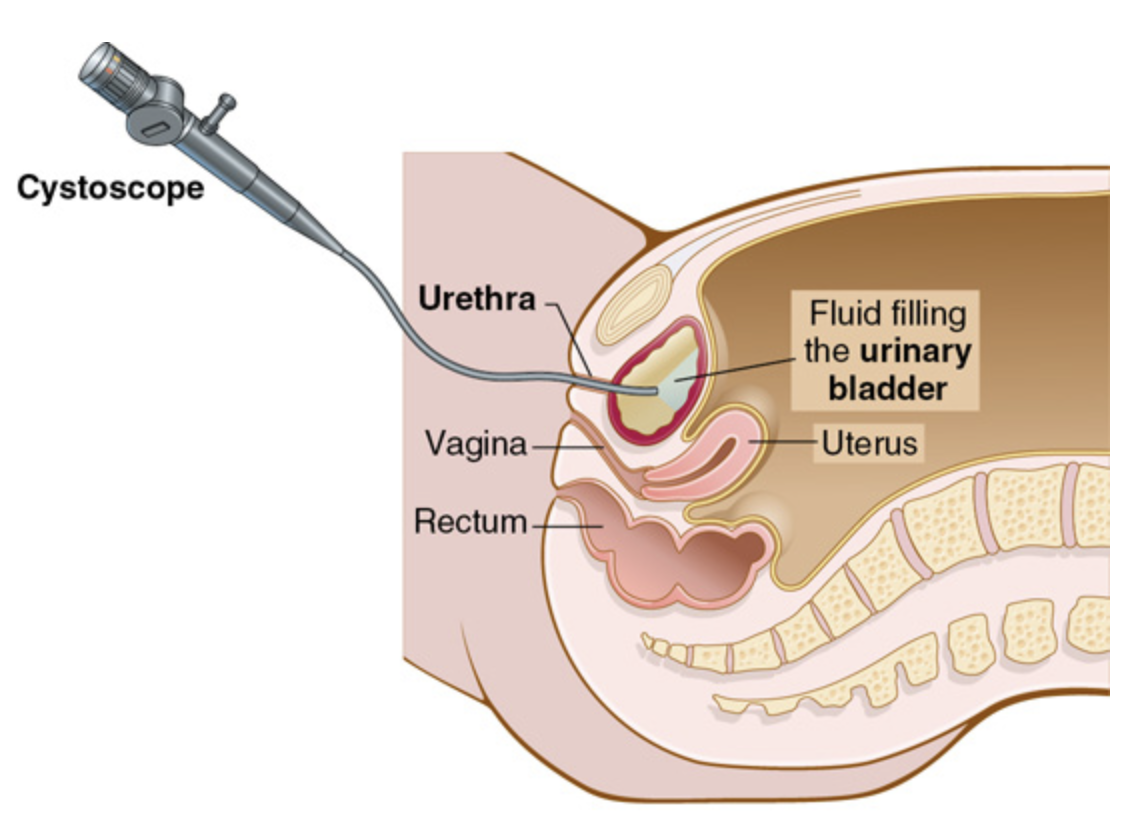
cystoscope
Instrument to visually examine the urinary bladder
: 방광을 눈으로 관찰하는 기구, 방광경
*A cystoscope is placed through the urethra into the urinary bladder during cystoscopy.
*방광경 검사 중 방광경을 요도를 통해 방광 안으로 삽입합니다.
Female urinary tract.
A cystoscope is placed into the urinary bladder through the urethra. Notice the position of the uterus and vagina between the bladder and the rectum.
The medical diagram depicts a female pelvic section with a cystoscope inserted into the urinary bladder through the urethra. The urinary bladder is partially filled with fluid, outlined in light blue. The vagina is positioned below the urethra and bladder, while the uterus sits behind the bladder. The rectum is located posterior to the vagina.
-scope
Instrument to visually examine: 눈으로 관찰하는 기구
cyt/o
Cell: 세포
cytology
Study of cells: 세포학
derm/o
Skin: 피부
dermal
Pertaining to the skin: 피부의, 피부에 관련된
dermat/o
Skin: 피부
dermatitis
Inflammation of the skin: 피부염
electr/o
Electricity: 전기
electrocardiogram (ECG)
Record of the electrical activity of the heart: 심전도, 심장의 전기 활동 기록
-gram
Record: 기록
encephal/o
Brain : 뇌
*within the head - also used to generally refer to the brain
electroencephalogram (EEG)
Record of the electrical activity of the brain: 뇌파 기록, 뇌전도
*This record is helpful in determining whether a patient has a seizure disorder, such as epilepsy.
*이 기록은 환자에게 간질(뇌전증)과 같은 발작 질환이 있는지 판단하는 데 도움이 됩니다.
enter/o
Intestines, often the small intestine : 장, 주로 소장
*Enter/o describes the small intestine and sometimes the intestines in general. Col/o and colon/o are combining forms for the large intestine (colon).
*Enter/o는 소장을 의미하며, 때로는 장 전체를 의미하기도 합니다. Col/o와 colon/o는 대장(결장)을 의미하는 결합형입니다.
**can refer to either the small intestine or both small and large intestines
fig. Location of the small and large intestines in the abdominal cavity. Note that the lungs, trachea, and esophagus are in the chest cavity, which is above the diaphragm.
def. Location of the small and large intestines in the abdominal cavity. Note that the lungs, trachea, and esophagus are in the chest cavity, which is above the diaphragm.

enteritis
Inflammation of the intestines: 장염
erythr/o
Red: 빨간색, 적색
erythrocyte
Red blood cell: 적혈구
*Red blood cells : 4-6 million / 약 400만~600만개
*White blood cells : 7,000-10,000 / 약 7,000~10,000개
Platelets: 150,000-450,000 / 혈소판 약 15만~45만 개
Blood cells: erythrocytes (carry oxygen), leukocytes (five different types help fight disease), and thrombocytes or platelets (help blood to clot).
def. The labeled anatomical diagram depicts blood components. At the top, erythrocytes (red blood cells) are shown in a circular view and a side view. Below, leukocytes (white blood cells) are presented in five types, namely eosinophil, basophil, neutrophil, lymphocyte, and monocyte, each with differently shaped nuclei and cytoplasmic textures. At the bottom, thrombocytes (platelets) are illustrated as small, irregularly shaped cellular fragments.

-cyte
Cell: 세포
gastr/o
Stomach: 위
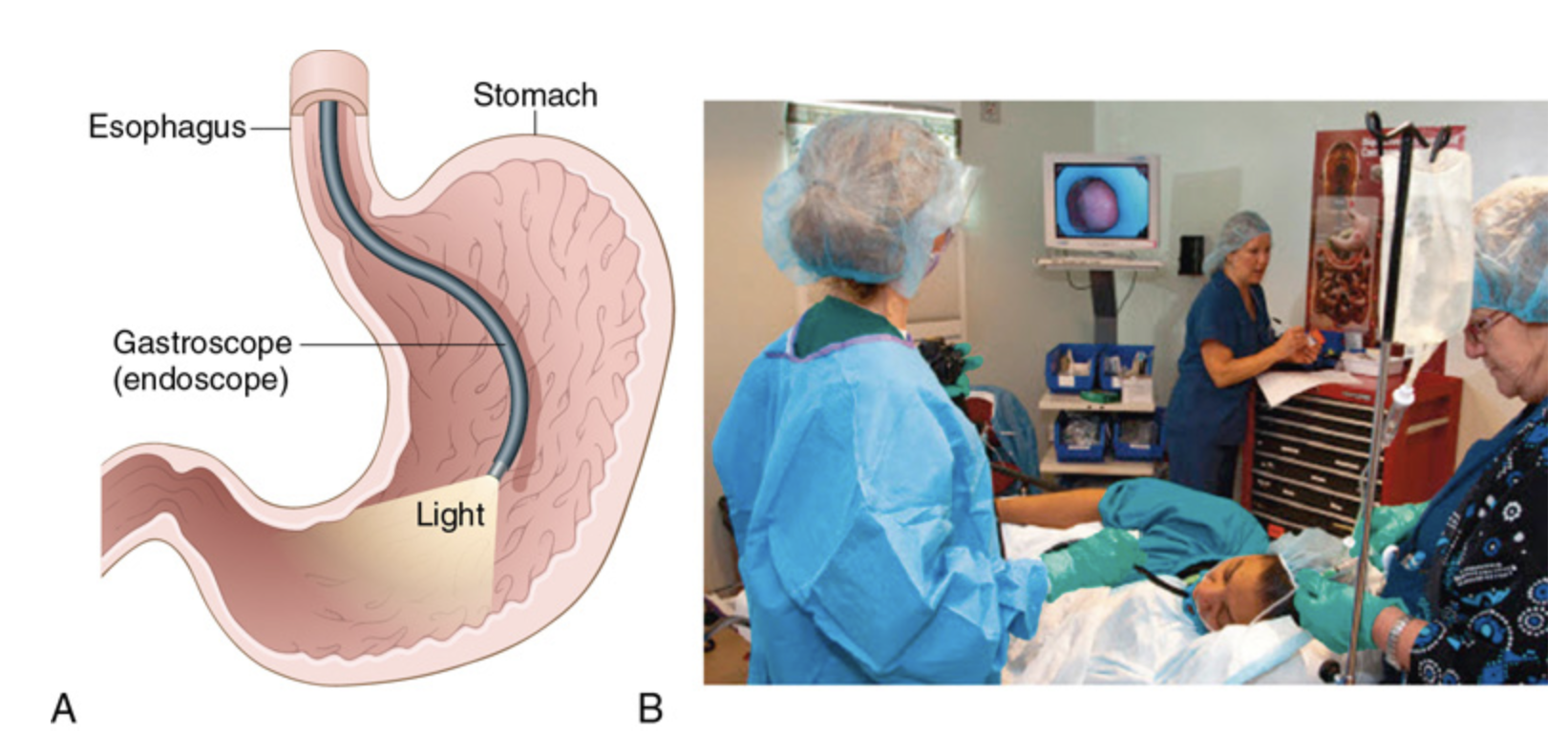
gastroscopy
Process of visual examination of the stomach with an instrument : 위 내시경 검사
*A gastroscope is passed through the mouth, throat, and esophagus into the stomach.
*위 내시경은 입, 목, 식도를 거쳐 위 안으로 삽입됩니다.
fig. A. Gastroscope inserted into stomach.
B. Gastroscopy procedure performed in a medical setting.
The illustration and the photo are labeled A and B. Part A is a medical illustration exhibiting a gastroscope (endoscope) inserted through the esophagus into the stomach, with a light at the tip illuminating the stomach interior. Part B is a clinical photograph capturing a patient lying on a hospital bed undergoing an endoscopic procedure. Medical staff dressed in blue scrubs and gloves manage the procedure, with one nurse monitoring a display screen exhibiting an internal view and another attending to medical notes beside an intravenous pole.
-scopy
Process of visual examination with an instrument: 기구를 이용한 시각적 검사 과정
*-scope(관찰 기구), -scopy(검사 과정), -gram(기록)*
예를 들어, gastroscope는 검사 기구이고, gastroscopy는 검사 과정이야.
gnos/o
Knowledge: 지식
diagnosis
Complete knowledge gained after testing and examining a patient: 진단, 검사와 환자 검진을 통해 얻은 종합적인 판단
*A diagnosis is the complete knowledge gained after testing and examining the patient. The plural of diagnosis is diagnoses.
*진단은 환자를 검사하고 진찰한 후 얻은 종합적인 판단입니다. Diagnosis의 복수형은 diagnoses입니다.
-sis
State of: 상태
dia-
Complete: 완전히, 전체적으로
prognosis
Prediction of the outcome of treatment: 예후, 치료 결과에 대한 예측
**literally "knowledge before" we will use "predicted outcome"
*A prognosis is a prediction made after the diagnosis. It forecasts the outcome of treatment.
*예후는 진단 후에 내리는 예측으로, 치료 결과가 어떻게 될지 예상하는 것입니다.
pro-
Before: 이전에, 앞에
gynec/o
Female: 여성
gynecology
Study of the female reproductive system and its diseases: 부인과학, 여성 생식기관과 그 질환을 다루는 의학분야
*A gynecologist specializes in diseases of the female reproductive organs.
*산부인과 의사 중 부인과 전문의는 여성 생식기관의 질환을 전문적으로 다룹니다.
Sub-
Prefix / meaning under or below
Trans-
Prefix / meaning across
Retro
Refix / Behind
Plurals
복수형
Terms ending in -is (diagnosis, prognosis) form their plural by dropping the -is and adding -es.
-is로 끝나는 용어(diagnosis, prognosis)는 -is를 없애고 -es를 붙여 복수형을 만듭니다.
e.g. diagnosis → diagnoses = 진단 → 진단들
prognosis → prognoses = 예후 → 예후들
hem/o , hemat/o
Blood : 혈액
hemoglobin
Protein in red blood cells that helps carry oxygen in the blood
혈색소, 혈액에서 산소를 운반하는 적혈구의 단백질
Hemoglobin is the protein in red blood cells (erythrocytes) that helps carry oxygen in the blood.
혈색소(헤모글로빈)는 적혈구에 있는 단백질로, 혈액에서 산소를 운반하는 데 도움을 줍니다.
-globin
protein: 단백질
hematoma
Mass of blood trapped in tissues: 혈종, 조직에 혈액이 고여 생긴 덩어리
A hematoma is a mass of blood trapped in tissues of the skin or an organ. It often results from trauma and is commonly called a bruise or "black-and-blue" mark.
혈종은 피부나 장기의 조직에 혈액이 고여 생긴 덩어리입니다. 흔히 외상으로 발생하며, 일반적으로 멍이라고 합니다.
fig. Hematoma from broken ribs.

-oma
mass or tumor: 덩어리 또는 종양
hepat/o
liver: 간
hepatitis
Inflammation of the liver: 간염
This condition is often caused by different types of viruses: hepatitis A, B, or C virus.
이 질환은 흔히 A형, B형 또는 C형 간염 바이러스와 같은 여러 종류의 바이러스에 의해 발생합니다.
lapar/o
abdomen (area between the chest and hip): 복부, 가슴과 엉덩이 사이의 부위
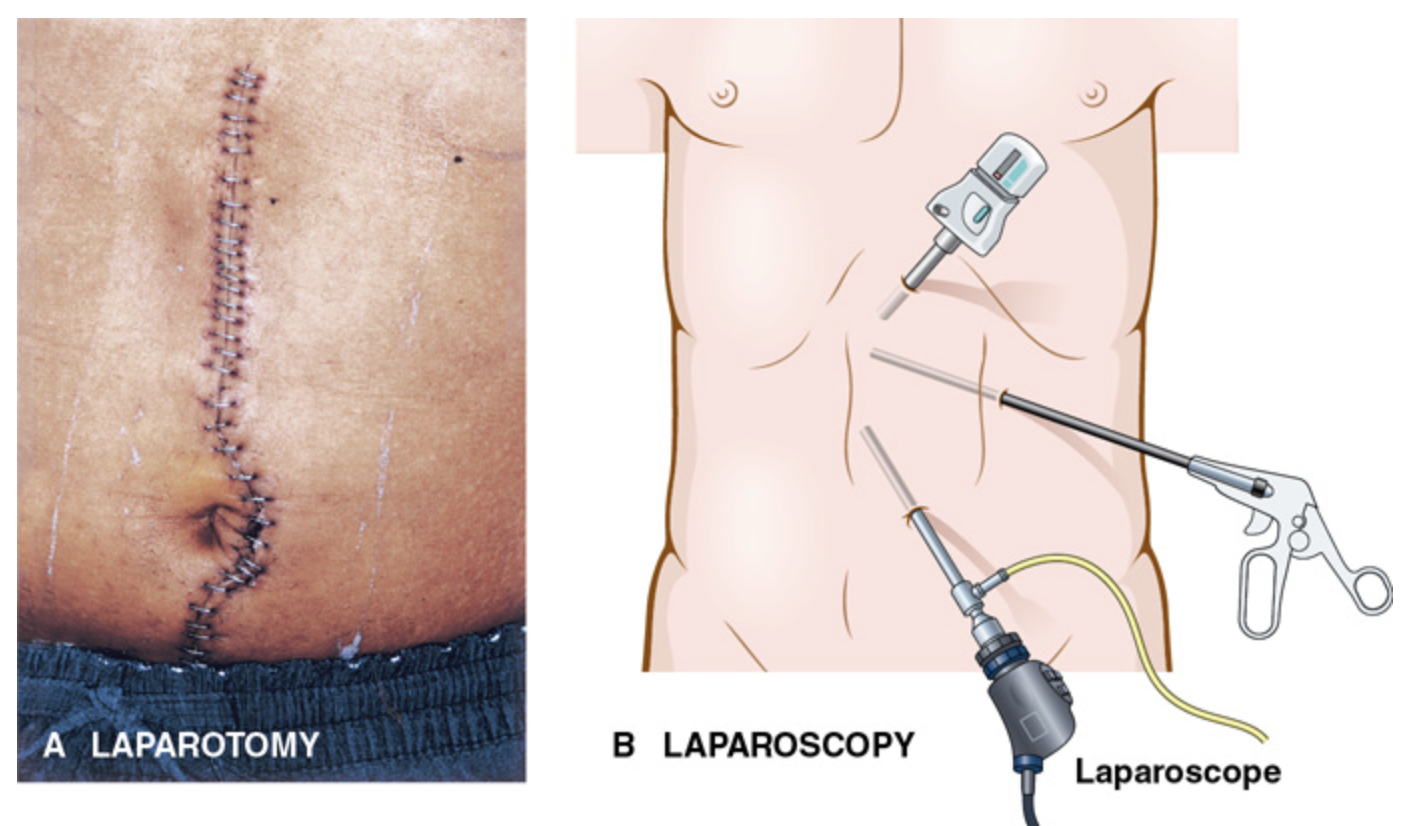
laparotomy
Incision into the abdomen: 개복술, 복부를 절개하는 수술
In an exploratory laparotomy, the surgeon makes a large incision in the abdominal wall to inspect organs for evidence of disease.
탐색적 개복술에서는 의사가 복벽을 크게 절개하여 장기에 질병의 증거가 있는지 확인합니다.
fig. A, Laparotomy. This large incision was closed with surgical staples. B, Laparoscopy. The abdomen is examined making small incisions and using a laparoscope.
The comparison of two views labeled A and B. Part A presents a photograph of a human abdomen with a vertical laparotomy scar closed by surgical staples extending from above the navel to below it. Part B presents a diagram of a human torso exhibiting laparoscopic surgery with three inserted instruments, including a laparoscope and two surgical tools connected through small abdominal incisions.
Laparoscopy
복강경검사
Visual examination of the abdomen using several small incisions for a laparoscope and other instruments.
복강경과 다른 기구를 사용하여 여러 개의 작은 절개를 통해 복부를 관찰하는 검사입니다.
lapar/o = abdomen (복부)
-scopy = visual examination (육안 검사, 내시경 검사)
📌 암기 팁: lapar/o (복부) + -scopy (검사) = 복강경 검사
-tomy
cutting into: 절개, 자르는 것
leuk/o
white: 흰색, 백색
leukocyte
White blood cell: 백혈구
nephrectomy
Surgical removal of a kidney: 신장절제술
-ectomy
Cutting out; excision (resection): 절제, 잘라내어 제거하는 것
neur/o
nerve: 신경
Neutrophils
The most numerous leukocytes.
가장 많은 수를 차지하는 백혈구입니다.
onc/o
tumor (cancerous) : 종양, 악성 종양
oncologist
Specialist in cancer: 종양 전문의