Cell Cycle, Mitosis, and Meiosis: Key Concepts and Checkpoints
 Call Kai
 Learn
 Practice Test
 Spaced Repetition
 Match
 Flashcards
 Knowt Play
1/43

There's no tags or description
Looks like no tags are added yet.
44 Terms
4 main stages of the cell cycle
Gap 1, synthesis, gap 2, mitosis
cytokinesis
cytoplasms splitting (end of cell division)
Surface area to volume
volume increases more rapidly than does surface area
Gap 1 (G1)
Interphase. Cell grows in size and synthesizes proteins, lipids, and organelles.
Metabolic activity is high; the cell performs its normal functions.
Preparation for DNA replication: The cell ensures it has enough nucleotides, enzymes, and energy to replicate DNA accurately.
Checkpoint: The G1/S checkpoint ensures DNA is undamaged and the environment is favorable before committing to replication. If conditions are not met, the cell may enter G0, a quiescent state.
S Phase (Synthesis)
Interphase. The cell replicates its DNA: each chromosome duplicates to form sister chromatids held together by a centromere.
DNA replication is semi-conservative, meaning each new DNA molecule contains one original strand and one new strand.
Centrosomes (microtubule organizing centers) also duplicate in preparation for mitosis.
By the end of S phase, the cell has twice the normal DNA content (2N → 4N in diploid cells), but still only one nucleus.
G2 Phase (Gap 2)
Interphase. The cell continues to grow and produce proteins necessary for mitosis, especially tubulin for microtubule formation.
DNA replication is checked for errors; repair mechanisms correct any mismatches.
Organelles continue to replicate.
The G2/M checkpoint ensures that DNA is fully replicated and undamaged before entering mitosis. If errors exist, the cell cycle is paused for repair.
Prophase
Mitosis. Chromatin condenses into visible chromosomes.
Each chromosome consists of two sister chromatids joined at the centromere.
The nucleolus disappears and the nuclear envelope begins to break down.
Centrosomes move to opposite poles of the cell and begin forming the mitotic spindle, a structure of microtubules that will guide chromosome separation.
Microtubules start to attach to chromosomes at the kinetochore, a protein complex at the centromere.
Metaphase
Mitosis. Chromosomes align at the metaphase plate (the imaginary plane equidistant between the two spindle poles).
Each sister chromatid is attached to spindle fibers from opposite poles, ensuring accurate segregation.
The spindle assembly checkpoint ensures all chromosomes are properly attached before the cell proceeds to anaphase.
Anaphase
Mitosis. Sister chromatids are pulled apart toward opposite poles of the cell.
The centromeres split, and spindle fibers shorten (microtubule depolymerization), dragging chromatids along.
Each pole now has an identical set of chromosomes.
Telophase
Mitosis. Chromosomes arrive at opposite poles and begin to decondense back into chromatin.
A new nuclear envelope forms around each set of chromosomes.
The nucleolus reappears in each nucleus.
The spindle apparatus disassembles.
Often overlaps with cytokinesis, the division of the cytoplasm, which produces two separate daughter cells.
G0 phase
G0 is a resting or non-dividing state. Cells in G0 have exited the active cell cycle. The cell is metabolically active but does not prepare to divide.
Some cells enter G0 temporarily (like liver cells that divide only when needed).
Some cells enter G0 permanently (like neurons or cardiac muscle cells, which rarely divide after maturity).
Order of mitosis
PMAT. Prophase, metaphase, anaphase, telophase.
Checkpoints
G1/S Checkpoint
G2/M Checkpoint
Spindle Assembly Checkpoint
DNA damage checkpoints during S phase
Cytokinesis checkpoint
G1/S Checkpoint Where why what
Location: End of G1, before entering S phase.
Purpose: Decide whether the cell should replicate DNA.
DNA damage: Ensures DNA is intact before replication.
Cell size: Must be large enough to support two cells.
Nutrients and growth factors: Enough resources to proceed.
G2/M Checkpoint Where why what
Location: End of G2, before entering mitosis.
Purpose: Ensure the cell is ready to divide.
DNA replication completion: All chromosomes must be fully duplicated.
DNA integrity: No errors remain from replication.
Cell size: Large enough to support division.
Spindle Assembly Checkpoint (SAC) Where why what
Location: During metaphase of mitosis.
Purpose: Ensure chromosomes are correctly attached to the spindle before separation.
Checks for:
Each chromosome is attached to spindle microtubules at the kinetochore.
Chromosomes are aligned at the metaphase plate.
DNA damage checkpoints
During S phase. Can slow replication if DNA damage occurs.
Cytokinesis checkpoint:
Ensures cell division completes correctly and the cytoplasm is properly distributed.
Cytokinesis Plants vs Animals
In animal cells the cell membrane is pinched to separate the 2 new cells. In plant cells a cell plate forms between the 2 nuclei because of the cell wall.
Daughter cell vs parent cell after mitosis
Identical to each other and to the parent cell. (sometimes mutations can mess things up a lil.)
Length of each phase longest to shortest.
Interphase > Prophase > Metaphase > Telophase > Anaphase
Somatic cells vs gametes
Somatic cells are body cell, somatic cells are diploid cells which have 2 chromosomes a set from mom and dad 2n=46 in humans.
Gametes are sex cells, gametes are haploid cells which only have 1 set of chromosomes, combination of chromosomes from mom and dad n=23
2 types of chromosomes
Autosomes. carry traits that make you who you are (1st 22 pairs of chromosomes)
Sex chromosomes carry traits that make you who you are and determine what sex you are. (23rd pair of chromosomes). XY=male XX=female
Meiosis vs Mitosis
Meiosis makes gametes and is for sexual reproduction
Mitosis makes somatic cells and is for growth and recovery.
Meiosis
makes haploid sex cells (eggs and sperm) with half the amount of chromosomes as diploid body cells.
Process of meiosis
Parent cell 2 chromosomes with duplicated sister chromatids
2 daughter cells with 1 chromosome with duplicated sister chromatids
4 daughter cells with one sister chromatid in each
chromatids are attached by centromeres until the 4 daughters.
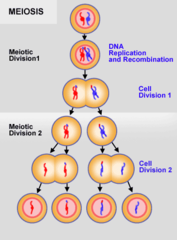
Homologous vs sister chromatids
Homologous (tetrads) are the same the same type of chromosomes from mom and dad but not identical (counts as 2 chromosomes) sister chromatids are identical pieces of genetic information connected by a centromere.
Meiosis 1 vs 2
Meiosis separation of homologous chromosomes (tetrads)
Meiosis 2 separation of sister chromatids
Before meiosis 1
Interphase (cell growth/ DNA replication) S phase makes sister chromatids
meiosis prophase 1
Prophase nuclear membrane breaks down, centrioles separate and make spindle fibers, homologous chromosomes pair up/ become visible. Crossing over occurs. parental chromosomes pair up having a chance to be on right or left. This and crossing over allows for a lot of diversity in people who are related.
Meiosis metaphase 1
Homologous chromosomes (tetrads) line up in the middle of the cell in pairs.
Meiosis anaphase 1
homologous chromosomes separate duplicated chromosomes are pulled to separate sides of the cell. (sister chromatids remain attached).
meiosis telophase 1
chromosomes gather at separate poles, nuclear envelope may reform, cytoplasm divides into 2 cells
meiosis cytokinesis 1
cytoplasms divide into 2 cells, 2 haploid daughter cells with duplicated chromosomes that are different than the sets in the original diploid cell.
Interkinesis
Chill point between meiosis 1 and meiosis 2 No DNA replication takes place.
Prophase 2 meiosis
Nuclear envelope breaks down if it reformed spindle fibers form and attach to the centromeres of sister chromatids.
Metaphase 2 meiosis
sister chromatids line up in the cent of the cell, single file
Anaphase 2 meiosis
Sister chromatids are separated and pulled to opposite sides.
Telophase 2 meiosis
nuclear envelope form around chromosomes spindle fibers dissolve.
cytokinesis 2 meiosis
cytoplasms divide. Result 4 haploid cells that are genetically unique
Egg haploid cells vs sperm
3 supply proteins for main egg. all 4 are small in so they are fast to get to the egg.
Frequency mitosis vs meiosis
mitosis occurs all throughout the organisms life and meiosis only occurs at certain points. Males its puberty, females its before birth.
Crossing over
Crossing over during prophase I occurs when homologous chromosomes form tetrads in synapses and non-sister chromatids exchange segments of DNA with one another is crucial because it increases genetic variation among offspring. This variation is essential for evolution as it provides the raw material for natural selection.
importance for meiosis to produce haploid cells
Meiosis produces haploid cells (n) because these cells (gametes) will fuse during sexual reproduction to form a diploid zygote (2n). If meiosis produced diploids then when the sperm and egg combine during fertilization the zygote would have 96 chromosomes.