
Theories

0.0(0)
Studied by 0 people
call kaiCall Kai
learnLearn
examPractice Test
spaced repetitionSpaced Repetition
heart puzzleMatch
flashcardsFlashcards
GameKnowt Play
Card Sorting

1/3

encourage image

There's no tags or description

Looks like no tags are added yet.

4 Terms

1
New cards

What is Mackinder’s Heartland theory (1904)

That who ever controlled the area of Russia, China, Arctic & The Himalayas would control a large amount of the physical and human resources worldwide.


It contributed to the policies of containment as it tried to contain countries from expanding into this area.


However since technology has advanced, transportation is easier to physical location doesn’t matter as much as resources can be transported around the world quickly
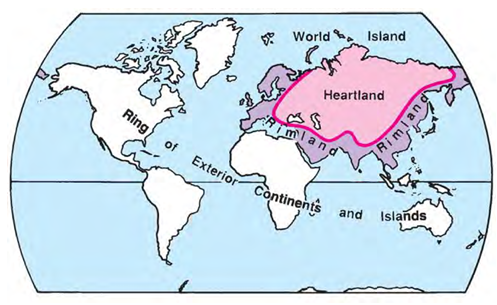
<p>That who ever controlled the area of Russia, China, Arctic &amp; The Himalayas would control a large amount of the physical and human resources worldwide.</p><p></p><p>It contributed to the policies of containment as it tried to contain countries from expanding into this area. </p><p></p><p>However since technology has advanced, transportation is easier to physical location doesn’t matter as much as resources can be transported around the world quickly</p>
2
New cards

What is Wallerstein’s World Systems theory (1974)

It identifies 2 different econbomic areas within the world, the core and the periphery. Core regions have a large economy and control global trade agreements and currency. They trade with the periphery as they have the labour or the materials.


  1. Periphery sells their primary resources to the core and provide skilled workers

  2. The core manufacturers adding value to the goods

  3. The core or the semi-periphery consumes the goods whereas the periphery doesn’t

  4. The semi-periphery is exploited by the core and exploiting the periphery


This theory explains how the colonialism worked as the periphery (Africa) was exploited for people and natural resources using hard power.

More recently though, these relationships are more to do with trade agreements (soft power) such as the WTO

<p>It identifies 2 different econbomic areas within the world, the core and the periphery. Core regions have a large economy and control global trade agreements and currency. They trade with the periphery as they have the labour or the materials.</p><p></p><ol><li><p>Periphery sells their primary resources to the core and provide skilled workers</p></li><li><p>The core manufacturers adding value to the goods</p></li><li><p>The core or the semi-periphery consumes the goods whereas the periphery doesn’t</p></li><li><p>The semi-periphery is exploited by the core and exploiting the periphery</p></li></ol><p></p><p>This theory explains how the colonialism worked as the periphery (Africa) was exploited for people and natural resources using hard power.</p><p>More recently though, these relationships are more to do with trade agreements (soft power) such as the WTO</p>
3
New cards

What is Rostows Modernisation theory (1960)

Rostow belived that countries pass through these 5 stages as they develop & grow economically

  1. Traditional society - Economy is primary based and there is minimal technology as well, they have cultural traditions and religion

  2. Pre-conditions for Take Off - There is a demand for raw materials and trade from other countries. Constructionand infrastructure start to occur, the inudstry will centre around secondary sector jobs in manufacturing

  3. Take Off - Rapid industrialisation, large surge of empoyment opportunities and productivity. The environment will start to degrade as well and be exploited

  4. Drive to Maturity - The growing economy will encourage new industries nad investment to create further jobs and improving services, this positive feedback mechanism contributes to improved living conditions

  5. High Mass Consumption - Developed countries are capitalist and goods are catered towards the consumer


Rostows model is mainly based on capitalist ideologies, ignoring other stages of growth in some nations such as communism. Also some nations skip stages of development due to their natural reosurces.

Also Rostows model doesn’t include declining states which would include corrupt governments and running out of natural resources.

Rostows model is discredited due to it focusing as countries individually not in a gobalised world.


<p>Rostow belived that countries pass through these 5 stages as they develop &amp; grow economically</p><ol><li><p>Traditional society - Economy is primary based and there is minimal technology as well, they have cultural traditions and religion</p></li><li><p>Pre-conditions for Take Off - There is a demand for raw materials and trade from other countries. Constructionand infrastructure start to occur, the inudstry will centre around secondary sector jobs in manufacturing</p></li><li><p>Take Off - Rapid industrialisation, large surge of empoyment opportunities and productivity. The environment will start to degrade as well and be exploited</p></li><li><p>Drive to Maturity - The growing economy will encourage new industries nad investment to create further jobs and improving services, this positive feedback mechanism contributes to improved living conditions</p></li><li><p>High Mass Consumption - Developed countries are capitalist and goods are catered towards the consumer</p></li></ol><p></p><p>Rostows model is mainly based on capitalist ideologies, ignoring other stages of growth in some nations such as communism. Also some nations skip stages of development due to their natural reosurces.</p><p>Also Rostows model doesn’t include declining states which would include corrupt governments and running out of natural resources. </p><p>Rostows model is discredited due to it focusing as countries individually not in a gobalised world.</p><p></p>
4
New cards

x


