Communication and role play:
 Call Kai
 Learn
 Practice Test
 Spaced Repetition
 Match
 Flashcards
 Knowt Play
1/14

There's no tags or description
Looks like no tags are added yet.
15 Terms
Intro
1) Introduce yourself and establish rapport
- Greet the person.
- Introduce yourself.
- Establish a comfortable and respectful environment.
- Use an appropriate tone and body language.
Example: "Hello, my name is ... How would you like me to address you?"
2) Listen carefully
- Allow the person to explain their situation.
- Avoid interrupting.
- Pay attention to verbal and non-verbal communication.
- Do not immediately jump to solutions.
3)Acknowledge their feelings
- Recognise their emotions.
- Validate their concerns without making assumptions.
- Demonstrate empathy.
Example: "I can appreciate why that would be upsetting."
4)Ask open-ended questions
Encourage the person to explain their concerns.
Examples:
- "Could you tell me a little more about that?"
- "What is worrying you most?"
- "How has this affected you?"
5)Explain information clearly and without judgement
- Avoid medical jargon.
- Break information into manageable sections.
- Avoid being patronising.
- Be honest about what you know and don't know.
6)Check their understanding
- Ask whether your explanation was clear.
- Invite further questions.
- Correct misunderstandings sensitively.
Example: "Would it help if I explained that in a different way?"
7)Agree on appropriate next steps
- Identify what the person needs.
- Discuss practical options.
- Involve an appropriate professional when necessary.
- Ensure they know what happens next.

Seven step communication framework:
1) Introduce yourself and establish rapport
- Greet the person.
- Introduce yourself.
- Establish a comfortable and respectful environment.
- Use an appropriate tone and body language.
Example: "Hello, my name is ... How would you like me to address you?"
2) Listen carefully
- Allow the person to explain their situation.
- Avoid interrupting.
- Pay attention to verbal and non-verbal communication.
- Do not immediately jump to solutions.
3)Acknowledge their feelings
- Recognise their emotions.
- Validate their concerns without making assumptions.
- Demonstrate empathy.
Example: "I can appreciate why that would be upsetting."
4)Ask open-ended questions
Encourage the person to explain their concerns.
Examples:
- "Could you tell me a little more about that?"
- "What is worrying you most?"
- "How has this affected you?"
5)Explain information clearly and without judgement
- Avoid medical jargon.
- Break information into manageable sections.
- Avoid being patronising.
- Be honest about what you know and don't know.
6)Check their understanding
- Ask whether your explanation was clear.
- Invite further questions.
- Correct misunderstandings sensitively.
Example: "Would it help if I explained that in a different way?"
7)Agree on appropriate next steps
- Identify what the person needs.
- Discuss practical options.
- Involve an appropriate professional when necessary.
- Ensure they know what happens next.
Other techniques
Open ended questions:
-How have you been feeling?
-What concerns you about the treatment?
-Can you tell me what happened?
Active listening:
You should:
- Maintain appropriate eye contact.
- Avoid looking distracted.
- Use verbal acknowledgements.
- Reflect back important information.
- Allow pauses.
- Summarise what you have understood.
"So, if I've understood correctly, you're not necessarily worried about the appointment itself, but about what the results might mean?"
Teach back technique:
When explaining something important, ask the person to explain their understanding in their own words.
For example:
"I just want to make sure I've explained that clearly. Could you tell me what you understand the next steps to be?"
This is better than simply asking, "Do you understand?", because people sometimes say yes even when they are confused.
Explaining a difficult concept to someone without scientific knowledge.
What is being assessed? - Ability to simplify complex information. - Adaptability. - Patience. - Checking understanding. - Avoiding medical jargon. | The interviewer might ask you to explain: - What blood pressure means. - What diabetes is. - What a particular medical investigation involves. - What a particular organ does. - Why antibiotics do not work against viruses. Your approach | Use this four-step process: 1. Establish what the person already knows. 2. Explain the concept in simple language. 3. Use an analogy if helpful. 4. Check their understanding. |
Explain high blood pressure
Imagine someone asks: "What exactly is high blood pressure? My doctor says I have it, but I don't really understand."
Model answer:
"Of course. I'll try to explain it simply.
Your heart pumps blood around your body through blood vessels. Blood pressure describes the force that your blood exerts against the walls of those vessels.
When someone has high blood pressure, it means that this force is consistently higher than it should be.
Over time, this can place additional strain on your heart and blood vessels, increasing the risk of conditions such as heart disease and stroke.
The important thing is that high blood pressure can often be managed through lifestyle changes and, when appropriate, medication.
Does that make sense so far? Is there anything in particular you'd like me to explain further?"
Why this is effective:
- Simple explanation.
- No unnecessary terminology.
- Explains why the condition matters.
- Provides reassurance without promising an outcome.
- Checks understanding.
A patient has been waiting several hours for an appointment. They become visibly upset and say:
"I've been waiting all afternoon. Nobody here cares about me!"
What is being assessed?
- Empathy.
- Emotional intelligence.
- Patience.
- Active listening.
- Ability to manage difficult emotions.
Step 1: Don't become defensive: Even if you aren't personally responsible for the delay, avoid immediately justifying the situation.
Step 2: Acknowledge their frustration: "I can understand why you're frustrated, especially after waiting for so long."
Step 3: Allow them to explain: "Could you tell me a little more about what has happened?"
Step 4: Identify their immediate needs: "Are you feeling any worse while you've been waiting?"
This is particularly important because their clinical condition might have changed.
Step 5: Explain what you can do: "I'd like to see if I can find out what's happening with your appointment and whether someone can update you."
Step 6: Follow through: You should not promise that they will immediately be seen. Instead, find an appropriate member of staff who can help.
Model response
"I'm sorry that you've had such a long wait. I can appreciate how frustrating and worrying that must be, particularly when you're already dealing with health concerns.
I'd like to understand a little more about what's happened. Has anyone explained the reason for the delay?
I can try to find someone who can update you. In the meantime, has your condition changed at all or is there anything you're particularly concerned about?"
Key lesson: Never dismiss someone's emotions simply because you cannot immediately resolve the situation.
A patient is waiting for an operation and says:
"I'm really frightened. I've never had surgery before, and I'm worried something will go wrong."
Model answer:
"I can understand why you might be feeling anxious, especially if this is your first experience of surgery.
Would you mind telling me what worries you most? Is it the operation itself, the anaesthetic or perhaps what recovery might involve?
I don't want to give you inaccurate information, but I would be happy to help you find someone from the surgical team who can explain the procedure and answer your questions.
It's important that you feel informed and comfortable raising any concerns before making decisions about your care."
Avoid saying:
"Don't worry, everything will be fine." You cannot guarantee this.
Instead say:
"It's understandable to feel worried. Let's see if we can get your questions answered so you feel better info
Handling a disagreement within a team.
You are working in a healthcare team. Another member disagrees with your suggestion and dismisses your opinion in front of everyone.
You are working in a healthcare team. Another member disagrees with your suggestion and dismisses your opinion in front of everyone.
1. Remain professional: Don't respond emotionally or become confrontational.
2. Listen to their perspective: They may have information or expertise that you do not possess.
3. Explain your reasoning respectfully: "I understand your perspective. Could I explain why I initially considered that approach?"
4. Focus on the shared objective: The objective should be providing the best possible care for the patient, not proving who is right.
5. Seek clarification or assistance: If the disagreement concerns patient safety, raise it through appropriate professional channels and seek senior guidance.
Model response
"I think it's important to recognise that different members of a healthcare team bring different experiences and expertise.
I would first listen to the other person's reasoning rather than immediately dismissing their opinion.
I would then explain my perspective respectfully and try to establish whether we could reach a shared understanding.
Ultimately, I would prioritise the patient's safety and wellbeing over personal disagreement. If we were still unable to resolve an issue involving clinical care, I would seek advice from an appropriate senior professional."
Communicating with someone who is reluctant to accept advice:
A patient has been advised to make lifestyle changes to manage their diabetes, but they say:
"I don't want to change my diet. I've eaten this way my entire life, and I don't see why I should change now."
Possible reasons why they might be reluctant include: - They don't understand the benefits. - They are worried about the difficulty of changing their lifestyle. - They have cultural or personal dietary preferences. - They have financial limitations. - They have previously tried and struggled. - They feel that their independence is being threatened. | Your approach 1. Avoid judgement. 2. Ask why they feel reluctant. 3. Listen to their concerns. 4. Explain the potential benefits of the advice. 5. Discuss realistic alternatives. 6. Respect their autonomy. 7. Encourage them to make an informed decision. |
Model response
"I appreciate that changing habits you've had for a long time can be difficult, and I wouldn't want to make assumptions about your circumstances.
Could you tell me what concerns you most about making these changes?
It might be helpful to explore whether there are smaller adjustments that would feel more manageable, rather than changing everything at once.
The reason these changes have been recommended is that they may help you manage your diabetes and reduce the risk of complications.
Ultimately, it's important that you feel involved in decisions about your health. I would want to understand your priorities and help you explore options that work for you."
Explaining why confidentiality matters:
A friend asks you whether another student has been diagnosed with a particular medical condition because they heard that the student visited the hospital.
Model response
"I would explain that medical information is private and that people should be able to trust healthcare professionals with sensitive information without worrying that it will be shared unnecessarily.
Confidentiality is essential because it allows patients to be open about their circumstances, which helps doctors provide appropriate care.
However, confidentiality is not absolute. If there were serious concerns about someone's safety or a safeguarding issue, information might need to be shared with appropriate professionals.
The important distinction is that information should only be disclosed when there is a justified reason, and only to the appropriate people."
If someone tells you something concerning during an interview role-play, do not promise to keep it secret.
Instead say:
"I would respect your privacy, but if I became concerned that you or someone else was at risk of harm, I might need to involve someone who could help keep you safe."
Breaking difficult news
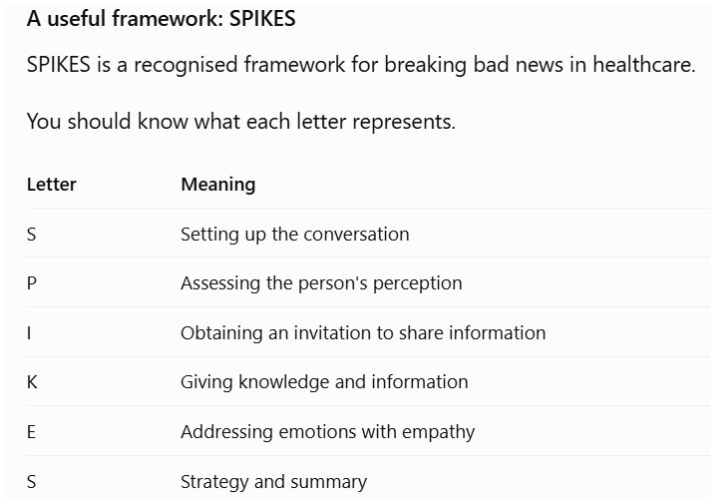
S – Setting
- Find an appropriate private environment.
- Minimise interruptions.
- Ensure the person is comfortable.
- Allow sufficient time.
P – Perception
Establish what the person already understands.
"What have you been told so far?"
I – Invitation
Establish how much information they would like.
"Would you like me to explain the results in detail?"
K – Knowledge
Communicate information clearly, honestly and in manageable sections.
Avoid unnecessary jargon.
E – Emotions
Allow the person to react.
Acknowledge their feelings rather than immediately trying to solve everything.
S – Strategy and summary
Discuss what happens next, what support is available and any further questions.
Scenario:
You are a doctor speaking to a patient who has undergone investigations following several weeks of unexplained symptoms.
The results indicate that the patient has cancer.
The patient is sitting in front of you and asks:
"I've been waiting for these results for weeks. Please just tell me honestly. Is it cancer?"
Your task is to communicate the diagnosis sensitively.
Setting:
"Hello, it's good to see you. Before we discuss your results, would you be comfortable having this conversation here? Is there anyone you would like to have with you?"
Perception:
"I know you've been waiting for these results for some time. Before I explain them, could you tell me what you've been thinking or what you understand about the investigations so far?"
Invitation:
"Would you prefer me to explain everything in detail, or would you rather take things one step at a time?"
Knowledge:
"I'm afraid the results have shown something concerning. The investigations have confirmed that you have cancer."
[Pause and allow the patient to respond.]
"I appreciate that this is extremely difficult news to hear. I want to give you some time to process what I've said."
Emotions:
"I can see that this is a lot to take in. Would you like to tell me what is going through your mind at the moment?"
[Listen carefully and acknowledge their response.]
"It's completely understandable to have questions and concerns. We don't need to discuss everything immediately."
Strategy and summary:
"The next step is to arrange a further discussion with the relevant specialist team, who can explain what the results mean, discuss any additional investigations needed and go through the treatment options available.
I also want to make sure you have the support you need, both medically and emotionally.
Before we finish, is there anything in particular that you would like me to explain or any immediate concern that I can help address?"
You are a medical student on a hospital ward.
A patient's family member arrives at the hospital expecting to take their relative home. However, they discover that the patient will need to remain in hospital overnight for further investigations.
The family member becomes visibly angry and says:
"This is ridiculous! Nobody told us they would have to stay another night. We've arranged everything for them to come home, and now you're telling us they need more tests? Why couldn't you have done these tests earlier? Nobody seems to know what they're doing!"
Your task: Respond to the family member and manage their frustration.
"Hello, my name is [name], and I'm a medical student working with the team on this ward.
I can appreciate how frustrating and unexpected this must be, especially when you've made arrangements to take your relative home today.
I don't want to make assumptions about what you've been told, so would you mind explaining what happened and what you were expecting?
[Allow the family member to respond.]
I understand. It sounds as though the main concern is that you weren't expecting another overnight stay and haven't been given a clear explanation of why this is necessary.
I can appreciate why that would be upsetting. I think it's important that you receive a proper explanation rather than being left uncertain about what's happening.
The medical team has indicated that further investigations are needed before your relative can be discharged. However, I wouldn't want to speculate about the clinical reasons or give you information that might be inaccurate.
With your relative's permission, I would be happy to arrange for the doctor or nurse responsible for their care to speak with you, explain why the additional investigations are necessary and discuss what this might mean for their discharge.
I would also like to understand whether the unexpected delay has created any particular difficulties for you, such as transport or caring arrangements, so we can see whether there is any support available.
I appreciate that this isn't the outcome you were expecting, but I want to make sure your concerns are listened to and that you understand what happens next."
Avoid mental jargon:

Phrases to memorise:
When someone is upset
- "I can appreciate why this is upsetting."
- "Would you like to tell me a little more about what's happened?"
- "Take your time. There's no rush."
When someone is anxious
- "What is worrying you most at the moment?"
- "Is there anything in particular you're concerned about?"
- "Let's see if we can address some of those concerns."
When someone disagrees
- "I appreciate your perspective."
- "Could you help me understand your reasoning?"
- "Perhaps we could explore another approach."
When explaining something
- "I'll try to explain that in simpler terms."
- "Would an example help?"
- "Does that make sense so far?"
When you don't know something
- "I wouldn't want to give you inaccurate information."
- "I'd rather check that with someone appropriately qualified."
- "Let me see if I can find someone who can help."