Decision Making and Problem Solving – John Adair (5th ed.)
 Call Kai
 Learn
 Practice Test
 Spaced Repetition
 Match
 Flashcards
 Knowt Play
1/197

Earn XP
Description and Tags
HOSA Creative Problem Solving
198 Terms
What does Adair say a leader who wants excellence must do about thinking?
Become master of the processes of practical thinking that lie behind effective decision making, problem solving and creative thinking. You cannot guarantee outcomes (luck plays a part), but you can use well-tested processes.
What does Adair mean when he says "thinking is fun"?
Not a mere diversion, but an activity that engages interest or imagination; it may involve challenge and hard work but is still enjoyable. If you come to love thinking for yourself, you will learn to do it well.
What did Roy Thompson say about success and thinking?
"If one wants to be successful, one must think; one must think until it hurts." He added that few people are prepared to perform this arduous and tiring work
List the learning aims Adair sets out for the book.
Understand how the mind works and the principles of effective thinking; have a clear framework for decision making; know the relation between decision making and problem solving; use a unified model for both; sharpen creative thinking skills; chart a way forward for improving thinking skills.
What are the two aspects of the mind according to Adair?
(1) The information it can store in memory; (2) what it can do (apply knowledge, think).
Why are decision making and problem solving hard to think of in the abstract?
They are so bound up with particular kinds of information or knowledge (areas of professional competence), e.g. a doctor problem solving to diagnose a weak left leg.
What are Adair's three opening problems in Chapter 1?
(1) The nine dots (connect with four straight consecutive lines); (2) The six matchsticks (make four equilateral triangles without breaking them); (3) Who owns the zebra? (a five-house logic puzzle; who drinks water and who owns the zebra).
Why does Adair withhold answers to problems 1 and 2?
Because the answers may come to you later via the Depth Mind if you cannot solve them immediately; the problems illustrate principles about thinking.
What distortion can occur when one thinking mode dominates?
E.g. a group of academics may become over-analytical or too ready to give negative criticism. In effective thinking all three meta-functions form a "dynamic trio" – one on stage while the other two wait in the wings.
Why do differing mental strengths mean we need each other?
Effective thinking is both a solitary and a social activity; you alternate thinking alone and thinking with others. Still, you should develop weaker areas like building muscle, since the right people won't always be at hand to correct your bias.
What is the "Spot the fallacy" exercise (St Samaritan's Hospital Trust)?
A chief executive receives five letters of complaint about doctors' abruptness, two mentioning age, and decides to sack/retire all surgeons and physicians over 55 – an illogical inference from a tiny sample, mistaking correlation of a few remarks for cause
What two ideas does the "Who owns the zebra?" problem combine?
Logical reasoning/deduction and the principle of trial and error ("suck it and see") – when faced with alternatives (e.g. two roads), you must try each in turn. Decision making is not an exact science.
What faculty is called into play in synthesizing, and how does it work?
Imagination, which works in pictures; a picture is a whole that is more than the sum of its parts (e.g. you see your house or car as a whole, not a pile of bricks).
Who coined "holism" and what did he mean?
Field Marshal Jan Smuts (South African, also an agricultural scientist): nature creates wholes by ordering/grouping units together; essential realities are irreducible wholes that lose their holistic quality if analysed into parts.
Which poet is quoted on analysis and what is the line?
William Wordsworth: "We murder to dissect."
What are the objective and subjective elements of valuing?
All valuing has an objective element (outside yourself) and a subjective one. We are born with the capacity to value, but what we value depends largely on environment and culture.
How does Adair use the colour of grass to illustrate values?
Grass has no intrinsic colour; it reflects light in the wave band we call green, and our eyes' structure contributes. So our subjective contribution to perception is significant (Adair is partly red–green colour blind).
Why does Adair argue for acting "as if" truth exists "out there"?
Truth is a member of the trinity of goodness, truth and beauty; the success of modern science is impossible to explain without scientists like Einstein working on the belief that truth is "out there" waiting to be discovered.
What is the "Depth Mind"?
Adair's name for the dimension of the mind (beyond the subconscious and unconscious) in which analysing, synthesizing and valuing continue silently, e.g. in sleep or while gardening. It plays a large part in scientific discovery and creative art and is the source of intuition (the "sixth sense").
What is the Conrad Hilton story in Chapter 1?
Hilton bid $165,000 for an old Chicago hotel after hasty calculations. He woke next morning with the feeling it was too low; the figure $180,000 kept coming from his Depth Mind. He changed his bid; the closest rival bid was $179,000.
What proverb does Adair attach to the Depth Mind-as-computer analogy?
"Garbage in, garbage out."
How does Roy Thompson (After I Was Sixty, 1975) describe the Depth Mind at work?
When a problem wasn't immediately answerable he let it go; it was as if it went the rounds of the brain cells for guidance, and by next morning the solution often came right away – his subconscious had been turning it over and relating it to memory.
What is the "secret of effective thinking" Adair gives at the end of the Depth Mind section?
Working with the natural grain of your mind – "go with the flow, but see if you can steer the boat" – starting with awareness that the Depth Mind exists and works.
Why are we called homo sapiens, according to Adair's key points?
On account of our minds; the capacity to exercise the mind (thinking) is remarkable, yet few of us use it near its full capacity.
What does John Dewey say about when we think?
"We do not think as long as things run along smoothly for us." Only when routine is disrupted by a difficulty, obstacle or challenge are we forced to stop drifting and think what to do.
What proverb is mentioned at the start of Chapter 2?
"Men sleep well in the Inn of Decision." (Arab proverb)
What musical analogy does Adair use for the five steps?
Five notes of music: logically played in strict sequence, but the mind darts about and notes combine in different sequences and "chords". Thinking is not tidy, but should be done with a sense of order. Making the framework conscious helps you notice a missing step.
What three points does Adair make to put decision making in perspective?
(1) No decision, however big, is more than a small fraction of the total outcome; (2) Some decisions are bigger than others and some are forks in the road; (3) A much larger number of small decisions have a cumulative result – great outcomes come from a stream of small decisions made and executed with craftsman's skill.
Which proverb illustrates the need to define your objective?
"If you do not know what port you are heading for, any wind is the right wind."
What tip does Adair give if you are in doubt about your aim?
Write it down, leave it for a day or two if time allows, then look again – you may see how to sharpen or focus it.
What is the distinction between "available" and "relevant" information?
A classic mistake is asking "How can I use this information?" instead of "Is this relevant?" Information required vs information available (Figure 2.2) overlap only partly; quantities of data may merely add bulk to a report without adding weight.
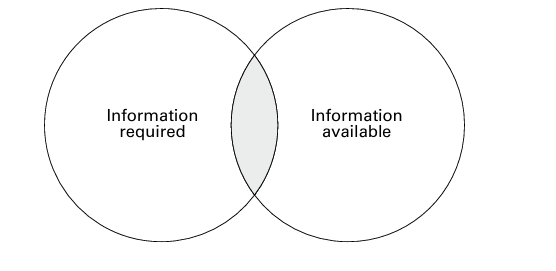
What principle does Adair state about decisions made without critical
information?
Don't make decisions in the absence of critically important information that isn't immediately to hand, provided that a planned delay is acceptable.
What comparison does Adair make about the New York Times and
information growth?
The New York Times contains as much distinct information each day as the average 17th-century person encountered in a lifetime.
What did Bismarck say to his generals about enemy courses of action?
"If the enemy has only two courses of action open to him, he will choose the third."
What did Alfred Sloan (GM) do when presented with two alternatives?
He adjourned meetings, saying "Please go away and generate more options."
Describe the lobster pot model (Figure 2.4).
Options narrow through funnel stages: Creativity/possibilities → Feasible options (no more than five or six, since the mind struggles with more) → Three options → Alternatives (two) → Choice/Decision/Action. Key principle: it is easier to falsify something than to verify it.

What is the risk of having too many or too few options?
Too many: overload and difficulty choosing at all. Too few: options may be too limited.
Walk through the car-buying example of narrowing options.
Five estate cars: one is nine inches too long for the garage (out); one costs £1,200 more for just a prestigious name (out); partner (an artist) dislikes one's colour (out); two left – trade time for information via test drives; one dealer offers a better price and the right colour, so one option remains.
What are four ways to decide in complex cases?
List advantages and disadvantages; examine consequences of each course; test the proposed course against the yardstick of your aim/objective; weigh risks against expected gains.
What headings are in Adair's decision-making matrix?
Option; Advantages; Disadvantages; Consequences; Any way to test this option?; Risks; Gains.
Which two conflicting proverbs show the difficulty of high-risk decisions?
"Look before you leap" and "He who hesitates is lost."
What does Adair say about the role of mathematics in risk assessment?
Probability theories and statistical methods can sometimes help, but mathematics' contribution is very limited; experience plays a much larger part.
How should you handle risk according to Adair?
Define the worst downside (can you accept it or will it sink you?). In high-risk/high-reward cases you may still take the risk if the reward is too important. Then reduce risk through experience, practice, consultation with specialists, reconnaissance and mental rehearsals – turning possibility of success into probability, though risk can't be eliminated.
What does Adair say about solutions and latent consequences?
The emergence of latent consequences triggers another round of decision making and problem solving: "solutions are the seeds of new problems." We can only make the best decisions we can, then make further decisions to deal with latent consequences.
What is the outcomes window (Figure 2.6)?
A grid with Positive/Negative columns and You/Others rows, used to list the consequences of a decision (e.g. making pay totally performance-related vs not) to assess risk and which decision has the most undesirable consequences.

What did Anna Wintour say about confidence in decision making?
"People respond well to those that are sure of what they want." (Adair's tip: confidence in decisions benefits those around you.)
How does Figure 2.8 depict decision making, and why is it a spiral?
A spiral: Define objective → Collect information → Develop options → Evaluate and decide → Implement → Monitor consequences → Sense effects → back again. It is more a spiralling process than a strict sequence.

What are the leadership functions in Figure 3.3?
Achieving the TASK: defining the task, planning, briefing, controlling. Building/maintaining the TEAM: (also controlling/evaluating/organizing…). Developing the INDIVIDUAL: motivating, providing an example. Overall list: defining the task, planning, briefing, controlling, evaluating, motivating, organizing, providing an example.
