FUNDABIOCHEM MIDTERMS TOPIC 2
 Call Kai
 Learn
 Practice Test
 Spaced Repetition
 Match
 Flashcards
 Knowt Play
1/130

There's no tags or description
Looks like no tags are added yet.
131 Terms
Transcription
is a process in which ribosomal nucleic acid (RNA) is synthesized from DNA.
ribosomal nucleic acid (RNA); DNA
Transcription is a process in which —— is synthesized from ——.
Gene
refers to the functional unit of the DNA that can be transcribed.
DNA
Gene refers to the functional unit of the —— that can be transcribed.
DNA; RNAs
The entire molecule of — is not expressed in transcription. — are synthesized only for some selected regions of DNA.
primary transcript
The product formed in transcription is referred to as —
nucleoid ; cytoplasm
DNA is located in the — region of the —
True
Transcription and translation happen simultaneously. True or false?
exon (coding) and intron (non-coding) regions; DNA → transcription → pre-mRNA → processing → splicing → mRNA → nuclear export → cytosol → translation → protein.
In a eukaryotic diagram of transcription, DNA is located in the nucleus and features these two regions. Moreover, what is the general flow or process of this?

TEMPLATE STRAND (Antisense strand)
The DNA strand actually used as the template for RNA synthesis.
RNA synthesis
Template strand (antisense strand) is the DNA strand actually used as the template for —
RNA polymerase
What reads the template (antisense) strand?
3' → 5' direction
What direction does the template (antisense) strand read in?
complementary
Template (antisense) strand is — to the RNA produced.
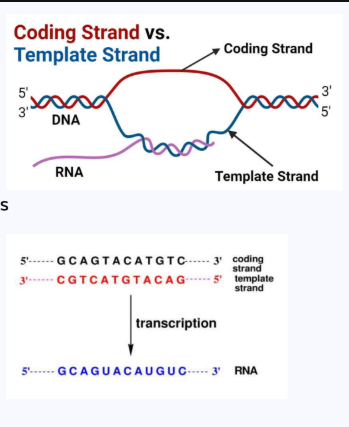
CODING STRAND (Sense strand)
is the DNA strand not directly used as the template.
RNA
CODING STRAND (Sense strand) has the same base sequence as —
T (thymine) ; U (uracil)
CODING STRAND (Sense strand) has the same base sequence as the RNA, except DNA has — and RNA has —
amino acid ; protein
CODING STRAND (Sense strand)’s sequence corresponds to the — sequence of the —
Initiation, Elongation, and Termination
Transcription is divided into three steps for both prokaryotes and eukaryotes: —, —, —
elongation; initiation ; termination
The process of — is highly conserved between prokaryotes and eukaryotes, but — and — are somewhat different.

Core Enzyme
In prokaryotic transcription, this is composed of five core subunits with a total mass of about 400 kDa.
five ; 400 kDa
In prokaryotic transcription, core enzyme is composed of — core subunits with a total mass of about —.

Two Alpha (α) subunits
In prokaryotic transcription, these build the structure and assemble the enzyme.
Beta (β) subunit
In prokaryotic transcription, this contains the main catalytic activity to build RNA.
Beta-prime (β′) subunit
In prokaryotic transcription, this binds nonspecifically to DNA.
Omega (ω) subunit
In prokaryotic transcription, this helps assemble the holoenzyme and keeps it stable.
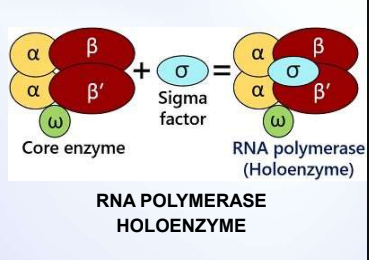
Sigma (σ) Factor
In prokaryotic transcription, this binds to the core enzyme to create the complete holoenzyme.
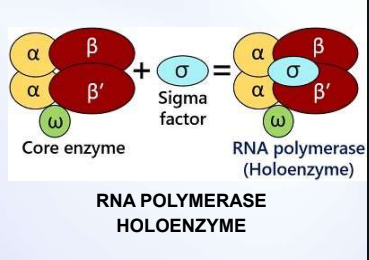
Sigma (σ) Factor
In prokaryotic transcription, it guides the enzyme to specific promoter sequences on the DNA.
mRNA
carries information for protein synthesis.
rRNA
part of ribosomes
tRNA
carries amino acids during translation.
small regulatory RNAs
what other types of RNA can prokaryotic transcription produce?

PROMOTER REGION
In prokaryotic transcription, it is a specific sequence of DNA located near the beginning of a gene.
DNA ; beginning of a gene
The promoter region in a prokaryotic transcription is the specific sequence of — located near the —
recognition site ; binding site ; transcription machinery
In prokaryotic transcription, the promoter region acts as a — and — for the — and determines where transcription begins.
promoter region
determines where transcription begins in prokaryotic transcription
Pribnow box (TATA box)
The '-35' sequence
In prokaryotic transcription, there are two base sequences on the coding DNA strand which the sigma factor of RNA polymerase can recognize for initiation:
sigma factor ; RNA polymerase ; initiation
In prokaryotic transcription, there are two base sequences on the coding DNA strand which the — of — can recognize for — : Pribnow box (TATA box) and The '-35' sequence
-35 region
Recognition site in the promoter region of DNA. Contains a base sequence TTGACA, located about 35 bases (upstream) away on the left side from the site of transcription start.
DNA ; TTGACA ; 35 bases ; transcription start
-35 region: Recognition site in the promoter region of —. Contains a base sequence —, located about — (upstream) away on the left side from the — site.
-10 region (Pribnow box / TATA box)
Consists of 6 nucleotide bases (TATAAT), located on the left side about 10 bases away (upstream) from the starting point of transcription.
6 (TATAAT) ; 10 bases
-10 region (Pribnow box / TATA box): Consists of — nucleotide bases, located on the left side about — away (upstream) from the starting point of transcription.
+1 region
Nucleotides that start transcription.
TTGACA region (-35 sequence) ;
TATAAT region (-10 sequence) ;
DNA duplex ;
17 bp
In prokaryote initiation, RNA-polymerase recognizes the —, and slides to the —, then opens the —. The unwound region is about —.
RNA-polymerase ; unwound region
In prokaryote initiation, — recognizes the TTGACA region (-35 sequence), and slides to the TATAAT region (-10 sequence), then opens the DNA duplex. The — is about 17 bp.
+1 site
triphosphate
5'-pppG
3'-OH
RNA polymerase
transcription initiation complex
In initiation steps:
RNA polymerase positions itself at the —
The first nucleotide enters as a —.
RNA initially has a — structure.
Additional nucleotides are then added to the —.
The assembled promoter, —, and initiating nucleotides constitute the —.
RNA polymerase
first nucleotide
RNA
Additional nucleotides
assembled promoter
nucleotides
In initiation steps:
— positions itself at the +1 site.
The — enters as a triphosphate.
— initially has a 5'-pppG structure.
— are then added to the 3'-OH.
The —, RNA polymerase, and initiating — constitute the transcription initiation complex.

what is the transcription initiation complex formula
3',5' phosphodiester bond
Sigma (σ) subunit falls off from the RNA-pol once the first — is formed.
Sigma (σ) subunit
— falls off from the RNA-pol once the first 3',5' phosphodiester bond is formed.
DNA template ; elongation
The core enzyme moves along the — to enter the — phase.
Elongation ; σ
— phase begins with releasing the — subunit from the RNA polymerase.
σ subunit
DNA template
mRNA
5' to 3'
40 nucleotides per second
The dissociation of the — allows the core enzyme to proceed along the —, synthesizing — in the — direction at approximately — rate.
3' → 5'
5' → 3'
RNA polymerase reads DNA —, but synthesizes RNA —.
termination
Transcription ends when — signals are reached.
RNA transcript ; RNA polymerase
In termination in prokaryotes, — is released. — dissociates from the DNA.

Rho-Dependent Termination ; ATPase ; RNA
— is where a specific protein, named Rho factor (ρ), acts as — and terminates transcription and releases —.
Rho factor (ρ)
is responsible for the dissociation of RNA polymerase from DNA.
rut site (Rho utilization site) ; C-rich
In the binding of Rho-Dependent Termination, Rho binds to the —, a — region.
5' → 3' direction ; RNA polymerase ; ATP hydrolysis
In the translocation of Rho-Dependent Termination, Rho moves along the RNA in the — direction, following —, using energy from —.
RNA polymerase;
termination;
Rho;
transcription complex
In the pausing of Rho-Dependent Termination, — pauses at a — - associated site, allowing — to catch up with the —
Rho
RNA-DNA hybrid
RNA
RNA polymerase
DNA
In the dissociation of Rho-Dependent Termination, — disrupts the —, releasing the — transcript and separating — from the — template.
Rho-Independent Termination
hairpins
RNA
palindromes
The termination in this case is brought about by the formation of — of newly synthesized —.
This occurs due to the presence of —.
hairpin loop structure
slows down
In Rho-Independent Termination, complementary sequences base pair to form a —. RNA polymerase —, thus termination happens.
RNA POLYMERASE I
Responsible for the synthesis of precursors for the large ribosomal RNAs (rRNAs).
RNA POLYMERASE II
Synthesizes the precursors for mRNAs and small nuclear RNAs (mRNAs & SnRNAs).
RNA POLYMERASE III
Participates in the formation of tRNAs and small ribosomal RNAs (tRNAs & small rRNAs).
large ribosomal RNAs (rRNAs)
RNA POLYMERASE I: Responsible for the synthesis of precursors for the —.
mRNAs
small nuclear RNAs (mRNAs & SnRNAs).
RNA POLYMERASE II: Synthesizes the precursors for — and —
tRNAs ; small ribosomal RNAs (tRNAs & small rRNAs).
RNA POLYMERASE III: Participates in the formation of — and —

Hogness box (or TATA box)
promoter region in eukaryotic transcription
Located on the left about 25 nucleotides away (upstream) from the starting site of mRNA synthesis.

25 ; mRNA synthesis
promoter region in eukaryotic transcription
Hogness box (or TATA box): Located on the left about — nucleotides away (upstream) from the starting site of —.
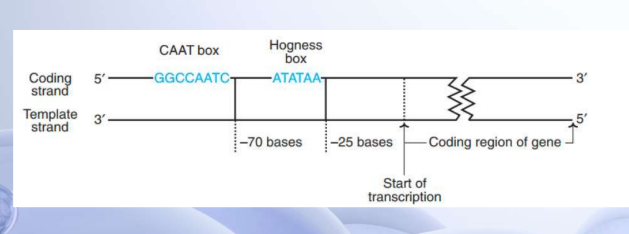
CAAT box
promoter region in eukaryotic transcription
Another site of recognition between 70 and 80 nucleotides upstream from the start of transcription.
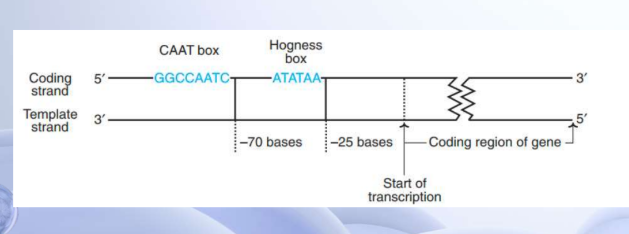
70 and 80
promoter region in eukaryotic transcription
CAAT box: Another site of recognition between — and — nucleotides upstream from the start of transcription.

RNA-polymerase II
six
(TFII A - TFII H)
TFs
enzyme RNA polymerase
Initiation in Eukaryotes
— does not bind the promoter directly.
RNA-pol II associates with — transcription factors, —.
A large number of transcription factors interact with eukaryotic promoter regions.
In humans, about six transcription factors have been identified (TFIID, TFIIA, TFIIB, TFIIF, TFIIE, TFIIH).
It is postulated that the — bind to each other, and in turn to the — .
True
The elongation in eukaryotes is similar to that of prokaryotes. True or false?
nuclear membrane
In eukaryotic elongation, the transcription and translation do not take place simultaneously since they are separated by the —.
RNA-polymerase II
3' → 5'
5' → 3'
PRE-mRNA
ELONGATION IN EUKARYOTES
Reads DNA —;
Synthesizes RNA —
Creates a —.
pre-mRNA;
polyadenylation signal: 5'—AAUAAA—3’
3'-end processing
In termination involving eukaryotes, when RNA polymerase transcribes the gene, it produces the — . It reaches the —. This is the important signal for —
nascent RNA
primary transcript
In post-transcriptional modifications, the —, also known as — needs to be modified to become functional tRNAs, rRNAs, and mRNAs. The modification is critical to eukaryotic systems.
capping ; 5’
tailing ; 3’
mRNA splicing
Post-transcriptional modifications include:
— at the — end
— at the — end
—
mRNA
7-methylguanosine
5'-5' triphosphate linkage
In post-transcriptional modifications, specifically involving capping at the 5’ - end, the 5' end of — is capped with — by an unusual —.
RNA TRIPHOSPHATASE
guanylyltransferase
GMP (guanosine monophosphate)
In post-transcriptional modifications, specifically involving capping at the 5’ - end:
An enzyme called — cleaves off one of the three phosphates on the 5' end.
Another enzyme called — adds a — to the 5' end.
methyltransferase
7-methylguanosine (m7G).
S-Adenosyl methionine (SAM)
In post-transcriptional modifications, specifically involving capping at the 5’ - end:
Then the added guanine is methylated by an enzyme called — to form: —
Methyl Donor: —.
AAUAA
Poly A- Polymerase; adenine (A); cleaved
In post-transcriptional modifications, specifically involving TAILING AT THE 3' - END,
Nucleotide Signals at the 3' end are: —.
— adds many — nucleotides to the 3' end of the — RNA.
To Initiate Translation Process
Prevents Degradation by Enzymes
Stability
Transportation
PURPOSE/FUNCTIONS OF CAPPING
Exons
matured mRNA
— are the coding sequences that appear on split genes and primary transcripts, and will be expressed to —. (Codes for Amino Acids)
Introns
are the non-coding sequences that are transcripted into primary mRNAs, and will be cleaved out in the later splicing process. (Do not code for Amino Acids).
Small nuclear ribonucleoproteins (snRNPs, pronounced "snurps") ;
spliceosome
Introns and their removal/SPLICING DETAILS
— bind to pre-messenger RNA (pre-mRNA)/ heteronuclear RNA (hnRNA) in the cell nucleus to help cut out unneeded sections called introns.
The term — is used to represent the snRNP association with hnRNA at the exon-intron junction.
pre-messenger RNA (pre-mRNA)/ heteronuclear RNA (hnRNA) ; nucleus ; introns
snRNP ; hnRNA ; exon-intron junction
Introns and their removal/SPLICING DETAILS
Small nuclear ribonucleoproteins (snRNPs, pronounced "snurps") bind to — in the cell — to help cut out unneeded sections called —.
The term spliceosome is used to represent the — association with — at the —.
Actinomycin D (Dactinomycin)
inhibitors of transcription
—: Synthesized by Streptomyces. Binds with DNA template strand and blocks the movement of RNA polymerase. Very first antibiotic used for the treatment of tumors.
Rifampin
inhibitors of transcription
—: Antibiotic widely used for tuberculosis and leprosy. Binds with the β-subunit of prokaryotic RNA polymerase and inhibits its activity.
D-Amanitin
inhibitors of transcription
—: Toxin produced by mushroom, Amanita phalloides. Tightly binds with RNA polymerase II of eukaryotes and inhibits transcription.

Reverse transcription
Definition: Biological process of synthesizing a complementary DNA (cDNA) strand from an RNA template (exact reverse of normal cellular transcription).
Enzyme: Reverse transcriptase.
complementary DNA (cDNA)
Reverse transcriptase
Reverse transcription: Biological process of synthesizing a — strand from an RNA template (exact reverse of normal cellular transcription).
Enzyme: —.
RNA genomes; host genome
unstable RNA; stable cDNA
target RNA
Uses of Reverse Transcription
Viral Replication: Retroviruses (HIV, HTLV-I) convert — into DNA to integrate into —.
Gene Expression Analysis & Research: Convert — into — for cloning, sequencing, measurement.
RT-PCR Diagnostics: Detect and quantify — (viral infections, genetic changes).
proteins;
translation
The genetic information stored in DNA is passed on to RNA, and ultimately expressed in the language of —.
The biosynthesis of a protein or a polypeptide in a living cell is referred to as —.
genetic code ; simply codons ; 64
Three nucleotide (triplet) base sequences in mRNA that act as code words for amino acids constitute the — or —.
Four bases produce — different combinations (43) of three base codons.
61
— code for the 20 amino acids found in protein.
UAA, UAG, and UGA
termination codons / non-sense codons
—,—,— are stop signals in protein synthesis. Collectively known as — or —.