CS0019 Module 1
 Call Kai
 Learn
 Practice Test
 Spaced Repetition
 Match
 Flashcards
 Knowt Play
1/108

There's no tags or description
Looks like no tags are added yet.
109 Terms
A problem-based discipline that allows for repeated testing of a hypothesis
Modeling and Simulation (M & S)
The foundation of an M & S program of study is its curriculum built upon four precepts:
Modeling
Simulation
Visualization
Analysis
A construct or collection of different elements that together produces results not obtainable by the elements alone
System
The elements can include people, hardware, software, facilities, policies and documents – all things required to produce system-level qualities, properties, characteristics, functions, behavior an performance
System
A construct or collection of different elements that together produces results not obtainable by the elements alone. The elements can include people, hardware, software, facilities, policies and documents – all things required to produce system-level qualities, properties, characteristics, functions, behavior an performance. (International Council of Systems Engineering (INCOSE))
System
A construct or collection of different elements that together produces results not obtainable by the elements alone. The elements can include people, hardware, software, facilities, policies and documents – all things required to produce system-level qualities, properties, characteristics, functions, behavior an performance.
International Council of Systems Engineering (INCOSE)
An aggregation of objects joined in some regular interaction or interdependence for achievement of a common goal
System
An organized set of interrelated ideas or principles
System
A collection of entities (people, parts, messages, machines, servers, …) that act and interact together toward some end
System
Types of System:
Physical System
Notional System
Something that already exist
Physical System
A plan or concept for something physical that does not exist
Notional System
It refers to the subject of model development
System
It is the subject or thing that will be investigated or studied using M & S
System
Types of Systems:
Discrete
Continuous
State variables (variables that completely describe a system at any given moment in time) change instantaneously at separate points in time
Discrete
State variables change continuously with respect to time
Continuous
Ways to Study a System:
The actual system vs. a model of the system
A physical vs. mathematical representation
Analytic solution vs. simulation solution
Primary concerns of the modeler in the study of systems:
The quantitative analysis of the systems
The techniques for system design, control or use
The measurement or evaluation of the system performance
A physical, mathematical or otherwise logical representation of a system, entity, phenomenon or process
Model
It serves as representations of events and/or things that are real (such as historic case study) or contrived (a use case)
Model
Types of Models:
Physical
Notional
An applied methodology that can describe the behavior of that system using either a mathematical model or a symbolic model
Simulation
It can be the imitation of the operation of a real-world process or system over a period of time
Simulation
The overall process of developing a model and then simulating that model to gather data concerning performance of a system
M & S
It used models and simulations to develop data as a basis for making managerial, technical and training decisions
M & S
Developing computer simulation or a design based on a model of an actual or theoretical physical system
Executing that model on a digital computerAnalyzing the output
M & S Steps:
Components of a System:
Entity
Attribute
Activity
It is used to denote an object of interest in a system
Entity
It is used to denote a property of an entity
Attribute
Process that causes changes in the system
Activity
Collection of all the entities, attributes and activities at one point of time
State of the System

Ways to Study a System
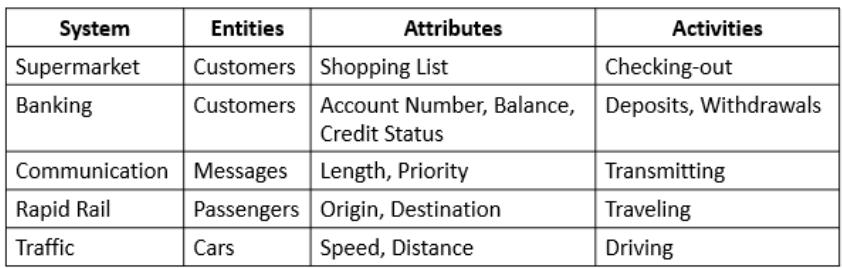
Examples of System
It is where changes occurring outside the system are said to happen
System Environment
Types of Activities:
Endogenous
Exogenous
Deterministic
Stochastic
Activities that occur within the system
Endogenous
Activities that occur outside the system
Exogenous
Activities wherein the outputs can be described completely in terms of its input
Deterministic
Activities wherein the outputs cannot be described in terms of its input or outputs
Stochastic
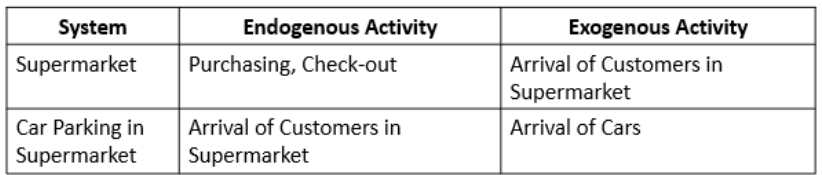
Examples of Activities:
Types of System —>
Open
Closed
Continuous
Discrete
Sampled-data
A system which has exogenous activities
Open
A system which don’t have any exogenous activities
Closed
A system in which the changes are predominantly smooth. (Ex: Aircraft system)
Continuous
A system in which the changes are predominantly discontinuous. (Ex: Factory system)
Discrete
A system which is intrinsically continuous but information about them is only available at discrete points in time
Sampled-data
The system might not be accessible
Why model a system?
The system might be dangerous to engage
Why model a system?
The system might be unacceptable to engage
Why model a system?
The system might simply not exist
Why model a system?
Subtasks in Deriving a Model:
Establishing the model structure is possible by:
a. Determining the system boundary
b. Identifying the entities, attributes and activities of the system
Supplying the data means:
a. Provides the values of attributes
b. Defines the relationships involved in the activities

Types of Models
Types of Models:
Physical
Mathematical
Physical:
Static
Dynamic
Mathematical:
Static
Dynamic
Static (Mathematical):
Numerical Technique
Analytical Technique
Dynamic (Mathematical):
Numerical Technique
Analytical Technique
Numerical Technique (Mathematical → Dynamic):
System simulation
It is the process of representing a model which includes its construction and working
Modeling
It is the process of creating a model which represents a system including their properties
Modeling
It is an act of building a model
Modeling
Principles used in Modeling:
Block Building
Relevance
Accuracy
Aggregation
A system can be described in series of blocks
Block Building
Each block describe a part of the system
Block Building
It depends upon few input variables and results in a few output variables
Block Building
The system can be described as interconnection between the blocks
Block Building
The system can be represented graphically as a simple block diagram
Block Building
The model should only include relevant aspect of the system
Relevance
The information gathered for the model must be correct and accurate
Accuracy
It is the extend to which the number of individual entities can be grouped together into larger entities
Aggregation
It is the process of imitating the operations of a facility or process, usually via computer
Simulation
What’s being simulated is the system
Simulation
To study system, often make assumptions/approximations, both logical and mathematical, about how it works
Simulation
These assumptions form a model of the system
Simulation
If model structure is simple enough, could use mathematical methods to get exact information on questions of interest — analytical solution
Simulation
It is the operation of a model in terms of time or space, which helps analyze the performance of an existing or a proposed system
Simulation
The process of using a model to study the performance of a system. It is an act of using a model for simulation.
Simulation
A method named ‘Monte Carlo’ was developed by researchers (John von Neumann, Stanislaw Ulan, Edward Teller, Herman Kahn) and physicists working on a Manhattan project to study neutron scattering
1940
A method named ‘__ __’ was developed by researchers (John von Neumann, Stanislaw Ulan, Edward Teller, Herman Kahn) and physicists working on a Manhattan project to study neutron scattering
Monte Carlo
A method named ‘Monte Carlo’ was developed by researchers (__, __, __, __) and physicists working on a Manhattan project to study neutron scattering
John von Neumann, Stanislaw Ulan, Edward Teller, Herman Kahn
The first special-purpose simulation languages were developed, such as SIMSCRIPT by Harry Markowitz at the RAND Corporation
1960
The first special-purpose simulation languages were developed, such as __ by Harry Markowitz at the RAND Corporation
SIMSCRIPT
The first special-purpose simulation languages were developed, such as SIMSCRIPT by __ __ at the RAND Corporation
Harry Markowitz
During this period, research was initiated on mathematical foundations of simulation
1970
During this period, PC-based simulation software, graphical user interfaces and object-oriented programming were developed
1980
During this period, web-based simulation, fancy animated graphics, simulation-based optimization, Markov-chain Monte Carlo methods were developed
1990
The Process of Simulation:

Classification of Simulation Models:
Static vs. Dynamic
Deterministic vs. Stochastic
Continuous vs. Discrete
Most operational models are dynamic, stochastic, and discrete – will be called __ simulation models
discrete-event
Other Types of Simulation:
Hybrid Simulation
Real-time Simulation
Web-based Simulation
The technique of solving problems by the observation of the performance, over time, of a dynamic model of the system
System Simulation
Used when models are simple and easy to understand
Analytical Method
Mathematical methods (such as algebra, calculus or probability theory) are used to get exact information needed to solve the problem
Analytical Method
Used when systems are too complex to allow realistic models to be evaluated analytically
Simulation Method
Computers are used to evaluate the model numerically and data are gathered in order to estimate the desired true properties
Simulation Method
Gives general solution.
It considers all the conditions to solve a problem.
There is limited problem that can be solved mathematically.
Analytical results occur in the form of complex series or integrals that still require extensive evaluation.
Expensive and time consuming.
There are many simple limitations such as physical stops, finite time delays or nonlinear forces.
Employs the deductive reasoning of mathematics to solve the model.
Analytical Method
Gives specific solutions.
Tells only about particular conditions.
It is an extension of mathematical solution.
Provides a quicker or more convenient way of deriving results.
Gives results in few minutes at a very low cost.
Easily removes limitations such as physical stops.
Employs numerical methods.
Simulation Method
Advantages of Modeling and Simulation
Easy to understand
Easy to test
Easy to upgrade
Easy to identifying constraints
Easy to diagnose problems
Allows to understand how the system really operates without working on real-time systems
Easy to understand