Exam 2
 Call Kai
 Learn
 Practice Test
 Spaced Repetition
 Match
 Flashcards
 Knowt Play
1/146

There's no tags or description
Looks like no tags are added yet.
Name | Mastery | Learn | Test | Matching | Spaced | Call with Kai | Chat |
|---|
No analytics yet
Send a link to your students to track their progress
147 Terms
Intro
HIV resistant alleles
'+' is wild type and cell susceptible to HIV infection, 32 mutant T-cell resistant to HIV infection
How does allele frequency change over time
Samles can only be taken from individuals
Step 1: measure genotype frequency
Step 3: Calculate allele frequency (based on pop. Gen. models)
Population Genetics Model
Punnett square can only make predictions about the probabilities of offspring based on genotype of parents (gametes)
Population genetics account for gametes present in a population (gene pool)
Population Genetics
Given genotype frequencies we can
Calculate allele frequencies
Predict genotype frequencies that should be present
Compare predicted outcomes to observations to detect evolution
Population Genetics
Life beyond the Punnett square
Evolution can only be measured in populations
Null model= allele frequencies remain the same from 1 gen to the next
Things that cause deviation from null model= mechanisms of evolution
Drift (random processes), migration, mutation, natural selection, non-random mating (inbreeding)
Population Genetics
Provides a theoretical foundation for understanding evolution in populations
Determine if evolution is occurring
Make predictions usually modes about how evolution might proceed
Population Genetics
Evolution= change in allele frequencies over time (not what is predicted by null model)
Anything that causes evolution results in changes in allele frequencies
Hardy Weinberg
Null Model
If a population of adults contributes alleles to the next generation (in the form of gametes) randomly w/ no differences in survival of reproduction then
Allele frequencies (A and a) shouldn't change from 1 generation to the next
Genotype frequencies (AA, Aa, aa) shouldn't change from 1 generation to the next
Null Model
The math for 1 locus w/ 2 alleles
Proportion (frequency of alleles can be expressed as: proportion of allele A=p; proportion of allele=q -> P+q=1
Null Model
Proportion of alleles allows us to predict the proportion of genotypes in the next generation
Recombo of alleles p and q) in random mating can be expressed as squaring of proportions of alleles (since p+`q^2=1^2 (allele proportions) then p^2+2pq+q^2=1 (genotype proportions)
Null Model
Proportion of genotypes can be expressed as
AA= pXp=P^2
Aa=2pq
Aa=qXq=q^2
Null Model
Generations
Gen 1= of starting allele frequencies are p and q then genotype frequencies are P^2, 2pq, q^2
Gen 2= if we calculate allele frequencies (p and q) from genotype frequencies (p^2, 2pq, q^2) then allele frequencies are p and q
No change in allele frequencies b/w G1 and G2
Null Model Example
Population where A= .6, a-.4
A(p)= .6, a(q)=.4 (add up to one)
Proportion of genotypes
AA: .6 times .6= .36
Aa: 2pq: .48
Aa: qXq= .16
Next generation : .36+.48.16=1
p= .36+(.5)(.48) -> .36 + .24 = 0.6 .6
Q -> .6-1=-0.4 .4
Hardy Weinburg Equilibrium
Under ideal conditions (no evolution)
Allele frequencies in a population will not change from 1 generation to the next
If the allele frequencies in a population are given by p and q, then genotype frequency will be given as p^2, 2pq, q^2 (rule sometimes broken)
Hardy Weinburg Equilibrium
Detecting deviation
Measure genotype frequency (observed)
Calculated allele frequency (p and q)
Count p and qs, don’t take square root of p^2 b/c fit the population is not in HW equilibrium, will get wrong answer
Using genotype frequencies: count ps as the value of p^2 plus 1/2 of the value of 2pq
Using genotype counts: count up the total # of ps in each genotype and divide by the total # f alleles
Calculate expected genotype frequency in the next generation from step 2 (p^2, 2pq,q^2, expected
HWE is the idea that allele frequencies, genotype frequencies, and phenotype
frequencies in a population do not change from one generation to the next,
unless evolution is happening
IMPORTANT: However, when determining if populations are in
HWE, YOU CAN NOT ASSUME HWE. Therefore, you need to count up the p’s and q’s to determine allele frequencies in populations. That is, you CANNOT take the square root of homozygous genotypes to calculate allele frequencies
If the genotype frequencies of all three genotypes are known, we can
count alleles, calculate allele frequencies (p & q), use them to predict genotype frequencies (p2, 2pq, q2) at equilibrium, they can be tested for statistically significant deviations from HWE (using tests) by comparing the predicted results with the actual frequencies.

Examine Figure on 6.1 from lecture. Can you tell if evolution is happening? Why or why not? If you say that evolution is happening, can you tell what is causing evolution to happen? Why or why not?
Yes because the frequency is changing. What cannot tell the specific mechanism but we can see that the frequency of specifically the TRYP1 G Allele
has been changed
How is population genetics like an exploded Punnett square
Punnett square can only make predictions about the probabilities of offspring based on genotype of parents (gametes)
Population genetics account for gametes present in a population (gene pool)
Population genetics allows for biologist to determine if evolution is happening or how you might predict evolution to proceed under a variety of circumstances. How might such a technique be useful in the modern world?
Evolution can only be measured in populations
Provides a theoretical foundation for understanding evolution in populations
Determine if evolution is occurring
Make predictions usually modes about how evolution might proceed
What are the mechanisms of evolution? What do I mean by mechanism of evolution?
Things that cause deviation from null model= mechanisms of evolution
Drift (random processes), migration, mutation, natural selection, non-random mating (inbreeding)
What does the null model predict about changes in allele frequencies over time?
Null model= allele frequencies remain the same from 1 gen to the next
Evolution= change in allele frequencies over time (not what is predicted by null model)
Anything that causes evolution results in changes in allele frequencies
Hardy Weinberg
a population is not undergoing evolution and has allele frequency of p=0.6 and q=0.4;
a. What are the expected allele frequencies in the next generation?
b. What are the expected genotype frequencies
A(p)= .6, a(q)=.4 (add up to one)
Proportion of genotypes
AA: .6 times .6= .36
Aa: 2pq: .48
Aa: qXq= .16
Next generation : .36+.48.16=1
p= .36+(.5)(.48) -> .36 + .24 = 0.6 .6
Q -> .6-1=-0.4 .4

Use the mouse example from lecture to practice determining if a population is in HW equilibrium.
If a population of adults contributes alleles to the next generation (in the form of gametes) randomly w/ no differences in survival of reproduction then
Allele frequencies (A and a) shouldn't change from 1 generation to the next
Genotype frequencies (AA, Aa, aa) shouldn't change from 1 generation to the next

Use the data given in the below table to determine if the delta-32 allele is in HW equilibrium in the two populations listed.
Math
How are alleles related to phenotype?
Allele: an allele is the specific form of the gene that is present. Alleles differ from each other in terms of their DNA sequence, and these differences may produce changes in the protein that is produced. Each individual can carry 2 different alleles of each gene (one from each parent in organisms with sexual reproduction). If you have 2 identical alleles, you are homozygous. If you have 2 different alleles you are heterozygous. A population of organisms as a whole may have many different alleles for a single gene
Phenotype: phenotype refers to the outward expression of a genotype. For example, pea plants may produce green peas or yellow peas. Color is controlled by a single locus with 2 alleles, which we can call G(green) & g(yellow). GG, Gg, & gg are the genotypes. The green phenotype is visible in both GG & Gg individuals, therefore we call “G” dominant over “g”. The yellow phenotype is only visible in gg individuals, therefore we call “g” recessive
H-W Equilibrium
No selection, mutation, migration, chance events, and individuals mate at random (no mechanisms of evolution)
Any population deviating is likely undergoing one of the above processes
Selection
Selection occurs when individuals vary in fitness due to traits (alleles)
Fitness= success f individual (genotype) in contributing alleles to the next generation)
Selection
The power of selection to change allele frequency is dependent on
Relative fitness of genotype
Frequency of allele in pop
Selection
Fitness= estimates lifetime reproductive success of genotype (individuals)
Use approximate measures of lifetime reproductive success to assign fitness
Fitness of genotypes is relative, range from 0 (no fitness) to 1 (highest fitness)
Selection favors the genotype with the highest relative fitness
Selection
Selection acts through favoring the genotype w/ the highest fitness causing allele frequency to change across generations by
Differential survival (zygotes, juvenile, adult)
Differential reproductive success)
Selection
Persistent selection can produce substantial change in allele frequencies over time even with very low frequencies
Detecting selection
Empirically detect evidence of selection using experimental approaches
Selection can cause allele frequencies to change across gen: invalidate assumption 1 for HW is a pop is under selection, can you calculate expected genotype frequencies from all allele frequencies=)
Selection
Detecting selection
Selection can change genotype frequencies so they cannot be calculated by allele frequencies
When 40% of each homozygote in this pop die, the allele frequencies don't change
But among the survivors there are more heterozygotes then predicted by HW
Selection
Selection can change genotype frequencies so they cannot be calculated by allele frequencies
Initial genotype frequencies: B1B1= .25, B1B2= .5, B2B2= .25; Initial allele frequencies: B1= .05, B2= .5
Post selection genotypes: B1B1= 15, B1B2= .625, B2B2-15; observed genotype frequencies: B1B1: .1875, B1B2: .625, B2B2: .1875; post selection allele frequencies: B1= .05, B2= .5 (50 het/20 homo)
Selection
Selection against homozygotes didn't change relative gene frequencies
Observed genotype frequencies are different from expected
This violates conclusion 2 of HW
Natural selection has driven genotype frequencies away from the HW equilibrium
Selection
Empirical studies: incidence of kuru (spongy brain disease) in Fore population
A mutation in the PrP gene was found to influence resistance to kuru in the fore population
Is selection impacting frequencies in prp gene
Selection
H-W analysis for women who never practice ritualistic cannibalism, women who practice ritualistic cannibalism
Measure genotype frequency (observed) for women who never practiced ritualistic cannibalism (met and val): met: .22, Met/val: .51, val:.26
Calculate allele frequency (p and q): count p and q, don't take square root b/c doesn’t work if pop not in equilibrium
Met: (.48)62=.23, met/val: 2(.48)(.52)= .5, val: (.52)^2=.27
Compare observed to expected= close enough, the population of women who didn’t practice ritualistic cannibalism is consistent w/ HW
What is the definition of fitness? How is relative fitness represented in AlleleA1?
success of individual (genotype) in contributing alleles to the next generation)
Graphing and parameters
How is relative fitness of a genotype related to the probability of alleles persisting in populations? What about the genetic architecture of the trait do you need to know to be able to make predictions about how relative fitness influences persistence of alleles?
The power of selection to change allele frequency is dependent on
Relative fitness of genotype
Frequency of allele in pop
Fitness= estimates lifetime reproductive success of genotype (individuals)
Use approximate measures of lifetime reproductive success to assign fitness
Fitness of genotypes is relative, range from 0 (no fitness) to 1 (highest fitness)
Selection favors the genotype with the highest relative fitness
We should be able to predict the direction and rate of allele frequency change under a variety of selection regimes
Selection for dom allele, recessive allele, homozygotes, heterozygotes
Which patterns of selection maintain genetic diversity within and between populations. How so?
Selection for dominant allele
Frequency of recessive allele never reaches 0
Frequency of dominant allele never reaches 1
Recessive lethal alleles (1) can be hidden from selection in heterozygotes if they have a noraml phenotype
Dom and allele frequency interact to determine the rate of evolution
When a recessive (1) allele is common, selection is fast (vice versa)
Selection favoring heterozygote
Heterozygote superiority/overdominance
2 alleles (v and l), l is lethal: vv: .735, vl: 1, ll: 0
Natural selection can act to maintain 2 alleles at a stable equilibrium if heterozygotes have superior fitness
Selection
Empirical studies: incidence of kuru (spongy brain disease) in Fore population
Observed genotype frequency among women who did practice ritualistic cannibalism but never contracted disease
Met: .13, met/val: .77, val: .10 (allele frequency= met: .52, val: .48)
Expectation: met: .27, met/val= .5, val= .23 (math done in other card)
If in equilibrium, would match
Expectation: met: .27, met/val= .5, val= .23; observed= met; .13, met/val= .77, val= .10
Don't match
Population of women exposed to cannibalism but survived not consistent w/ H-W equilibrium, heterozygote resistant
Predicting Selection
Population genetic models= simulate how allele frequencies change across generations
Using pop genetic models= we can predict how selection might proceef if we know
Initial allele frequency
Strength of selection: fitness of each genotype
Ex= we can predict whether HIV resistance will evolve
Predicting Selection
Population genetic models= simulate how allele frequencies change across generations
If we know the initial allele frequency and sirvival of each genoptype we can predict
Impact of selection on evoltuion of HIV resistance in humans
How long it will take for resistancr to evolve
Selection maybe too wea to change allele 32 alleles in human pops in the fort term of 40 gens
Patterns of Selection
We should be able to predict the direction and rate of allele frequency change under a variety of selection regimes
Selection for dom allele, recessive allele, homozygotes, heterozygotes
Patterns of Selection
Selection for dominant alleles : 4 beetle genetics
Locus L= 2 alleles (+ (wild type) and l (lethal)
+/+ and +/l are normal, l/l dies
Start a new colony w/ only heterozygotes
Knowing that all l/l (A2A2) individuals will die but other genotypes have no decreased fitness survivors
What is the fitness f each genotype
How do predictions of pop genetics models compare to the data from beetle colonies
A1A1 and A1A2= 1, A2A2= 0
Patterns of Selection
Selection for dominant allele
Frequency of recessive allele never reaches 0
Frequency of dominant allele never reaches 1
Recessive lethal alleles (1) can be hidden from selection in heterozygotes if they have a noraml phenotype
Dom and allele frequency interact to determine the rate of evolution
When a recessive (1) allele is common, selection is fast (vice versa)
Patterns of Selection
Selection favoring heterozygote
Heterozygote superiority/overdominance
2 alleles (v and l), l is lethal: vv: .735, vl: 1, ll: 0
Natural selection can act to maintain 2 alleles at a stable equilibrium if heterozygotes have superior fitness
Patterns of Selection
Natural selection against heterozygotes
Natural selection against heterozygotes
Homozygote superiority or underdominance
When heterozygotes have inferior fitness, one allele goes ot fixation, other is lost
Patterns of Selection
Probability of fixation depends on
Relative fitness (differential of homozygotes)
Initial allele frequencies
Patterns of Selection
Bottom line
Different pops may lose different alleles
Both alleles will be maintained but in different pops
Heterozygote superiority maintains 2 allele within pops
Heterozygote inferiority leads to loss of genetic diversity in pops
May help maintain genetic diversity b/w pops
Frequency Dependent Selection
Maintains heterozygosity
When fitness of an allele depends on its frequency in the pop
Selection can maintain 2 allele sin a pop if each allele is advantageous when rare
Frequency Dependent Selection
Elderflower orchids come in 2 colors
Pops typically contain both colors
Yellow flowers found slightly more
Attract bumblebees but offer no nectar reward
Bee finds no reward- switch to different color
Bees visit each color equally, rare color receives more visits per plant
Selection favors 1 color until common when switches
Color favored depends on frequency of color in pop
Frequency Dependent Selection
Elderflower orchids come in 2 colors
Experimental design
Experimental plots / varying frequencies of yellow flower
Measure repro success of ales/females at each expected frequency
Repro success of yellow was dependent on frequency in pop
Equivalent repro success stabilized at naturally occurring frequency of .7
What do we call the forces that cause populations to deviate from H-W equilibrium?
No selection, mutation, migration, chance events, and individuals mate at random (no mechanisms of evolution)
Any population deviating is likely undergoing one of the above processes

Use table 5.3 (Lecture slide #12) to determine if the delta-32 allele is in Hardy-Weinberg equilibrium in each of the three regions for which data are presented (Europe, Middle East, Africa)
Math
When using the allele A1 modeler, how do you model selection? How would you model selection for an allele? Against and allele? For a genotype? How would you model weak selection versus strong selection.
Change the allele frequency (fill in more after assignment)
Make a sketch of what the AlleleA1 model would look like for the following scenarios; Freq A = 0.5 under H-W equilibrium, Freq A = 0.2, under H-W equilibrium, Freq a = 0.4, under H-W equilibrium, Freq a = 0.1 under H-W equilibrium, Freq AA = 0.25, under HA equilibrium
equilibrium= straight line w/ generation on x axis and allele on y axis
find other frequencies and graph
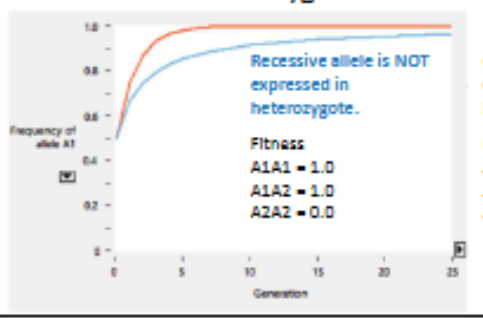
Differentiate between the patterns of selection for a dominant allele vs for a co-dominant allele. How would you model these two different patterns of selection using allele A1 modeler?
Model= fill in later
Selection for dominant allele
Frequency of recessive allele never reaches 0
Frequency of dominant allele never reaches 1
Recessive lethal alleles (1) can be hidden from selection in heterozygotes if they have a noraml phenotype
Dom and allele frequency interact to determine the rate of evolution
When a recessive (1) allele is common, selection is fast (vice versa)
Selection for a co-dominant allele
Recessive alleles can be eliminated if they aren't hidden in heterozyogte
Co-dominant allele is expressed in heterozygote
Recessive allele is not expressed in heterozyogote
model= fill in
Differentiate between the patterns of selection for the heterozygote vs for the homozygote? Under which pattern is variation maintained within populations? Under which patterns is variation lost in populations? Under which pattern is variation maintained between populations?
Selection against homozygotes didn't change relative gene frequencies
Observed genotype frequencies are different from expected
This violates conclusion 2 of HW
Natural selection has driven genotype frequencies away from the HW equilibrium
Natural selection against heterozygotes
Homozygote superiority or underdominance
When heterozygotes have inferior fitness, one allele goes ot fixation, other is lost
Probability of fixation depends on
Relative fitness (differential of homozygotes)
Initial allele frequencies
Bottom line
Different pops may lose different alleles
Both alleles will be maintained but in different pops
Heterozygote superiority maintains 2 allele within pops
Heterozygote inferiority leads to loss of genetic diversity in pops
May help maintain genetic diversity b/w pops
model= fill in
Patterns of Selection
Selection for a co-dominant allele
Recessive alleles can be eliminated if they aren't hidden in heterozyogte
Co-dominant allele is expressed in heterozygote
Recessive allele is not expressed in heterozyogote
Summary
Selection has significant impacts on allele frequencies in pops
Acts on individuals to change allele frequencies
Favors alleles by only by acting on genotypes
Can remove/fix alleles in pops depending on patterns of selection
Can maintain diversity of alleles depending on patterns of selection
Selection for heterozygote, selection against heterozygote, frequency dependent selection (higher the frequency, lower the fitness)
Another Assumption of HW Equilibrium Is That There Is No Mutation
What happens to allele frequencies when this assumption is violated?
Assuming a mutation rate of 1 copy per 10k (A converted to a) every generation (high mutation rate)
Mutation Alone Is A Weak Mechanism Of Evolution
Important source of variation upon which selection can act upon
Lenski Experiment
e.coli= selective enviroment, limit food, collect and sequence DNA every 5000 generations
Most alleles generated by mutation unrelated to fitness fluctuate randomly
Beneficial alleles become fixed, some alleles lost due to selection or drift
Mutation-Selection Balance
Most are deleterious
Selection eliminates deleterious mutations
May persist b/c they are created anew every generation
When mutation rate= selection, the frequency is at equilibrium and can persist
Mutation-Selection Balance
Most are deleterious
Can mutation rate be high enough to maintain a deleterious allele (a) at equilibrium
Can calculate equilibrium frequency as:
u= mutation rate, s= selection against deleterious allele (selection coefficient 0-1)
If mutation Is highly deleterious (s is large) and mutation rate is low, then equilibrium frequency for allele will be low
Mutation-Selection Balance
Most are deleterious
Spinal muscular atrophy is a rare neuro-degenerative disease that involves a loss of function allele associated w/ ta/smn locus
Loss of function allele a frequency (a) is .01 in some populations, selection est. at .90
With strong selection, why does the allele persist?
Does the mutation rate explain the persistence of a deleterious allele
Determine if mutation rate at equilibrium is = or larger than actual mutation rate
If mutation rate is = or greater than actual mutation rate at equilibrium, mutation is maintaining deleterious allele
Is less than mutation rate at equilibrium, then mutation isn't maintaining deleterious allele
Rearrange the mutation/selection equation to solve for u
u=q^2 (q=.01, s=.90)= .9(10^-4)
Compare actual (1.1x10^-4) to answer (greater than)
High enough to explain the persistence of allele in population
Mutation-Selection Balance
Most are deleterious
Cystic fibrosis (loss of function allele: 1=1 .02, s=1)
u=4X10^-4 (u=q^2)
Actual: 4X10^-7
Compare
The frequency of the deleterious cystic fibrous allele isn’t maintained by mutation selection balance
What other process could explain heterozygote superiority
Cystic fibrosis allele is resistant to typhoid bacteria
Severity of typhoid outbreaks is correlated w/ an increase in the frequency of mutant allele
Summary Mutation
H-w equilibrium forms the basis of population geneticsMutation is a weak mechanism if evolution but interacts w/ selection
Mutation-selection balance maintains deleterious alleles
Summary Mutation
Population genetics allows us to
Detect effects of selection
Predict how selection will change allele frequency
Understand maintenance of heterozygosity
Summary Mutation
Patterns of selection
Selections for alleles
Selections for heterozygote/homozygotes
Frequency-dependent selection
Migration (aka Gene Flow)
The movement of alleles b/w pops (not seasonal)
Caused by any process that moves alleles from 1 population to another (dispersal, strategies vary by species)
Is a potent mechanisms of evolution
The most important mechanism for preventing pops from diverging and may act in opposition to natural selection
Migration (aka Gene Flow)
How does migration change alleles or genotype frequencies
Ex= the effect of gene flow is much greater from continent to island than vice-versa
Migration (aka Gene Flow)
Rate of change and outcome of migration on alleles in host population depends on
Starting allele frequencies in source and host pop
Size of host pop
Migration (aka Gene Flow)
Water snakes
Plain patterned snakes are favored on islands b/c it protects them from predation
Genetics of banding patterns of 2 water snakes
Single locus w/ 2 alleles, banded is co-dominant
Migration (aka Gene Flow)
Water snakes
Plain patterned snakes are favored on islands b/c it protects them from predation
Banding patterns
Mainland= most individuals are banded
Islands= most individuals are plain
Mainland and peninsular (ohio) snakes are mostly banded
Banding decreases w/ distance from mainland
Migration (aka Gene Flow)
Water snakes
Plain patterned snakes are favored on islands b/c it protects them from predation
If selection favors plain snakes on islands, when why do banded snakes persist
Migration in water snakes from land to islands is working in opposition to natural selection w/ 2 consequence
Maintaining genetic diversity (and morphological) diversity
Preventing divergence
Migration (aka Gene Flow)
How migration interacts with natural selection will depend on level of gene flow and strength of selection
High gene flow= alleles brough by migration will be maintained
Low gene flow/strong selection= alleles brought by migration will be at much lower frequencies
How does a violation of the assumption that no migration is happening in populations under Hardy-Weinberg Equilibrium influence allele frequencies?
The movement of alleles b/w pops (not seasonal)
Caused by any process that moves alleles from 1 population to another (dispersal, strategies vary by species)
How does migration change alleles or genotype frequencies
Ex= the effect of gene flow is much greater from continent to island than vice-versa
A single bout of random mating will return the population to HW equilibrium
Describe the continent-island model of migration.
How does migration change alleles or genotype frequencies
Ex= the effect of gene flow is much greater from continent to island than vice-versa
Why wouldn’t you expect banded snakes to occur on islands? Explain why banded snakes are being maintained in island populations.
Plain patterned snakes are favored on islands b/c it protects them from predation
What are the consequences for allele frequencies when the assumption that no random effects are present under Hardy-Weinberg equilibrium?
A single bout of random mating will return the population to HW equilibrium
potent mechanism of evolution
By what mechanism is most heritable genetic variation generated? How is genetic variation quantified? Why is the observation that most populations have plenty of genetic variation significant?
Mutation, allele/genotype frequency, because it introduces variation and creates opportunity for selection
Why do we say that mutation is a weak mechanism of evolution, yet mutations can sweep through populations such as mutations on the spike protein in SARS-CoV2?
Important source of variation upon which selection can act upon
allowed viruses to develop resistance to treatments
How do mutation and selection mostly interact?
Selection eliminates deleterious mutations
May persist b/c they are created anew every generation
When mutation rate= selection, the frequency is at equilibrium and can persist
Can mutation rate be high enough to maintain a deleterious allele (a) at equilibrium
Can calculate equilibrium frequency as:
u= mutation rate, s= selection against deleterious allele (selection coefficient 0-1)
If mutation Is highly deleterious (s is large) and mutation rate is low, then equilibrium frequency for allele will be low


Explain the significance of the Lenski experiment (Fig. 6.16).
e.coli= selective enviroment, limit food, collect and sequence DNA every 5000 generations
Most alleles generated by mutation unrelated to fitness fluctuate randomly
Beneficial alleles become fixed, some alleles lost due to selection or drift
Use the below data for red blood cell genotypes (A and S) in a population of people to
determine if the populations is in H-W equilibrium.
a. AA 9365
b. AS 2993
c. SS 12,387
Math (do later)
Use Figure 6.20 (and associated content on page 207) from your textbook to help you interpret
your H-W analysis.
Get image from textbook
Use AlleleA1 to determine the impact of co-dominance alleles on mutation- selection-balance estimates. Hint: Use the scenario presented in the Selection Mutation Worksheet #9. Change the fitness of the heterozygote to reflect a loss of fitness in the heterozygote. How does that change the estimate for the mutation rate necessary to maintain the allele at 0.01 after 500 generations?
Go do
How does mutation effect allele frequencies?
Most are deleterious
Selection eliminates deleterious mutations
May persist b/c they are created anew every generation
When mutation rate= selection, the frequency is at equilibrium and can persist
Can mutation rate be high enough to maintain a deleterious allele (a) at equilibrium
Can calculate equilibrium frequency as:
u= mutation rate, s= selection against deleterious allele (selection coefficient 0-1)
If mutation Is highly deleterious (s is large) and mutation rate is low, then equilibrium frequency for allele will be low

What are the ways in which mutation interacts with selection? What are the outcomes? Which way predominates?
Most are deleterious
Selection eliminates deleterious mutations
May persist b/c they are created anew every generation
When mutation rate= selection, the frequency is at equilibrium and can persist
Can mutation rate be high enough to maintain a deleterious allele (a) at equilibrium
Can calculate equilibrium frequency as:
u= mutation rate, s= selection against deleterious allele (selection coefficient 0-1)
If mutation Is highly deleterious (s is large) and mutation rate is low, then equilibrium frequency for allele will be low

How can you tell whether mutation or something else is maintaining deleterious alleles in
populations?
Can calculate equilibrium frequency as:
u= mutation rate, s= selection against deleterious allele (selection coefficient 0-1)
If mutation Is highly deleterious (s is large) and mutation rate is low, then equilibrium frequency for allele will be low

If p=0.7, and q=0.3, what proportion of individuals should be heterozygous?
Math
If we are given a single allele frequency, we can calculate the frequency of the other allele, and then all other expected genotype frequencies, if we assume the population is in HWE
A disease is controlled by a single gene with 2 alleles. If a rare recessive disease-causing mutation makes up 10% of the gene pool, what proportion of individuals in the population have the disease?
What proportion of individuals will be carriers for the disease?
do math
If we are given a genotype frequency for one of the homozygotes, we can calculate the expected frequency of both alleles, and then all other expected genotype frequencies if we assume the population is in HWE.
Coloration in snow geese is controlled by a single locus with 2 alleles W (white) & w (blue), and incomplete dominance. WW individuals are white (see below left image). Ww individuals are intermediate (see below left image. ww individuals are blue (see below right image). If 64% of the population is white, what are the allele frequencies and proportions of the other genotypes?
do math
If we are given a raw numbers of individuals of one genotype, we can calculate the expected frequency of both alleles, and then all other expected genotype frequencies if we assume the population is in HWE.
In a population of 50 snow geese, 18 of them are blue. How many would you expect to be white?
do math
Coloration in snow geese is controlled by a single locus with 2 alleles W (white) & w (blue), and incomplete dominance. In a population of 50 geese, 18 of them are blue, 6 are white, and 26 are intermediate. Is this population in HWE (qualitatively)?
math
In a western population in the Great Plains, you observe 50 geese, 25 are intermediate, 10 are white and 15 are blue. Is the population in HWE (qualitatively)?
math
In reality, there are different frequencies of blue geese in eastern and western populations (Blue is more common in western populations and White is more common in eastern populations. Based on your analysis in numbers five and six, what can you tell me about the significance of whether an allele is “dominant” (capital letter) or “recessive” (lower case letter) in predicted the frequencies of phenotype that you expect to find in populations? In other words, does an allele being dominant or recessive allow you to predict it’s frequency in the population
Examine the effects on your analysis if you used square roots of genotypes rather than counting alleles.
math
Individuals Meet At Random (Inbreeding)= Non-Random
When alleles in the pop aren't coming together by random chance
Conclusion of 2 of HW is violated by inbreeding= we cannot predict genotype from allele frequencies